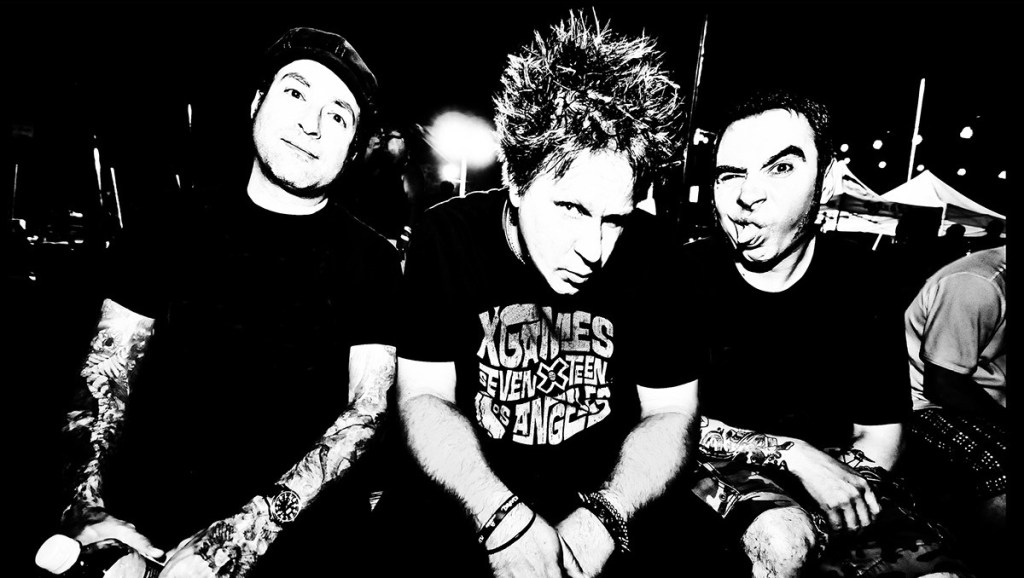
Agent Orange returns! Back in the ’80s, the Southern California trio led by singer and guitar player Mike Palm cranked out some of the most whiplash, compelling, and emotionally distraught surf and skate punk tunes ever committed to tape. Seeing the group live is kind of a rite of passage. Skin Jobs and Loony also perform. $18 (adv). $21 (doors). Sat., Feb. 26. The Earl.
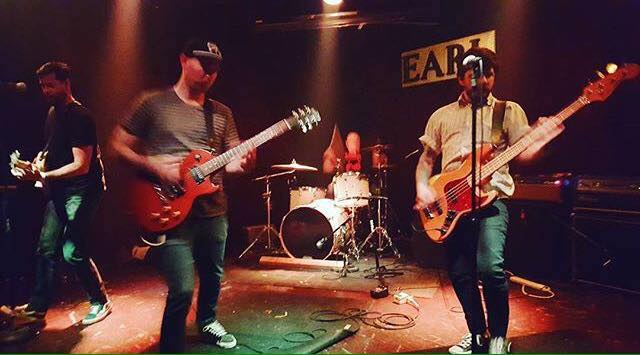
Skin Jobs.
If you have enjoyed reading this post, please consider making a donation to RadATL.
For this run of North American shows, they’re performing songs from Gang of Four’s first three albums, 1979’s Entertainment!, Solid Gold (’81), and Songs of the Free (’82).
Guitarist and co-founding member Andy Gill died in February of 2020, and bass player Dave Allen is sitting out this round of touring.
In the meantime, the group’s lineup features fellow co-founders vocalist Jon King and drummer Hugo Burnham, joined by bass player Sara Lee, who joined Gang of Four’s line up from 1980 to 1984 (circa Songs of the Free), and David Pajo of Slint, Papa M, The For Carnation, Tortoise, et. al., which is awesome.
If you have enjoyed reading this post, please consider making a donation to RadATL.
REST IN PEACE: Tom Smith (on the far left, with Frank “Rat Bastard” Falestra). Photo by Chad Radford. Jon Kincaid (center) photo courtesy Amy Potter. Robert Cheatham (right) photo by Tara-Lynne Pixley.
There’s an old African proverb that says: “When a person dies, a library burns to the ground.”
Point being, when someone dies a lifetime of knowledge, experience, and context is lost forever, and the world is left a poorer place in their absence.
In January, Atlanta music quietly suffered through three profound deaths: First, news spread that Jon Kincaid, longtime 91.1 FM / WREK DJ and host of Sunday nights’ “Personality Crisis” radio show had died on January 4. He was 57 years old.
A week later, On Jan. 11, word spread across social media that former Eyedrum Art & Music Gallery Executive Director and avant-garde music and art scenes fixture Robert Cheatham had died at the age of 73.
Another week later, post-punk journeyman and noise music provocateur Tom Smith died as well. He was 66 years old. All three men represented somewhat different but primary eras and enclaves of Atlanta music. And while it may not be immediately obvious, each of their respective influences played an indelible role in shaping the city’s musical identity.
For more than 30 years, Kincaid hosted “Personality Crisis,” giving a platform to countless fledgling alternative rock, post-punk, underground, and Southern rock luminaries. In the early days of their careers, Atlanta-based acts the Indigo Girls, Drivin’ N Cryin’, and countless others benefitted from his steadfast dedication to music, and his encyclopedic knowledge.
Check out the backside of Mission of Burma’s 1988 LP Forget, and you’ll see bass player Roger Miller sporting a WREK T-shirt. It’s a good bet that Jon had a hand in Roger owning that shirt.
Jon explored every type of music known to humankind through his work as a WREK music director, and by creating his own experimental music under the name Sequence 3.
Cheatham led Eyedrum through its defining eras; he was Executive Director when the venerable arts institution was awarded a $30,000 grant from the Warhol Foundation in 2006. Cheatham also hosted Eyedrum’s long-running open improv nights, which became an institution for outsider and experimental arts. His band Tinnitus was well known for cranking out squelching, heavily-amplified noise and feedback created with the expressed intention of driving everyone out of the room.
His Brahvar Large Ensemble would often corral as many musicians together as possible — once even crowding more than 20 performers onto the tiny stage in the basement of Eyedrum’s original Trinity Ave. location for a massive improv blowout. Connections were made, new ensembles were formed, and wholly new configurations of musicians perpetuated the community. Cheatham’s brilliance lied in his merger of skronking, careening free jazz, and untethered exploration of sound as art without restraint.
Tom Smith reveled in a more confrontational aesthetic. With his groups To Live and Shave in LA, Peach of Immortality, and Boat Of, he placed elements of noise, the avant-garde, and sleazy rock ‘n’ roll on a level playing field. He wove them together seamlessly, while hopping around the globe — from Atlanta to Washington D.C. and finally Hanover, Germany. Along the way, he amassed collaborations with everyone from Thurston Moore of Sonic Youth, Andrew WK, Harry Pussy, Bill Orcutt, and more.
Kincaid, Cheatham, and Smith were all driven to create by exploring, not just rest on the past. Their sense of creativity, their dynamism, and their willingness to open up to the new — and the old — left a lasting mark on the city. Atlanta was made richer by their presence and their contributions, and the world suffers a tremendous loss with each of their passing.
On Fri., Feb. 18 (3-9 p.m.) and Sat., Feb. 19 (1-9 p.m.) Gallery 378 (378 Clifton Rd. in Candler Park) will host a two-day celebration of Jon Kincaid’s life and history at WREK. Video installations featuring broadcasts from “Personality Crisis” and more from the WREK archives will be playing throughout the gallery. On Saturday night, several acts including the Nightporters, the Chant, Kevn Kinney and friends, Current Rage, Will Rogers, and more will take turns playing songs on the stage downstairs.
Daniel DeSimone (left) and Willow Goldstein of the Bakery. Photo by Chad Radford.
Inside the dilapidated remains of a Chosewood Park warehouse that, in the distant past, was home to the offices of the Yellow Cab Company of Atlanta, Willow Goldstein and Daniel DeSimone point toward a concrete riser emerging from the shadows. “This is where the stage will be for The Bakery’s new venue,” DeSimone says.
As he looks up, rays of sunlight catch clouds of dust, shining through a long gap where the wall and the ceiling don’t quite meet.
“Of course, there will be a build out,” he adds. “We’ll seal up the wall, and do quite a lot of work in this room.”
DeSimone is the venue manager for the Bakery, a multi-purpose DIY gallery and venue space that Goldstein launched with her mother Olive Hagemeier in the Fall of 2017. Over the years DeSimone has run sound for live shows, worked the door, and booked shows under his Face Of Knives Productions company, all while performing various other roles there.
When asked about her title, Goldstein ponders several possible descriptions before settling on “owner, operator, and creative director.”
She has final say in pretty much all aspects of the Bakery’s business, although she gives a lot of freedom to DeSimone and Amanda Norris, who handles much of their press and public relations. The Bakery also works with teams of volunteers.
Gyan Riley at The Bakery in 2018. Photo by Chad Radford
Everyone involved wears many hats when it comes to the full-time endeavor of running the DIY institution that has hosted countless art openings, workshops, film screenings, dance parties, Southern Fried Queer Pride events, and live concerts. Guitarist Gyan Riley (son of minimalist composer Terry Riley) played there while supporting his 2018 album, Sprig. Guitarist Nels Cline of Wilco (performing in a free jazz trio with percussionist Gerald Cleaver and sax player Larry Ochs) played there.
Scores of younger indie rock, hip-hop, electronic, hardcore and post-punk acts including Upchuck, Misanthropic Aggression, and DeSimone’s blackened metal outfit Malevich also graced the stage there.
On June 30, 2020, just as the COVID-19 pandemic was coming to a head, The Bakery’s three-year lease on the warehouse space at 825 Warner St. ended and was not renewed.
Soon after, the building was demolished, making way for a new Trees Atlanta facility.
Since then, the Bakery has carried on, settling into a gallery space at 92 Peachtree St., a block away from the Five Points MARTA station in South Downtown. There’s also the Bakery’s private artist studio spaces inside the BuggyWorks complex near downtown East Point.
The latest endeavor, though, is the multi-purpose venue at 249 Milton Ave., in a development that is tentatively being called Yellow Studios.
For now, the Bakery’s performance room is a 5,000 square-foot space filled with dozens of dust-covered office chairs, toppled empty filing cabinets, broken glass, and other bits of debris — remnants of what was once a thriving taxi cab headquarters, now in ruins. Still, the potential the space holds is undeniable.
Outside, the sounds of a chainsaw cutting through an old fence, the beeps of heavy machinery, and a chorus of hammers and nail guns hitting the roof fill the air.
Just down the road, more construction can be heard as towering condominiums are being constructed along the BeltLine.
Both Goldstein and DeSimone talk at length about partnering with fellow DIY arts venue Mammal Gallery co-founder Chris Yonker who found the location and is spearheading the project. Yonker plans to open a Morning Mouth Tattoo studio as well as a recording studio in the building. Mammal will also be promoting live performances and other events there. Kyle Swick of Irrelevant Music will book shows in the Bakery’s new venue. There’s talk of various other collaborations as well, including the possibility of working with their kindred spirit at Eyedrum Art & Music Gallery, with whom Goldstein is a former board member.
There are also plans for a coffee shop, and a second, more intimate performance space, and other businesses will utilize office spaces elsewhere in the building.
The plan is to have the new space open and hosting live performances by Spring 2022.
Willow Goldstein (left) and Daniel DeSimone of the Bakery. Photo by Chad Radford.
“Ultimately, the goal is to bring the most professional level of production as possible to nontraditional events, non-traditional curators, and provide a space where people who want to challenge the status quo, or show what an event or a concert could be, have a space where feel like they can stretch out,” DeSimone says. “It’s a space for musicians who might not feel like they jive with the status quo of Atlanta’s music scene.”
DeSimone goes on to describe their vision for the room as being more than a bar, while keeping its activities art-focused, across disciplines.
“Intersectional artistry! We encourage people to incorporate non-musical components to their musical performances, or musical components to their non-musical events,” DeSimone adds. “Bring a DJ to your art show, bring an aerialist to your concert. If something’s happening at the Bakery, there is an understanding that it will be something more than what you could get somewhere else. We want to build our own niche while not chasing the tail of de rigueur — doors open at 8 p.m. and you’re out at 11 p.m. We can’t do that. We don’t want to do that. And the city doesn’t need another of that.”
In 2020, Field Day’s Opposite Land EP raised the bar high for Doug Carrion and Peter Cortner’s modern take on a classic hardcore charge. Together, they pulled off the unlikely feat of reinventing the disaffected ethos of their brief but defining tenure with D.C. hardcore outfit Dag Nasty for 1987’s Wig Out At Denko’s and 1988’s Field Day LP.
With their latest offering, the four-song “Why?” 7-inch (Unity Worldwide/Sense of Place Records), the group wields an even sharper edge.
Field Day’s emergence was a postmodern reference to a reference — a triumph that dug deep into the past to find wholly new levels of fertile creative soil in which to grow. The short, sharp blasts they delivered with Opposite Land’s cuts “One Song,” “Stolen Words,” “Speak The Truth,” and “Waiting For A Miracle” laid the blueprint for a new, no-nonsense aesthetic, and proved there was more music and chemistry left to explore within vocalist Cortner and singer and bass player Carrion’s dynamic.
“Why?’s” opening salvo expands upon the speed and velocity of Field Day’s previous efforts, while coalescing around a searing guitar lead and the lyrics: “You’re living in a world built on fiction. What’s the reason? I wonder why you never realized. It’s up to you, but you keep living a lie. Did you ever stop to ask the question: How did you get so disconnected?”
This open-ended indictment underscores the crucial power of PMA to find balance amid an era in which technology has gone awry and social unrest percolates under the shadow of an oppressive virus. It could mean anything, or it could mean something very specific — it’s about what the listener brings to the music.
The increased focus on display between Cortner, Carrion, guitarist Shay Mehrdad, and drummer Kevin Avery simply and powerfully ignites the group’s melodic tension, and amplifies Field Day’s search for answers while placing the human experience under the microscope.
A hidden A-side track and the B-side cuts “Alive” and “Audience Of One” tighten the melodic songwriting made sharp by Mehrdad’s high-octane guitar shredding.
Across the board, the group has stepped up the intensity of every element in the music. And with production by Carrion and mixing courtesy of Cameron Webb (Pennywise, Motörhead, Ignite), these four songs are louder and strike with a greater sense of urgency.
Doug Carrion of Field Day. Photo by Josh Coffman
“Field Day revels in a real-time musical confrontation of emotions — a trait that’s extended since Cortner and Carrion’s days with Dag Nasty, and Carrion’s formative years spent playing with the Descendents. Their veracity hits hard with “Audience Of One.” The song kicks off with a thunderous drum roll, signaling a heart-pounding finale. The fiery guitar tones, sprinting rhythm, and the lyrical query: “You always tell yourself what you want to believe, but when will you accept that you’re an audience of one?” brings the record’s prompt to a fine point: Look deep within yourself to find the power to rise above apathy.
Field Day has already proven their skills by releasing a handful of powerful and direct offerings. The four songs on the “Why?” 7-inch carry the pace to a higher level. Each number is bristling with rejuvenated and undeniably electric energy. It’s one thing to create something new from a decades-old chapter in Dag Nasty’s discography. It’s an entirely different thing to find new relevance, and outshine the past by creating vital new music. With “Why?,” Field Day revives classic punk and hardcore’s base emotions, while asking the hard questions, and always keeping their gaze fixed on what lies ahead.
If you have enjoyed reading this review, please consider making a donation to RadATL.
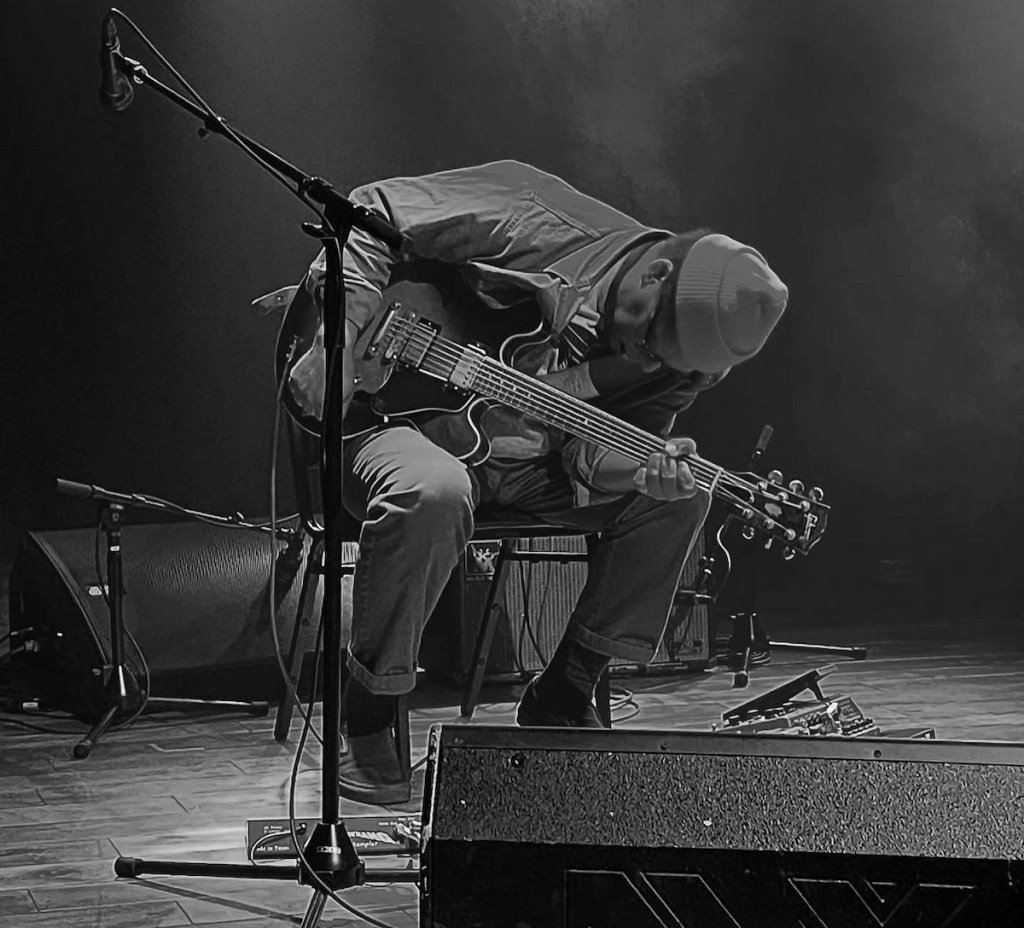
Jeff Parker (left) and Steve Gunn at Terminal West. Photo by Chad Radford
Jeff Parker walked onto the stage at Terminal West on Wed., Dec. 8, to polite applause followed by silence — the kind of explosive silence that’s felt just seconds before an orchestra strikes up and fills a symphony hall with its opening salvo.
Parker drew out the silence, and communed with the quiet tension before tangling his fingers around the neck of his guitar and slowly unwinding them along the fretboard. The guitarist and co-founder of Chicago’s post-rock luminaries Tortoise, stands atop a body of solo recordings and collaborations that traverse everything from mutant funk and hip-hop beats to skronking free jazz, minimalism, and drones.
At first, the sounds he created seemed ill-shaped. But loops were being created, and within moments notes percolated and collided into one another as Parker’s singular musical style revealed itself in tones and textures that were instantly familiar, yet guided by wholly new, next-level composition.
Jeff Parker. Photo by Chad Radford
Much (if not all) of the material he played throughout the night comes from his latest solo guitar album, Forfolks (International Anthem Recording Co.). But this was a solid three days before the album was released. As such, Parker offered a preview into one of the most pleasantly challenging chapters of his career. Smoke machines hissed quietly somewhere in the darkness. The slow rumble of a train rolling along the tracks behind Terminal West almost felt scripted, as Parker created long, sustained tones that rung out for so long they started rattle, revealing the intricacies inside the sounds of his amplified steel strings. When rhythm and melody are taken away — acoustic feedback is a beautiful thing.
In the midst of his deep dive into the avant-garde, Parker subtly weaved in the melody of “Jetty” from Tortoise’s 1996 masterpiece, TNT. This reimagined take on the song appears on Forfolks under the name “La Jetée.”
Steve Gunn. Photo By Chad Radford
Steve Gunn joined Parker for a short collaboration before closing out the night with a solo set. Gunn offered a cover of British folk singer and guitarist Michael Chapman’s “Among The Trees” before delving into a stripped down rendition of “Way Out Weather,” the title cut from Gunn’s 2014 album, which set the tone for his performance. Gunn leaned into “Fulton,” “Good Wind,” “Morning River,” and “On the Way” from his 2021 release, Other You (Matador).
On record, these songs are the backbone of Gunn’s most ambitious work to date. On stage, they flowed with the cool quietude of the seemingly effortless Zen-like vibe that has come to define his strongest songwriting. It was also a grounding agent that balanced out an evening of acoustic, psychedelic, and forward-thinking music.
ENTERTAINMENT: Bari Donovan (left), Trey Ehart, and Jim Groff. Photo by Will Weems.
In September, Atlanta post-punk outfit Entertainment releasedHorror Part 1, the first of a two-part EP that finds the group returning from more than a decade between releases. Founding members Trey Ehart (vocals, guitar, bass, and synthesizer) and Bari Donovan (drums and percussion), convened with newer members Jim Groff (synth), and Henry Jack (bass) over a few years to chop, layer, and hack a new body of dark and abstract post-punk into being.
In keeping with its title, the HorrorPart 1 EP’s four songs create austere, intense, and icey cold ebb and flow. The music is loosely thematic, drawing out those deeply buried childhood memories of dread and despair that came along with watching horror movies on late-night cable back in the ‘80s. It’s a singularly abstract and powerful approach to songwriting that resonates in a deeper, dark part of the subconscious that more traditional songwriting does not reach.
Ehart took a few minutes to talk about how the music came into being, and what’s in store with Horror Part 2.
Listening to The Horror puts me in an October/November kind of mood. I’ve found myself looking up quotes from movies like Chopping Mall and Sleepaway Camp as I’ve been listening. This is being released by BatCave and Stickfigure, correct?
Those are both great movies! We may have a quote from Night of the Demons on Horror Part 2, it depends on if I feel like it’s too on the nose or not. I always liked the way The Smiths/Morrissey and the Chameleons used TV and movie quotes in their songs, it added a really bittersweet layer to me.
We’re self-releasing Horror Parts 1 & 2, digital only, through Bandcamp. Stickfigure is releasing vinyl of both parts together in 2022, doing all the PR, and handling the streaming services. BatCave Productions is releasing a CD in Europe that combines both parts with all the singles and remixes in early 2022.
For what song are you making a video?
We’re finishing a video for “Voyeur” right now. It should have been out with the single last March but we had to move it from the first person we hired over to John from Hip to Death. We wanted the visuals to match the current sound of the band as much as possible, and John’s aesthetic lines up perfectly with the kind of psychedelic, dark, dream-like layers of sound. John also did the video for “Maggot Church” that we released in late 2020.
Tell me a little bit about the concepts you’re working with in the song and the video?
Conceptually it was originally more like the mimed performances you’d see on ‘80s TV, in front of green screens with a nod to Japan. We hired a model, shot through blinds, making it much more literal to the idea of enticement and voyeurism.
We tend to hide ourselves, or obscure who we are visually, and for this we really wanted to try and push ourselves up front. But when it was put together it was just too sterile for the track. The painterly quality of the music wasn’t coming through. Layers and layers of information, the kind of desperate sound wasn’t coming through.
The cover art effectively projects a sense of cold, dark isolation. What is the idea that’s at work here?
We struggled with how to visually represent what we sound like right now, and with the fact that Gender had such an iconic cover, how do we keep that visual strength going, but move forward?
After talking about it we decided the best way to represent these songs was through the idea of layers of paint on a canvas. As a reference to how some artists can never finish, like Edvard Munch, who would constantly print and paint the same image and theme over and over, seemingly never satisfied, often painting over his own images, leaving canvas outside to rot in the elements then coming back to them, or scraping the paint off a nearly finished piece and starting over. Similar to the writing process for these songs.
So if you look at the covers of all the singles we released leading up to the EP you’ll see a similar obscure bleakness, layers of different paintings overlapping and overwriting each other. I also wanted to make the obvious reference to the Horror sticker from VHS stores, as well as overlaying a torn plastic wrapping to each cover, since these will probably never be physical, it’s the ephemera, the fake idea of a lost reality.
That’s what you see in the cover, layers of paint, fake plastic wrap, and then some neon lights thrown on top, the spark of nostalgic light piercing the dark, or just sinking into it.
It’s also probably another Japan rip off …
The music itself can be described using similar painterly terms. The sounds of the instruments and the vocals feel like big swathes of paint that collide and blend into each other. Can you talk a little bit about this?
It’s hard for me to approach music in terms of traditional means most of the time, I don’t know if I have a mild form of synesthesia, but I’m never happy with a piece of music until I can’t hear myself in it, I don’t know how it was formed, and it comes back to me as something alien of the speakers. I want the sounds to affect the listener in an emotional or psychedelic way. Putting you in a world all its own, appealing but revolting at the same time. To get there I’m constantly layering and revising in overdubs, leaving phantom chords and impressions of sound and texture, unrefined and wild. Kind of merging an artistic approach with a raw punk ethos, and Brian Eno’s “generative music” theory and Oblique Strategies.
The treatment of the sound draws out a more mysterious atmosphere than a lot of more straight-ahead Songwriting with a capital S. There’s an element of abstraction here that puts the imagination into overdrive. Has this presented any obstacles in terms of how the music is perceived, or does it seem like listeners are open to the music?
It’s definitely turned some people away, especially with how at odds we are with modern, sterile production, some people just shut down right away, some are immediately pulled in.
We used to say we wanted our records to infect and ruin every other record in your collection, so you never hear music the same. But maybe that’s a cover up for not being able to write in a pop structure yet… I love the mental space our records put the listener in, but I definitely needed guidance in not taking it too far for this release, reining it in, learning the “correct way,” which I really want as we come back and move forward.
Live, we’re a different beast, more minimal but impactful, deliberate, we’re often told it’s “powerful and sexy,” which makes me a little uncomfortable, but I think it’s a reaction to our rhythm section taking over, the bass lines and beats really shining through.
We accept it, next year we’re going into the studio with Tom Ashton — finally — to re-record a lot of these tracks and make them bigger, more palatable to a wider audience, maybe shed some of the deathrock for more traditional post-punk sounds… whatever that means for us. Tom hears potential in our sounds that I’m really excited about.
If you have enjoyed reading this interview, please consider making a donation to RadATL.
When Gentleman Jesse Smith released his second album, Leaving Atlanta in 2012, the lauded local songwriter had gained a reputation as something of a power pop savant, crafting songs steeped in garage-punk minimalism and tales of heartbreak. Over the last decade, Smith has spent much of his time working as co-owner of seafood restaurants Watchman’s in Krog Market and Decatur’s Kimball House. Shiny Dimes Oyster Farm will open in Florida this year as well. Music, however, did not fall by the wayside. In December, Gentleman Jesse released Lose Everything, a 10-song return that finds him singing and playing every instrument — organ, keyboard, guitar, bass, drums, melodica, etc. — while eschewing the pop reductionism to embrace a layered and sophisticated approach to songwriting. On the heels of the album’s arrival, Smith took a few minutes to talk about how the songs have taken shape.
Nearly 10 years have passed since you released Leaving Atlanta. Did you reach a point where Lose Everything felt like it was too much to make happen?
Yeah, after the first day of recording! I can play the drums but I’m not a drummer. I practiced a ton, and if I played a show you might think, “Jesse’s not bad …” But recording drums is a whole different beast than playing drums in front of people. The consistency of your snare hit will affect the way it’s recorded.
We recorded at Notch 8. Andrew Wiggins and Ryan Bell have a control room there, but because other bands had to practice and use the space, we had to record the drums in one day. So I recorded for 13 hours. By the end, I was just done. There are songs that just aren’t great performances because I was like, “I used to have the ability to play a song this way, but because I’ve been playing for 13 hours my hip hurts. I can’t do it anymore.”
You get through an entire day of that, and you’ve spent so much of your own personal income to do it, and then you hear the results, and you’re like, “Fuck it, we tried …”
Ryan talked me off the ledge by saying things like, “You gotta understand that we’ll layer things. We’ll mix the drums, the things that bother you will start to disappear.” I know every missed hit and and fucked up thing about the record. But you can sweeten the sound, and once you add bass, guitar, keyboards, and vocals it’s less distracting.
I often wonder if it’s a burden for musicians to bear — listening to music and focusing on the snare, the bass, etc., and not just hearing the mass.
There are two different ways to listen to music: There’s the bird’s eye view, and there’s focusing on every little nuance. If you watch the Paul McCartney and Rick Rubin thing, one of the best things about it is a moment where they pull out one specific vocal track and play it by itself. One of their voices cracks, or gets a little gruff, and you’re like that’s the Beatles! So you realize that things can go away with a little mixing magic.
Stylistically speaking, the songs on Lose Everything are about as far removed from what’s on your previous two albums as you can get while maintaining a connection.
That’s partially by design, but what you might not realize is that I’ve been sitting on the riff for the title track since Leaving Atlanta. Same with the intro riff from “Dead May Rest.” I’ve had that riff for a long time, but thought it was too indie-sounding for Gentleman Jesse.
Fun fact: You’re hanging out at a party during SXSW, talking with your musician buddies that you don’t get to see all that much. I was at a party with Jay Reatard and we talked about collaborating. He wanted to do one-off collaboration records and stuff like that. So I was saving that riff for Jay, but then I finished it. There are things that are stylistically different, but I’ve been incubating them for a long time. “God Is Blind” is one that I’d been working on for nine years. I finally finished it but a lot of the stuff would have been on the record if it had come out two years after.
The second to last song on the album, “The Line,” is the only song that I wrote during the pandemic.
What is that song about?
It’s about a lot of different things: It’s about a person’s connection with the place where they live. It’s about an idea of nature reclaiming man-made structures, and what the world would look like if we disappeared — how quickly our mark would go away.
Is the cover art a representation of that idea?
That image is something that I drive by every day on my way to work. Specifically, I know the person whose house is where you would see it. I shucked oysters and worked an event at his house. I saw it out there and knew that it would be the cover. The original idea was going to be a burned out house. Lose Everything is a record about loss in all different forms, and I was going to take a photograph of myself standing in the rubble. Sort of like Leaving Atlanta style, but it’s just Gentleman Jesse loses everything. I think this is more tasteful.
When I think of what you’ve accomplished since Leaving Atlanta — opening two restaurants — calling the album Lose Everything feels like the stakes are high.
That’s one way to look at it. The title track deals with the idea that no one is anything, everyone can be whatever they want. We’re learning that more and more. But the idea is that you can change anything — whether it’s your opinions, or anything about your nature. You can lose the identity that you’ve created. You can shed that into whatever you want at any given moment. I thought this was a good way to wrap that idea.
That song kind of sums up everything, and brings everything together after all these other ideas are explored — losing a loved one, or losing your direction. The album is bookended with “Become Nothing” and “Lose Everything.”
I’ve been searching for a lyric in “Lose Everything” that ties it all together.
That song deals with abstraction, and it’s not something you can put your finger on. “Dead May Rest” has a lyric that sums up the idea of not being sure of anything — nothing is concrete. And that’s the line about whether or not destiny exists: “Scholars have wondered throughout the centuries if mankind was bound to destiny, and if so, why freedom of the will while we dance in circles ever still.”
Ultimately, we know nothing and we’re a blip in time. So none of this really matters all too much.
The long, slow fade out in “Become Nothing” projects a lot of what you’re talking about.
Yeah, and there’s a moment where I pulled a This Heat trick, and as the song fades out, I fade into the demo version of the song. So the audio changes to something of lesser quality.
Post-modern! A reference to a reference to a reference!
See! I’m not as one-dimensional as I painted myself to be with my first couple of records.
Has finishing and releasing the record lit a fire under you to continue with the next record?
Yes! Part of the reason I forced myself to do it all by myself is because I wanted to get this one out of the way so that I can work on more. I feel like I have a new angle, and I’m comfortable putting out more music as Gentleman Jesse.
MASTODON: Bill Kelliher (left), Troy Sanders, Brann Dailor, and Brent Hinds. Photo by Clay Patrick McBride
On Halloween eve, Mastodon unleashed its 8th proper studio album, Hushed and Grim (Reprise). The album’s sprawling 15-songs distill the group’s legacy as the pride of Atlanta metal, and a force of nature the world over, into a punishing, real-time reflection on death, sorrow, and reclamation.
From the moment the album’s first single, “Pushing the Tides” arrived, the brutal power on display made it clear that Mastodon was coming out of the gate strong. Guitar players Bill Kelliher and Brent Hinds, drummer Brann Dailor, and bass player Troy Sanders channeled their anguish over the loss of their friend and former manager Nick John, who died from cancer in 2018, into a serpentine musical saga.
Within weeks, “Pushing the Tides” was nominated for a “Best Metal Performance” Grammy. In the meantime, the group has remained on the road playing shows across the U.S.
Dailor took a few minutes between tour stops to talk about how the ideas and imagery behind Hushed and Grim came together to form an emotionally hefty and gorgeously articulated new chapter for Mastodon.
Over the years we’ve had conversations about each new Mastodon album, and there’s often an element of the band confronting death—losing someone close—and dealing with it in a real-time kind of way. I recognize this in Hushed and Grim, but the album also feels empowered.
When you start writing an album, maybe you find out that you have less control than you imagined you did. It just starts to unfold, and maybe in the back of your head you’re thinking, “We need to be heavier, faster, and crazier.” Then the things that you naturally gravitate toward are slower, darker, and deeper. Then you think, “Maybe this is actually the vibe.”
It starts to reveal itself, and it really is the manifestation of what we’re going through during that moment in time. Nothing happens in a vacuum. When you’re creating something, the emotions that you’re experiencing with whatever you’re dealing with in life will ride in tandem with that.
Going into Hushed and Grim, We weren’t feeling too good as a group. So during the writing process, wallowing in those feelings led to what the album sounds like. Anything that sounded remotely happy was kicked out immediately. It was like, “No! I’m not happy. Get rid of that.”
Maybe by the end of the album it becomes empowered — it gets there eventually. For me, it’s a tough listen. It puts me back in these places that weren’t fun to go through, but it was necessary to get through it.
I don’t know what’s going on with us, but for the last bunch of albums, I don’t know if we’re cursed or something … I don’t believe in curses, but I’ll just say it to be fun. From Crack the Skye on, it seems like every time we go into the writing process somebody close to us fucking dies. So word to the wise, don’t be close friends with anyone in Mastodon.
In that pure songwriterly way, Hushed and Grim has multiple meanings. I first saw it as a pandemic reference. … In the early days of the pandemic I even heard someone describe Atlanta’s streets as “hushed and grim.”
Actually, I stole it from Gone With the Wind. I’ve had the title in the back of my head for a long time.
Gone With the Wind was my sister’s favorite movie, and we used to watch it every time it came on. I just really liked that phrase. It’s on a title card halfway through the film, after Sherman burns Atlanta to the ground. You see this massive crane shot over downtown Atlanta, and you see thousands of dead soldiers. Scarlett is running around tending to the wounded that are lying in the street.
Sometimes when a tragedy takes place it’s not people running around screaming. It’s quiet and there’s this acceptance that something terrible is happening, and it’s quiet. When our former manager Nick John had gone into home hospice care we all flew to L.A. to see him one last time, and to say goodbye. He was asleep in a hospital bed, his mom was there, his sister, his wife and some close friends. “Hushed and grim” was the perfect phrase to explain the feeling in that house that day.
So the Atlanta connection, the connection to Nick John in that specific circumstance, and the fact that I felt like it encapsulated the sound of the album being quieter, melancholy, and more sparse really resonated with me. … At least it’s more sparse than maybe we’ve ever been. We’ve hinted at it over the years, but this one really goes in on that slower, more methodical, take-our-time kind of thing.
From the beginning, when I was first hearing the riffs, writing the stuff with the guys, and putting it together, I had this black and gray color palette that I felt was lending itself to the album. I could see black and gray with a touch of gold. That’s the initial conversation I had with Paul Romano about doing the cover. I didn’t have anything else but the color palette.
Song-for-song, the variety goes beyond a lot of what Mastodon has done in the past. Was it your intention to make an album that’s a little more complex?
No, I think that’s the result of having more time to work on it. There was no tour looming. In the past, there’s always something we have to go and do. I don’t want to say that it rushes things, because early on we wrote Leviathan in like three months. But we had a lot of time with this one. We worked on it, and kept coming back to our garden of songs and watering them and watering them. We poured over these things like a barista in a San Francisco coffee shop [laughs]. We really took our time making sure certain parts are what we wanted them to be, building on bridges, and getting into the nooks and crannies that maybe we wouldn’t have discovered if there was a hard time constraint.
Even during Crack The Skye, it was like, “Ok, we need to go play Bonnaroo now.” It’s a mind shift to go from writing and pouring over new songs to practicing “Crystal Skull” and “Blood and Thunder.” So it’s the result of being able to stay in writing mode longer, without any hope of going on tour, ‘cause that wasn’t happening! It was like, “In fact, your industry will be the last one to come back. So now, we’re out here trying to figure it out while staying safe and making sure that our tour can happen. Just yesterday we had a scare with a false positive. This could all be taken down so easily, and everybody goes back home and loses hundreds of thousands of dollars.
That’s the general mood everywhere right now.
Yeah, it’s all hanging on by a thread, but we’re hoping for the best. Getting back to your question, we’re probably most known for complex arrangements. Anytime we come up with something that’s lesser than, people are surprised. But if a simple song reveals itself and we dig it, we’ll go for it. We don’t put on the idea that we have to be proggy all the time, or that every song has to have a thousand riffs, and within those riffs there are hundreds of little riffs. A lot of the time we’re taking stuff away, saying to ourselves, “My God, this song has five bridges. What is going on here?”
It also feels like the band has mastered working at West End Sound and Ember City Studio. Emperor Of Sand through Hushed and Grim encapsulates an era for Mastodon’s sound that has developed since the studio was built. You know how to get the best possible results out of that room.
Yeah, we’re comfy-cozy in there. And if we didn’t have the studio we wouldn’t have been able to make the record. We couldn’t fly to L.A. or anywhere else to record because of the pandemic. Getting David Bottrill to say yes and come to Atlanta and live there for three months while we worked on it was paramount.
The album’s cover is a departure for Mastodon, both in color and orientation — it’s kind of a landscape image.
Yeah, it has Nick John as the Green Man in the middle of the tree. It is expansive; that’s the middle panel of a nine-panel piece by Paul. We were both on the same page as far as having a twisted tree be the main focus, and that it would reveal the seasons as you go around. So the panels are the different seasons. And there are all sorts of Easter eggs in there that Paul takes from the lyrics and song titles, and whatever any of the band members offer. He always fits everything in somewhere. There’s a reference to Jakuchu’s “Elephant and Whale” diptych in there. There’s all sorts of fun stuff in there. I wanted the fan base to know when they saw the cover art that, at least in my perception, they were getting something different. So we wanted it to be a departure, and to look different from the rest of the album covers, while reflecting the mood of the album.
Nick John as the Green Man: I tend to think of the Green Man mythology as being about regeneration, or it being about a new beginning. Is that part of what you are projecting with the artwork?
My whole made up afterlife mythology was that your soul enters the heart of a living tree. In order to say goodbye, it lives there for a whole calendar year, and experiences the seasons to reflect on the life that you had. And that’s how you’re able to say goodbye to the natural world.
… As if we needed any more afterlife mythologies, here’s one more for you! [laughs]
If you have enjoyed reading this interview, please consider making a donation to RadATL.









 Rad/ATL