On Friday, September 4, Kevn Kinney of Drivin N Cryin returns with a new installment of his monthly “Free Parking” live-streaming solo performances on Facebook. Kevn will play some Drivin N Cryin classics and deep cuts along with some newer numbers he’s written. He’ll tell stories, tell jokes, and he might even offer up a few cover tunes.
In the meantime, check out a podcast I did with Kevn in April 2019. He talks about reconnecting with Drivin N Cryin’s first LP, the group’s most recent album, Live the Love Beautiful, and looking within himself to find true happiness.
Press play below to check out Live the Love Beautiful.
Mark your calendars now, folks. On Thursday, September 24, at 6 p.m. Eastern Time, I am talking with journalist, author, archivist, and commentator Paul Gorman about his epic new biography, The Life and Times of Malcolm McLaren. It’s an 855-page book—I don’t know that I’ve ever read an 855-page book in its entirety (although Ulysses and Gravity’s Rainbow come close). McLaren carved a singular place for himself in history as a clothing designer, boutique shop owner, artist, and as a manager and promoter for both the Sex Pistols and the New York Dolls. Alongside his partner Vivienne Westwood, McLaren was an early progenitor of the punk movement. He’s a fascinating, worthy, and misunderstood subject for such a hefty tome, and I cannot recommend this book enough.
Gorman is an excellent conversationalist as well. Our Zoom chat is hosted by A Cappella Books. Check out the shop’s website for details on how to sign in, and how you can get a signed copy of the book.
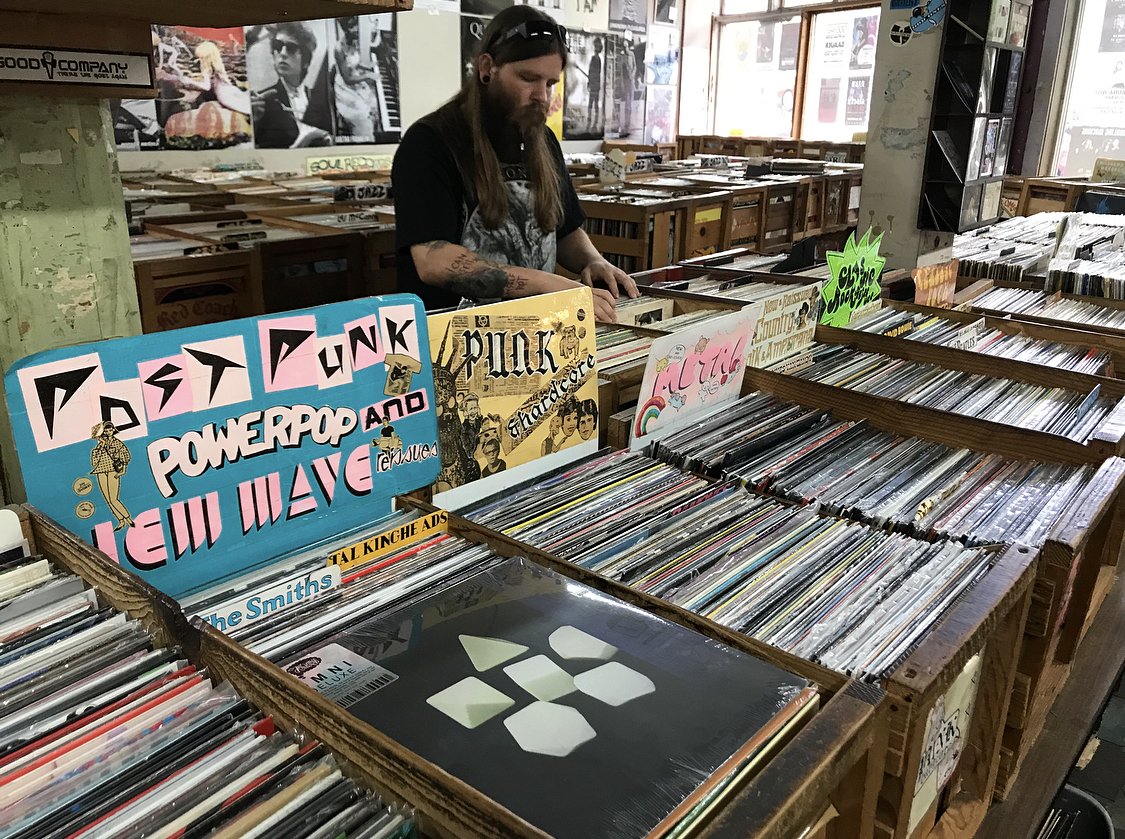
In 2008, RSD was created to help drive traffic to record stores, which, at the time, were an endangered species. Times have changed, and vinyl now reigns supreme among music heads. The local shops that the annual hallmark holiday was invented to save now struggle to make room for the flood of limited edition RSD releases that fill the racks each year.
This year, RSD is spread across three Saturdays — August 29, September 26, and October 24. Georgia is still a hotbed for COVID-19, so things are being handled delicately across the board. If you are venturing out in search of that highly coveted Hawkwind At The BBC 1972 2xLP, Billie Eilish Live At Third Man Records, or anything else from Anoushka Shankar to June of 44, wearing a mask and maintaining at least six feet of distance between your fellow record shopping friends and fiends is a must.
No matter where you go, there you are, standing in line for a minute no matter where you go. But that’s never stopped you before. The following list is a field guide of best bets for your Atlanta RSD experience. Be safe, be cool, and check out the list of RSD official drops here.
CD Warehouse generally opens at 10 a.m., but if there’s a line they’ll open the doors early. Plenty of RSD drops in stock. 50 Barrett Pkwy. Marietta. 770-425-3472 and 2175 Pleasant Hill Rd. 770-623-1552.
Comeback Vinyl‘s physical shop will be closed for all in-store shopping and RSD pick ups. The store will be selling RSD title at Comebackvinyl.com beginning at 1 p.m. Eastern time. Keep an eye on their website, email newsletter, Instagram, and Facebook page for a list of titles, prices, and how many of each release they have in stock. 1 South Main St., Alpharetta. 678-580-0583.
DBS Sounds is the place to be at 4 p.m. when CeeLo Green stops by at 4 p.m. to sign copies of his latest album, titled CeeLo Green Is Thomas Callaway (BMG / Easy Eye Sound). He’ll be signing CDs and LPs. 10 a.m. 7 p.m. 6610 GA-85, Riverdale. 770-997-5776.
Decatur CD & Vinylis currently closed on the weekends, but they’re posting some RSD drops on the shop’s eBay store beginning at 1 p.m. Eastern time. 356 W. Ponce de Leon Ave., Decatur. 404-371-9090.
Fantasyland Records is stocking as many RSD releases as they can get their hands on, and the shop is opening an hour early (10 a.m). There is no validation required for the entire parking deck for all three RSD dates in August, September, and October—park wherever you’d like on all three levels! Masks are required for entry, and social distancing while waiting in line is a must. Customers may purchase one copy per limited edition RSD title. 360 Pharr Road N.E. 404-237-3193.
Mojo Vinyl is operating at limited capacity from 10 a.m. till 6 p.m. Five customers will be allowed in at a time between 10 a.m. and noon. After 12 p.m. the doors are open to everyone. Wearing a mask is required for entry, and hand sanitizer is provided at the door. Outside, wearing a mask and no less than six feet distance must be maintained between each customer. The line should form from the side porch and run down the driveway. Take an Uber or a Lyft, or park at the two large lots at the soccer field next door. Each RSD title is limited to one copy per person— first come, first served. Bring a list, be prompt, and remember that we’re all in this together. 26 Webb St. Ste. 2, Roswell. 678-523-5042.
Moods Music, Little Five Points’ premier neo soul, hip-hop, dance, acid jazz, Afro-Cuban, house, funk, and rare grooves music shop is opening an hour early (11 a.m.), and the store is stocked with RSD drops. 1131 Euclid Ave. N.E. 404-653-0724.
Sweet Melissa Records opens at 9 a.m. and is stocked with plenty of this year’s RSD drops. 146 South Park Square Marietta. 770-429-0434.
Waterloo Sunset is stocked with some but not too many of this year’s RSD drops. Stop by for the sidewalk sale featuring $1 LPs from 10 a.m. till 5 p.m. 900 Battery Ave. Ste. 1010. 770-989-1967.
Wax N Facts is opening an hour early (10 a.m.) and serving up RSD drops buffet style. Customers may purchase one copy per title. Five customers at a time are allowed in the shop. Bring a list, and be cool. Wearing a mask is required for entry. 432 Moreland Ave. N.E. 404-525-2275.
Wuxtry Records: The usual rules apply. The shop is open from 11 a.m. till 6 p.m., and is fully stocked with RSD titles. Wearing a face mask is required for entry, and the shop allows eight customers in at a time. 2096 N. Decatur Road, Decatur. 404-329-0020.
Did we forget someone? We tried to be as thorough as possible with this year’s list of participating record shops. Drop us a line and let us know.
A (not so) subtle new number from Amy Rigby and Wreckless Eric sums up what’s on pretty much every thinking American’s mind at the moment: “Vote That Fucker Out.”
The song is more of an empowered motivational anthem than it is a protest song per se. Call it what you will; with the 2020 presidential election looming on the horizon we all know who and what this song is about. And really, it’s all about common decency at this point. Rigby, however, eschews the obvious in such a way that her words can remain relevant come election time circa 2024, 2048, 2100—if humanity still exists. The point is: evil is timeless, and evil will always find a way to sabotage the Executive Office.
Like when John Doe and Exene Cervenka sang X’s “The New World”—“It was better before / Before they voted for what’s-his-name / This was supposed to be the new world”—a timeless song is forever in order when it comes to rising above the recurring nightmares of American politics.
When morale is low, a song like this provides a good bit of cathartic musical therapy, and with it comes a much needed bit of relief on the old heart valves. Still, the message is urgent. The republic, the environment, humanity, and a whole lot more are on the line.
Beyond the message, both Rigby and Wreckless Eric are in excellent form here, belting in unison as they wield their voices and guitars like combat-ready machines that kill fascism. The fuzz on Wreckless Eric’s guitar draws out the nuances in Rigby’s voice for a psychedelic yet powerful and direct treatment of lyrics such as “I never want to see his stupid face again / I never want to hear his name. Except for January 2021 / When I yell shame shame shame. Goodbye.”
For the visual accompaniment, Rigby and Wreckless Eric craft a potent distillation of their mutual aesthetics. The flashing illustrations recall the cover painting featured on Eric’s 2015 album amERICa, adding color to this gloriously ramped-up expansion on the sentiments that Rigby delivered with her 2017 single, “The President Can’t Read.”
The incoming administration may not be perfect, but this is America. No politician is perfect. However, when applying the basic principles of logic to the situation the solution is simple. We’ll all be a lot better off if we just vote that fucker out!
Simon David is an independent filmmaker from Geneva, Switzerland, who spent three years in Atlanta working on Time And Place, a documentary film that chronicles the life of R&B and soul singer and guitarist Lee Moses.
Moses is considered by many to be an unsung genius, who blended funk, soul, R&B, and psychedelic rock during the late 1960s and early ’70s. He worked closely with fellow Georgia-based musicians such as Hermon Hitson, the Mighty Hannibal, and the Allman Brothers, and he wrote and recorded such R&B hits as “Got That Will” and “Time and Place.” He even cut an early version of Jimi Hendrix’s “Hey Joe,” alongside Hendrix himself.
Moses’s gravely voice and his fiery performance made him the star of the Royal Peacock during the club’s late ’60s heyday. Following his death in 1998, his songs such as “Bad Girl,” “Time And Place,” and “How Much Longer (Must I Wait)” have continued to attract a growing fan base around the world. But Moses has become something of a ghost in his hometown.
Time And Place is one of the featured films at this year’s Macon Film Festival (August 13-30). Virtual screenings of Time and Place will take place between 10 a.m. and midnight Aug. 19 and 28. There is also a physical screening on Aug. 23 as part of the Black Cat Picture Show in Augusta.
David took a few minutes to talk about discovering Moses’ music and telling his story with Time And Place.
When I was in Belgium studying through a friend who is an African American himself. But it was during a screening of a French movie called House of Tolerance that I heard Lee Moses for the first time and started identifying myself to him. It was Lee’s big hit “Bad Girl.” The song appears at the end of the film.
The film’s subjects are 19th century prostitutes working in a closed brothel, who have quite little knowledge of how things evolve in the world outside the brothel. I had never heard anything quite like “Bad Girl” pt.1 and pt. 2. Such a cry from the heart. Then I started researching, listening, and singing a lot about Lee Moses. I could not understand how little I could find about him on the internet. How he became a ghost. Another thing to know also is that Lee has quite a strong following in countries like France, Belgium, Switzerland, and the UK. Not only by record collectors, but for a generation of kids like me. And that became interesting for me to discover Atlanta (later on), to see how much Lee had kind of disappeared from people’s memories and how unknown he was in his hometown. How the whole soul scene he was part of was unknown. Then I got in contact with some of the closest people to him, like his sister Donia. And the story goes on.
What was the biggest hurdle you encountered while tracking down information about Lee?
There weren’t any hurdles with subjects or whatsoever. I always knew it would be impossible to frame Lee as accurately as possible. I knew that there would be a lack of clarity concerning dates for example, talking to subjects, some of whom are quite old and having quite a life behind them. And it was always a wish for me to picture Lee Moses as a mystical and mysterious creature. Giving the audience a feeling almost having more questions than answers after watching the film.
At the beginning of the film, his sister Donia Moses quotes Maya Angelou: “People will forget what you did, people will forget what you said but people will never forget how you made them feel.”
I think it summarizes well what I tried to achieve through the doc. And I’ve been lucky to find people trusting me so quickly. Especially since I’m a young white male whose subject is a black musician. I also think I’ve had luck finding people that knew Lee in a matter that wasn’t only musical. And there was so much to say for them, to talk about someone that was such a great brother, friend, and musician for them. I do think, maybe in a very moral way, that it was therapeutic for Doris Moses or Donald High to speak about Lee—to be given an opportunity to honor him.
The one problem I had was finding archives, because no one thought about taking “pictures for posterity,“ as Lee’s sister Donia would say. Very few people around him saw the true genius. It was hard to put a hand on archives (images and footage). Even in public archives it was hard to find anything about Lee and the soul scene from the 1960s and ’70s. I’ve been through most of the public archives of Atlanta (GSU archives, Auburn Avenue Research Library, Atlanta History Center, etc…) but I could barely find anything about the Peacock or the clubs that disappeared. Nothing on clubs like the Palladium (inaugurated by Aretha Franklin!) or Mammie’s Diner where Lee, Hermon, and Jimi would jam with the Allman Brothers in the cellar. It was so frustrating to not find anything. But also so relevant seeing that all these buildings did not exist anymore. For me, Lee has always been a ghost and it was clear for me that I wouldn’t be able to have a well visually documented life.
Why is it important for you to tell Lee’s story?
I completely identified myself to Lee Moses—I still do sometimes. Through his music first of course, through his emotions and cries, through his personality, through his traumas, through his naivety. I have never felt so attached to someone whom I’ve never met. And it’s a weird feeling to feel like you know someone that you never met. It’s irrational even, but I felt so driven, in a very spiritual way.
Of course the other part is that, seeing that Lee had barely any following in Atlanta, it was and is important for me to crystalize Lee’s memory there, because Lee Moses is more than Lee Moses.
I recently caught up with percussionist Chris Frántz to talk about his new memoir, Remain in Love: Talking Heads, Tom Tom Club, and Tina. A Cappella Books hosted the hour-long Zoom chat, during which we talked about everything from Talking Heads’ early days at CBGB and the hardcore matinees that saved the club in the ’80s to the group’s first time playing Atlanta and hanging out with the Fans and the B-52’s.
Frántz’s book is out now via St. Martin’s Press, and it’s a truly great read. Remain in Love tells the story of a passionate band that brought a tremendous vision to American music by being in the right place at the right time, and by thinking with their eyes and their ears.
And if you’ve ever wondered what exactly David Byrne was doing with that arm-chop gesture in the “Once In A Lifetime” video—you know the one—press play above.
Bryan Malone, the long-standing Star Bar promoter and guitar player with Atlanta rockers the Forty-Fives and Bad Spell hosts a weekly live streaming variety show from his home in Pendleton Manor.
Every Thursday night at 8 p.m. Eastern Time, Malone takes a different approach to live streaming performances, ranging from Kinks and Ramones-themed rock ‘n’ roll dance parties to root beer float appreciation nights. On August 13, Malone is hosting a Garden Party—virtually, of course—with the Post-Apocalyptic Malone Show and Pet Showcase. Send in a photo of your favorite pet and receive a post-apocalyptic shout out. This week’s setlist also features Malone performing songs by Ricky Nelson, Buddy Holly, Bobby Darin, the Beatles, and more.
In the meantime, Malone took a few minutes to talk about how the show comes together each week, the state of the Star Bar, and the power of live music—even when it’s pre-recorded.
What prompted you to start hosting your own live streaming performances?
Well, I didn’t really have any money coming in. The Star Bar closed down on New Year’s Eve, and I found myself out of work. I had a feeling it was coming, so I was prepared to take a few months off. But when it happened I didn’t know there was going to be a pandemic. By the time March rolled around and things started getting serious I looked at the calendar and thought, “man, this could go on for a long time.” I had never done anything even remotely like a live stream, much less ever really even played a solo show live. So this was a big step for me. I felt cornered, and I had to do something to make some kind of money. I noticed that other people were doing shows online. I watched several of them and thought maybe I’ll give this a shot and see if I can pull it off.
Do you feel like you’re pulling it off?
There are varying degrees of success with everybody, but I try to make my shows a little different: I don’t just play music. I have little segments, I tell dumb jokes, show videos, and do all kinds of different stuff. Of course, it’s always based on the music, but I try to make it as close to a variety show as possible.
What kind of a software do you use to toggle between each part?
It’s an OBS—online broadcasting software—and I think it’s originally meant for gamers, so people can play video games online with each other. When I started doing this the sound was terrible. It had this fishbowl sound, and there was no way to control it. You can’t monitor it because you’re live-streaming. There is no playback, so you’re putting yourself out there without a net. It took me two or three shows to realize I’ve got to fix this. So I started working with software and it started sounding better. It’s an ongoing struggle.
I started watching Kimono My House live streams, and Kenosha Kid, Cicada Rhythm, and Adron did a really well-produced live streaming variety show …
Adron is great anyway, but one of the things that helps her so much is that her performances are quiet. She plays very subtly, and it’s soft, which is conducive to this kind of setup. The louder you get the more problems you run into—at least that’s how it’s been for me.
What have you learned that helps overcome the problems you encounter when presenting loud music?
Each week is different. I started running my stuff through an 8-track, and I started using microphones and the OBS software, trying to balance it all out. It’s a wild ride. I’ve definitely gotten better at it. At first it was pretty rough, and I didn’t know what was happening.
But using a microphone makes a huge difference. I thought I would be able to do it by just sitting in front of my computer with an acoustic guitar. I was used to playing in clubs, and playing on stage. So I was really going for it and belting it out, and I was overloading the little mic on the computer. There was no way to control it, and even though I kept trying to adjust my personal volume it was just crazy.
Success varies from week to week. I put a lot of work into the show, and try to make each one different—I try to make each one an event. Quickly, I realized that I can’t play the same set every week, or no one’s going to come back. So every week I learn an entirely new set (for the most part). I usually do 10-to-12 songs and I mix it up with a lot of originals, and a lot of covers. I’m learning all this new material, and it’s been really good for me as a musician, regardless of circumstances, because I’m forced to learn new material every week.
I’ll do theme nights: I did a Kinks night where I played all Kinks songs, or I did a Ramones night and played all Ramones stuff. Or I’ll do a night where I play songs by one of my bands, like an all Bad Spell night, or something like that. Some nights it’s just a free-for-all. I’ll play songs by the Who, and I’ll take requests. People will say “I want to hear this song, not that song,” So I’ll write all this stuff down and say “let me learn it,” or “I already know that one and I’ll play it!”
I picked Thursdays because I was watching Kimono My House and I noticed a lot of people playing on weekends. So I thought, “Everyone’s just sitting around anyway, so a weeknight might be better.” I picked Thursday. Then I kinda fell into that slot. After a while people were kind of expecting me to come on and play every Thursday night, so I stuck with it.
How has the response been?
I usually get a pretty good response. One of the fun things about it is you have a lot of friends who log on, so it’s kind of like a little chat room. People start talking: “I love this song,” or “Hey, how are you?” People are socializing inside this little bubble. I realized that pretty quickly. So I started making it as interactive as possible, and engaging in conversation with people. That makes it a whole lot of fun.
How do you promote your live streams? Do you put up fliers in Little Five Points or are you relying on Facebook?
I do everything online. I promote it through Facebook, and I’ll promote it on Instagram, and that’s about it so far. Sometimes I’ll make a little promo video—a short thing that I can share. I am doing it mostly on Facebook, but I’m going to start doing a YouTube live stream as well.
I recently did an afternoon pop-up show with Kimono My House. I didn’t really announce that one, I just set up my phone and went live, like, “Hey, I’m going to play a bunch of stuff, whatever comes to mind!” I took requests and whatnot.
Trying to navigate the Facebook algorithm is maddening.
I know! They make it as complicated as possible. And it always seems like once you start figuring it out they change it. You’re constantly chasing that ball, trying to figure out what’s going on.
Are your live streams available afterward, or is it still like you have to be here now kind of set up?
You don’t have to be there; they’re still available on Facebook. After the show, I will put them up on YouTube for my family—my dad doesn’t watch stuff on Facebook. He watches YouTube on his TV. So, I’ll do some of that but it is a lot more fun when you’re watching it live. That’s when you’re getting interaction with all the other people who are watching. That’s one element that you will miss when you’re watching the replay.
You run the Star Bar’s “Almost Live From Little 5 Points” live streams as well.
Yeah, we do them on some Sunday nights. We can’t book any live shows right now due to social distancing measures, and there aren’t going to be any live shows in a sweaty, windowless bar for quite a while—maybe next year. So people send me tapes—I use the word tapes because I’m an old guy—or videos of them performing a song. Then I put them all together and have Ted Weldon host. Then I transmit that as a live show. Even though it’s prerecorded, I put it all together and broadcast live. That’s why it’s Almost Live From Little Five …
Each song has its introduction and then the song plays. I’ll have like 10 or 12 different videos ready and throughout the program I put them together and transmit them live.
Is this a new skill for you?
Oh yeah, absolutely. This is all brand new for me. I’ve never done anything like this before. I have definitely learned a lot in the way of editing videos, putting stuff together, and live streaming. It’s something that I never thought I would ever do. But it’s like that old saying about necessity goes … I had to do something, and this is a lot of fun! I’m like a lot of people, and a lot of people miss live music. They miss seeing people perform, and so I think this is a pretty good thing for everybody.
I recently attendedGallery 992’s Sunday night jazz session, which they’re now doing outside, in a vacant lot across the street. It was a profound experience; I didn’t realize how much I missed, and needed to engage with live music!
There really is no substitute for watching musicians perform in front of you. That’s something that cannot be replaced. The live stream is the closest that I have been able to come to that. And that’s one of the things I love about the live streams—especially when I do my stream. It is live! I am playing in real time, so you get the bumps and bruises that come with it, man. It’s something that happens when you’re learning 10 new songs every week. You learn that some songs work better than others.
I think that is what people crave—spontaneity.
It’s a lot of fun, and it has allowed me to reconnect with people whom I haven’t seen in a while. I’ll have people watching from all over the country—people from everywhere tuning in, and I’m like, “Hey there’s my buddy from San Francisco, or there’s so and so from New York!” It really has been a lot of fun.
How is the Star Bar coming along?
They’ve done a lot of work on the bar, and it looks really good. The upstairs is closed, but they are open downstairs. They’re doing patio service, so you can get a drink and sit outside. You can go into the lounge downstairs, which has been redone. They moved the bar—you know when you come in through the back door and go around the corner, that bar was right up to the door. They’ve moved that back a little bit, so it doesn’t cause a bottleneck right there anymore. They have a couple of pinball machines in there now, and they have a couple of booths in the back, so it’s starting to look like its own little bar down there, which is nice.
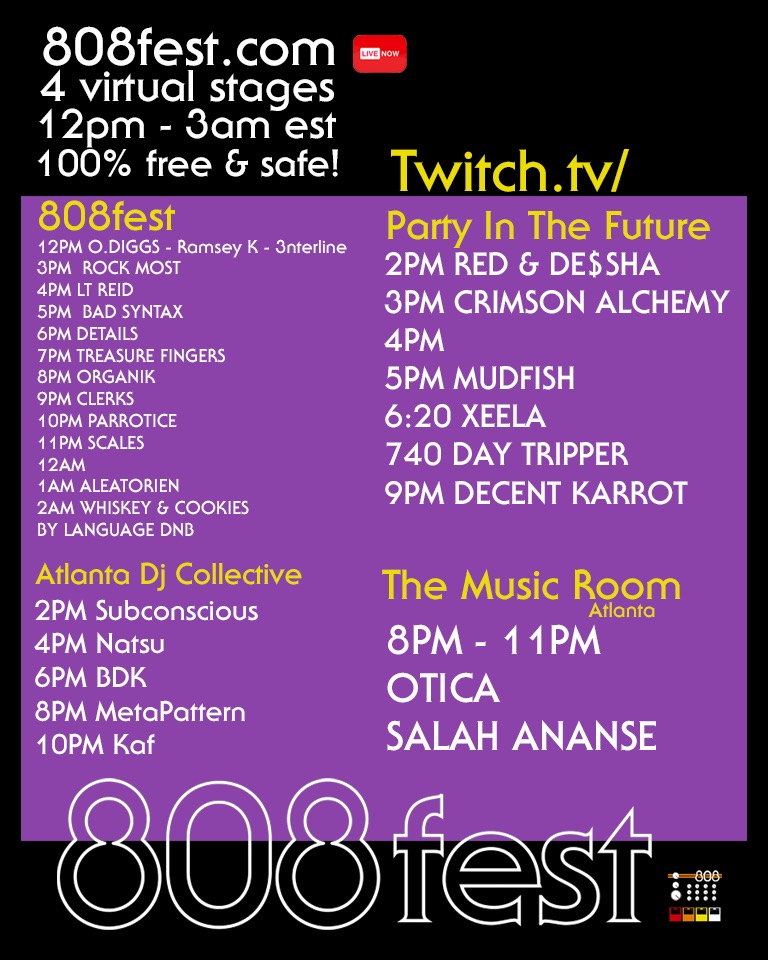
808 Fest kicks off today, Saturday, August 8, at Noon Eastern time and runs tills 2 a.m. Free, live streaming from the Music Room to your living room. Tune in via 808 Fest’s Twitch page.
Stay tuned for more information as it becomes available.
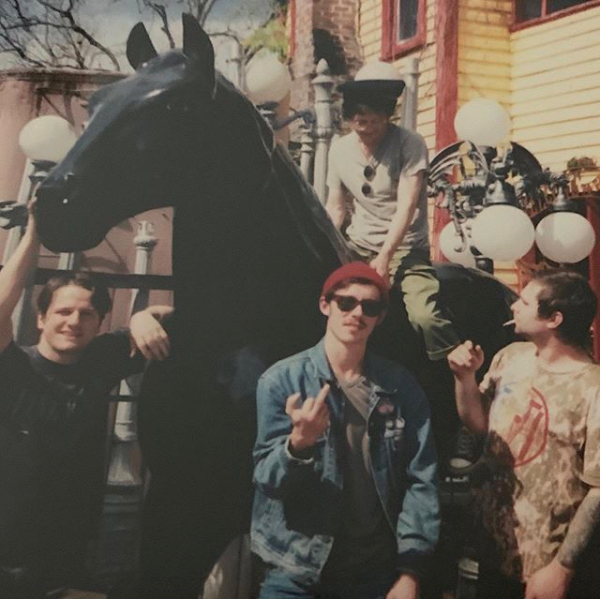
Warm Red is (clockwise from left) Stephen Lewis, Tony Gary, Bryan Sherer, and Jacob Armando. Photo by Eric Brooks.
Press Play on “Super Bowl,” the latest single from Atlanta post-punk and noise rock outfit Warm Red.
“Super Bowl” is the first single to be released from the group’s forthcoming debut album, titled Decades Of Breakfast. The LP is due out in October via Atlanta punk label State Laughter.
Bryan Malone, the long-standing Star Bar promoter, and guitar player with Atlanta rockers the Forty-Fives and Bad Spell, hosts a weekly live stream from his home in Pendleton Manor.
Malone takes on a new theme every week, ranging from Kinks and Ramones-heavy rock ‘n’ roll dance parties to root beer float appreciation nights.





 Rad/ATL