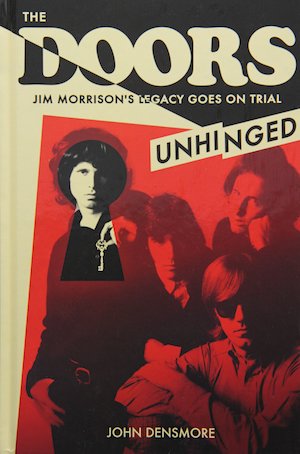
In October 1968, the Buick Motor Company paid the American rock ‘n’ roll group the Doors $75,000 to use the song “Light My Fire” in a commercial for a new luxury car, the Opel. For drummer John Densmore, keyboardist Ray Manzarek, and guitarist Robby Krieger, the deal was simply a way of getting paid for their song. But the group had previously agreed that every decision the Doors made was to be done unanimously, and each of its four members, including Dionysian front man Jim Morrison, had 100 percent veto power. When Buick came knocking, Morrison was out of the country, so the other three went forward with the commercial. When Morrison returned and found out, he was so angry that he threatened to smash an Opel with a sledgehammer on television if the commercial continued airing. For Morrison, the Door’s artistic integrity was at stake. He died in 1971, but his reaction to the commercial resonated with Densmore profoundly. So much so that it became the basis for waging legal action to stop Krieger and Manzarek when they tried to relaunch the group without him, and without Morrison, in 2002 as the Doors of the 21st Century. In his latest book, The Doors Unhinged: Jim Morrison’s Legacy Goes On Trial (CreateSpace.), Densmore chronicles the courtroom proceedings, and his subsequent victory, while justifying his actions against his former bandmates to honor Morrison’s vision.
Chad Radford: Why did you feel compelled to write The Doors Unhinged?
John Densmore: Several years ago, the Doors were knocked off of their hinges because the guitar player and the keyboard player thought they could continue without Jim. The Doors without Jim Morrison is like the Stones without Mick, or the Police without Sting. No. No. No. So I rallied Jim’s estate and we entered a legal struggle to stop them. At the time, some fans—the hardcore ones, certainly—said “What!? They’re suing the other guys?! Then it was ‘Ugh! … The other guys are countersuing for $40 million?! Oh my God, this is a train wreck.” If you read the book, you get that our goal was to preserve the Doors’ legacy, and to keep the original band and its intent intact. That’s why I wrote it. I want that story out there for those that are interested.
The word that keeps coming up around this case is “integrity …”
Jim Morrison—when he gave us that great line about “Come on Buick light my fire,” he said, “Great! I’ll smash one on television with a sledgehammer!” When he said that, he sledgehammered his feelings into my brain. I can’t get that out of my head, and the underlying thing that the book is all about is integrity. What’s interesting is that the song “Light My Fire” was primarily written by Robby. Jim wrote a couple of lines—”Our love becomes a funeral pyre.” But he went ballistic when he saw the commercial, so what does that say? He cared about the whole catalog and the meaning of the whole band. He’s dead; he’s my ancestor, and I’m going to honor him as much as I can.
Your perspective is from a very pure, circa 1965-67 kind of ideology.
That’s really smart, because when people talk about the ’60s, they really do mean ’65-’67. After that, 1968, ’69, ’70, that’s when people started getting burned out, and went from using street psychedelics to cocaine. Yuck.
Point being, you’ve carried that ideology into 2013, an era when a lot of bands would trip over themselves to have a song used in a commercial.
If you’re trying to pay the rent, the music industry is tough, man. If you have to use your songs to hawk stuff, do it. But if things get going for you, think about what Tom Waits said about selling your songs: “You’re turning your lyrics into a jingle, which means, you’re saying whatever you’re saying with your lyrics, plus you won’t be happy without this product!” And it’s true, when you sell your songs you’re selling your audience. It changes the meaning of your songs. I understand that in the beginning you have to do what you have to do to get going. But the Doors were in a different situation. People often ask, why not play Robin Hood, take the money and donate it to charity, or something, but turning a song into a commodity like that violates the sacred exchange that takes place between the artist and the listener.
Also, let me just say, a lot of people like to pooh-pooh the ’60s, and they did burn out toward the end. But it really was an incredible renaissance. The seeds of integrity, civil rights, the peace movement, feminism, and all these things were planted in the ’60s. These are big seeds! Maybe it’ll take 50 or 100 years for them to flourish, but they were planted. So keep your water cans out. Those seeds are going to grow into big beautiful trees that break up sidewalks.
Did you worry about being perceived as the villain when you took Ray and Robby to court?
In the beginning, yes, I did. Ray and Robby are great musicians, and I want them to be out there playing music, but let’s get the name straight, and it is straight now: Manzarek–Krieger, founding members of the Doors. Go see them play, they’re great. But I’m not there because Jim’s not there. Why would I play these songs without him, when I played them with him? At the beginning of the whole Doors of the 21st Century thing, people would ask, “Why aren’t you playing with them?” Truth is, a long time ago Jim said, “We’re all together in this. I don’t know how to write a song, or play a chord on any instrument. We’re going to share everything, equally. Everything! It was a beautiful pact. And you know, the Beatles are John, Paul, George, and Ringo. The Doors are Jim, Ray, Robby, and John—not Ray, Robby, Ian, Tom, Fred, Stewart, and whoever the hell else. That’s no slight on those guys, they’re fine musicians, but Ian is not Jim, and that was not the Doors.
That kind of pact—four equal shares, each with 100 percent veto power—was unprecedented at the time, correct?
It was completely unheard of in musical and in popular culture, but it made us all feel empowered to give 200 percent into those songs.

In the end, were you also putting yourself on trial by writing this book?
Yeah. Just bringing all of this up—money is such a volatile subject. It makes us crazy, and people have criticized me: “Obviously you’re just hanging out with rich socialists …” You can’t please everybody, but it affects you a little. The great thing about the Internet is that it unites us as a global village, but it gives a prominent voice to the fringe crazies. But yes, I really did feel like I was taking myself to task.
Are you willing to make amends with Ray and Robby now that the case is settled, and they’re not calling themselves the Doors of the 21st Century?
Yeah, and the road to recovery is open. I sent them the last chapter a few weeks ago, and want to make sure they get them. It’s a hard pill to swallow, but how could I not love Ray and Robby? We created this thing that’s bigger than all of us in a garage in Venice. They will forever be my musical brothers. Maybe we’ll hang again, and maybe we’ll make music again one day. Not playing Doors songs, but maybe a benefit, like Pink Floyd did a few years ago. That would be a nice, altruistic reunion.
Until then, you’re on the road with the book.
Yes, and I’m excited to come to Criminal, because I feel like one! The Doors were banned from Atlanta—oh my God. After Jim died, we tried to continue for a while, and it was kind of stupid. Anyway, we did a couple albums and were touring with one called Other Voices. We wound up on the phone with the mayor of Atlanta [Sam Massell] saying, “I don’t want no obscene Doors in my town!” Because of what went down with Jim in Miami. I said, “Our singer has passed and things are somewhat different …” He said, “I don’t care, the Doors are not playing in my town!” So we were banned from Atlanta, unceremoniously. This must have been 1973, give or take. So it’s an appropriately named venue for me. Hopefully I’ll be better received this time.
A version of this interview originally appeared in Creative Loafing on April 30, 2013.
If you have enjoyed reading this article, please consider making a donation to RadATL.


 Rad/ATL