Photo by Ron Sherman. Courtesy of the Stuart A. Rose Manuscript, Archives, and Rare Book Library, Emory University
Photographer Ron Sherman will be at Different Trains Gallery in Decatur, discussing his photographs of The Sex Pistols first show on North American soil on Thursday, November 9 at 7 p.m.
On January 5, 1978, British punk landed in Atlanta when the Sex Pistols played their American debut at The Great Southeast Music Hall in Buckhead’s Lindbergh Plaza. Sherman was in the audience that night shooting pics for Newsweek Magazine.
It was just another night on the job for a working photographer. The media was steeped in a moral panic leading up to the show. Sherman’s photos portray the group as what it was, a young rock’n’roll band.
GOLD SPARKLE BAND: Live at the Silver Ceiling circa 1997. Photo by Steve Pomberg
Gold Sparkle Band, one of the most influential and far-reaching ensembles to emerge from Atlanta’s underground music scene of the early ’90s, is returning to headline an evening at Eyedrum Art & Music Gallery on Saturday, October 14. The group’s deft compositions, improvisations, and live performances defined a sophisticated era for Atlanta’s underground music scene, alongside contemporaries such as Smoke, Cat Power, and the Rock*A*Teens. Decades later, the energy the group has wielded since 1994 still resonates within the more adventurous realms of the city’s outsider music and arts scenes.
This show marks the first in a series of events geared toward raising awareness for Eyedrum’s two-night 25th anniversary party happening the weekend of Nov. 11 and 12.
Since August of 1998, two of Gold Sparkle Band’s co-founding members, alto saxophone and reeds player Charles Waters and percussionist Andrew Barker have resided in New York City, where they remain musically active under different iterations of the group’s moniker—mostly as the Gold Sparkle Trio.
For the evening of their Eyedrum performance, Waters and Barker are returning to play two full sets with fellow GSB co-founder and trumpet player Roger Ruzow and longtime bass player Chris Riggenbach.
Other co-founding members, bass players Andrew Burnes and Joe Jamerson are no longer performing with the group. Saxophonist and flautist Rob Mallard, who was also a founding member of GSB, died in 2018.
Gold Sparkle Band. Photo by Thomas Tulis
“Charles and I still communicate pretty much every day,” Ruzow says. “He sends me new music that he’s working on all of the time—any genre that you can imagine. I send him new material pretty much every day as well. We have been talking about getting together to play another show down here for quite some time. When Randy Castello and Will Lawless from Eyedrym contacted us about playing their anniversary, it felt as though the time was right.”
For this show, Waters, Barker, Ruzow, and Riggenbach will perform the first set as a quartet. After that, they’ll lead a second set performing as the Gold Sparkle Big Band, an expanded version of the group that will include tenor sax player Ben Davis (Purkinje Shift, Edgewood Sax Trio, Teardrinker Salts), oboe player Robbie Hunsinger, Jason Casanova (4th Ward Afro Klezmer Orchestra) playing euphonium, flautist Anne Richardson, and pianist Chris Case—nine players total.
“Stylistically speaking, what sets these two performances apart is the extremely high caliber of musicians that are joining in for the large ensemble performance,” Ruzow says. “They will make it an absolute blow out no matter what the hell we decide on playing.”
Throughout the years, improvisation based around deconstructing traditional musical forms while straddling the avant-garde and solid grooves to create an evocative atmosphere has remained at the heart of GSB’s sound. Gold Sparkle Band has long wielded the talents of a world-class jazz unit. Each number is built upon a structured composition—mostly written by Waters—that’s used as a vehicle to drive the melody and the musical ideas that are brought to the fore, while also creating a form and context for the music. Improvisation launches from there, and the music can glide along in a linear, blues-based progression, or it can go full-on primal scream. It all depends on the moment in which the music is created.
The group has collaborated with likeminded musicians ranging from free jazz double bassist and Cecil Taylor cohort William Parker to Chattanooga’s the Shaking Ray Levis. The group’s New York-based members have even collaborated with lauded Chicago free jazz veteran Ken Vandermark for the 2004 CD, Brooklyn Cantos.
The music often sidles up to a simmering middle ground, easing in at first, then skittering to life with muscular, horn-punctuated grooves that barrel through numbers such as “Zodiac Attack” from the Fugue & Flowers album, and “People’s Republic” from Brooklyn Cantos.
Songs from releases such as 1995’s Earth Mover, 1997’s Downsizing, and 1999’s Nu-Soul Zodiac build on an ethos that resembles something of a punk rock aesthetic, although far beit from anything that can be easily categorized.
“Punk is a good touchstone, but what we’re creating is more like a contemplated combustion,” Ruzow says. “In previous years, when we were experimenting with punk aesthetics, it was all about us learning to command a particular energy and direction. Now, we have a slightly better understanding of that energy and how to turn it into something that we drive, rather than it driving us,” he adds. “It incorporates aspects from each of our lives, which are all very different, but connected by a compulsion to play music.”
Gold Sparkle Band playing the Jump Fest at Eyedrum in 2002. Photo by Thomas Tulis
Waters adds: “All of us come from sone kinda analog punk background. Our first bassist Andrew Burnes—he was a superstar and super vital in my process of becoming a ‘composer’—has his hands in the middle of all you describe. Our frequent guitatist Jer Wilms, now back in Atlanta, who worked in a million ensembles and then brought his genius to the Nuzion Big Band, is amazing. We are a band of collaborators and saboteurs, poets, ghosts, and some special sauce that jazz mostly doesn’t have. That is because we are a BAND! We’re a fucking band, and we play each others mistakes, we love each other—sometimes each others others and many in between. Gold Sparkle is a band and thats why we rock and have a future.”
During GSB’s mid-to-late ’90s Atlanta heyday the group could be seen on most nights tearing up stages everywhere from Homage Cafe and Dottie’s to the Moreland Ave. Tavern, the Point, Cotton Club, and Frijoleros. Gold Sparkle Band even shared the stage at the Highlander with John Zorn’s Masada—an ensemble playing compositions inspired by radical Jewish culture. “It was a life-changing experience,” says Ruzow, who now leads the 4th Ward Afro Klezmer Orchestra.
All of the aforementioned venues are long gone—relics of an everychanging cityscape that no longer exists.
The Star Bar, MJQ, and Eyedrum were also regular haunts for the group. But as Waters says, the group still has a future.
For this show, the group will delve into material from their early aughts albums including 2002’s Thunder Reminded Me and Fugues & Flowers.
“During our whole trajectory in New York City, which is semi taking for granted, me and Barker have worked a million gigs and we still love doing it,” Waters says. “Barker leads his trips, and I play my wacky garden chamber music. We just keep on with it.”
Throughout the ‘90s, GSB emerged as a Southern counterpart to the post-rock, indie rock, and free jazz sounds created by Midwestern acts such as Slint, Tortoise, and the Vandermark 5. In a single musical moment, the group’s live performances would unfurl with all the flare of a conventional jazz outfit before drifting into psychedelic clusters of skronk and wail. Each number intimating a cerebral sense of immediacy that defined an innovative and iconoclastic era of Atlanta’s underground music scene, and dovetailed with what was happening with the world at large.
That sound and vision remains as potent as potent as ever, and the future remains wide open.
On Oct. 12, two days before playing Eyedrum, Gold Sparkle Band’s members are hosting a workshop from 6-8 p.m., discussing a hands-on approach to live improvisational musical styles.
TAV FALCO PANTHER BURNS (L to R): Walter Brunetti, Mario Monterosso, Giuseppe Sangirardi, and Tav Falco. Photo by Jamie Harmon
Singer, guitar slinger, filmmaker, and creative provocateur Tav Falco began his career in a Memphis cotton loft on the banks of the Mississippi River circa 1979, when he chain sawed a guitar into pieces. It was an act of performance art that has resonated across the globe ever since, taking shape amid a cabaret of the Southern rockabilly, rock ‘n’ roll, and the avant-garde. Over the years, Falco’s notoriously outsider musical outfit Panther Burns has included everyone from Big Star singer and guitarist Alex Chilton to Minutemen and fIREHOSE bass player Mike Watt, and Nick Cave and the Bad Seeds drummer Toby Dammit.
These days, Falco calls Bangkok home. In recent years, Panther Burns’ lineup has solidified around a powerful trio of Italian players, including guitar player Mario Monterosso, bass player Giuseppe Sangirardi, and percussionist Walter Brunetti.
On Tuesday, October 3, Tav Falco’s Panther Burns plays Smith’s Olde Bar, supporting the group’s latest album, Nashville Sessions: Live at Bridgestone Arena Studios. Monterosso, Sangirardi, and Brunetti set the night in motion with an instrumental set of cinematic surf and rockabilly numbers. Savannah-based post-punk outfit Twisty Cats performs as well.
While making his way from Paris to the United States., Falco took a few minutes to answer a few questions about his lifetime of cross-cultural voyages and gaining a deeper understanding of his origins.
I have been told that you are laser-focused on completing the Urania film trilogy. How is the work coming along, and can you talk a bit about how the idea behind the trilogy has evolved as you’ve been working on it? Also, why is this such an important work for you to complete?
Chad, delighted to speak with you again. After much travail, delays due to hardware and equipment issues, interventions of concert tours, and diversions with female interests, I have finished the complete Urania Trilogy of intrigue films. From February through August, I managed to chain myself to the editing bench, flogging it day and night. With the remote collaboration of Steff Galvan, an emerging photographer in Vienna, who proofed my edits and offered invaluable aesthetic suggestions, we brought this feature movie to its inevitable conclusion. I say inevitable because there is much of Fate involved – its long, reaching arm overriding any one’s efforts who dares create a narrative flow from nothing more than fragments and shards of a filmic idea.
The film begins on the banks of the Arkansas River, then swiftly decamps to the merry/sinister capital of old Vienna, onward to the alpine lake region of Austria on the mystic Traunsee – the Lake of Dreams. The final dénouement plays out in a hotel room on the Grand Canal of Venice. It seemed like those ghostlike fragments sitting in their film cans decomposed – as if they hardly existed. On the screen, the retrieved images appeared thin and spectral. Once I began to assemble those fragments into a kind of Orphic flow, the movie suddenly began to live… and to breathe. It is alive, I thought. And it was and is alive with a life of its own. A pale Frankenstein that once again exposed to light, took form and gesture larger than Fate. I began to realize that I was merely the servant of this film. I became its priest at the altar serving its rights of creation. The film has its own destiny and rituals to be honored. Each scene has a secret that had to be discovered lurking within the black and white tonalities, gestures, and movements. Inside each scene is an intelligence hidden and buried that I had to find. A riddle that only an oracle or a muse could unravel.
Soon I became an animal chained to the keyboard. I tutored myself technically, but no film theory or scholarly method could offer guidance. As Werner Herzog wrote, “Film is not the Art of scholars, but of illiterates.” I excavated this movie from chaos, from extinction. Now that the trauma of it is over – the trauma of revelation, I realize I’ve conjured a film that is living and breathing, yet it is a dead thing. That is the nature of anything photographic. Once the living image is captured, it is frozen in time. It dies. That is the dichotomy of film. Motion pictures are a living dead thing.
One can contextualize film, or any expression, and call it Art. But if it is contextualized again and again, context swallows art and eventually excretes it. Then what you are left with is excrement. Let’s not make art of my movie. It is a lyrical ribbon of images that lives and dies on the screen telling its own story on its own, however imperfect terms. My cabal of musical alchemists have created themes to serve this commanding filmic ghost that stalks across the screen like a corsair hurling deception, vengeance, and betrayal at the audience – while seducing the viewers’ senses with a vital elegance.
Is there any overlap with the work you’ve been pouring into the film trilogy and with what we hear on the Nashville Sessions: Live at Bridgestone Arena Studios LP? Is it difficult for you to mentally toggle between filmmaking and making music? Is there a difference for you? Do you feel like either one of these avenues helps you achieve a more mysterious version of yourself?
My intent is not to achieve a more mysterious version of myself. Either someone is mysterious, or they are not. Yet I am an enigma, even to myself. Somethings are meant to be a mystery. Why tamper with that, and shine flashlights up every nook and cranny of the human psyche attempting to make logical that which is ineffable? I don’t know what I am doing, and I don’t want to know. That I learned from Fellini. As I’ve said before, I have only one song to sing whether intoxicated within the imbroglio of film, or intoning music before the microphone, or writing with a pencil. The new live album of the Panther Burns stage show is a manifestation of that one song – that lone, subjective eye.
TAV FALCO: Photo by Jamie Harmon
How did you get involved with Sirius XM’s Outlaw Country station to record this latest release?
Like most of what we do, the project came about through a process of association. Over time we’ve been invited to appear on a number of SiriusXM Radio shows in their studios at Rockefeller Plaza when we were passing through New York. Outlaw Country was the most recent show where our incendiary impulses were recorded for their honky tonk, hillbilly listeners. Before that, it was truckers’ radio show. I asked if they were sure they wanted an esoteric band like Panther Burns for that road gang radio broadcasting. The programmers said, yup. We know who you are. Jeremy Tepper, the erudite producer of Outlaw Country, recorded us in Nashville for a Halloween special. When we heard the mixes, we sent them to our label ORG Music in LA who became stoked to release the broadcast as an LP.
Will you be performing with the same lineup that plays on the record?
The very same Panther Burns band of Italians will be on tour as appeared on our previous album Cabaret Of Daggers and on the new Nashville live album: Mario Monterosso, electric guitar; Giuseppe Sangirardi, electric bass; Walter Brunetti, drums, cow bell, and tambourine.
When you consider the song list on the new album, is there a song or songs that you think of as your favorite here, or is there a song that really resonates with you now, maybe more than the others?
“The Ballad Of The Rue De La Lune” is a kind of true romance story I never seem to tire of hearing. Probably the more meaningful of any on the record.
What is your favorite thing about playing music with Mario Monterosso?
Mario Monterosso has the mind and ears of a producer and an arranger. He has the soul of a volcano, and the poetic depth of the Gulf of Tirania in his guitar playing. He saw me on stage in Catania as a teenager. Mario is far more than a brilliant musician, and he understands my vision. What more can you ask for?
Over the years, you have lived in rural Arkansas, Memphis, Paris, Vienna, and now Bangkok Thailand. There’s an old expression that says: “No matter where you go, there you are!” As you have moved from city to city around the world, and experienced these vastly different cultures on a day-to-day basis, what have you learned about yourself? What have you learned since leaving Memphis?
Cross-cultural voyages firstly open a deeper understanding of where one comes from, where one has grown up. When one lives day to day in another culture different from the last, the senses also deepen. Perception of languages deepen. Language itself becomes abstractly wonderous – how sounds and utterances become attached to meaning; how each culture has divined its own languages, meanings, rituals, and of course, its music. It is true that music is a universal language; and even though it has elaborated harmonic structures, it is an abstract one. Another abstract mystery. From this vantage, I know Memphis better now than when I had lived there for 17 years. After a certain age it is not possible to fully adopt another culture; I will always be an American living wherever – I cannot change that nor intend to. Also, I have learned that contrary to what becomes instilled in the minds of many, i.e., borders, flags, war paint, and propaganda, betray cultural identity rather than protect it. —Tav Falco, Paris 2023
If you have enjoyed reading this post, please consider making a donation to RadATL. Venmo to @Chad-Radford-6 or click on the Paypal link below.
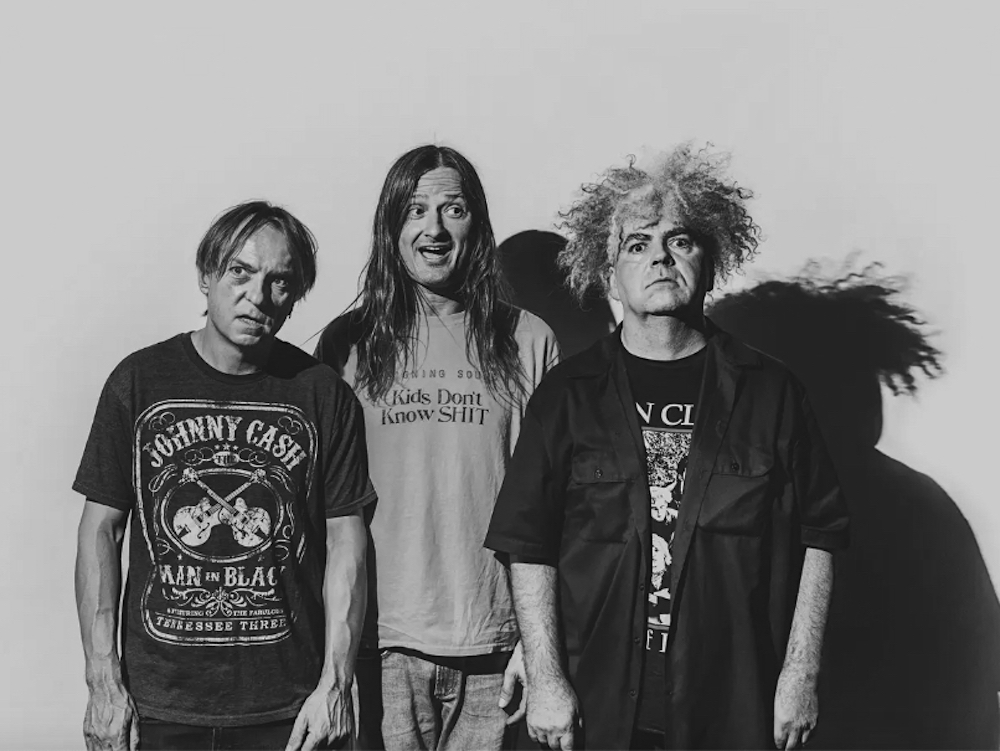
MELVINS: Dale Crover (left), Steven McDonald, and Buzz Osborne. Photo by Chris Casella.
The monolithic punk-metal speed and molasses dirges of the Melvins establish the group as both forerunners and contemporaries of the Pacific Northwestern musical underground of the early ‘90s. In the modern era, singer and guitarist Buzz Osborne, drummer Dale Crover, and current bass player Steven McDonald have continued pushing the group to creative new heights with 2022’s, Bad Mood Rising, followed by this year’s The Devil You Knew, The Devil You Know, featuring the original versions along with new recordings of the six songs from the Melvins’ debut 7-inch EP.
Now, Melvins have teamed up with Atlanta-based abstract electronic project Void Manes to unleash an homage to British industrial music luminaries Throbbing Gristle, titled Throbbing Jazz Gristle Funk Hits (Amphetamine Reptile Records). It’s an entirely electronic album—a first for the Melvins—featuring TG-inspired improv sessions and covers of songs such as “Sic Sick 60’s,” “Hot On the Heels of Love,” “Hamburger Lady,” and more. The first single is a thickened take on “Discipline 23,” which appears on the CD and on a flexi single that comes tucked inside the LP sleeve.
The video, created by Jesse Nieminen, builds on TG’s subversive late ‘70s mantra on dismantling the mechanisms of social and psychological control amid an era defined by misguided patriotism and technology gone awry. The more things change, the more they stay the same. Here, a minimalist blend of fascist imagery, made hollow under a sheen of maximum color saturation and distortion, pushes the Melvins’ vision of industrial overload to the nth degree. Press play above and get disciplined.
Throbbing Jazz Gristle Funk Hits is the latest in a loose but ongoing trend of paying homage to the confrontational and anti-commercial/pro-good-taste force that prompted British tabloids to label Throbbing Gristle “the wreckers of civilization.” “Heathen Earth” appears on the Melvins’ covers CD titled Everybody Loves Sausages. Head down the Discogs rabbit hole and there are more TG renditions by all parties involved to be discovered and devoured.
“Buzz talks a lot about giving people creative freedom and he’s right on about it,” Nieminen says. “There might be some discussion beforehand or none at all. For ‘Discipline,’ I had an idea, it turned into another, and I put it together. I didn’t ask for suggestions for it. I was free to do whatever I wanted and it was pretty close to what I envisioned from the start.”
Nieminen goes on to say: “We made the A Walk with Love and Death short film together. It was a conversation where we sat and riffed on ideas and edited it together. For Melvins TV they shot green screen in LA and sent stuff for me to do what I wanted,” he adds. “That grew from an idea where I was planning to shoot them in a studio with green screen backdrops and do a single music video in the style of those old German Beat Club episodes. Because of the pandemic it turned into Melvins TV and ballooned into 3.5 episodes.”
In a more recently released video for “Zyklon B Zombie,” Nieminen sets the songs fugue-like bouts of faux tropical rhythms and staccato electronic sounds to waves of billowing and blackened clouds, looped in a tussle of natural beauty rendered exquisitely for the simulacrum. It’s just a taste of what the album holds in store.
March of 2023 marked the 40-year anniversary of the Melvins’ first live performance. The group has spent much of the year celebrating by offering a slew of reissues and new releases, and playing shows around the world. The next Atlanta show is on Wednesday, September 27, at Variety Playhouse, where they’re playing 1991’s sprawling Bullhead LP in its entirety, along with more highlights from throughout the Melvins repertoire.
“We’ve been a band since 1983. We’ve never quit, we’ve never taken a break and stopped being a band, and I have seen people come and go from the highest heights to the lowest lows—death, resurrection, and more death,” Osborne says. “In the art world that I am in, there is a war of attrition; whomever is the last man standing is the winner. So far it’s me, with no end in sight.” READ MORE FROM MY OCTOBER 2022 FLAGPOLE MAGAZINE FEATURE STORY.
Void Manes is performing opening sets at several of the Southern Melvins/Boris shows. Keep your fingers crossed that they tear into some of the Throbbing Jazz … material on stage.
I will be at Virginia Highland Books this Thursday, September 28 at 7 p.m. I’ll be talking about my book, Atlanta Record Stores: An Oral History, as well as a few other related topics. I might even talk a bit about my next book! But I mostly just want to talk with y’all! I would be honored by your presence. We might even get a beer across the street afterward.
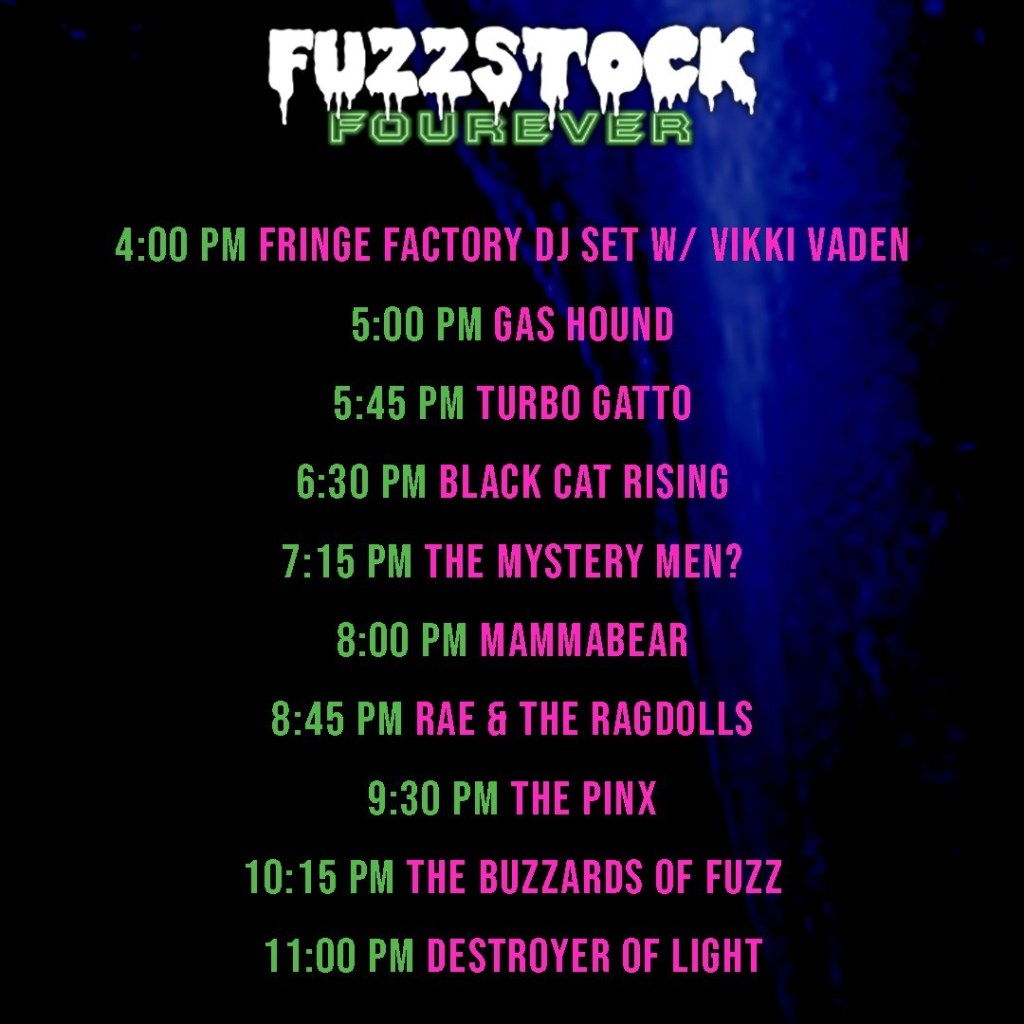
Now in its sixth year—but fostering it’s fourth actual festival thanks to that global pandemic that happened a while back—Fuzzstock is a celebration that blends Atlanta’s local music scene with sounds from the rest of the country. The tie that binds is friendship and a sense of community united by all things fuzz, stoner, and rock ‘n’ roll.
There will be food, a vendor market, and music all day. Festivities kick off at 4 p.m.
ROT: Kevin Cornelius (left) and Corey Pallon. Photo courtesy Boris Records
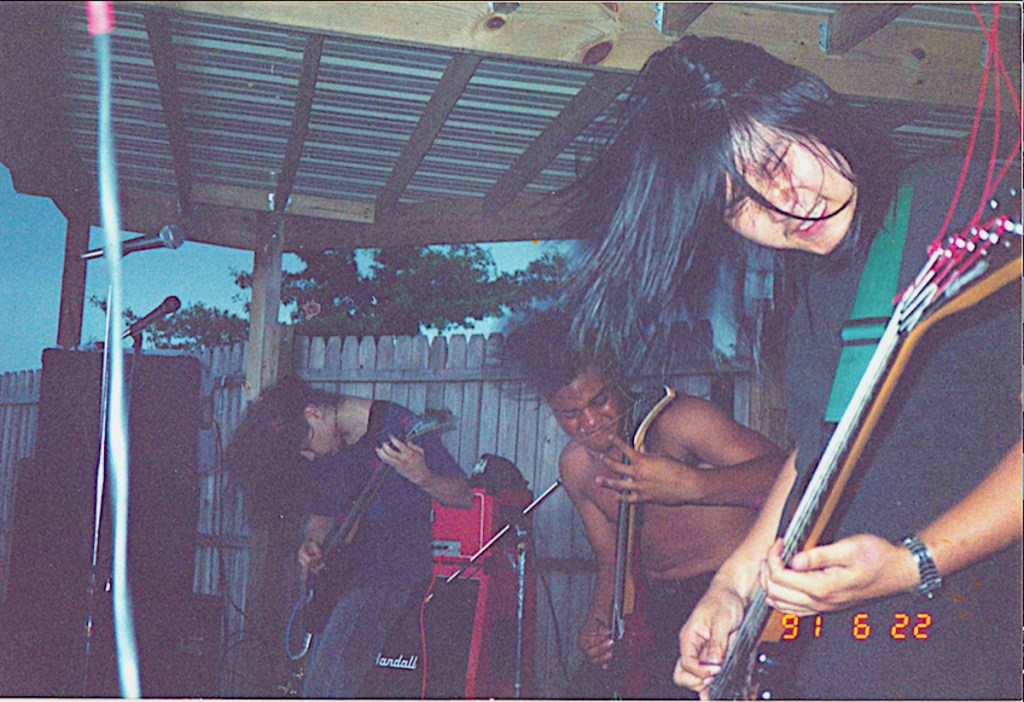
The story of Rot is the story of four friends—outsiders—fighting for survival amid Atlanta’s unforgiving music scene of the late 1980s and early ‘90s. Drummer Corey Pallon, guitar player Richard Googe, bass player James Liu, and vocalist, guitar player, and principal songwriter Kevin Cornelius lived in musical, cultural, and geographic isolation. Metal was a rising force amid the Reagan/Bush era, but Rot’s musical style looked far beyond the eyeliner and Aqua-net that antagonistic audiences in the southeastern United States demanded.
Rot drew power from the same down-tuned dirges of Swedish death metal luminaries Entombed as well as early Carcass and the concentrated grindcore riffage of Napalm Death’s debut album Scum.
Cornelius, Pallon, Googe, and Liu played the music that was written in their bones, capturing a portrait of a place, a time, and an attitude, driven by unrelenting darkness. The group’s would-be legendary status was constantly at odds with a litany of socio-political hurdles that came from every direction. The scene was stalked by a diabolical skinhead crew at nearly every turn. As a band that included two Asian members, guitarist Googe and bass player Liu, and Cornelius, a Black frontman, Rot found itself in the crosshairs, subjected to real violence and torment. The group played as though their lives depended on it, and often times it did.
On stage and in the practice space, Cornelius progressed quickly on guitar, rising from beginner status to death metal master within just 18 months. Working alongside his bandmates, he wrote and recorded gnarly odes of putrescence during the early gestation period of grindcore and death metal. He also experimented with a whispered vocal style that Nuclear Holocaust later made famous with their 1991 album Dawn of Satan’s Millennium.
ROT LIVE: Liu (from left), Cornelius, and Googe.
Upon arrival, Rot’s demo tape, Diabolus (The Unholy Rot), promised great things to come. Songs bearing titles such as “Mutilation of the Christians,” “Pray To Death,” and “Parasitic Withdrawal” were and still are unrelenting in their raw intensity of sound and bleak musical textures.
The demo tape has lied in obscurity for more than 32 years, existing only as a grainy video buried deep on the Youtube. Now, Boris Records has pressed the first official vinyl release of Diabolus (The Unholy Rot), unleashing one of the most strikingly raw and gutteral death metal recordings to ever come from the Atlanta scene.
The album places a remastered recording of Rot’s original four-song demo EP alongside two previously unreleased cuts, “Baphomet” and “Violent Beast.” There’s also a recently unearthed live recording filling out the B-side. Really, though, it’s John Mincemoyer’s in-depth storytelling in the liner notes that adds depth, context, and a human element to the story of these four friends, illustrating the countless hurdles and seemingly insurmountable odds they faced, and the extremely hard, fast, and loud music they created during their brief but fiery existence.
If you have enjoyed reading this interview, please consider making a donation to RadATL. Venmo to @Chad-Radford-6 or click on the Paypal link below.
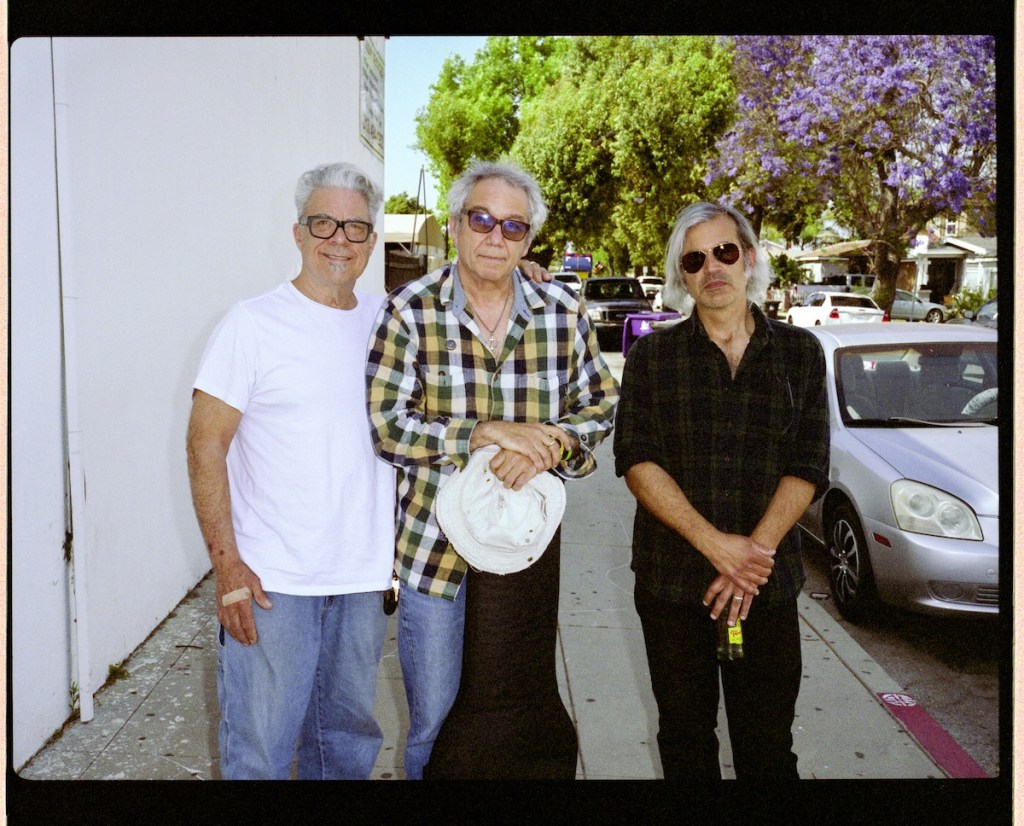
MSSV: Stephen Hodges (from left), Mike Watt, and Mike Baggetta. Photo by Devin O’Brien
It’s misleading to call MSSV an experimental rock trio, as these three elder statesmen of the underground know exactly what they’re doing. Still, bass player Mike Watt, guitarist Mike Baggetta, and drummer Stephen Hodges craft a fluid, mostly-instrumental body of work that flows beyond the confines of their impressive collective resumes. Hodges has performed with the likes Tom Waits, David Lynch, Wanda Jackson, and Mavis Staples for years. Baggetta has collaborated with everyone from Bob Stagner of Chattanooga’s Shaking Ray Levis on the Triage album to legendary session drummer Jim Keltner. And, of course, Watt raised the bar high for American punk and indie rock playing bass and singing with the Minutemen, fIREHOSE, and via scores of solo releases and offshoot ensembles. Together, MSSV hones in on a rhythm, a groove, or a subtle shift in sound to explore and expand upon with each new number. Their approach is part composition, part improvisation, and part file-under-some-other form of silent musical telepathy that is as sophisticated as it is undeniably catchy.
MSSV is on the road playing songs from their second studio album Human Reaction, due out Sept. 1 on Big Ego Records.
Atlanta’s noisey post-punk newcomers Blood Circuits (featuring former members of Free Masonry, Gaijin, Remuxers, Hal Al Shedad, and Car Vs. Driver) and the city’s quintessentially baroque chamber-punk balladeers W8ING4UFOS set the night in motion.
CANCELED: This live appearance has been canceled, but you can hear Thurston Moore’s interview with Chad Radford on 90.1 FM/WABE’s “City Lights” on Monday, October 30 at 11 a.m. and again at 8 p.m.
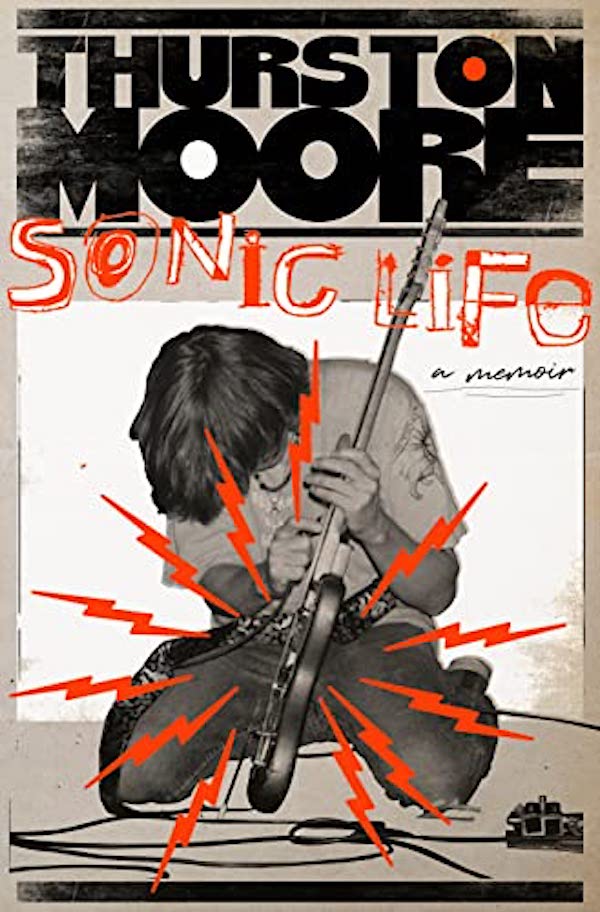
From the founding member of Sonic Youth, a passionate memoir tracing the author’s life and art—from his teen years as a music obsessive in small-town Connecticut, to the formation of his legendary rock group, to 30 years of creation, experimentation, and wonder.
A Cappella Books welcomes Thurston Moore to The Plaza Theatre to discuss his new book, Sonic Life: A Memoir, on Monday, October 30, at 7 p.m. Moore will speak with your truly, Chad Radford, music journalist and author of Atlanta Record Stores: An Oral History. Moore will also perform a short musical set.
Following the conversation, The Plaza will host a screening of director Stuart Swezey’s documentary, Desolation Center, featuring performances by Sonic Youth, Minutemen, Meat Puppets, Swans, Redd Kross, Einstürzende Neubauten, and more. Moore will introduce the film.
A note on the THREE types of tickets available for this event:
Book Talk Ticket: Includes a pre-signed copy of Sonic Life + admission for the 7 p.m. book talk. ($35+tax).
Book Talk and Movie Ticket: Includes a pre-signed copy of Sonic Life + admission for the 7 p.m. book talk, and the 8:30 p.m. screening of Desolation Center. ($45+tax).
Movie Ticket: Admission to the 8:30 p.m. screening of Desolation Center. ($20 + tax)
About the Book Thurston Moore moved to Manhattan’s East Village in 1978 with a yearning for music. He wanted to be immersed in downtown New York’s sights and sounds—the feral energy of its nightclubs, the angular roar of its bands, the magnetic personalities within its orbit. But more than anything, he wanted to make music—to create indelible sounds that would move, provoke, and inspire.
His dream came to life in 1981 with the formation of Sonic Youth, a band Moore co-founded with Kim Gordon and Lee Ranaldo. Sonic Youth became a fixture in New York’s burgeoning No Wave scene—an avant-garde collision of art and sound, poetry and punk. The band would evolve from critical darlings to commercial heavyweights, headlining festivals around the globe while helping introduce listeners to such artists as Nirvana, Hole, and Pavement and playing alongside such icons as Neil Young and Iggy Pop. Through it all, Moore maintained an unwavering love of music: the new, the unheralded, the challenging, the irresistible.
In the spirit of Just Kids, Sonic Life offers a window into the trajectory of a celebrated artist and a tribute to an era of explosive creativity. It presents a firsthand account of New York in a defining cultural moment, a history of alternative rock as it was birthed and came to dominate airwaves, and a love letter to music, whatever the form. This is a story for anyone who has ever felt touched by sound—who knows the way the right song at the right moment can change the course of a life.
About the Author Thurston Moore is a founding member of Sonic Youth, a band born in New York in 1981 that spent 30 years at the vanguard of alternative rock, influencing and inspiring such acts as Nirvana, Pavement, the Yeah Yeah Yeahs, My Bloody Valentine, and Beck. The band’s album Daydream Nation was chosen by the Library of Congress for historical preservation in the National Recording Registry in 2006. Moore is involved in publishing and poetry and teaches at the Summer Writing Workshop at Naropa University in Boulder, Colorado. He divides his time between the USA and England.
About the Film Desolation Center is the previously untold story of a series of early ’80s guerrilla music and art performance happenings in Southern California that are recognized to have inspired Burning Man, Lollapalooza, and Coachella, collective experiences that have become key elements of popular culture in the 21st century. The feature documentary splices interviews and rare performance footage of Sonic Youth, Minutemen, Meat Puppets, Swans, Redd Kross, Einstürzende Neubauten, Survival Research Laboratories, Savage Republic and more, documenting a time when pushing the boundaries of music, art, and performance felt almost like an unspoken obligation.
Directed by Stuart Swezey, the creator and principal organizer of these unique events, Desolation Center demonstrates how the risky, and at times even reckless, actions of a few outsiders can unintentionally lead to seismic cultural shifts. Combining Swezey’s exclusive access to never-before-seen archival video, live audio recordings, and stills woven together with new cinematically shot interviews, verité footage and animated sequences, Desolation Center captures the spirit of the turbulent times from which these events emerged.
If you have enjoyed reading this post, please consider making a donation to RadATL. Venmo to @Chad-Radford-6 or click on the Paypal link below.
Nearly 27 years after the tragic death of Brainiac frontman Tim Taylor brought an end to the group’s meteoric rise, the beloved Dayton, OH post-punk freak out ensemble is returning to stages once again. The group’s Surviving members—guitarist and vocalist John Schmersal, drummer Tyler Trent, and bass player Juan Monasterio—are paying homage to Brainiac’s fallen leader with the addition of guitarist, keyboard player, and vocalist Tim Krug of Dayton-based indie rockers Oh Condor as well as the electronic projects Hexadiode and Halicon.
From 1992–1997, Brainiac twisted the boundaries of indie rock, industrial music clatter and collage, and noise rock to the tune of a mangled Moog synthesizer. The group’s sound was truly revolutionary, as evidenced by their three steller full-lengths 1993’s Smack Bunny Baby, 1994’s Bonsai Superstar, and 1996’s Hissing Prigs in Static Couture.
The group’s final offering, 1997’s Jim O’Rourke-produced Electro-Shock for President EP offered just a hint at the bold and engaging new sounds the group had in store. But Taylor’s death in a single car accident that same year marked the end for Brainiac.
Cincinnati’s drums and cello two-piece Lung opens the show with a set of blackened and apocalyptic post-grunge, post-goth dirges.







 Rad/ATL