Fresh off of releasing his brilliant 2022 album Music For Four Guitars (Palilalia), punk-blues and no wave-inspired improv guitarist Bill Orcutt returns to play a solo set at Eyedrum Art & Music Gallery on Sunday, February 19.
What at first feels like irony quickly fades as Upchuck’s vocalist and frontwoman KT and guitar player Mikey, laugh while explaining how spending time on the road with Melbourne’s garage punk provocateurs Amyl & the Sniffers instilled in them a sense of discipline.
“It’s true,” Mikey says. “We learned a lot from them in terms of professionalism and staying on point just by watching how they put on shows from the business end of things. We learned what it’s like playing bigger venues, how production goes, and how important it is that we show up on time.”
KT agrees, adding, “It really is a whole different game. You have to make some serious decisions if you’re going to keep stepping it up. How far do you want to take this? I learned there’s a balance between how lit do you want to get each night before you go on stage and how much do you want to deliver. I learned that there can be a natural, kinetic energy between peeps when you are on tour together, and that we can learn from each other.”
Both Mikey and KT’s voices collide, clipping each other out during a Zoom interview. Shaky connections stutter, freeze, and leap back to life—Mikey is in his car, holding his phone in his lap while driving home after a day spent working on the set of a new Exorcist film. KT keeps her phone in her hand while wandering in and out of darkened rooms in her home. For brief, fleeting moments the image of her face emerges from the glowing contrasts of the computer screen only to disappear again back into the inky darkness for the duration of our conversation. But she never misses a beat while talking, cracking herself up, laughing at her own answers, despite her sincerity. Then, a chime and another voice joins the Zoom, second guitar player Hoff announces his presence, by explaining that he’s dialing into our Zoom chat from work. “I’m listening, and I’ll might have some input here and there, but I’m running up and down stairs,” he says.
Chaos rules Upchuck—at least when viewed from the outside—following the example of their outrageous Aussie compatriots Amyl and the Sniffers, who’s early single “Some Mutts (Can’t Be Muzzled)” barked the song’s title as a primordial battle cry. Later, the same group closed out their second and most recent album, 2021’s Comfort To Me, with a song titled “Snakes,” in which singer Amy Taylor declares in her banshee howl, “Worked at the IGA, now I’mma famous cunt.”
For now, though, Upchuck’s members still punch a clock. All of this comes into perspective when parsing out the group’s hard, fast rise amid Atlanta’s disjointed, pre-pandemic local music scene.
The group came out of the gate strong in 2018, packing out DIY venues such as the Bakery’s original Warner Street location near the Adair Park and Oakland City neighborhoods, and the Drunken Unicorn on Ponce de Leon Avenue, with wall-to-wall mosh pits that sent bodies flying through the air like missiles.
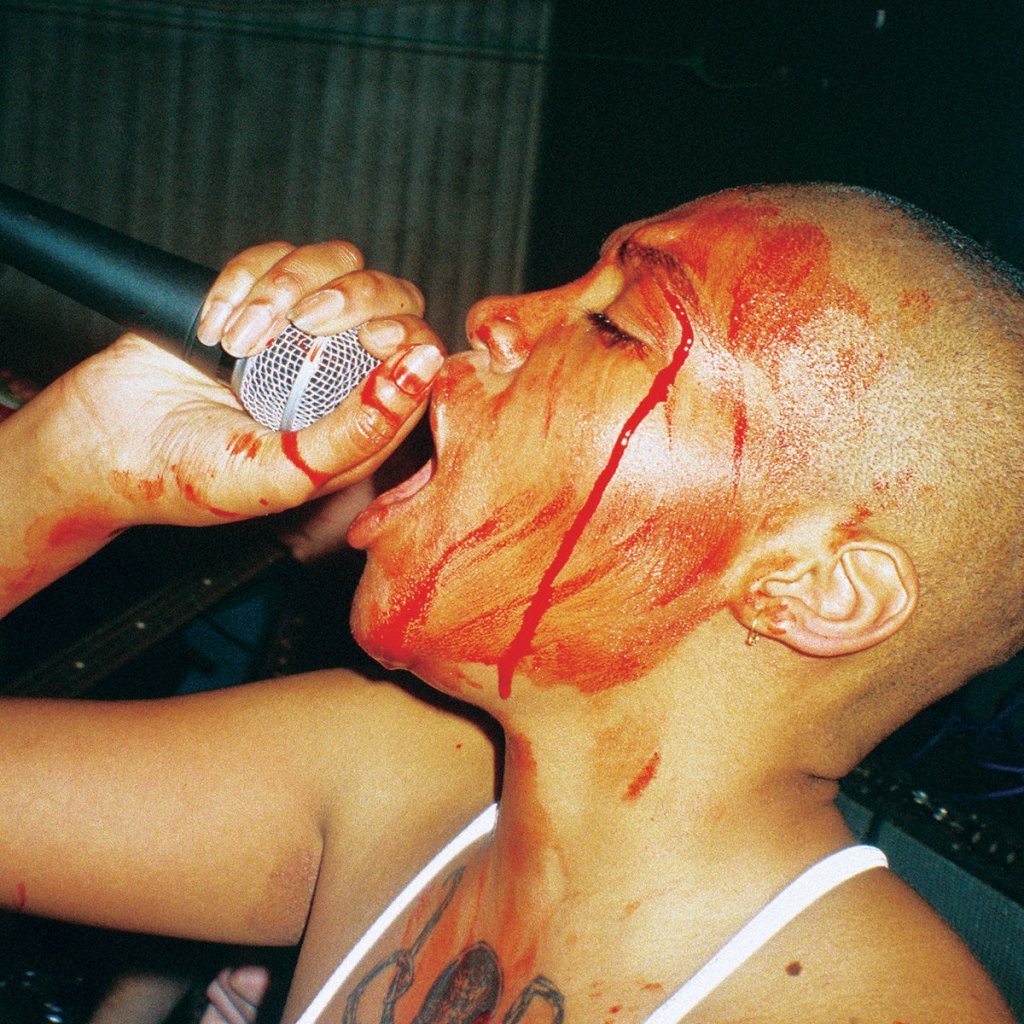
KT of Upchuck on the cover of “Sense Yourself.” Photo by Nathan Davenport.
The album was two years in the making, and arrived bearing a vibrant image of KT, screaming into a microphone with blood oozing down the sides of her face and hands. It is an instantly arresting image, captured by photographer Nathan Davenport, and shot only seconds apart from Marlon Garcia’s image on the cover of the group’s “Upchuck” b/w “In Your Mind” 7-inch single. It’s a pic that has become synonymous with the group’s fun and feral energy. The whirlwind of fury kicked up during their live shows as the group tore through early songs bearing titles such as “Shakin,’” “Wage of War,” and Upchuck’s fiery self-titled anthem captured the attention of everyone from the local hardcore scene to dispassionate indie rockers and beer-swilling college kids from all walks of life.
Sense Yourself is an album that’s teeming with the sounds of swaggering danger and youthful abandon, all embodying a deeply ingrained sense of innocence. It’s a celebration of intensity that reaches a fever pitch while traversing a shared, collective experience for listeners, a seemingly insurmountable task in the modern era.
Other songs such as “Boss Up,” “In Your Mind,” “Our Skin,” and “Facecard” coalesce around a forward-leaning momentum that has kept the group forging confidently ahead this year, all the while bolstering the spirit of Atlanta’s young, underground rock music scene onto the national and international radar. If ever there was a candidate for Atlanta’s 2022 album of the year, Sense Yourself is it, its thunderous rhythms reaching larger crowds from coast to coast nearly every day since it arrived. The album’s searing energy is matched only by its bounding urgency fueled by equal parts contempt for a broken society and camaraderie within the band’s ranks.
“These boys are my family, and Mikey is literally like my big bro,” KT laughs. “We all love each other unconditionally, and my POV is that this will never change. Someone would literally have to do something crazy to bring that to an end, but that will never happen because we’re all cool beings and we value each other so much.”
Aesthetically speaking, there is no realm that Upchuck does not touch. KT (Kaila Thompson), Mikey (“Spuzz Dangus”), Hoff, bass player Armando Arrieta, and drummer Chris Salado’ songs are driven by a defiantly creative blend of post-punk, hip-hop, and indie rock energy that’s channeled through a haze of distortion.
They prefer to identify themselves only by their first names, and to the ire of promoters around the country, the group’s social media presence is kept to a bare minimum. Upchuck has no Facebook page. No Twitter, and no Tik Tok. Just an Instagram account that allows them to project just enough about themselves to remain compelling to those who are genuinely interested in the music, and their numbers are growing.
“The songs are always changing when we play them live,” Mikey says. “Maybe it’s that the rhythm is different, or we’ll cut it short in a certain way. Change up the lyrics. Even the old songs we change up to keep things fresh—keep things from getting boring.”
KT continues his thought, adding that the changes are always unspoken. “Communication with us all has literally come down to just a look. We’ll all look at each other, and it’s like, ‘Aight, I know exactly what you’re saying.’ We all know what to do.”
“Hoff adds that he and Mikey have been jamming together since pre-Upchuck days, and developed the group’s shared musical instincts together. “We practiced the songs that we had for six months before we even played a show with them, so we kind of already know what to anticipate when we go into a song.”
This kind of interaction between band members during practice is one thing, but expounding upon that in front of a crowd of hundreds of people or more is something different. But it’s an instinct that the group’s members have continuously honed. “I feel like if that kind of energy and communication doesn’t happen during practice, it definitely won’t happen on stage.”
That energy translates across the board. “Perdido,” is sung entirely in Spanish by drummer Chris, and builds energy around the phrase: “Hago lo que quiero”—”I do what I want.”
The album’s title track also carries the explosive energy to a new level. The quick intro catches audiences off guard, as the rooms they play visibly come alive based on the riff alone. “That’s definitely by design,” Hoff says.
Photo by Alec Pugliese.
One of the album’s more introspective numbers, “Facecard,” finds KT taking on the superficiality of modern America: “The trifling yuppie fuck, comes out beyond the cut to try and low ball, low ball,” KT sings.
“It’s always on the setlist and it’s definitely a breather for me,” she adds. “It’s also one of those tracks where people hear the riff and start reacting immediately.”
The connection with Amyl and the Sniffers was born in July of 2019. The group was coming to the States and had booked a show at The Earl. Upchuck’s manager Randy Castello of the Tight Bros. Network seized the opportunity to lobby for them to open the show. He sent over a link to Upchuck’s demo tape on Bandcamp. “Amy Taylor responded almost immediately,” Castello says. “She was like, ‘Yes, definitely add them to the show!’”
Afterward, Taylor and her bandmates approached Upchuck, asking them if they wanted to play just a few more shows together. “It actually turned out to be a lot more shows together,” Mikey says,” and we both played the biggest show that either of our bands have played to date, at Brooklyn Steel in May.”
The show pushed the 1,800-capacity venue nearly to the breaking point, and opened up a whole new audience for Upchuck.
As 2023 approaches, the group is preparing to record its sophomore album for Famous Class. While the exact details as to where and with whom they’re recording remain a closely guarded secret for the time being, they’re heading to California in February to capture it all on tape.
“We’re definitely gonna keep working with Famous Class, regardless,” Hoff says. “Cyrus [Lubin] at Famous Class has given us so much creative freedom and trust, and aside from a few minor tweaks here and there, doesn’t mess with what we do at all.”
Mikey adds, “The songs that we’re recording are songs that we’ve been playing pretty much just as long as everything that’s on the first record, so the two should fit together really well.”
Teetering on the axis of punk, hip-hop, and indie rock, a sense of discovery, and the power of youthful energy, the new music contained within these songs—either live and in the moment or on record—is intoxicating to the end.
If you have enjoyed reading this post, please consider making a donation to RadATL.
In Greek mythology, dryads appear as tree-dwelling spirits who lure men to their deaths by seducing them into a shadowy realm of the unknown, sometimes replacing them with a doppelgänger—a sinister look alike. It’s a dark and mysterious tale that’s been repurposed in everything from David Lynch’s surreal T.V. saga “Twin Peaks” to Jordan Peele’s paranoid horror film Us. It’s a puzzling metaphor about there being more to the natural world than meets the eye. It’s also a bewitching entry point into The Book of Flowers’ debut cassette tape, Pastels.
Press play on the opening three numbers, “Foxfire & Clover,” “The Housewitch,” and “The Dryad,” and dreamlike imagery takes shape amid swathes of murky country crooning, mellotrons, and British folk-style songwriting.
“I was thinking a lot about impressionist painting and things that use a lot of pastels,” says songwriter James Andrew Ford. “I wanted the songs to have a pastoral feeling to them, with a kind of a dark feeling as well, like watching the sun set over an empty field.”
Ford is a co-founder of Atlanta’s industrial, EBM, and dark wave label DKA Records. The lingering earthly and ethereal tones that he conjures in the songs on Pastels are a far cry from the digital crunch and urgency of much of the label’s output, including that of his own former project Tifaret. But from the soft dissonance of the cover art’s pink and green colors to the balance of electronic and organic textures over Krautrock rhythms of “The White Dress” and “Watch the Stars,” Ford’s shift in style emerges quite naturally.
“During the latter part of Tifaret, I was banging my head against the wall because I was having a lot of issues trying to do a full-length,” Ford says. “I was trying to figure out how to do something that felt satisfying and cohesive, but wasn’t just eight tracks of Front 242 or whatever. How do you create a sad song using synthesizers that doesn’t just sound like old synth pop? How did somebody like Trent Reznor or Depeche Mode get around the monotony of synthesizers?” he asks. “Well, In Depeche Mode, Martin Gore wrote a lot of songs on an acoustic guitar. Trent Reznor writes everything on a piano, or at least he used to. So I thought maybe I need to start writing on acoustic guitar.”
But Ford had never played acoustic before. He hadn’t played an electric guitar in nearly a decade. So he spent much of the pandemic learning how to play an acoustic guitar. The process was a period of discovery, planting the seeds for the songs on Pastels.
“It basically taught me how to have a song there before you have any music,” he says. “With Tifaret, I always wrote the lyrics last. So I was trying to cram in syllables, melody lines, and whatever else into what was already there. Versus if you start with an acoustic guitar, you’ve got your melody, you’ve got your lines written out. You don’t have to cram everything in.”
Book of Flowers
Previously, Ford was a religious studies major at Georgia State University. With The Book of Flowers he took a deep dive into British folklore. The first two songs to emerge were “Golden Lily” and “Housewitch,” both illustrate a reciprocal harmony that finds his slow and sweeping baritone voice shape the guitar tones, while the natural resonance of the acoustic guitar guides his rich, warm voice.
The lyrics call an epic range of images to mind, from rustic to quite horrific, in one musical motion.
In “The Dryad” he sings: “There in the bed she laid me to rest and slit my throat with a willow rod. She threw me to the raven. She threw me to the hound. She cleaned my skull for her god.”
“With that song, I always thought that I was basically writing an old fashioned murder ballad, but with the positions reversed.”
It’s a scene of pagan carnage that could have been pulled straight from films such as Robin Hardy’s “The Wickerman” or Ari Aster’s “Midsommar”—channeled through a palette of dark and apocalyptic musical inflections ranging from influences such as Current 93 and Nick Cave and the Bad Seeds. It’s quiet, it’s intense, and it’s not for the faint of heart, despite the music’s idyllic presence.
A version of this story originally appeared in the November issue of Record Plug Magazine.
If you have enjoyed reading this article, please consider making a donation to RadATL.
Tav Falco and Giuseppe Sangirardi. Photo courtesy Prime Mover Media.
Tav Falco is something of a renaissance man. The singer, guitar slinger, author, and provocateur began his extraordinary career in a cotton loft on the banks of the Mississippi River in 1979. It was there that he chain sawed a guitar into pieces during a performance art act. Since then, his notoriously outsider musical outfit Panther Burns has included everyone from Big Star singer and guitarist Alex Chilton to Minutemen and fIREHOSE bass player Mike Watt and Nick Cave and the Bad Seeds drummer Toby Dammit.
These days, Falco calls Bangkok, Thailand his home. For Panther Burns 2022 U.S. tour, the group’s lineup is rounded out by bass player Giuseppe Sangirardi, guitar player Mario Monterosso, and drummer Walter Brunetti.
Over the decades, the Arkansas-born auteur has mastered a singularly primitive motif. Blues rhythms carry his less-than-pitch-perfect singing, creating an off-center momentum in which songs feel as though they could tumble apart at any moment. But he always reins them in, creating a marvelous avant-garde tension on the stage. In recent years, his sound has expanded to incorporate elements of cabaret and tango performances, which underscore his latest five-song EP, Club Car Zodiac.
Before his cabaret-infused blend of Memphis rock ‘n’ roll takes over the the Earl for an evening of music and mystery, Falco took a few minutes to talk about how the new EP came together.
Panther Burns are back on the road after surviving the global pandemic!
Yes, and these are the first shows that we have played since the height of the pandemic, when we played a contagion-controlled event at the Il Castello Della Spizzichina in Italy, and that was July 31, 2021. Now, we’re out supporting our Club Car Zodiac EP, which came out for Record Store Day’s Black Friday, and it’s a highly personal recording.
What makes this such a personal recording for you?
I wrote three of the songs, “Dance Me to the River,” “Tango Primavera,” and “La Brigantessa,” which I sing in English. I wrote “La Brigantessa” for a cabaret artist in Rome, Adèl Tirant. I saw her perform with La Conventicola degli Ultramoderni. When I met her I was so impressed with her that I wrote this song for her. In Italian, “La Brigantessa” translates as “a lady thief.” We got to know one another and she sings the chorus of the song that you hear on the recording. I am so very happy with how that recording turned out, and I hope people will listen to it.
The lineup on the record also includes Mike Watt playing some bass. You also have Didi Wray playing guitar. Were you all in a room playing and recording together or were these songs done remotely?
Mike Watt initiated this recording during lockdown. He said, “Let’s do a couple of songs and put out a single.” I thought, why not? So we recorded the entire record remotely. When I got into it I wasn’t happy with the vocals I was getting. So I ordered a large diaphragm microphone, and once that came the vocals started happening for me—and my software. So I said, “This is sounding pretty good, I’m gonna do some more songs for this record. I wrote one, called “COVID Rebel Girl.” It was highly electrified, but that one did not make it onto the record because everyone but Mike Watt thought my playing on the song was just way too bizarre.
So it’s just five songs, but it’s a rather dense recording. Didi Wray is a tango surf guitarist from Argentina. She plays on “Dance Me to the River.” That is a very personal song; lockdown was a very lonely period for me, and I delved into my interior life. I brought out a lot of what was floating around in the dark waters of my unconscious. That song is set in Paris, on the banks of the Seine. It’s a personal statement about separation, betrayal, unrequited love, a sense of loss, bewilderment, and general confusion. It was the end of a period of my life that had gone on for quite some time—the shattering of a relationship—and I wanted to treat it artistically. Doing that was a kind of catharsis.
Then there is “House of the Rising Sun.”
Yes, and that is a song that I have always wanted to do. In fact, most vocalists attempt their version of it at one time or another throughout their career. I thought it was time for me to do my own version. I did ok with it. I’m not unhappy with that track.
“Tango Primavera,” is the last song on the EP, and it’s a rewrite of an Ettore Petrolini recording from the 1930s, the cabaret artist from Rome.
Petrolini has a song called “Tango Roman,” which means Roman tango. I heard it performed in Rome by Maria Freitas in the cabaret La Conventicola degli Ultramoderni.
Maria performed that in the same cabaret that Adèl Tirant performs in and Mirkaccio Dettori plays the piano.
I had done a small show there with Panther Burns, and I became enchanted with this cabaret in the San Lorenzo district, which is the working class district of Rome, where Pier Paolo Pasolini lives.
I went back to Rome after the tour and said, “I would like to perform here.” They asked, “What would you like to do?” I said, “I would like to sing and dance with a dancing cane and a Matta Low hat—the straw hat, like French singer, actor Maurice Chevalier wore.
So I started working on some songs and rehearsing, and I came across “C’est mon Gigolo,” in French, by the 1930s cabaret artist Damia. So I got an English translation from some radio people in Paris, and I put together an arrangement in French and English that I brought to the cabaret. We do it in three languages now: French, English, and Mirkaccio sings it in Italian. It is the original gigolo song, not the one that Louis Prima had a hit with in the ‘50s by grafting together the original song with “I Ain’t Got Nobody.” I’m not interested in that. I’m interested in the original, which is a very dark and expressionistic song. It’s an admonition to the gigolo of what will happen in the end.
I also brought in the Irving Berlin number “Puttin’ On The Ritz,” which has some racial overtones in today’s world. But that’s the song. I sing it, and anybody who’s heard it won’t deny that tune. And I do “Brazil,” which I do with Panther Burns, and “St. Louis Blues,” the W.C. Handy number that I recorded on Behind the Magnolia Curtain. After this tour, I will return to Rome and continue doing that under the adopted persona, L’Ultimo Gigolo, the Last Gigolo. That is my character, and I’ll bring it to America in 2023, probably as a Cabaret of Daggers, musical theater piece. We’re developing that in Memphis, with Mario Monterosso who will be the producer, as he has been the producer for my last four albums, and the lead guitar player and arranger in Panther Burns and on Tav Falco solo records.
Mario has a new record out called Take It Away on Org music. It’s a record of instrumentals from which he’ll be playing six tunes in Atlanta, prefacing the Panther Burns performance. Don’t miss that! It’s really outstanding what Mario is doing with these instrumentals.
Yes, I took the photograph that appears on the front cover of that book.
That photograph came up in our conversation. Robert said that you gave him some advice about writing, filmmaking, and anything else, and that was to just jump in and do it.
I think he’s talking about what I learned from William Eggleston. I was learning photography from William, and I asked, “How do you do this, Bill?” He said, you just have to jump in the middle and work your way out. That’s what Robert’s referencing, and that is true.
It’s good to prepare. Technique is important. Learn your instrument and learn your craft: If you are an actor you learn your body and your voice, but that will take you so far. You can learn from a mentor. You can learn in a school. You can be self-taught. You can start from the beginning of an itinerary that’s going to take you to a certain level of ability and control. Or you can just jump in the middle and figure it all out. That’s the way I did photography. That’s the way I did music and theater, and to an extent, film. It may not be the best way, but it’s one way.
In doing that you learn to rely on and to draw from intuitive sources rather than a dogmatic plan of some kind. Only now, after all this time, am I looking at music theory. I’ve started to study that because, Chad, I do not know a note from a molecule, at least not until recently.
Now I have an understanding of the concepts that go all the way back to the classic modes of music and poetry. It’s exciting, but I don’t know if it will help me as a musician or as an artist. It may help me on an intellectual level of some kind, and maybe on a subliminal secondary level. But I don’t see it having any direct effect on what I do. It might help me choose the chords that are more pleasing without having to do trial and error all the time, which is how I normally do it.
I want to communicate with musicians, and I want to do so in the language that I understand. And I want to have a better understanding of musical structure and dynamics in terms of notation, frequency, vibration, and how the musical scale and tonal parameters of music are understood. I’m making progress, but putting it into practice is not so easy.
Singer, guitarist, author, and all-around renaissance man Tav Falco brings his legendary, cabaret-infused Memphis rock ‘n’ roll outfit Panther Burns to The Earl for an evening of music and mystery.
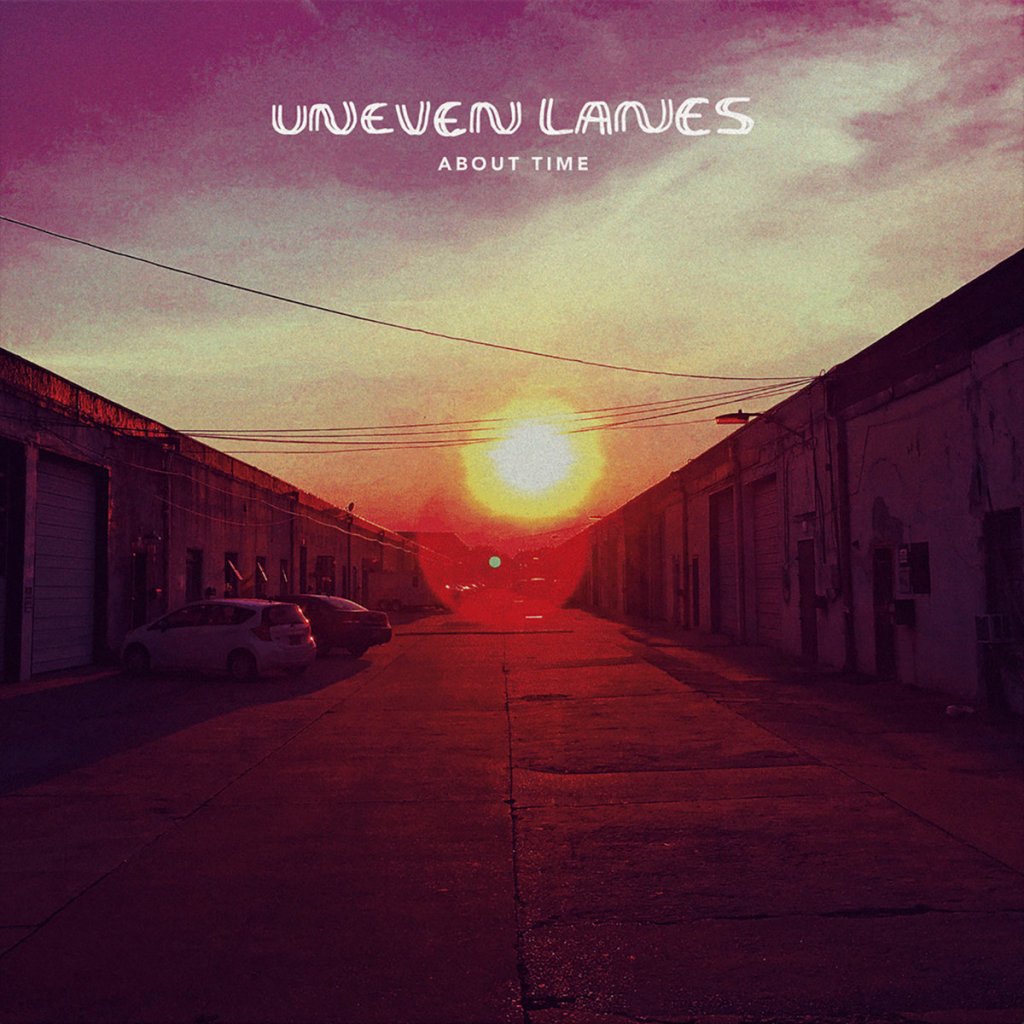
Uneven Lanes‘ debut LP, About Time, gathers up three years of songs that have amassed in the margins after Lloyd Benjamin’s time spent playing guitar and singing with various punk and indie rock outfits, including All Night Drug Prowling Wolves, Affection, and more. He’s also currently playing with Scratch Offs and Air Rights.
Each of the album’s lo-fi, salt-of-the-earth numbers are rich in melody and distortion, capturing the essence of a new, post-pandemic Americana that recalls the fractured indie rock sensibilities and songwriting of Guided By Voices, Pavement, and R. Stevie Moore.
Benjamin wrote, played, and recorded everything heard throughout on the album.
Live, the lineup is filled out by Greg Stevens on drums and Tony Kerr on bass, performing Sun., Oct. 2 for Elmyr’s 25th Anniversary party, on Sat., Nov. 5 at Sarbez! in Saint Augustine, and on Thurs., Dec. 8 at Whitewater Tavern in Little Rock, the latter of which is Benjamin’s hometown, and the base of operations for the record’s label, Max Recordings.
BONUS! The LP comes packed with a full-color 16-page booklet featuring artwork by Benjamin. Get your ears, your eyes, and your hands on one.
If you have enjoyed reading this post, please consider making a donation to RadATL.
In April, grindcore outfit Clot unveiled a debut single, titled “Cerebral Calamity,” via Earache Records Distribution.
In 2016, vocalist Christian Perez, who also leads the fractured Americana group Hark, suffered a stroke at the young age of 24 — hence the name Clot. Soon after, his father was involved in a car accident that left him with permanent brain damage. Dealing with these experiences opened up wholly new dimensions of music for Perez and bandmate Yasin Knapp (of math rock outfit Things Amazing, and atmospheric rockers Of The Vine) as a means of finding balance, context, and possibly resolution. Perez writes the lyrics and sings, while Knapp handles the musical arrangements, steeped in a hissing atmosphere of high-speed rhythms, and distortion. Drummer Cameron Austin (Apostle, Of The Vine) unleashes an avalanche of blast beats, pushing the music deeper into the maelstrom.
Bass player Parker Estopinal (of Kid Macho) and guitar player Daniel Weed (Holy Wound and Mannequin Grove) were recruited into Clot after these recordings were made.
Their latest single, “Casual Masochist,” expands upon these themes of real-time confrontation of grief, mortality, and emotional tumult. This time, songwriter and vocalist Perez channels feelings of utter contempt for organized religion and oppression — no matter what form it takes — into lyrics such as “Back up, you bastard. No gods, just masters. Skin stricken with pulsating blisters.”
“Casual Masochist” is a simple, powerful, death-afflicted dirge teeming with shades of grindcore touchstones (Full of Hell, Primitive Man, Old Man Gloom, and so on), but exists in a singularly miasmatic space. Press play below.
A new full-length album is in the works. Keep an ear out for a noiser, and more atmospheric approach with future offerings.
In the meantime, Clot plays Sabbath Brewing on Sun., June 12, with Iron Gag and Fox Wound. Catch them again on Thurs., June 30, When they play Eyedrum with For Your Health, askysoblack, and Royal Scam.
If you have enjoyed reading this post, please consider making a donation to RadATL.
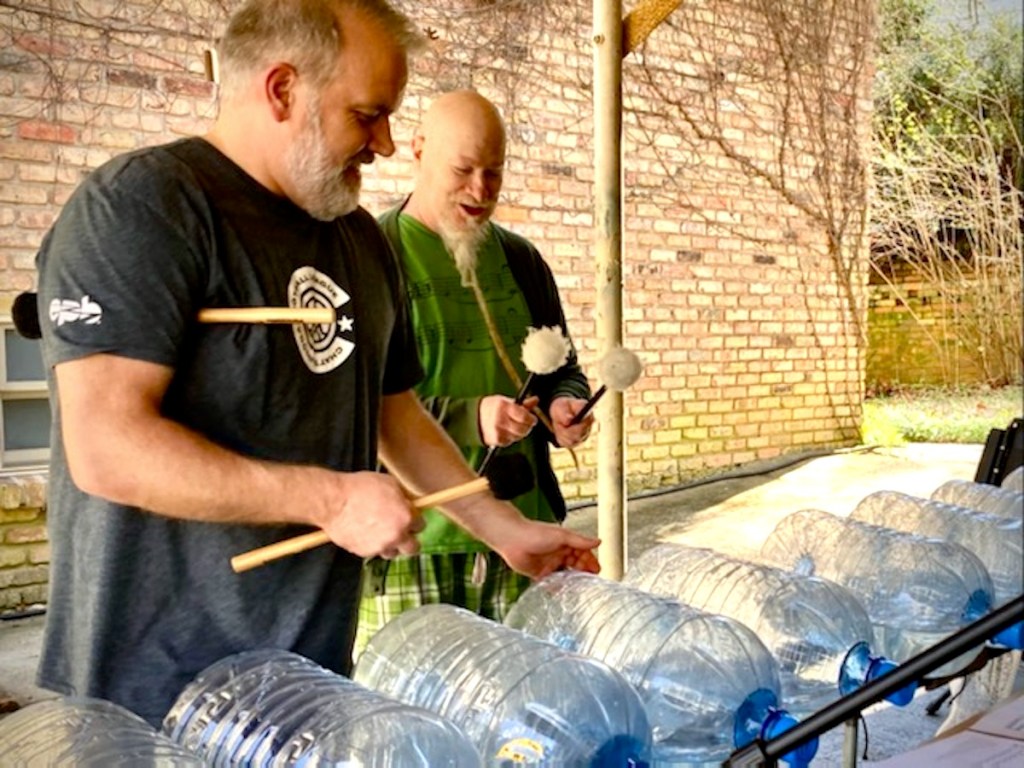
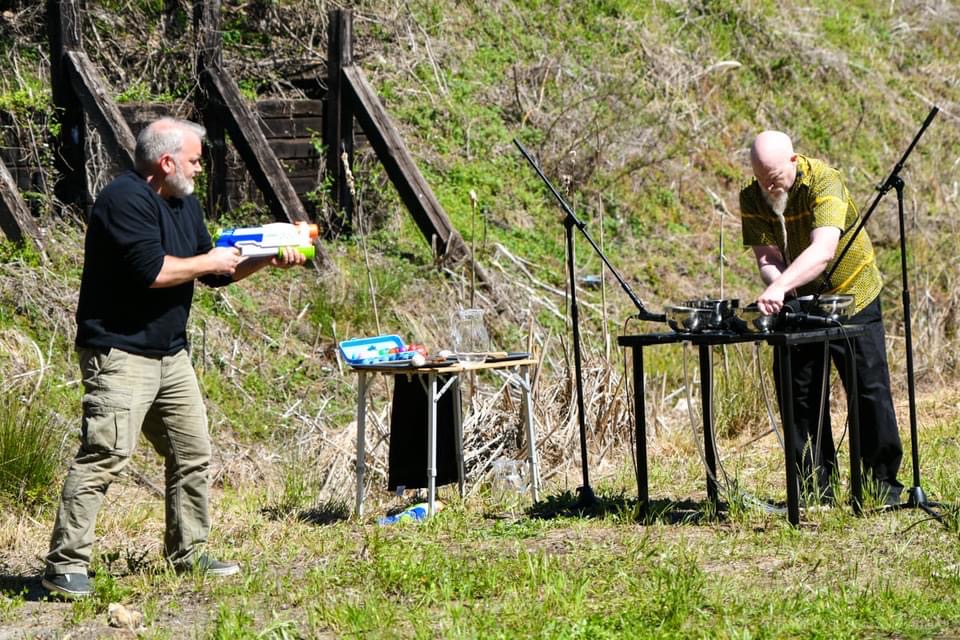
Stuart Gerber (left) and Klimchak. Photo courtesy Klimchak
Composer, percussionist, and longtime Atlanta sound sculptor Klimchak is bringing everything, including the kitchen sink, to the McDonough Tunnel on the Southside BeltLine on Sunday, May 15.
The performance, titled LeBeato Lounge: Water Wonderland, is part of the Art on the Atlanta BeltLine series, and will feature three water and percussion-based works performed live: “Waterphonics” and “Bowled Over,” both accompanied by GSU associate professor of percussion and founder of the new music ensemble Bent FrequencyStuart Gerber. A third piece, titled “When You Whistle, It’s Not Work,” will also be performed solely by Klimchak.
It will be an evening of deep listening and engaging rhythms, as both Klimchak and Gerber explore the vast and mysterious sonic qualities of the former train tunnel by way of various homemade percussion instruments, bows, electronic manipulations, bowls filled with various levels of water, and a working sink on a cart for a wet and wild journey into sound.
… And if you are a truly old school Atlanta music head, you’ll remember the tunnel from the freak-folk and noise shows that Matthew Proctor (Hubcap City, Pony Bones) organized there in the early aughts — when the BeltLine was a looming reality, the tunnel had train tracks running through it, and it was a fairly secluded location.













 Rad/ATL