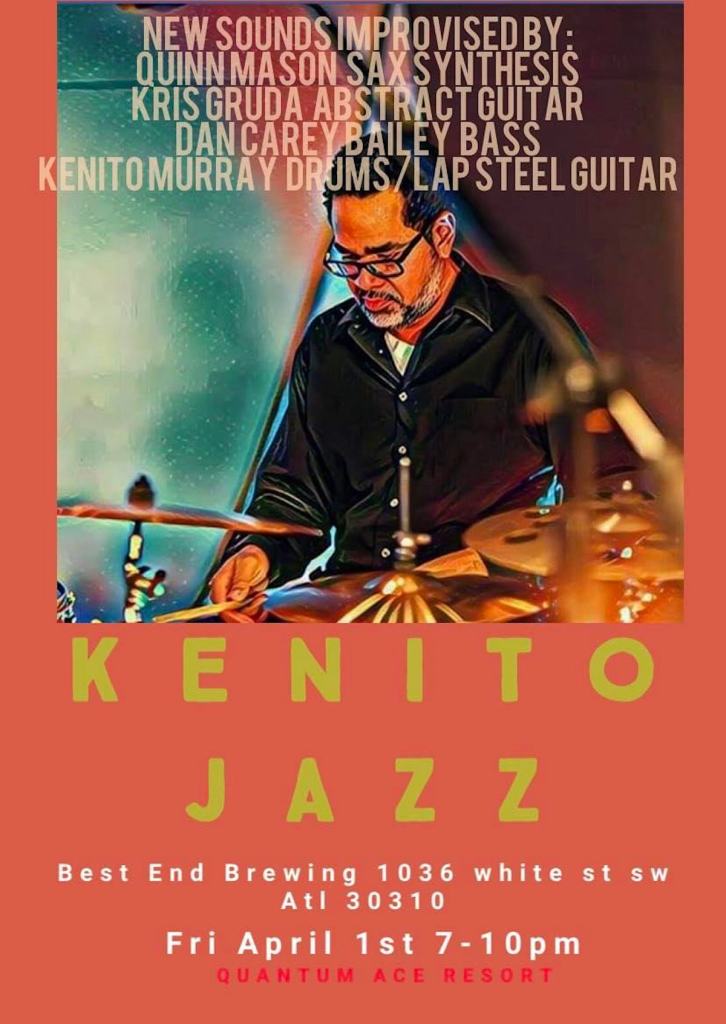
Kenito Murray leads an evening of improvisation at Best End Brewing Co. on Friday, April 1.
Percussionist Murray, along with Quinn Mason (tenor sax, keys), Kris Gruda (guitar), and Dan Carey Bailey (electric bass) will craft everything from trip hop and ambient sounds to jazz, Delta blues grooves, and dub beats.
Dan Carey Bailey (left) and Quinn Mason. Photo by Kenito Murray
Free. Music is live from 7-10 p.m. 1036 White St. SW (on the Westside BeltLine).
If you have enjoyed reading this post, please consider making a donation to RadATL.
After two years in the void, Emory University’s DIY fest returns on Thursday, April 7. Check out live music from Loony and the debut of El Matador (feat. Katy Graves from Catfight, Randy Gue of Final Offering, and Chris Pollette).
Stations will be set up for silkscreening T-shirts, making buttons, woodblock prints, learning how to write graffiti with Mad Clout, and more + Randy’s famous tower of pizza will be in full effect. Come hungry and pre game for the Spits show at the Earl later that night.
Free. 6:30-8:30 p.m. Emory’s Visual Arts Building and Campus Life Pavillion. 700 Peavine Creek Drive.Parking is available in the Peavine Parking Deck at 22 Eagle Row.
If you have enjoyed reading this post, please consider making a donation to RadATL.
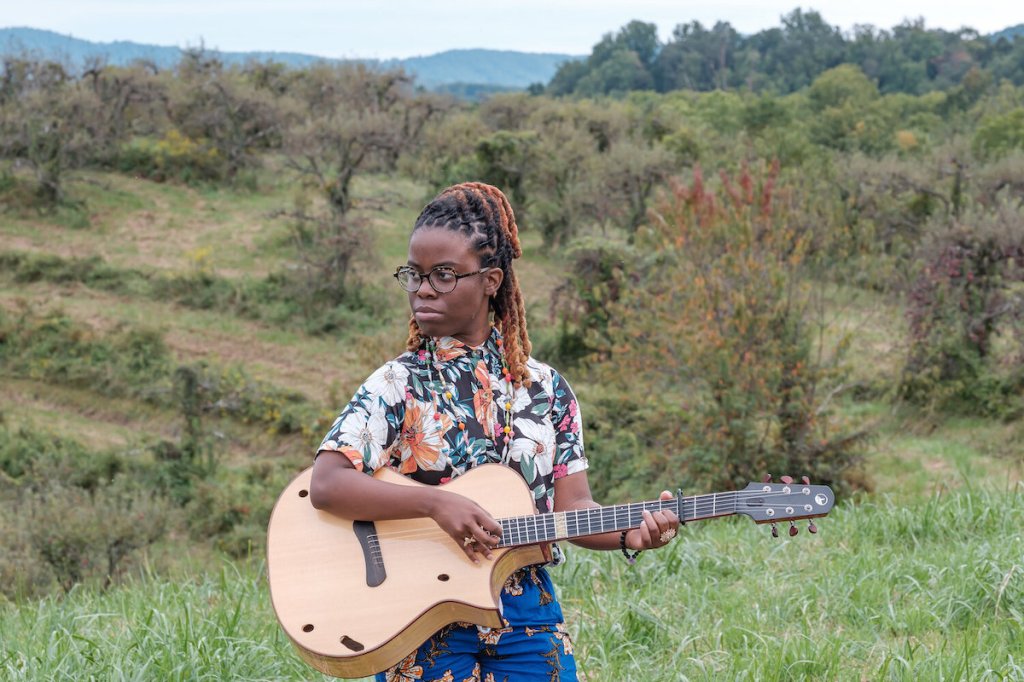
Woodbridge, Virginia native Yasmin Williams is a true innovator of acoustic music.
With her 2021 album, Urban Driftwood (Spinster), Williams fuses elements of traditional country and blues fingerpicking styles with jazz, hip-hop, and indie rock textures to weave a lush, sweet ambience. She plays the guitar almost like it’s a piano while tapping her feet on the floor to create percussive rhythms. Songs bearing titles such as “Through The Woods,” “Juvenescence,” and “Sundshowers” create a spacious atmosphere that’s filled with baroque melodies, giving nods to everyone from John Fahey to Alice Coltrane, while settling into a singularly modern and ethereal sound.
Kevn Kinney (left) and Clay Harper. Photo by Chad Radford
Since the early 1980s, Clay Harper and Kevn Kinney have left an indelible mark on Atlanta’s musical landscape. Harper first garnered significant attention as the voice behind the Coolies’ twisted and bombastic second album, 1988’s Doug: A Rock Opera And Comic Book. Over the years, he has released various collaborations with the likes of Wreckless Eric, Moe Tucker of the Velvet Underground, and Ian Dury. He’s also a co-owner of the Fellini’s Pizza and La Fonda Latina restaurant chains.
Over the years, Harper has rolled out a string of solo recordings leading up to his fifth and latest album, They’ll Never Miss A Five, a meticulously paced and quietly grand meditation on growing up near the Georgia and Alabama border.
Kinney, of course, is the frontman for Southern alternative rock juggernaut Drivin N Cryin. He has also released various solo recordings including his 1990 solo debut, MacDougal Blues, The Flower And The Knife (with the Allman Brothers’ guitarist Warren Haynes), and A Good Country Mile with The Golden Palominos.
Together, Harper and Kinney appeared on Not Dogs … Too Simple (A Tale of Two Kitties) and The Slippery Ballerina — both fall somewhere between children’s albums and rock operas. They also collaborated on the original score for a film that does not exist, titled Main Street.
After pairing up for a two-night stand at Gallery 378 in March, Harper and Kinney sat down to talk about their long history together.
Chad Radford: How did the two of you meet?
Clay Harper: We’ve known each other for at least 35 years — through Fellini’s, I guess.
Kevn Kinney: Fellini’s was the first restaurant I ever went to in Atlanta. I came to town in 1982. I was living on a campground in Marietta, in a trailer in someone’s backyard. We came into Atlanta and we were like “Fellini’s Pizza! That looks cool!” It was the first time I ever had pizza by the slice. Why would you want just a slice? In Wisconsin, where I’m from, everyone gets their own pie.
I’m actually one of the few people who never worked at Fellini’s.
CH: Tim Nielsen, Drivin N Cryin’s bass player worked there in the beginning. He was really good and competent. I always liked working with Tim.
When did you start playing music together?
KK: We haven’t ever played music together. Clay would give me some basic demo tracks and I would sing over them. Then when they came out there were all of these instruments and all of these people on them. I didn’t know Moe Tucker was going to be on Not Dogs. And I didn’t know Ian Dury would be on there.
CH: Ian did his parts in London. He already had cancer. And Slippery Ballerina had Ian and Wreckless Eric.
I remember when we were on the way to Ian’s to record. Eric was late, his car was fucking up and running out of gas, and I had him pull over because I had a full on panic attack. We stopped into a pub and the Stranglers were playing there that night. I really wanted to stay for the show!
You mentioned Main Street, which is a soundtrack to a film that doesn’t exist.
CH: When I was a kid, I listened to things like How The West Was Won, and sometimes they had little snippets of dialogue. So I wanted to do a record like that, but there was no movie. I liked the idea of “the original soundtrack” and “motion picture” — I liked using those words. Then I wrote these songs that sort of fit together. You think there must be a story there, but really I was interested in working with Kevn on something that was different for both of us. At that time I wasn’t that far removed from the Coolies, and it was so loud. This was a different story.
KK: We were both getting divorced at the same time, so we were commiserating and we were both staying at the same broken down hotel, the Biltmore Hotel, when it was like a ghost town. They had like eight rooms open.
CH: Kevn got divorced a little before me. So when I had to leave my house and go stay in a hotel, not only did Kevn recommend the Biltmore, he recommended the room with the best water pressure in the shower.
I remember one day seeing Kevin walking down Ponce de Leon, so I picked him up and said “What are you doing?” He said he was getting married the next day, so we went and had a little bachelor party, just me and him!
KK: He took me to the Clermont Lounge at 3 o’clock in the afternoon.
That was the bachelor party.
Kevn, I recently found a CD by your late ’70s/early ‘80s Milwaukee punk band, the Prosecutors.
KK: [He looks at the CD.] Look how cute I was!
That cover photo was taken at a little basement club called The Starship. Everybody played there: X played there, we opened for the Ventures there. It was only there for a few years. That stage is actually where Liberace started, back when it used to be a steak joint. One night, maybe on the night of this photo, Frank Zappa walked in and sat at the bar. There were like four people there that night.
I don’t know if the Prosecutors ever played for more than like 12 people. And that was usually other musicians who were also playing that night [laughs].
Let’s talk about the artwork for They’ll Never Miss A Five. My mind starts connecting the dots when I look at it … The ice machine is a nice touch.
CH: I asked Kosmo Vinyl to do the artwork. He asked, “Is it another record about a fucked up America?”
I said, “Yes, it is.”
There’s a line where I sing, “I found myself in Phoenix, Arizona living next to an ice machine.” I was remembering some shit hotels where I’d stayed, and he picked up on that. He also picked up on another song that says, “She looked up at the clock and said, ‘oh boy.’” He loves lyrics, and he picked up on them.
What about the rest of the artwork?
CH: I’m not sure what in the Hell is going on there, but it’s his vision of a fucked up America, and I think it’s fantastic. It blew my mind when I saw it. He’s a serious artist, and he’s never done anything halfway.
You didn’t give him any other direction on the artwork?
No, you don’t give Kosmo direction, you’re just sorta grateful that he’s working with you.
The music feels like a bit of a departure for you? It is spacious, but also up front — I hear a bit of an Ozark Mountain folk music influence in there.
CH: You don’t want to just recreate what you’ve already done, right? Kevin’s got it right, he says it sounds like “crystal meth music” [laughs].
It reminds me of some Ozark music in how it’s spacious, almost folk music, and it feels like a more ethereal approach.
CH: I’m not quite sure what ethereal means.
I mean it has a rich atmosphere; the sounds are bright and up front, but there’s space between the sounds.
I look for as much space as possible, but I still try to find a groove. In some songs it’s there, and in some songs it’s just kind of implied.
KK: My brother Mick Kinney plays Fiddle and banjo on the record. He’s an established musician — playing music from a different era. He’s five years older than me.
CH: He got what I was going for. The space was premeditated, and I didn’t really have to tell him anything.
KK: Our great grandfather, or our grandfather’s uncle or brother, I don’t know … GC Kinny was a tent preacher in the Missouri area. I wonder if some of that Ozark Mountain sound creeped in through that.
I first noticed it with the album Bleak Beauty, which moves like the opening scene from The Godfather. It tells you right up front, this is going to take some time.
CH: I worked my way up to that, and I’ve been going in that direction. Having a studio in your house and being able to take as much time as I want with it is how I found what I was looking for
KK: And if I could interject, Clay will record an entire album. It’s done. Then he’ll scrap it and start over from scratch.
CH: It’s kind of like a puzzle. Kevn has heard an earlier incarnation of almost every song on the album that’s been recorded and re-recorded and changed. Then I’ll go with the lyrics and a melody, and it just doesn’t sit right when I try to mix it. Then I’ll take it out and find what does sit right. Then I’ll start over again.
KK: It’s something you wish you could do, but you can’t do it with a rock band when you have a record deal. You wind up with an albatros — that one record where the drums were done a month ago. It’s not mixed, and it’s not working. It becomes the song that nobody likes, and you’re never gonna play it live. It could have been great, if only you could go back and record it again.
Have you considered that? Cheetah Chrome did that with the Dead Boys’ Young Loud and Snotty. He took “Hey Little Girl” off of the record entirely. He said he hated that song, and it was never supposed to have been on the record.
KK: If I could actually stop writing I would do that. I have wanted to re-record Fly Me Courageous because it has that ‘80s production. It says “play loud” because you have to … The quieter you play it, the worse it sounds. It sounded great on the radio because they compress it and match it with everything else.
I have never seen Fly Me Courageous on vinyl.
It came out on vinyl with a white sleeve only with a sticker. I drew all of the covers. It’s a very limited edition of maybe 200 of them. I had about 50 of them but I think someone found my storage locker. All of a sudden I was like, “Where are all of my CDs?” Then they all showed up for sale online.
CH: I have listened to Kevn’s upcoming album a million times, and it’s great. You shouldn’t do anything but move forward with that record.
KK: It’s called Think About It. It has two versions of “Think About It,” and neither one has anything to do with the other. It’s gonna come out someday. The first side was recorded three Januarys ago, right before the pandemic started in March. I recorded with Kevin Scott, Darren Stanley, and Peter Buck. We cut a lot of it in Athens over four days, then the pandemic hit. I finished it myself using Brad Morgan from the Drive By Truckers.
I’m singing very low, very quiet, and there’s a lot of spoken word on it.
You’ve been doing spoken word for a long time. There’s a spoken word piece on the Prosecutors CD.
KK: I just read that here in the liner notes, and I’m like, “What is that?” My friend Clancy Carroll put that out on Splunge Communications, Inc. He’s one of the only guys who’s trying to preserve Milwaukee music. One of the reasons that I like to put a lot of stuff out is because I’ve run into people who had a punk band in the ’70s/’80s, they made records, and they’ve got the tapes, but they won’t let you listen to them because they think someone will come along and pay them $20,000. But it’s just gonna wind up in a Goodwill someday. Just let us hear it.
There are so many great freaking records underneath people’s beds. Clancy has wrestled some great stuff away for that label.
My new record definitely has a side one and a side two side. Side one is Kevin Scott, me, and Darren Stanley. Side two is me, David Barbe, and Laur Joamets.The string section will make you laugh and it will make me cry. It’s Kevn Kenny, but presented in a different way.
Peter Buck plays his original R.E.M. Rickenbacker on it. He also does some e-bow stuff and puts a lot of atmosphere on the record.
Tommy Dean from Thermos Greenwood plays bass on Clay’s new record.
CH: I really love that guy, and to me, that’s what the record is about, being Southern. He’s a Southern gentleman. Super talented, super gracious, and has a style that’s halfway between upright and electric.
Can we talk about the song called “One More Lie And Cry About Everything?”
CH: That’s one of my favorite songs on the record, and it really means the most to me. And it has a big, heavy hip-hop beat that’s implied.
That’s one of the songs that I scrapped completely at least three times, and then recorded it again with a completely different set of lyrics and a different melody, and decided I didn’t like it and started over and found this version.
It means so much to me because I stuck with it enough to find it. I didn’t give up on it, so it’s like the dog that got away in the campground in Colorado and somehow made its way back home.
I like the song “They’ll Never Miss A Five” as well. When I was 16 years old, I worked at a Magic Market in Newnan, Georgia. The songs is loosely about a woman who worked there with me.
She was a victim of smalltown, Georgia, and she got through it the best she could. We worked in a Magic Market — later called Quickie Food Store. The song starts off: “She was selling head and day-old bread,” and that’s exactly what she was doing.
I was a drunk kid,16 at most, and I worked at several Quickies. They’d just leave you in there alone all day and then threaten you with inventory. It was a vague threat, like inventory is gonna show everything I’ve done, and all of my shoplifting is gonna come to light, and my manager would walk in with the cops.
The song is about that. “I ain’t lived this life to be some nobody’s ex-wife.” That’s her. “I’m gonna take what mama leaves and I’ll be gone.” It’s an endless, fruitless struggle to escape your shit reality in a convenience store in Noonan, Georgia.
So “They’ll Never Miss A Five” is about stealing a $5 dollar bill from the register.
She stole five bucks, and she figured they’ll never miss a $5. She skimmed a bit. I went a little further.
Kevn Kinney (left) and Clay Harper. Photo by Chad Radford
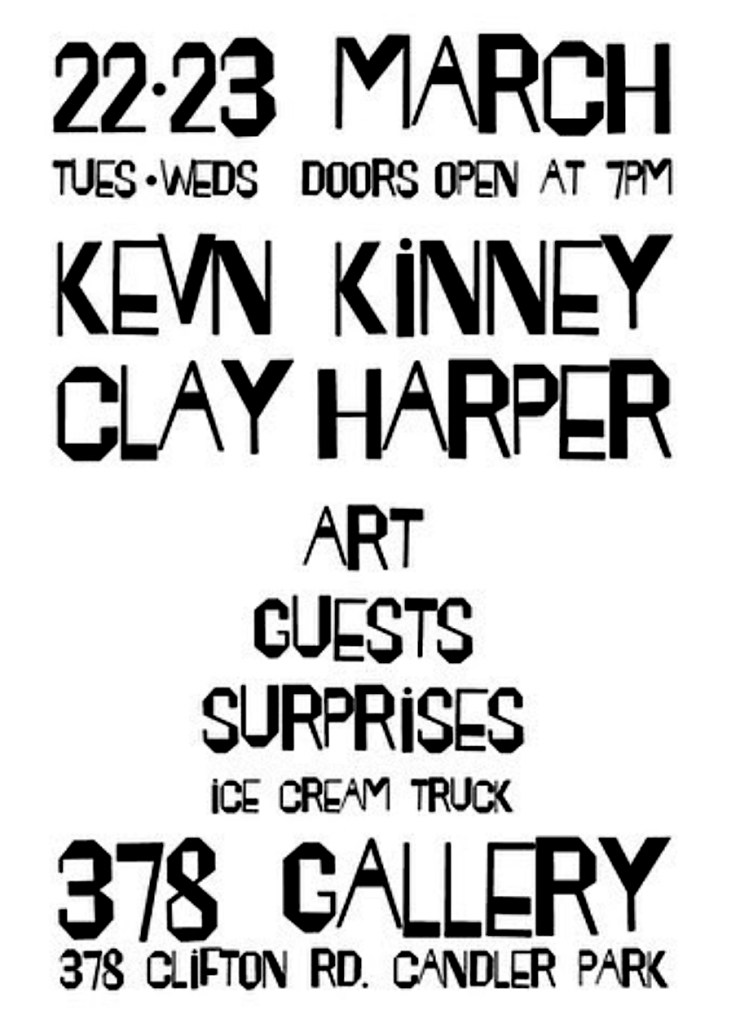
On Tuesday, March 22 and Wednesday, March23, Kevn Kinney and Clay Harper will co-headline two nights of music, art, and conversation at Gallery 378, pushing beyond what a traditional live show experience can be.
On both nights, Clay Harper will be joined on stage by long-time collaborators Marshall Ruffin (guitarist and vocalist) and Chris Case (keys). On Wednesday night they’ll be joined by Mark Harper (guitar) and Alex McGill (drums) to perform a handful of songs from They’ll Never Miss A Five, a meticulously paced and quietly grand meditation on growing up near the Georgia and Alabama border.
Kevn Kinney will be accompanied by keyboard player Billy Fields (W8ing4UFOs, Lynx Deluxe, Antagonizers ATL) for a set of spoken-word performances, improvisation, and songs that aren’t typical of Kevn’s solo shows.
Tuesday, March 22
6:30-7:30 p.m. Ice cream truck 7 p.m. Doors open Visual art in the gallery curated by Tom Patterson: “New Lamps For Old,” art from early ‘80s Atlanta: 7:30-8 p.m. Richard Taylor, Anger Management Consultant 8:10-8:40 p.m. Artifactual String Unit 8:45-9:15 p.m. Clay Harper 9:15-9:25 p.m. Dramatic performance by Dennis Coburn 9:25-10 p.m. Kevn Kinney
Wednesday, March 23
6:30-7:30 p.m. Ice Cream Truck 7 p.m. Doors open Visual art in the gallery curated by Tom Patterson: “New Lamps For Old,” art from early ‘80s Atlanta: 7:30- 8 p.m. Meet The Convicts pt. II “When Criminals Are Criminalized,” with Daniel Kane 8:10-8:40 p.m. Clay Reed (of the Subsonics) 8:45-9:15 p.m. Clay Harper & friends 9:15-9:20 p.m. Tap dancing by the queen of L5P 9:20-10 p.m. Kevn Kinney
If you have enjoyed reading this post, please consider making a donation to RadATL.
Circle Jerks: Zander Schloss (left), Greg Hetson, Keith Morris, and Joey Castillo. Photo by Atiba Jefferson
Southern California hardcore punk icons Circle Jerks are celebrating the 40th anniversaries of their first two albums, Group Sex and Wild In the Streets — both albums were recently reissued by Trust Records.
On Friday, July 22, the group’s current tour with 7 Seconds and Negative Approach stops at the Masquerade, marking the Circle Jerks first Atlanta show in over 16 years. Before heading out, vocalist Keith Morris took a few minutes to talk about revisiting the songs, drummer Joey Castillo playing them even fast, and what’s in store with his other band, Off!
Chad Radford: Have you had any new realizations about the Circle Jerks songs now that you’re singing them again after so many years?
Sometimes I question some of the lyrics. Why did I write that?
I wrote “Paid Vacation” about Vietnam. When I graduated from high school, I was almost 17 and-a-half. You don’t get drafted until you’re 18. I’d go to parties and at the end of the night the police would be outside questioning all the guys: “How old are you? Have you registered for the draft? I had a handful of friends spend the weekend in jail because they hadn’t registered.
When they filled out your paperwork in jail they automatically registered you for the draft.
I had a few friends that went to Canada. I had a few friends that actually went to Vietnam. I was fortunate because the draft ended maybe six months after I graduated.
One day, my dad said: “You’re not going to Vietnam, are you?” My dad was a staunch Republican. I don’t know if he was “a bomb those fuckers into oblivion” Republican, but he was a Republican on a business level. We didn’t converse much. He was basically telling me, “If I was your age, I wouldn’t register for the draft. I wouldn’t go to Vietnam.” Maybe my dad had the wherewithal to understand what was going on at the time.
It doesn’t matter if it’s a Republican or a Democrat in office. I think there’s a scenario where the incoming president gets pulled aside by all of the military and mighty industrialists who say, “You’re gonna continue doing what your predecessor did, who continued doing what the president before him did, just like the president before him. You’re gonna keep greasing our wheels. You’re gonna keep making us bigger and fatter and even more horrible than what we are right now. If you go against us, we, along with the CIA, will do to you the same thing that we did to JFK.
So, I look at “Paid Vacation” and think to myself, that is still as relevant today as it was when I wrote it.
The last time that you and I spoke was when I was writing a story about Bob Glassley (R.I.P.) who had recently revived his old band the Cheifs, with an all new lineup.
Yes, that’s when they came out here and played some shows. It was great seeing Bob. And that band was great. No one can ever take anything away from them. They had their shit together, musically speaking, and it was totally happening.
You know, Bob apologized to me, and I said, “Bob, it is not necessary.”
Why did he apologize to you?
At one point there was competition between our bands. I know there’s not supposed to be competition amongst us. We’re all supposed to be supportive of each other, unless you’re a dick. We could say it was a friendly competition, but at times it was a competition. And he apologized to me stating: “We were all friends. We were all growing up together. We were all drinking beer together, going to shows, and hanging out. For us to be snobby and say, “We were here before you. We should be playing before the headliners instead of you. And just all of that kind of stuff. … It never mattered to me. We’re just supposed to be alive and excited about it, and we’re supposed to be happy that we’re playing, and we don’t care where we are on the bill.
Just hanging out with Bob was great.
But he apologized and was so cool about the whole thing, and it was totally unnecessary. We were younger, and we were all aggressive and overly excited about some of these things.
What has playing with drummer Joey Castillo brought out of the Circle Jerks?
We wouldn’t be the band that we’re supposed to be if we didn’t have him adding his energy. He wants to play the songs even faster than what we’re playing them, and it’s like, come on Joey! We’re older guys!
Sometimes I find myself trying to catch up with my lyrics, which I don’t mind because it’s like a train coming down the tracks and it’s rambling and shaking and it’s gonna jump the rails. There should be a sense of danger with punk rock. There’s chaos, and that’s good.
Our bass player Zander will say, “This song has to groove, the bass and the kick pedal need to be doing the same thing.” But I’m like, “You figure that out.” I can’t worry about stuff like that. I’m 66 years old, and I’m gonna have points in the set where I need to take a break to catch my breath and have a couple of swigs of water.
Joey brings something that’s much needed, and he loves us! He grew up with us, he’s in South Bay, a couple of cities east of where Greg Hetson grew up in Hawthorne. He knows our songs better than we do.
He asked, “Do you want me to play the song the way that Lucky Lehrer played it on the first album, or do you want me to play it how Kevin Fitzgerald played it? It’s like, wow, thank you for doing your homework.
At this point, you’ve also logged a ton of hours playing shows with Negative Approach on this tour.
Yeah, and the John Brannon scenario: He comes out on stage, and all he wants to do is sandblast your face off, and make your ears bleed. They do an amazing version of Sham 69’s “Borstal Breakout.”
I saw the show at the 40 Watt in Athens — and I’ve seen Negative Approach every chance that I get — his scowl, when he looks at the crowd … Who know what kind of primal rage he’s gonna bring out of the person standing next to you? But at the end of the night, when he is at the merch table, he’s like the nicest guy on the planet.
He’s working class sweetheart. And when they come out on these tours — they’ve also toured with Off! — they, they can’t be a nicer group of guys. They can’t be more appreciative. Their whole outlook is like: We are honored to be able to do this, and it keeps us busy. We’re working and we’re doing something that we wanna do.
What’s the latest with Off!?
Off! is releasing our new album in September. We’ve recorded all of the songs, and for me it sounds amazing. We’re stepping out of our punk rock and hardcore box to do something different that’s gonna make the cavemen of our genre say, “I don’t like this. They’re not supposed to do this.”
Are you taking a more avant-garde approach with the songs?
We listened to a lot of Throbbing Gristle, Hunting Lodge, Can, Einstürzende Neubauten, Herbie Hancock’s Head Hunters, Miles Davis. We spent time with a character named Enid Snarb who was in Bastard Noise and Man Is the Bastard. He turned us on to some of George Harrison’s work after he visited India.
Our engineer mixer guy worked with Kyuss and he mixed over half of Spiritualized’s Ladies and Gentlemen We’re Floating In Space. We went to a lot of different places, rather than the Bad Brains, Blue Öyster Cult, and Stiff Little Fingers.
Autry Fulbright is playing bass, and he co-manages Thundercat. Our drummer Justin Brown plays drums with Thundercat, so now we’ve got a jazz drummer playing rock, and you’ll hear it. There are times when he’s all over the place, and we really have to pay attention to what he’s doing to play what we’re playing.
If your mind is free enough, and you’re able to see all of the different colors that we’re using, you’ll get it. There’ll be a lot of people that don’t, but we have no control over that.
What’s the label experience like now that Circle Jerks are working with Trust Records vs. what you experienced with record labels in the ‘80s?
The scenario with Trust is that we love them. Have you seen the Group Sex reissue?
Yes, I have a copy that came with the zine signed by you and Greg.
They’re willing to go to that length, where a lot of record labels won’t. Their sales pitch was: “We’re willing to bet that your royalties from all of the recorded work with all of those labels is probably so minimal that you could hold it in one hand. We want to change that.” They gave us an advance that was beyond ridiculous for a band of our stature.
They’ve been on time and they’ve done everything. The Wild In the Streets reissue is just as cool as the Group Sex reissue, and that’s one of the reasons why we’re playing shows. It was originally to celebrate the 40th anniversary of Group Sex. Now we’re also celebrating the 40th anniversary of Wild In the Streets.
As for all the labels we were on in the ‘80s, it was all a crapshoot. We weren’t getting hit up by any major labels, and being opportunistic, when somebody makes you an offer you could sit around with your thumb up your ass waiting to hear what the other offers will be. But your thumb could be up your ass for quite a while. We dealt with some really cool people and we dealt with some really horrible people. I could get into details, but I won’t because I don’t believe that any of these labels exist anymore.
Gang of Four drummer Hugo Burnham recalls reading a quote from his former bandmate, guitarist Andy Gill some years ago. Burnham had parted ways with the group in 1982, only to return for a brief stint between 2004 and 2006.
Fast forward to 2012 — Gill and Gang of Four vocalist Jon King announced that they would no longer work together, leaving Gill as the only remaining original member still performing with the iconic Leeds, U.K. post-punk outfit.
During an interview around that time, a writer asked Gill about moving forward with a new lineup. His reply, as Burnham recalls, was that Gang of Four is more than a band, it’s an attitude and it’s about ideas. “I don’t even need to be in the band for it to be Gang of Four,” Gill told the writer.
“I had never really thought about what that meant,” Burnham says.
Gill died suddenly in February of 2020. Since then, the gravity of his words has taken on new depth for Burnham, as he reconnects with the band’s legacy, and its incendiary attitude and ideas.
A recently released box set, titled 77-81 (Matador) makes clear its assertion that despite nearly 40 years spent releasing dozens of albums, Gang of Four turned out its most commanding works between 1977 and 1981. Those first five years encompass the group’s first three albums: Entertainment!, Solid Gold, and Songs of the Free. Throughout each of these albums, Burnham, King, Gill, and bass player Dave Allen — the latter of whom was replaced by Sara Lee for Songs of the Free — crafted terse anthems that sharpen their teeth and claws on everything from Marxist philosophy and the dangers of materialism to the trappings of love and maximum entropy.
Songs bearing titles such as “To Hell With Poverty,” “Not Great Men,” “Damaged Goods,” and “I Love A Man In A Uniform” are propelled by muscular rhythms, avant-garde grooves, and the jagged energy and freedom that their British punk rock forefathers in the Clash and the Sex Pistols had exposed.
Alongside British counterparts such as the band Wire, and American band Mission of Burma, Gang of Four’s first three albums have come to define the post-punk canon.
Following Gill’s death, Burnham and King have reconvened under Gang of Four’s banner to bring the group back to the stage. But who could fill Gill’s shoes playing guitar and bring the songs back to life?
They had their eye on a handful of potential candidates. Marissa Paternoster of New Brunswick, NJ trio Screaming Females was in the running, but the pandemic complicated the group’s early efforts. Then, in the midst of their search for Gang of Four’s next guitar player, Burnham’s friend Patrick Ferguson, a drummer with Athens, GA’s indie rock band 5/8, got in touch.
Ferguson hosts the Crash and Ride podcast, which had recently featured David Pajo as a guest. “Patrick said, ‘My god, I’ve just interviewed David Pajo!’ I hope that David forgives me for this, but I said, ‘Who’s that?’” Burnham laughs. “‘Cause you know, he’s a youngster!”
Pajo’s resume boasts of playing and writing with dozens of seminal early ‘90s indie rock luminaries such as Slint, Papa M, The For Carnation, Tortoise, Stereolab, and dozens of other acts.
“So I started digging and listening, and thought, oh god, this guy is good,” Burnham says.
As a founding member of Slint, Pajo is aligned with the early beginnings of math rock in the ‘90s. Semantics aside, his musical DNA blends quite well with Gang of Four’s rigid, angular songwriting style.
Ferguson introduced them to each other via email. After exchanging a few messages, Pajo recorded videos of himself playing guitar along to three of the group’s signature numbers, “Natural’s Not In It,” “To Hell With Poverty,” and “What We All Want.”
“It was chronically, cripplingly obvious that this was the only choice to make,” Burnham says. “We really didn’t want to have just another boring or predictable old white guy in the band,” he adds. “David is neither boring, nor predictable.”
Pajo instinctively adapted to Gill’s percussive style, and how the guitar parts intertwined with the group’s fast-paced rhythmic presence. “He was digging deep into the recordings, alternate versions, and different live things, trying to get [Andy]’s take on everything,” Burnham says. “I said, great! Learn the songs as [Andy] would play them, but make them your own. We are not a Gang of Four tribute band,” he stresses. “This is Gang of Four, here and now. David is in the band, and it’s as simple as that.”
Burnham, King, and Pajo were in place, but bass player Dave Allen opted out of rejoining the group for a round of North American tour dates.
Former bass player Sara Lee was the obvious choice to complete the lineup. After leaving Gang of Four circa ‘84, Lee had gone on to perform as a member of Robert Fripp’s band the League of Gentlemen, and has played with everyone from Robyn Hitchcock to the Thompson Twins, as well as with Georgia acts, the B-52’s and the Indigo Girls. Her 2000 solo debut, Make It Beautiful, was also released by Ani DiFrancos’ Righteous Babe label.
“When I called Sara, I didn’t quite know how to get to the point. Finally she says, ‘I’ve been sitting here on the phone, waiting for you to ask me if I’ll play!” Burnham laughs.
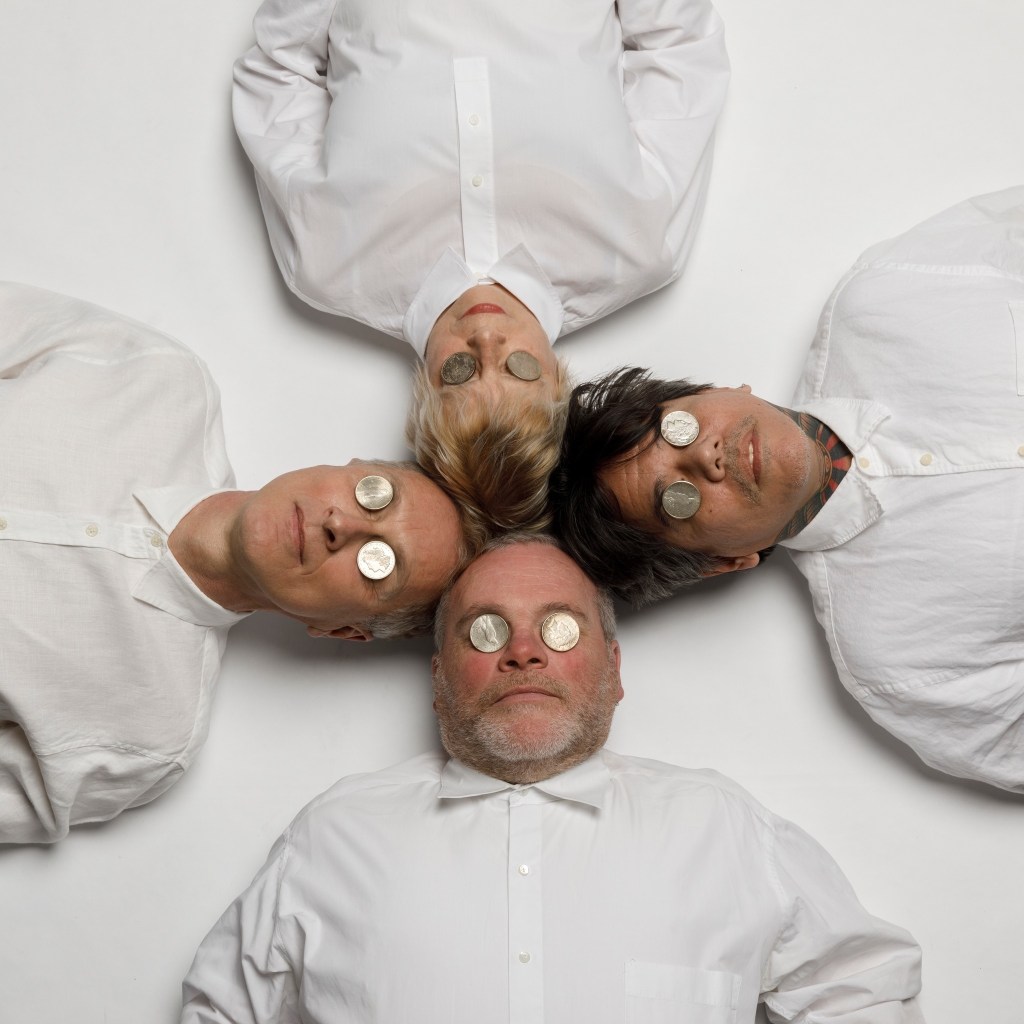
Gang of Four. Clockwise from top left, Jon King, Sara Lee, Hugo Burnham, and David Pajo.
With Lee in place, Gang of Four took on a new configuration, and started breathing new life into the music. On their current tour, the group is sticking mostly to the classic material from those first three albums, but they’ll pull out a few numbers from later albums as well, including “I Parade Myself” from ‘95’s Shrinkwrapped LP. “We’re not being assholic about any of this,” Burnham says, “We’re playing that song because it’s such a great song. But there is such a breadth of stuff that we can dive into from those first three albums, which is more like ‘77-’83.”
The million dollar question: Will Gang of Four record new material with its new lineup? Burnham pauses with a sheepish, tight-lipped smile before joking that for a million dollars he’d record with any lineup. “I hate to hyperbolise, but this has been a lot of fun,” he says. “There is no stress, no anger, no overwhelming control issues. David is a versatile and disciplined player who has done seriously great work leading up to joining us,” he adds. “It would be silly not to make the most of this lineup, even if it’s just for ourselves. We’re not kidding ourselves into thinking that the world is waiting for new stuff — but we’re waiting for it.”










 Rad/ATL