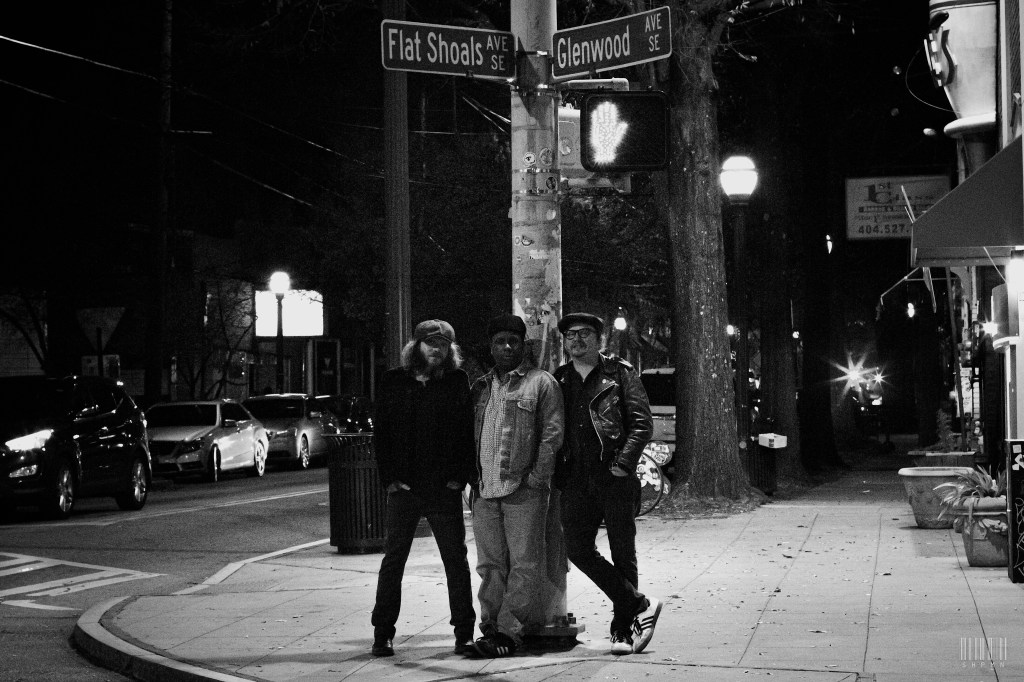
On Friday, July 10, Kevn Kinney of Drivin N Cryin plays “Free Parking: Stay-cation,” the latest installment of his live-streaming solo performances on Facebook. Kevn will play some Drivin N Cryin classics and deep cuts along with some newer numbers he’s written. He’ll tell stories, tell jokes, and he might even offer up a few cover tunes. It’s a pay-what-you’d-like affair. Tune in from 8-11 p.m.
In the meantime, press play below to hear Chad Radford’s April 2019 podcast interview in which Kinney talks about reconnecting with Drivin N Cryin’s first LP, the group’s most recent album, Live the Love Beautiful, and looking within himself to find true happiness.
Gallery 992‘s Sunday night free improv jams are back!
For the time being, every Sunday evening from 6-10 p.m., the weekly jam has moved just a few doors down to the lot near the corner of Ralph David Abernathy Blvd. and Peeples Street, where there’s plenty of space to get spaced out. Under the direction of alto saxophone player Quinn Mason and percussionist Dallas Dawson, an assemblage of the city’s finest players lock into each other for a massive and seemingly telepathic group improv blast before opening up the stage. They’ll play for as long as the law allows—the noise ordinance kicks in at 10 p.m.
In this new, temporary outdoor setting, the weekly jam has taken on a whole new vibe, summoning a rejuvenated sense of community spirit in the West End. These performances are about catharsis, purgation, and finding mental and spiritual balance in the shadow of a world in turmoil.
Witnessing so much energy, and engaging with live music on such visceral and cerebral levels, after so many months spent in lock down is a powerful and emotionally riveting experience that’s not to be taken lightly—you need it more than you know.
Bring a lawn chair—it’s outside, but wearing a mask and maintaining that six-feet of social distance makes everyone feel a safer, and little more comfortable.
EUCLID CREEPERS: The Young Antiques are Blake Parris (left), John Speaks, and Blake Rainey. Photo by Jeff Shipman.
Young Antiques are at it again. Longtime friends and songwriting cohorts Blake Rainey and Blake Parris have convened with drummer John Speaks to craft Another Risk Of The Heart (Southern Lovers Recording Company), a new eight-song LP that’s teeming with phantasmal Southern power pop and rock ‘n’ roll storytelling.
Another Risk Of The Heart is the Atlanta trio’s first offering in nearly a decade, and it’s what Rainey calls “a love letter to the band.” Songs with titles such as “Euclid Creeper,” “Armies In The Alley,” and “’92”reaffirm the power and allure of the group’s hook-laden legacy. Guest appearances from Atlanta-rooted voices such as Kelly Hogan, Chris Lopez of the Rock*A*Teens, and Tom Cheshire, expand the group’s repertoire, while keeping each song planted firmly in the Atlanta music mythos. Rainey took a few minutes to talk more about the album.
“Euclid Creeper” feels like a powerful statement coming right out of the gate on this album. What did you have in mind when you wrote the song, and why you put this one front and center?
“Euclid Creeper” is about the band in our early days—roaming around Little Five Points and EAV bars and drinking and partying and “looking for a little light” outside of this neighborhood-rat existence, all of which kind of felt like living in a coal mine at times. It’s also about a return to form and doing this rock ‘n’ roll band again—albeit a little bit differently this time around.
I see Blake Rainey and His Demons’ 2016 LP Helicopter Rose as an homage to your early years spent growing up in rural Georgia, and the new Young Antiques LP, Another Risk Of The Heart, as a nod to your time in the city—Cabbagetown specifically. Are there parallels between these two records?
Personally, the parallel that I see between Helicopter Rose and Another Risk of the Heart is that both mark a turning point in my songwriting, as far as attention to detail and quality goes. I was proud of Rose at the time more than anything else that I had previously done, even though I could see its flaws like most of my albums. When I finished Risk however, and when we got the track listing in order, it was like nothing I’d ever accomplished before. It was quintessential ‘Tiques, in a nutshell, and to me the quality was steady from beginning to end, the band’s performances were much more together this time around, and with Risk I think we really hit on a formula for all of three us—John Speaks, Blake Parris, and myself. And today, we are already starting work on the next album.
When listening to your records, and even now, thinking about the stories and characters in your songs, my mind starts pulling threads about the landscape, neighborhoods, and how you fit into the environment. When you’re crafting songs do you feel particularly inspired by your surroundings?
I do. I can definitely look at something like an old run down building or a dirt road and think about what sound might accompany it. It’s an interesting thing to think about—writing music to describe something visually inspiring—like walking down the sidewalk and seeing a church steeple showing through branches in a winter sky. What does that sound like? Or noticing an old man on a park bench with a sack of beer at 9 a.m. These type of things can definitely help me paint a vivid picture in a song.
Tell me about the title, Another Risk of the Heart, and what it means to you?
On the surface, the title, Another Risk of the Heart, is akin to what Soundtrack To Tear Us Apart (the previous ‘Tiques album) was like: a description of where the band is or was at the moment. The overall theme of this album is a love letter to the band, like, “here we go again…” We’re here, giving this thing another shot. Getting back together, doing what we do best—having fun, making records.
And how about the songwriting that’s on display here; is there one song on the album that resonates with where you are right now?
“Questions” is my favorite song on the album, and with all of the frustration and fear that we have going on with authority figures at this very moment, it definitely resonates to me the most. The opening line is, “Yesterday I woke at dawn/With the police on my lawn/Never had they stayed so long until today.”
Even before the pandemic or the protests, it was the song that somehow brought everything together on the album and kept the pace where it should be. So far, it’s been one of the more overlooked tunes on the record, but I like how it serves a deep cut purpose. It’s also set in a quasi sci-fi future like “Armies In The Alley” is, and it’s a sister song to that one in many ways. There’s an authoritarian bent to both in the lines about showing your papers and your government tattoo and hiding out in cinemas from the authorities and all that. There’s also another cinema reference in “’92,” which is another favorite of mine. It’s a young love song set in 1992 about two high school misfits falling for each other over cigarettes and the cinema and skateboards.
YOUNG ANTIQUES. Photo by Jeff Shipman.
Tell me about “Armies In The Alley.”
That one definitely feels Orwellian. A “lovely liberal in a dress” is new to town and is taken to the boulevard, even though it’s a risky move. The narrator is drawn to her because she is “without that fascist look.” The couple ducks in and out of alleys and the cinema to escape the oppressive authority outside—both literally and figuratively—while smoking and getting lost in film. To me it seems very close to reality or a past reality—just on the edge of science fiction. It also feels a little like what parts of Europe might have been like at times during WWII.
In the past, when writing about Young Antiques, I’ve dropped comparisons to Paul Westerberg and the Replacements. Over time, however, that seems like a pretty one-dimensional comparison. Who are some other songwriters that have influenced your writing and outlook on music?
I’m a big Replacements fan, no doubt, but I’m also a pretty big fan of rock ‘n’ roll and popular music in general. Right now, all I pretty much listen to is American jazz from the 1950s and ’60s. As far as songwriters go, I’m influenced by quite a few: Dylan, Ray Davies, Neil Young, Van Morrison, Jagger/Richards, Lou Reed, Elvis Costello, Strummer/Jones, Tom Waits, Bob Mould … I’m well versed in just about everything those guys have done. I’m leaving out a few, I’m sure.
How did you select the guests who appear on the album? Did you write songs with them in mind and approach them, or was it a more natural process?
John Speaks had been in the Jody Grind with Kelly Hogan and he was also old friends from that same era with Chris Lopez from Rock*A*Teens. Parris and I have known Tom Cheshire for years; he’s an old friend and a bandmate of mine (in the All Night Drug Prowling Wolves). So everyone involved is family in one way or another. I told Speaks, “We need a female singer on Goin’ Home.” He said, “Kelly Hogan.” I was like, perfect! We wanted gang backing vocals on “Euclid Creeper,” so I brought in Tom and Speaks brought in Lopez. I am a big fan of much of Chris’ songwriting, so that was extra special for me.
Chris and Tom came in separately and hung out all night and drank beer and sang their respective parts. It was amazing. Kelly had to do her part remotely in Wisconsin and the first time we heard her performances sent via the internet, we were like “Fuck. This is really good!”
Also, can you tell me what recording with this core lineup of you and Blake Parris teaming up with drummer John Speaks revealed about the songs or the chemistry that you share? I know that you and Blake have been working together since grade school. John, is someone who’s played shows with you, but hasn’t been in the studio with you, at least not for many years.
John is the drummer for the Young Antiques—no question about it. He joined the band in 2001-2003 and we recorded Clockworker with him and toured the Midwest to Chicago and the East Coast to NYC. That was the best time we’d had with any one drummer. When John left, we worked with another drummer, Kevin Charney, for a couple of albums before fizzling out. I moved on with two more solo albums with His Demons (Love Don’t Cross Me and Helicopter Rose). That band consisted of Joe Foy, Eric Young, and Aaron Mason (Nikki Speake and the Phantom Callers). Parris was performing with Volume IV and a variety of other bands around the city at that time. After that, John came into Boutique Guitar Exchange where I was working at the time and basically said, “You wanna get the band back together?” and Parris and I decided a reunion sounded like the right thing to do. So I put down the new solo material I was working on and started writing what would eventually become Another Risk Of The Heart.
I had no idea how comfortable or interesting we would sound when we got together. The time we spent bonding and performing in the early 2000’s has definitely played a big role in our overall chemistry today—plus we’re all better musicians individually at this point in our lives. It was the best decision we could have made.
On Friday, June 26, Kevn Kinney of Drivin N Cryin plays “Free Parking” episode 5, the latest installment of his live-streaming solo set on Facebook. Kevn will play some Drivin N Cryin classics and deep cuts along with some newer numbers he’s written. He’ll tell stories, tell jokes, and he might even offer up a few cover tunes. It’s a pay-what-you’d-like affair. Tune in from 8-11 p.m.
In the meantime, press play below to hear Chad Radford’s April 2019 podcast interview in which Kinney talks about reconnecting with Drivin N Cryin’s first LP, the group’s most recent album, Live the Love Beautiful, and looking within himself to find true happiness.
Speaking truth to power has been standard operating procedure for Public Enemy since the group released its 1987 debut single, featuring classic cuts “You’re Gonna Get Yours,” “Rebel Without A Pause,” and “Miuzi Weighs A Ton.” Coming out of the gate strong amid the Reagan era, spouting Black outrage and ultra-political lyrical brilliance: “From a rebel it’s final on black vinyl / Soul, rock ‘n’ roll comin’ like a rhino,” Public Enemy made civil disobedience their calling card—their vocation.
Now, some 33 years later, the United States’ presidential administration goose-steps deeper into an Orwellian nightmare every day. The seemingly endless COVID-19 pandemic has killed nearly double the number of Americans who died as a result of the VietNam War. The streets in every major city are alive with fiery protests over police brutality. “The Terrordome” has come to your home.
The group’s co-founding vocalists, frontman Chuck D and hype man Flavor Flav, backed by powerhouse DJ Lord have risen again from the smoke and ash of so much turmoil with “State of the Union (STFU),” a new song and video that jump-starts Public Enemy’s timeless charge. When Chuck D raps, “History’s a mystery if y’all ain’t learning / End this clown show for real a state bozo / Nazi cult 45 Gestapo,” his intentions are made blisteringly clear. Now is the time to fight harder than ever against the forces of racism, tyranny, and oppression. “The rest of the planet is on our side,” Chuck says. “But it’s not enough to talk about change. You have to show up and demand change. Folks gotta vote like their lives depend on it, ’cause [they do].”
Invoking the power of the voting booth is an unexpected move in an era where the electoral system appears to have been hijacked; everyone from Russian President Vladimir Putin to Georgia Governor Brian Kemp have thrown wrenches into the gears at the poll booth. But the system is good and worth fighting for. It’s how laws are passed, and without it the Republic is lost. “Better rock that vote or vote for hell,” Chuck D raps as the song plays out.
Chuck and Flavor’s matter-of-fact delivery is particularly haunting in “State of the Union.” There is no joy when Flavor Flav delivers his repeating mantra: “State of the union, shut the fuck up / Sorry Ass mother fucker, stay away from me.” Chuck’s counter rhyme, “Vote this joke out or die trying,” is a no BS assessment from the weary but empowered outfit. The energy is propelled forward by DJ Lord’s spectral boom-bap rhythms and DJ Premiere’s bold, old school production. The cumulative experience and wisdom of Public Enemy’s decades-long legacy of navigating media pitfalls and broadcasting righteous sedition rings loud and clear under the hue of DJ Premiere’s modern sheen.
“State of the Union (STFU)” bears the marks of a more experienced outfit following P.E.’s 1980s peak when the group led the charge to “Fight the Power” in the streets of Brooklyn’s Bed-Stuy neighborhood, alongside hundreds—thousands of outraged New Yorkers. The instinct is there, sharper and more focused. Public Enemy has persevered in darkness amid eras of great change in the past. But when it comes to unfucking the world in this lifetime, the greatest obstacles lie ahead. STFU! Press play and let it ride.
On Friday, June 12, Kevn Kinney of Drivin N Cryin plays “Free Parking” episode 4, the latest installment of his live-streaming solo set on Facebook. Kevn will play some Drivin N Cryin classics and deep cuts along with some newer numbers he’s written. He’ll tell stories, tell jokes, and he might even offer up a few cover tunes. It’s a pay-what-you’d-like affair. Tune in from 8-11 p.m.
In the meantime, press play below to hear Chad Radford’s April 2019 podcast interview in which Kinney talks about reconnecting with Drivin N Cryin’s first LP, the group’s most recent album, Live the Love Beautiful, and looking within himself to find true happiness.
The Almost Live from Little Five Star Bar Sunday night special and Grand Old Quarantine Music Show hosted by the Honorable Ted Weldon returns June 14, featuring performances by Heather Luttrell & Possum Den, Joel Burkhart, Andrea & Mud, Nikki Speake, Cletis Reid, Jett Bryant, Jimmy Brad from Jimmy & the Teasers, the Tom Jersawitz Cocktail Minute, and more. The live stream starts at 6 p.m. on the Star Bar’s Facebook page.
On Friday, May 29, Kevn Kinney of Drivin N Cryin plays Free Parking episode 3, the third installment of his live-streaming solo set on Facebook. Kevn will play some Drivin N Cryin classics along with some newer numbers he’s written. He’ll tell stories, tell jokes, and he might even offer up a few cover tunes. It’s a pay-what-you’d-like affair. Tune in from 8-11 p.m.
In the meantime, press play below to hear Chad Radford’s April 2019 podcast interview in which Kinney talks about reconnecting with Drivin N Cryin’s first LP, the group’s most recent album, Live the Love Beautiful, and looking within himself to find true happiness.
DUET FOR THEREMIN AND LAP STEEL: Frank Schultz (left) and Scott Burland. Photo courtesy Terry Kearns.
In the visually stunning BBC One documentary series Planet Earth, Sir David Attenborough describes a mesmerizing scene in which underwater caverns play tricks on the eye. “What seems like air … isn’t. It’s just another kind of water,” Attenborough says as he describes a phenomenon called halocline, a point at which freshwater and saltwater clash, like oil and water, maintaining separate densities. It is rich fodder for the imagination, and the title of Duet For Theremin and Lap Steel’s latest album. Theremin player Scott Burland and Lap Steel player Frank Schultz are back with an eight-song masterpiece of haunting, luminous atmosphere.
In the Fall of 2019, a chance meeting—sharing the stage at Louisville, Kentucky’s Kaiju—with vocalist Dane Waters gave rise to a collaboration in which she weaves her voice into songs with titles such as “Maelstrom,” “Swell,” and “Fata Morgana.” The result draws out an unforeseen abstract aquatic theme pulled from the depths of the subconscious, manifesting itself in fluid musical movements.
On the heels of the album’s May 16 release, Burland and Schultz took a few minutes to talk about working with Dane Waters, what the music means to them, and letting the music drive the concept.
Halocline describes what happens when two bodies of water are separated because of different salinities. How does this apply to the record?
Frank Schultz: The music drove the concept, not the concept driving the music. I had been watching a lot of Blue Planet and Planet Earth in the evenings during the time I was starting to put the album together, and the music seemed a perfect fit to the many faces of water. Water is one of those weird things that you can’t live without, sometimes it’s hard to live with, and sometimes it’s a killer. The illusion of a halocline is beautiful, but can be very distracting and deadly.
Scott Burland: Naming albums and song titles has been a challenging—though fun—process for us over the years, and this time the whole concept fell into place once Frank mentioned halocline to me. The music on this album varies from murky to clear, sometimes even in the same song. To me, some of this music sounds like it was recorded underwater. Or lends itself to imagining oneself moving around surrounded by, or completely underwater.
How does this expand upon your body of work and everything that you’ve accomplished with your previous recordings?
FS: I think it is our best body of work so far. It has connections to previous work, but goes in several different directions.
Filmmaker Robbie Land’s video for the title track from DfTaLS’ latest album, Halocline.
What are these different directions in which you see the music going?
FS: As far as a long term direction, who knows. We play, the music comes out, we record it and put some of it out. There is no preconceived notion of a path or direction.
SB: I think it fits nicely into our larger body of work. When 10 came out, I remember feeling like there was a certain maturity in the music. That’s definitely true of Halocline. There are no gimmicks per sé, it’s just the instruments, filtered through our approaches, and voice. It stands on its own and it seems a logical extension to our arc. I’d add that the majority of the album is sonically abstract, though there are moments of familiarity and traditional structure, or at least our version of that.
FS: There are several moments in the album when everything falls into place and still gives me goosebumps. Favorite songs change over time, at least for me. Current faves are “Maelstrom” and “Dissolver,” but I have a crush on all of them.
SB: I’m a big fan of the title track. When I hear it, I think wow, we did that? I don’t have a clear memory of recording it, it was just some random Wednesday, early in 2019. I appreciate that I’m working with someone who I can collaborate on a piece such as this, with no road map, no clear beginning or end and listen back and agree, hey that’s not half bad. “Brinicle” is another favorite, it’s both still and in motion and I have at least a vague memory of recording that one!
What did performing with Dane Waters bring out of DfTaLS?
FS: We met Dane in Louisville when we shared the stage with her in 2019. We were both floored by her performance. Floored enough that the two of us agreed, without any hesitation, that we should meet with her the next day and ask her to be on the album. She said yes! We fleshed out around 18 songs, got them down to nine songs we agreed on, and sent her three of them to record vocals. We ended up using all the songs for which she contributed vocals. Of course, once I received her recordings, it affected how the songs were treated and mixed.
SB: After that Louisville gig, Frank and I were asking ourselves why we didn’t invite her to join us for our set. Second best was asking her to contribute to the record. I think she adds a human quality to the album which isn’t exactly lacking in our previous efforts, but it’s just more in the forefront here. She slipped right into the spirit of the thing, I liked the way her voice reacted harmonically to the theremin and I appreciate the thought that she put into it. We look forward to sharing a stage with her at some unknown point in the future.
DUET FOR THEREMIN AND LAP STEEL: Halocline
Collaborations can often underscore one artist’s vision, or open up to the whole group making room for happy accidents, so to speak. Be it Jeff Crompton’s contributions to “Absinthium” on 10, filmmaker Robbie Land’s visuals, or working with Bill Brovold, the Shaking Ray Levis, and more on your 2011 album, Collaborations. What are the benefits of bringing outside influences into the realm you’ve created with DfTaLS?
FS: Kind of two camps here: Crompton and Dane recorded their pieces after the fact, so not really anything that influenced our playing. Robbie—we never see his films while we are playing, so not much influence, although we love when it happens, we just feel better knowing it is there, as does the audience. The Collaborations album was the one where we did live recordings with all the folks. So we were all influencing each other. In general, we enjoy collaborating with folks because it tends to bear lovely fruit and furthers our musical relationship and connection with those folks. Improvising with new folks is a chance to open your ears and learn something.
SB: This is the first time we’ve collaborated with someone without being in the same room, so the rules were different. On paper, there’s an immediacy that’s missing but in this case I think Dane nailed it with the vocals, almost as if we had recorded it together. Frank and I know the limitations of DfTaLS and an advantage of bringing someone else in is that the other people don’t necessarily know or even want to know those limits. It offers a fresh perspective, which gives us “permission” to stray from our comfort zone. To say it breaks up the monotony seems a little harsh, but surprise is good and we’ve been doing this long enough that introducing something new and/or unexpected keeps the fire going.
FS: Collaborating is part of our nature.
SB: It seems that we are able to fit into a variety of sonic scenarios, so I would say that collaborations allow us to expand on what DfTaLS is, and a glimpse into what it might become, or could be. Having time these last couple of months to contemplate even my own relationship to music has been eye-opening. Trying to strip everything away and then slowly reintroduce things to see what resonates. It’s a process. It’s hard to imagine my life without DfTaLS, so I am trying to figure out what it really means to me, what it means to Atlanta, to the region, and beyond. So it’s difficult for me to articulate the true nature of DfTaLS. Still working on that.
Bob Glassley was a man out of time. He was a hardcore sleeper cell who reawakened in 2016 with the uncompromising spirit and forgotten insights of Los Angeles’ early ‘80s punk snarl…in Atlanta. And he arrived like a thief in the night.
James Joyce called me that summer to ask if I remembered or knew anything about an old punk band from California called the Cheifs. He explained to me that he had been tapped to play drums with a new version of the group and wanted to know if I was interested in doing a piece on them for Creative Loafing. It wasn’t long after that we were all gathered around a table at Manuel’s Tavern discussing the legend of the band, and listening to Bob’s stories about his involvement in the early West Coast hardcore punk scene. Absorbing so much Cheifs history and lore was like discovering another great band that had been there all along, albeit buried by the sands of time, now uncovered and brought into full view.
At the end of 1982 in a set of circumstances singular to Bob’s life, he stepped away from punk and playing music altogether. He traded his bass for a computer and never looked back. As a result, his knowledge and familiarity with punk was a perfectly preserved time capsule. It also fostered a beautiful state of arrested development; he knew West Coast punk circa 1978-1982, but nothing beyond that. However, he understood the art of the outsider, the art of being an individual driven by righteousness, and the self-reliance of punk before fashion and hairstyles eclipsed the lifestyle, and before mainstream attention introduced the elements of violence and intolerance that ultimately pulled the scene apart.
Bob’s return to music was a reaction to right-wing influences gaining a stranglehold on America. He took a no-bullshit political stance –– he was outspoken with his opinions, and punk gave him direction and purpose in the shadow of the Trump presidency. But Bob also projected a raw, down-to-earth wisdom, and a forgotten knowledge and etiquette that affected everyone with whom he crossed paths, from his bandmates to the faces in the crowd. While loading out after playing shows at The Earl and 529 in East Atlanta, he connected with homeless people who were asking for spare change. He treated everyone with dignity and respect.
With the new Cheifs lineup in place, the group gigged hard in Atlanta and eventually the Los Angeles area. Bob seemed to know, maybe subconsciously, that he didn’t have much time left on earth. Not wasting any time, the group played and recorded as quickly and as often as possible. Whenever Bob took the stage wearing a “We the People” T-shirt (brandishing an image of the Constitution of the United States), he embraced the audience, reveling in the moment and screaming defiantly into the void of mortality.
On Tuesday, October 17, 2017, Bob unexpectedly died of complications related to liver cancer. He had been diagnosed with the disease a mere two weeks prior. He was 58. The following Saturday the Cheifs were set to play a sold-out show at the Masquerade supporting the Descendents, a big coup for the new lineup. Just four nights after his death, the Descendents opened the show by unleashing the most powerfully cathartic blast of “Everything Sux” the group had ever performed.
During the encore, James, Brad, and Scott joined Milo and Karl on stage for one last send-off, playing four final Cheifs songs as a dedication to Bob, and to all that the new lineup had worked to create.
The four songs captured here are bookends to the Cheifs legacy. Both “1988” and “Heart In Chains” were originally written and performed by Bob’s pre-Cheifs band, Portland, Oregon’s Rubbers. On the B-side, “Alienated” is a new jam that Bob penned. Loosely based on a forgotten early Cheifs song, “Mechanical Man” was partially reconstructed from memory, and hammered into a new form by the current lineup.
The 7” single you now hold in your hands stamps in time the one-year period of intense creativity and rediscovery that Bob and the reignited Cheifs unleashed. The distillation of ’80s punk songwriting and hardcore’s graceful, physical melodies, filtered through a lens of contemporary production, is filled with a new fire and spirit, channeled into a lifetime of fierce, empowering, and truly timeless songs. Fuck cancer. Cheif Out! — Chad Radford