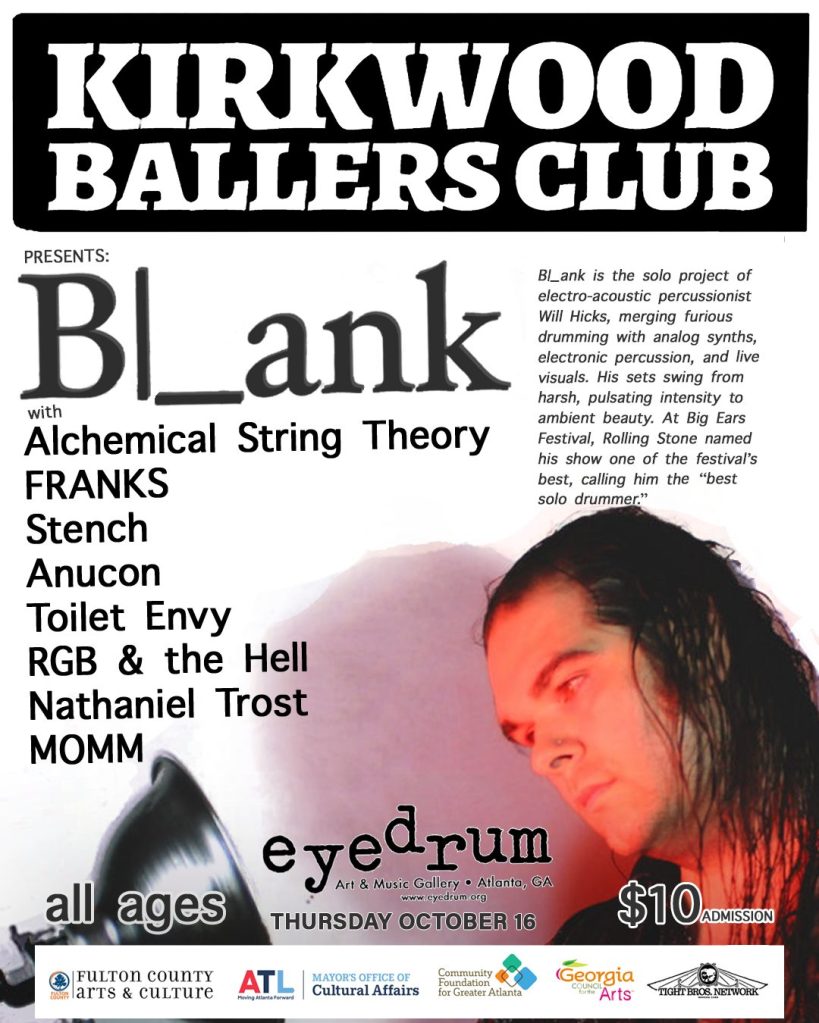
Every third Thursday of the month, Kirkwood Ballers Club takes over Eyedrum with an open forum for experimental, improvisational, and otherwise adventurous musicians and performance artists. It is the long-standing home to Atlanta’s avant-garde, experimental, and DIY musical underground. This month’s KBC takes place on Thursday, October 16. The lineup for the evening features a headlining performance by Bl_ank, the solo project of Portland Oregon’s electro-acoustic percussionist Will Hicks.
Alchemical String Theory, FRANKS atl, Stench, Anucon, Toilet Envy, RGB & the Hell, Nathaniel Trost, and Momm are also on the bill.
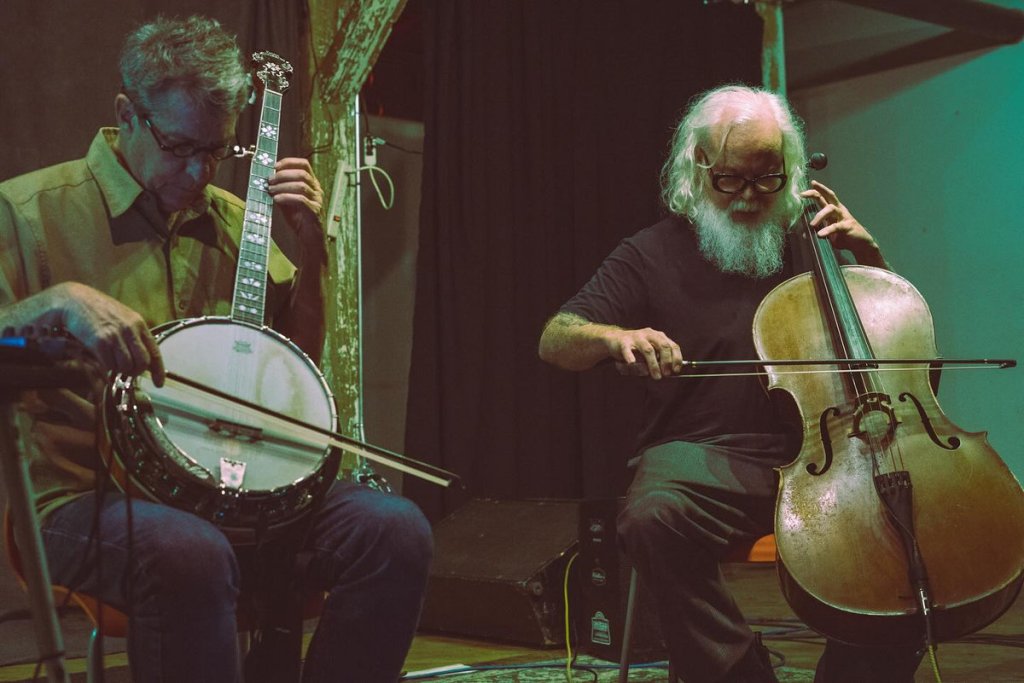
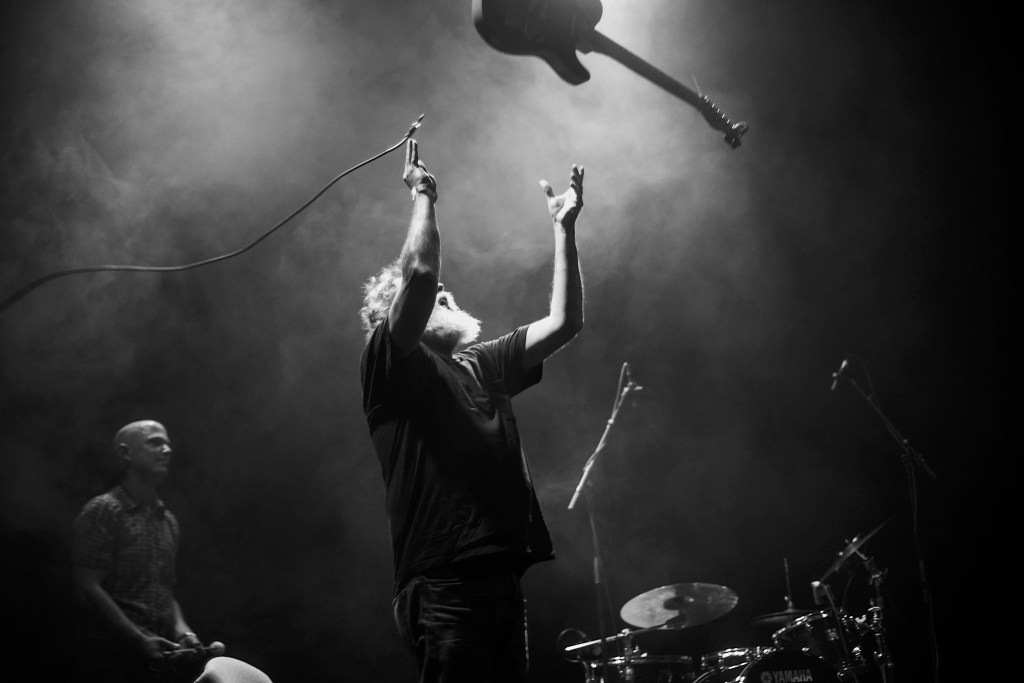
FRANKS atl. Photo by Ben Garden.
FRANKS atl, the two-piece collaboration featuring Frank Schultz (formerly of Duet For Theremin and Lap Steel) and B. Frank Holleran (W8ing4UFOs, ex-Smoke), are releasing a debut album, titled Ode to Lucenay’s Peter. They’re also hosting a Bandcamp release party on Oct. 19. Press play below for an enticing teaser of what they have in store.
Wisconsin-based percussionist and composer Jon Mueller brings a spectacle of rhythm and resonance to Eyedrum on Saturday, March 1, performing “All Colors Present,” a live “Sound + Visual Meditation” set to the works of photographer Tom Lecky.
Mueller is a master of the elemental—his approach to percussion is both physical and deeply hypnotic, an exploration of repetition, texture and atmospheric weight. Over the years, he has worked with avant-garde luminaries such as Z’ev, James Plotkin, Rhys Chatham, Volcano Choir, and Pele, forever pushing the boundaries of what percussion-based music can do. He is currently working on a recording for the formerly Atlanta-based drone, minimalism, and avant-garde label Table of the Elements.
For this performance, Mueller plays two drums, wielding a pulse and a shifting sonic landscape that unfolds to the tune of Lecky’s imagery.
Lecky’s work is a meditation in its own right. His photographs tap into memory, imagination, and perception, often weaving together his own words and images with found materials, forging an abstract narrative that exists in the liminal space between experience and recollection. All Colors Present creates a visual conversation with Mueller’s constantly evolving interplay, resulting in a performance that is as much a ritual as it is a concert, where repetition and movement pull the listener into an immersive space—both grounding and transcendent.
Ipek Eginli. Photo by Steve West.
Ipek Eginli is also performing Saturday night. Eginli is a Turkish-born Atlanta transplant who has established a formidable presence amid the city’s experimental musical enclaves as a pianist, electroacoustic sound artist, and improviser who describes her works as “a process of a creation and a creation of a process.” Her performances build upon elements of electroacoustic improvisation on piano, voice, and modular synthesizers. For this show, Eginli is taking a deep dive into drones, piano, and field recordings.
$10. 8:30-11 p.m. Eyedrum Art & Music Gallery. 515 Ralph David Abernathy SW. Buy tickets here.
If you have enjoyed reading this post, please consider donating to RadATL. Venmo to @Chad-Radford-6 or click on the PayPal link below.
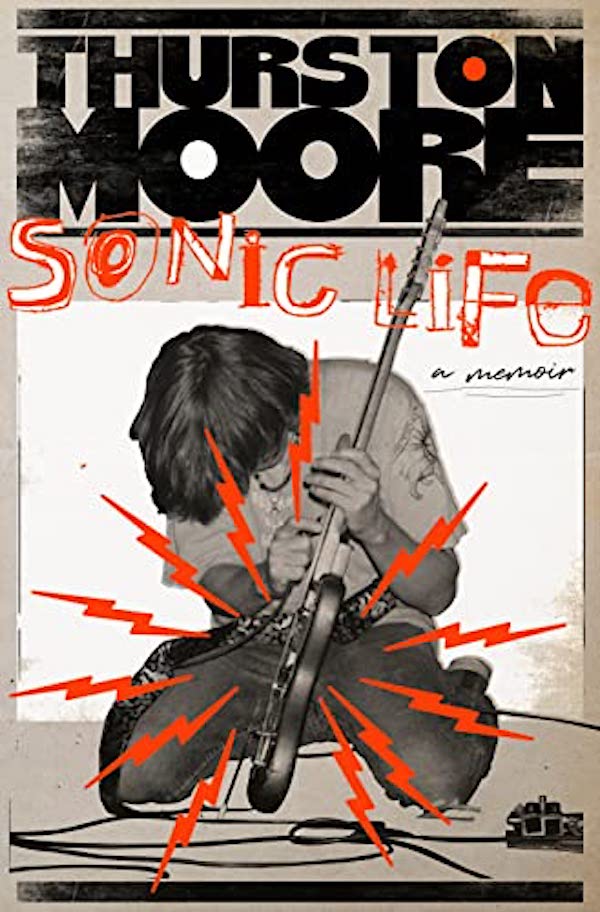
From the founding member of Sonic Youth, a passionate memoir tracing the author’s life and art—from his teen years as a music obsessive in small-town Connecticut, to the formation of his legendary rock group, to 30 years of creation, experimentation, and wonder.
Following the conversation, The Tara will host a screening of director Stuart Swezey’s documentary film, Desolation Center, featuring performances by Sonic Youth, Minutemen, Meat Puppets, Swans, Redd Kross, Einstürzende Neubauten, and more. Moore will introduce the film.
A note on the THREE types of tickets available for this event:
Book Talk Ticket Includes a signed paperback edition of Sonic Life and admission for the 7 p.m. book talk and signing. ($20 + tax)
Book Talk and Movie Ticket Includes a signed paperback edition of Sonic Life, admission for the 7 p.m. book talk and signing, and the 8:30 p.m. screening of Desolation Center. ($36 + tax)
Movie Ticket Admission to the 8:30 p.m. screening of Desolation Center. ($16 + tax)
About the Book Thurston Moore moved to Manhattan’s East Village in 1978 with a yearning for music. He wanted to be immersed in downtown New York’s sights and sounds—the feral energy of its nightclubs, the angular roar of its bands, the magnetic personalities within its orbit. But more than anything, he wanted to make music—to create indelible sounds that would move, provoke, and inspire.
His dream came to life in 1981 with the formation of Sonic Youth, a band Moore co-founded with Kim Gordon and Lee Ranaldo. Sonic Youth became a fixture in New York’s burgeoning No Wave scene—an avant-garde collision of art and sound, poetry and punk. The band would evolve from critical darlings to commercial heavyweights, headlining festivals around the globe while helping introduce listeners to such artists as Nirvana, Hole, and Pavement and playing alongside such icons as Neil Young and Iggy Pop. Through it all, Moore maintained an unwavering love of music: the new, the unheralded, the challenging, the irresistible.
In the spirit of Just Kids, Sonic Life offers a window into the trajectory of a celebrated artist and a tribute to an era of explosive creativity. It presents a firsthand account of New York in a defining cultural moment, a history of alternative rock as it was birthed and came to dominate airwaves, and a love letter to music, whatever the form. This is a story for anyone who has ever felt touched by sound—who knows the way the right song at the right moment can change the course of a life.
About the Author Thurston Moore is a founding member of Sonic Youth, a band born in New York in 1981 that spent 30 years at the vanguard of alternative rock, influencing and inspiring such acts as Nirvana, Pavement, the Yeah Yeah Yeahs, My Bloody Valentine, and Beck. The band’s album Daydream Nation was chosen by the Library of Congress for historical preservation in the National Recording Registry in 2006. Moore is involved in publishing and poetry and teaches at the Summer Writing Workshop at Naropa University in Boulder, Colorado. He divides his time between the USA and England.
About the Film Desolation Center is the previously untold story of a series of early ’80s guerrilla music and art performance happenings in Southern California that are recognized to have inspired Burning Man, Lollapalooza, and Coachella, collective experiences that have become key elements of popular culture in the 21st century. The feature documentary splices interviews and rare performance footage of Sonic Youth, Minutemen, Meat Puppets, Swans, Redd Kross, Einstürzende Neubauten, Survival Research Laboratories, Savage Republic and more, documenting a time when pushing the boundaries of music, art, and performance felt almost like an unspoken obligation.
Directed by Stuart Swezey, the creator and principal organizer of these unique events, Desolation Center demonstrates how the risky, and at times even reckless, actions of a few outsiders can unintentionally lead to seismic cultural shifts. Combining Swezey’s exclusive access to never-before-seen archival video, live audio recordings, and stills woven together with new cinematically shot interviews, verité footage and animated sequences, Desolation Center captures the spirit of the turbulent times from which these events emerged.
If you have enjoyed reading this post, please consider making a donation to RadATL. Venmo to @Chad-Radford-6 or click on the Paypal link below.
Mike Baggetta (left) & Peter DiStefano. Photo by Dan Jones
Mike Baggetta of MSSV teams up with Porno For Pyros’ Peter DiStefano for a duo performance blending together improvisation, some new compositions, and a few cover tunes in a set of dueling guitars and voices.
They’ve been on the road together for the “Punk Jazz 2024 Tour” since the beginning of August, working out material for a new album they’re recording at PULP Arts in Gainesville, FL the night before making their way to Atlanta.
For this second leg of the tour, Baggetta and DiStefano will show off some of the new material they’ve worked up while out on the road. They’ll roll out a Porno For Pyros song or two, and they’ll even play some newer MSSV songs that are coming together for an upcoming third album due out in the Spring of 2025.
CANCELED: This live appearance has been canceled, but you can hear Thurston Moore’s interview with Chad Radford on 90.1 FM/WABE’s “City Lights” on Monday, October 30 at 11 a.m. and again at 8 p.m.
From the founding member of Sonic Youth, a passionate memoir tracing the author’s life and art—from his teen years as a music obsessive in small-town Connecticut, to the formation of his legendary rock group, to 30 years of creation, experimentation, and wonder.
A Cappella Books welcomes Thurston Moore to The Plaza Theatre to discuss his new book, Sonic Life: A Memoir, on Monday, October 30, at 7 p.m. Moore will speak with your truly, Chad Radford, music journalist and author of Atlanta Record Stores: An Oral History. Moore will also perform a short musical set.
Following the conversation, The Plaza will host a screening of director Stuart Swezey’s documentary, Desolation Center, featuring performances by Sonic Youth, Minutemen, Meat Puppets, Swans, Redd Kross, Einstürzende Neubauten, and more. Moore will introduce the film.
A note on the THREE types of tickets available for this event:
Book Talk Ticket: Includes a pre-signed copy of Sonic Life + admission for the 7 p.m. book talk. ($35+tax).
Book Talk and Movie Ticket: Includes a pre-signed copy of Sonic Life + admission for the 7 p.m. book talk, and the 8:30 p.m. screening of Desolation Center. ($45+tax).
Movie Ticket: Admission to the 8:30 p.m. screening of Desolation Center. ($20 + tax)
About the Book Thurston Moore moved to Manhattan’s East Village in 1978 with a yearning for music. He wanted to be immersed in downtown New York’s sights and sounds—the feral energy of its nightclubs, the angular roar of its bands, the magnetic personalities within its orbit. But more than anything, he wanted to make music—to create indelible sounds that would move, provoke, and inspire.
His dream came to life in 1981 with the formation of Sonic Youth, a band Moore co-founded with Kim Gordon and Lee Ranaldo. Sonic Youth became a fixture in New York’s burgeoning No Wave scene—an avant-garde collision of art and sound, poetry and punk. The band would evolve from critical darlings to commercial heavyweights, headlining festivals around the globe while helping introduce listeners to such artists as Nirvana, Hole, and Pavement and playing alongside such icons as Neil Young and Iggy Pop. Through it all, Moore maintained an unwavering love of music: the new, the unheralded, the challenging, the irresistible.
In the spirit of Just Kids, Sonic Life offers a window into the trajectory of a celebrated artist and a tribute to an era of explosive creativity. It presents a firsthand account of New York in a defining cultural moment, a history of alternative rock as it was birthed and came to dominate airwaves, and a love letter to music, whatever the form. This is a story for anyone who has ever felt touched by sound—who knows the way the right song at the right moment can change the course of a life.
About the Author Thurston Moore is a founding member of Sonic Youth, a band born in New York in 1981 that spent 30 years at the vanguard of alternative rock, influencing and inspiring such acts as Nirvana, Pavement, the Yeah Yeah Yeahs, My Bloody Valentine, and Beck. The band’s album Daydream Nation was chosen by the Library of Congress for historical preservation in the National Recording Registry in 2006. Moore is involved in publishing and poetry and teaches at the Summer Writing Workshop at Naropa University in Boulder, Colorado. He divides his time between the USA and England.
About the Film Desolation Center is the previously untold story of a series of early ’80s guerrilla music and art performance happenings in Southern California that are recognized to have inspired Burning Man, Lollapalooza, and Coachella, collective experiences that have become key elements of popular culture in the 21st century. The feature documentary splices interviews and rare performance footage of Sonic Youth, Minutemen, Meat Puppets, Swans, Redd Kross, Einstürzende Neubauten, Survival Research Laboratories, Savage Republic and more, documenting a time when pushing the boundaries of music, art, and performance felt almost like an unspoken obligation.
Directed by Stuart Swezey, the creator and principal organizer of these unique events, Desolation Center demonstrates how the risky, and at times even reckless, actions of a few outsiders can unintentionally lead to seismic cultural shifts. Combining Swezey’s exclusive access to never-before-seen archival video, live audio recordings, and stills woven together with new cinematically shot interviews, verité footage and animated sequences, Desolation Center captures the spirit of the turbulent times from which these events emerged.
If you have enjoyed reading this post, please consider making a donation to RadATL. Venmo to @Chad-Radford-6 or click on the Paypal link below.
THE EDGEWOOD SAX TRIO: Ben Davis (from left), Jeff Crompton, and Bill Nittler. Photo by Jeff Crompton.
In December of 2022, the passing of baritone saxophonist Bill Nittler left a hole in the heart of Atlanta’s extended musical family.
As a tribute, his former Edgewood Saxophone Trio bandmates Jeff Crompton (alto) and Ben Davis (tenor) have launched a Gofundme campaign to release the group’s second full-length album, Heard.
Over the years, Nittler served as the Education Director for the Atlanta Young Singers youth choir. He also played a vital role performing with various jazz-based ensembles including Kingsized, Greasepaint, Nuzion Big Band, Lie And Swell, the 4th Ward Afro Klezmer Orchestra, Shaking Ray Levis, and more. He performed with Southern Culture on the Skids, and was known for crafting a bustling ska arrangement of Thelonious Monk’s “’Round Midnight” and an avant-garde take on the Butthole Surfers’ already twisted number “Cherub.”
Heard is the follow up to the Edgewood Sax Trio’s 2014 debut, Snake Nation, and marks the group’s final offering, which is expected to arrive this summer.
“I spent hours editing the existing studio material for side one of the LP,” says alto saxophonist and EST co-founder Jeff Crompton. “Some high-quality recordings from a live broadcast on Atlanta radio station WREK provided three of the tracks on side two. The final track is a special one—a live recording from our favorite gig ever: a 2015 concert at Atlanta’s Trinity House. The recordings have been expertly mastered by Chris Griffin of Griffin Mastering.”
Fresh off of releasing his brilliant 2022 album Music For Four Guitars (Palilalia), punk-blues and no wave-inspired improv guitarist Bill Orcutt returns to play a solo set at Eyedrum Art & Music Gallery on Sunday, February 19.
Eyedrum Art & Music Gallery has announced a new location opening in early 2021 at 515 Ralph David Abernathy Blvd., in a historic industrial corridor near the West End, Pittsburgh, Mechanicsville, and Adair Park.
In a press release issued September 29, Eyedrum states that this new location will feature a “flexible 3,000 square-foot interior including a small dedicated gallery, an outdoor stage, and a courtyard for programming.”
The press release also states that Eyedrum will carry on with its legacy as “a home to underserved, emerging artists, musicians, filmmakers, and writers. In times of uncertainty, members of the community need arts spaces now more than ever.”
In June of 2018, Eyedrum, along with fellow DIY arts and music space Mammal were forced to close after a nearby fire on Broad Street SW left one man dead. Soon after, both business were forced to leave their Downtown locations permanently.
Two years later, Eyedrum’s announcement comes as a beacon of hope for an underserved community of artists and musicians. In a 2011 CL cover story that I co-authored with Wyatt Williams, title Eyedrum: An Oral History, we described that scene as “those willing to embrace music and arts that are as contemptuous as they were conscientious. Indie rock acts as varied as Oneida, Don Caballero, and the Black Heart Procession to Simeon Coxe of the Silver Apples to DJ Cut Chemist all performed there amid exhibitions with titles such as The Penis Show, Switch, and Liquid Smoke.”
With the recent closure of the Bakery in Oakland City, Atlanta needs a venue that this community can call home, now more than ever.
515 Ralph David Abernathy Blvd.
Eyedrum’s new home sits adjacent to Parts Authority, an automobile parts and supplies facility.
Deisha Oliver, a member of Eyedrum’s board of directors, says the gallery and performance venue is renting “a 3,000 square foot portion of 515. The building owner has been so kind as to do the needed build out of our portion of that space.”
To keep Eyedrum’s endeavors moving forward, an effort to raise funds is underway, with plans to facilitate virtual programming, and to support the staff and curatorial budget for the next five years. A new website is planned for launch soon, which will offer membership options.
At the core of both releases stands the duo of cello player and Past Now Tomorrow label owner Ben Shirley and mandolin player Majid Araim. Together, they’ve fleshed out a singular musical voice while employing an arsenal of instruments—cello, fiddle, mandolin, banjo, harmonica, recorder, piano, reed organ, Korg MS-20, percussion, walkie talkies, tapes, and radio—to explore a haunted and wildly shifting terrain of musical timbres and colors.
“We did a crazy experiment with a process of overdubbing,” Shirley says of the Whispers Of Night release. “We improvised the initial pieces, then we started overdubbing. But only one of us wore headphones: One of us was listening to and playing along with what was already in the can. The other was responding to what was happening in the room. We traded back and forth, and a submerged musical composition rose up out of the ether as we went along,” he adds.
They recorded the sessions for The Dead Blessing using both a 4-Track and a computer. When finished, they spent weeks mixing it all together before Ben Price at Studilaroche put the final mastering touches on the five cavernous pieces presented here.
For voice resolve [sic.], Araim and Shirley teamed up with Philadelphia-based percussionist Leo Suarez to record a stripped-down early morning improv session—Shirley stuck with his cello, and Majid with a mandolin, violin, and his voice. Press play on the opening number, “Morning Of A Georgia Faun,” and the session sputters to life. The opening number’s title alone calls to mind Shirley’s former band—Faun And A Pan Flute—and Georgia native and saxophonist Marion Brown’s pastoral 1970 album Afternoon Of A Georgia Faun (ECM). Both provide heady context, and the song serves as an excellent entrypoint for the album’s lush and quietly calamitous survey of Georgia’s avant-garde landscape. The music is beautiful, abstract, and reflexive as songs such as “Let The Fish Gossip,” and “Grass So Soft” draw out tension in a subtle cacophony of sounds summoned from the depths of the subconscious minds of three players who all have their antennae dialed into the same frequencies.
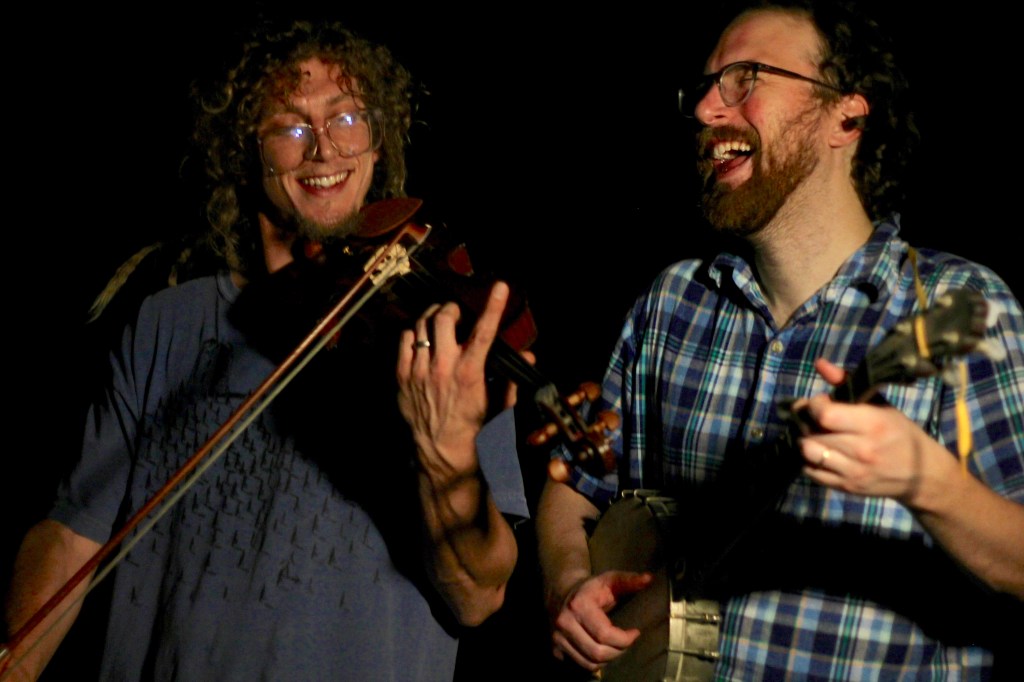
GEORGIA MORNING: Leo Suarez (left) and Majid Araim. Photo by Ben Shirley.
Prior to this session, Suarez, Araim, and Shirley had jammed together sporadically while Whispers Of Night was on the road playing shows around the country. In June of 2019, after Suarez played a show at the Magic Lantern, the three reconvened at 8 a.m. to roll tape. Ofir Klemperer recorded the session as they all locked in with their instruments. Aside from one small, imperceptible cut, the session went down as is.
“We consciously chose to make the trio not Leo + Whispers, as we conceived of it as each individual bringing their own independent voice to the group, rather than any sort of specific sound,” Shirley says.
Both the Whispers Of Night and Suarez + Araim + Shirley releases live on Past Now Tomorrow’s Bandcamp page. A limited edition of 50 copies of The Dead Blessing and voice resolve on CD can be found on the Bandcamp page as well—not for long, though. The sturdy, cardboard sleeves and hand-assembled cover art brings a tactile element to music that often eludes conventional terms. “I wanted to have a unifying aesthetic for this set of releases,” Shirley says. “I’m trying to still produce physical things, even though not many people buy them. This way I can make them at a low cost and keep the charge down. I use the least amount of plastic possible, and still have sturdy packaging with a spine on the side—working at WREK, I know that your CD is way more likely to get pulled off the shelf if it has a spine that looks interesting. That’s at least part of the idea.”
DUET FOR THEREMIN AND LAP STEEL: Frank Schultz (left) and Scott Burland. Photo courtesy Terry Kearns.
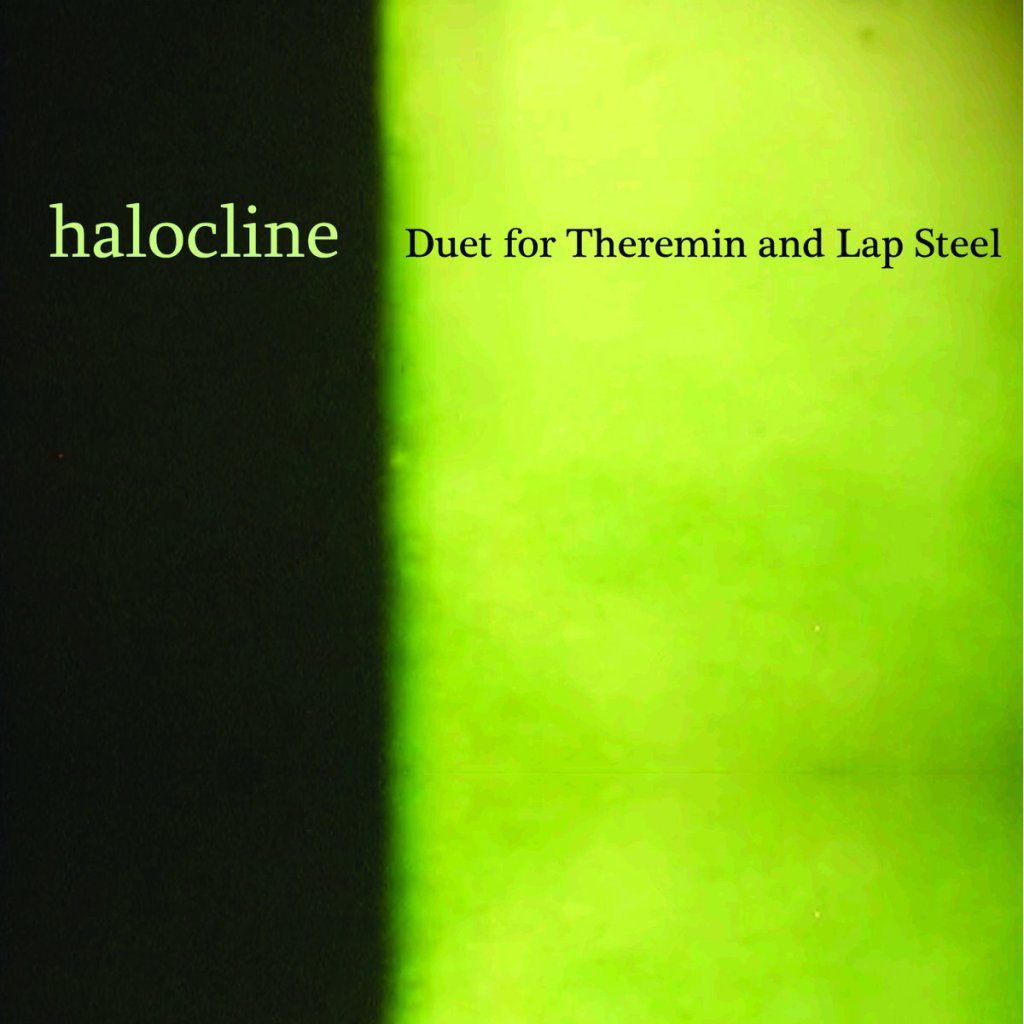
In the visually stunning BBC One documentary series Planet Earth, Sir David Attenborough describes a mesmerizing scene in which underwater caverns play tricks on the eye. “What seems like air … isn’t. It’s just another kind of water,” Attenborough says as he describes a phenomenon called halocline, a point at which freshwater and saltwater clash, like oil and water, maintaining separate densities. It is rich fodder for the imagination, and the title of Duet For Theremin and Lap Steel’s latest album. Theremin player Scott Burland and Lap Steel player Frank Schultz are back with an eight-song masterpiece of haunting, luminous atmosphere.
In the Fall of 2019, a chance meeting—sharing the stage at Louisville, Kentucky’s Kaiju—with vocalist Dane Waters gave rise to a collaboration in which she weaves her voice into songs with titles such as “Maelstrom,” “Swell,” and “Fata Morgana.” The result draws out an unforeseen abstract aquatic theme pulled from the depths of the subconscious, manifesting itself in fluid musical movements.
On the heels of the album’s May 16 release, Burland and Schultz took a few minutes to talk about working with Dane Waters, what the music means to them, and letting the music drive the concept.
Halocline describes what happens when two bodies of water are separated because of different salinities. How does this apply to the record?
Frank Schultz: The music drove the concept, not the concept driving the music. I had been watching a lot of Blue Planet and Planet Earth in the evenings during the time I was starting to put the album together, and the music seemed a perfect fit to the many faces of water. Water is one of those weird things that you can’t live without, sometimes it’s hard to live with, and sometimes it’s a killer. The illusion of a halocline is beautiful, but can be very distracting and deadly.
Scott Burland: Naming albums and song titles has been a challenging—though fun—process for us over the years, and this time the whole concept fell into place once Frank mentioned halocline to me. The music on this album varies from murky to clear, sometimes even in the same song. To me, some of this music sounds like it was recorded underwater. Or lends itself to imagining oneself moving around surrounded by, or completely underwater.
How does this expand upon your body of work and everything that you’ve accomplished with your previous recordings?
FS: I think it is our best body of work so far. It has connections to previous work, but goes in several different directions.
Filmmaker Robbie Land’s video for the title track from DfTaLS’ latest album, Halocline.
What are these different directions in which you see the music going?
FS: As far as a long term direction, who knows. We play, the music comes out, we record it and put some of it out. There is no preconceived notion of a path or direction.
SB: I think it fits nicely into our larger body of work. When 10 came out, I remember feeling like there was a certain maturity in the music. That’s definitely true of Halocline. There are no gimmicks per sé, it’s just the instruments, filtered through our approaches, and voice. It stands on its own and it seems a logical extension to our arc. I’d add that the majority of the album is sonically abstract, though there are moments of familiarity and traditional structure, or at least our version of that.
FS: There are several moments in the album when everything falls into place and still gives me goosebumps. Favorite songs change over time, at least for me. Current faves are “Maelstrom” and “Dissolver,” but I have a crush on all of them.
SB: I’m a big fan of the title track. When I hear it, I think wow, we did that? I don’t have a clear memory of recording it, it was just some random Wednesday, early in 2019. I appreciate that I’m working with someone who I can collaborate on a piece such as this, with no road map, no clear beginning or end and listen back and agree, hey that’s not half bad. “Brinicle” is another favorite, it’s both still and in motion and I have at least a vague memory of recording that one!
What did performing with Dane Waters bring out of DfTaLS?
FS: We met Dane in Louisville when we shared the stage with her in 2019. We were both floored by her performance. Floored enough that the two of us agreed, without any hesitation, that we should meet with her the next day and ask her to be on the album. She said yes! We fleshed out around 18 songs, got them down to nine songs we agreed on, and sent her three of them to record vocals. We ended up using all the songs for which she contributed vocals. Of course, once I received her recordings, it affected how the songs were treated and mixed.
SB: After that Louisville gig, Frank and I were asking ourselves why we didn’t invite her to join us for our set. Second best was asking her to contribute to the record. I think she adds a human quality to the album which isn’t exactly lacking in our previous efforts, but it’s just more in the forefront here. She slipped right into the spirit of the thing, I liked the way her voice reacted harmonically to the theremin and I appreciate the thought that she put into it. We look forward to sharing a stage with her at some unknown point in the future.
DUET FOR THEREMIN AND LAP STEEL: Halocline
Collaborations can often underscore one artist’s vision, or open up to the whole group making room for happy accidents, so to speak. Be it Jeff Crompton’s contributions to “Absinthium” on 10, filmmaker Robbie Land’s visuals, or working with Bill Brovold, the Shaking Ray Levis, and more on your 2011 album, Collaborations. What are the benefits of bringing outside influences into the realm you’ve created with DfTaLS?
FS: Kind of two camps here: Crompton and Dane recorded their pieces after the fact, so not really anything that influenced our playing. Robbie—we never see his films while we are playing, so not much influence, although we love when it happens, we just feel better knowing it is there, as does the audience. The Collaborations album was the one where we did live recordings with all the folks. So we were all influencing each other. In general, we enjoy collaborating with folks because it tends to bear lovely fruit and furthers our musical relationship and connection with those folks. Improvising with new folks is a chance to open your ears and learn something.
SB: This is the first time we’ve collaborated with someone without being in the same room, so the rules were different. On paper, there’s an immediacy that’s missing but in this case I think Dane nailed it with the vocals, almost as if we had recorded it together. Frank and I know the limitations of DfTaLS and an advantage of bringing someone else in is that the other people don’t necessarily know or even want to know those limits. It offers a fresh perspective, which gives us “permission” to stray from our comfort zone. To say it breaks up the monotony seems a little harsh, but surprise is good and we’ve been doing this long enough that introducing something new and/or unexpected keeps the fire going.
FS: Collaborating is part of our nature.
SB: It seems that we are able to fit into a variety of sonic scenarios, so I would say that collaborations allow us to expand on what DfTaLS is, and a glimpse into what it might become, or could be. Having time these last couple of months to contemplate even my own relationship to music has been eye-opening. Trying to strip everything away and then slowly reintroduce things to see what resonates. It’s a process. It’s hard to imagine my life without DfTaLS, so I am trying to figure out what it really means to me, what it means to Atlanta, to the region, and beyond. So it’s difficult for me to articulate the true nature of DfTaLS. Still working on that.









 Rad/ATL