Since Edward Ka-Spel and cEvin Key first merged their creative worlds in the late 1980s—bridging the surreal poetics of the Legendary Pink Dots with the dystopian electronics of Skinny Puppy—their collaboration has always thrived on the outer limits of both realms. Astral Elevatorreinforces their hold on that liminal space where mysticism and melody blur into something strange and beautiful.
“Lady Fate” with its spacious and droning melodies rekindles the psychedelic beauty, melancholy, and paranoia of the Tear Garden’s defining masterpiece, 1992’sThe Last Man To Fly. Later, “Square Root” emerges like a spectral echo from 1987’s Tired Eyes Slowly Burning, subtly recalling the supreme weirdness of “My Thorny Thorny Crown.” Its interplay of a high, brittle vocal winding around a low, counting voice vaguely personifies a ritualistic dialogue between innocence and gravity—an auditory tether to the project’s origins, rendered here with the clarity that comes from decades of stylish evolution.
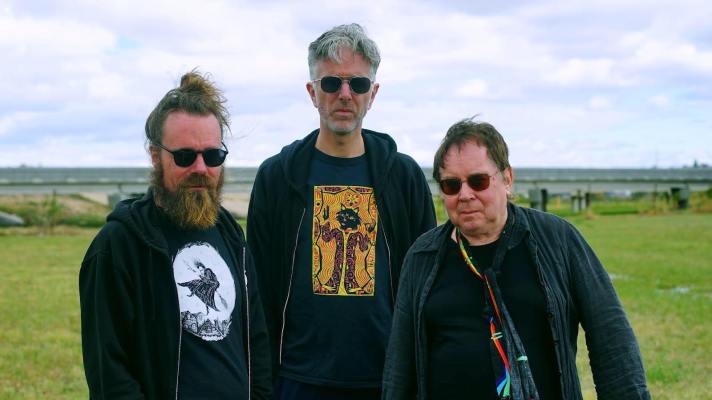
Astral Elevator, eschews the impenetrable darkness of 1996’s To Be An Angel Blind, The Crippled Soul Divide and 2000’s Crystal Mass. Here, the group—rounded out by Randall Frazier and Dre Robinson—reaches for a shimmering new plane where memory and revelation become one, and the music drifts like a transmission from some unknown realm that lies just beyond the edge of consciousness.
“War Crier” unravels around a skeletal rhythm, layered with shimmering synths that pulse like a dim heartbeat. Ka-Spel’s voice hovers in the mix like a transmission from a lost frequency—detached yet intimate. “Toten Tanz” channels the darker undertones of Key’s industrial roots, twisting through metallic percussion and vaporous drones, while “Exorcism” leans into rhythmic dissonance; its tension underscored by cascading synths that crackle like static in the ether.
“Swallow the Leader” balances that darkness with warped melodies, unfolding like a carnival waltz in zero gravity. “Chow Mein” delivers the record’s sharpest dose of surrealism, pairing grotesque humor with a hypnotic, playful groove. “Unreal” lands as one of the album’s most striking statements—a reflective confrontation with modern disconnection, holding a mirror to the hollowing effects of AI on human intuition, creativity, and trust in perception. It’s both prophetic and deeply personal, as its synthetic textures frame a lament for authenticity in an increasingly artificial world.
“It Just Ain’t So” and “Always Take the Highway” tap into a lighter strain of the chaotic pulse that propelled “Inquisition” from Skinny Puppy’s LastRights.
By the time “Undiluted Bliss” fades into focus, the record resolves its internal tension—weightless yet grounded, alien yet profoundly human. Ka-Spel, Key, and Co. refine their own musical vocabulary. The result is a work of hallucinatory grace, and an ascent that is entirely of this moment, yielding a worthy successor to the Tear Garden’s most luminous works.
Press play below to watch Randall Frazier’s video for “In The Name Of” and Cory Gorski’s “A Return.”
If you have enjoyed reading this post, please consider donating to RadATL. Venmo to @Chad-Radford-6 or click on the PayPal link below.
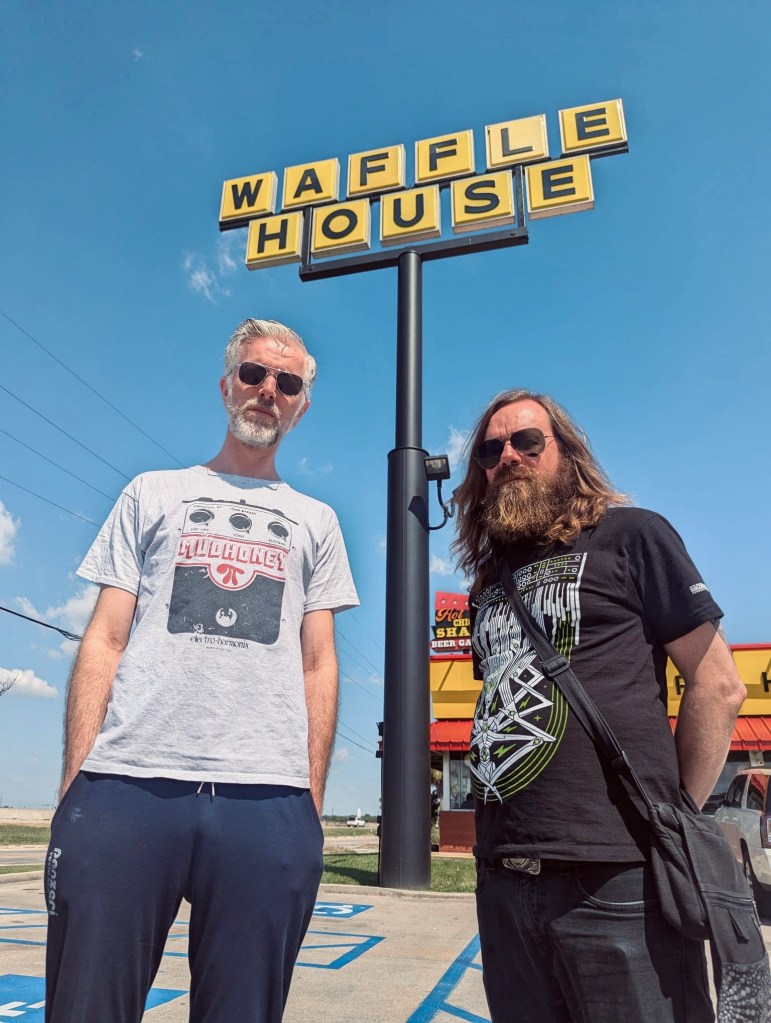
ORBIT SERVICE: Erik Drost (left) and Randall Frazier. Photo by Joep Hendrikx.
The Legendary Pink Dots and Orbit Service are two bands bound by a shared sense of mystery, atmosphere, and musical exploration. Over the years, both projects have cultivated an aura that’s equal parts cosmic and deeply personal—music that drifts between dream states, where melody and texture blur into something transcendent. Now, the connection between the two acts runs deeper than ever. Guitarist Erik Drost and keyboard and electronics player Randall Frazier—both longtime fixtures in the Pink Dots’ ever-evolving lineup—are on the road performing sets steeped in the ethereal tones of both Orbit Service’s Spirit Guide and the LPD’s latest album, So Lonely in Heaven, and the more abstract, experimental energy of Chemical Playschool 23–24.
In conversation, Drost and Frazier reflect on their creative chemistry and how their paths crossed during the making of 2004’s The Whispering Wall. They trace the evolution of Orbit Service from its early recordings to its current incarnation, and share what it means to inhabit the ever-expanding universe of Edward Ka-Spel’s songwriting. Together, they reveal that for all the mystery and gravity that surrounds their music, the heart of it all remains simple: connection, experimentation, and the pursuit of transcendence through sound.
Before playing a show in Purgatory at the Masquerade, on Friday, October 17, Drost and Frazier took an hour out of their day to talk about collaborating with each other, collaborating with Ka-Spel, and their go-to Waffle House meals while traveling across the United States.
Press play below to listen in on our conversation.
Since forming in London in 1980, the Pink Dots have carved out a singular space in the underground—too strange for pop, too melodic for noise, too abstract for goth, and too open-ended to be called industrial music. Led by enigmatic vocalist and founding member Edward Ka-Spel and rounded out by Randall Frazier (synths, samples, and electronics), Erik Drost (guitar), and Joep Hendrikx (live engineering and effects), the LPDs weave together surreal narratives and immersive, cinematic soundscapes that take shape like dispatches from a fever dream.
The group’s catalog spans countless albums, each one a kaleidoscopic swirl of experimental electronics, post-punk texture, avant-garde noise, and darkly poetic meditations on the human condition. On stage, their shows become ritualistic experiences—hypnotic and theatrical, blurring the line between performance and séance.
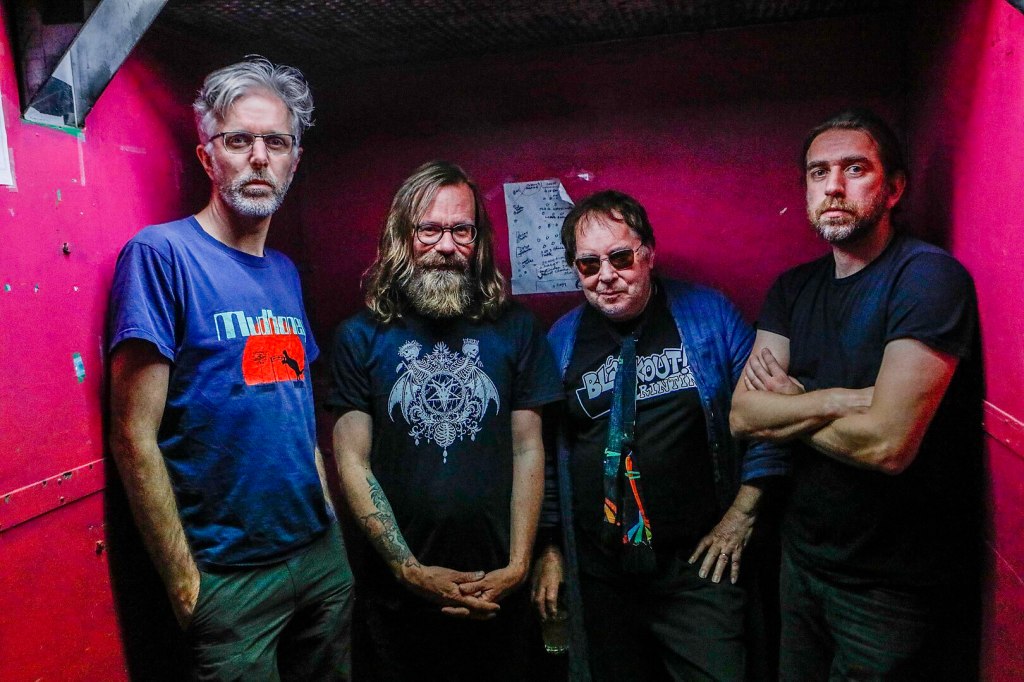
Erik Drost (from left), Randall Frazier, Edward Ka-Spel, and Joep Hendrikx. Photo courtesy the Legendary Pink Dots.
The LPD’s latest album, So Lonely In Heaven (Metropolis Records), finds the group at its most evocative, melancholy, and Orwellian in years, layering haunting synths, spectral melodies, and existential poetry into a deeply human meditation on isolation and transcendence. It’s a reminder that even after 40-plus years, the LPDs are still evolving; still chasing the unknown.
Bologna, Italy-based Orbit Service opens the evening with a set of deep, slow-burning atmospherics and haunted melodies. Featuring Frazier and Drost performing together, the duo builds patient, ethereal songs that hum with existential weight. They are the perfect gateway into the LPDs’ strange and beautiful world. The latest offering, Spirit Guide, leans deeper into cosmic territory, expanding its sound with shimmering drones, meditative textures, and a slow, patient gravity that feels like it’s tuning into another frequency.
For the faithful, this show is a rare chance to step back into the Dots’ orbit. For the uninitiated, it’s an invitation to get lost in one of experimental music’s most enduring and imaginative universes.
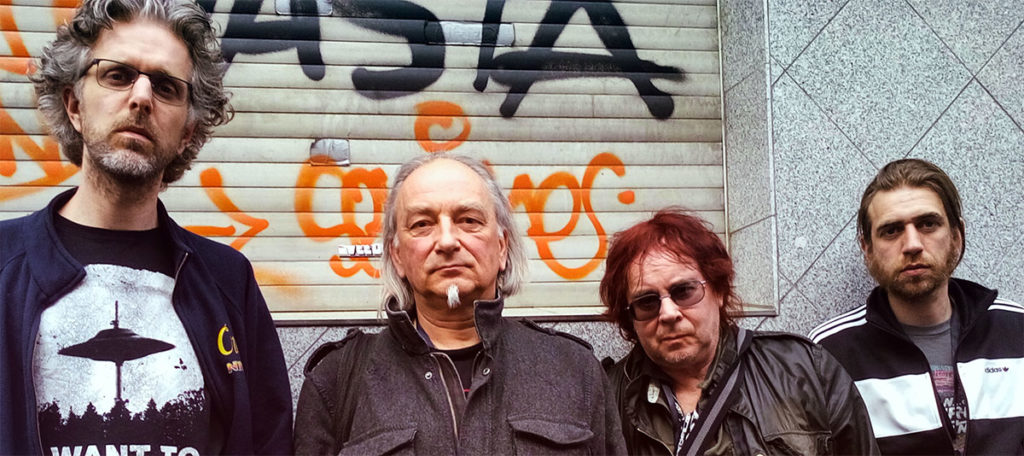
LPDs: Randall Frazier (from left), Erik Drost, and Edward Ka-Spel. Photo by Joep Hendrikx.
As memories of the COVID-19 pandemic and quarantine-time behaviors become a distant bad memory, the era has left impressions on the collective subconscious that are both subtle and monumental. This is where one finds The Museum of Human Happiness, the latest offering from London-based psychedelic musical explorers the Legendary Pink Dots.
Since August of 1980, the group’s enigmatic leader and vocalist Edward Ka-Spel has released a seemingly endless chain of albums, cassettes, and CDs with the Pink Dots, with various side projects, and under his own name. After more than 40 years in the group, Ka-Spel’s longtime friend, keyboard player, and co-founding member of the Dots Phil “The Silverman” Knight has retired from touring. But the show must go on. In the Silverman’s stead, keyboard player Randall Frazier of Bailey, CO’s Orbit Service has stepped into the fold. Ka-Spel checked in just as rehearsals were beginning for the group’s first trek in the brave new world with its newly configured lineup to tackle what he says is the most complicated set he’s ever performed.
The last time I saw the Legendary Pink Dots play live was in November 2019 for the Angel In the Detail tour. Was that the last time you played in the States?
Yes, we played a European leg of that same tour that finished on February the 29, 2020. That was when the pandemic really broke out everywhere. That was the last time we played live. To be honest it’s been a bit nerve-wracking coming back after nearly three years. It was a long and lonely stretch. I am happy to be playing shows, but it’s a real challenge.
What have the days been like for you leading up to playing live again?
Oh, frenetic. Today was absolutely frenetic. I got up at around 7:30 a.m., and the rest of the guys went into Denver to arrange for keyboard stands, and to get some mailers. I’ve got a lot of stuff to send out to people. Basically, I’ve brought all of the stuff with me from Europe so I can mail it out while I’m here.
While the guys were out picking up things I worked on the setlist and developed keyboard parts and collages.
I have also been going through songs in my head. Lyrically, this is the most complicated set I have ever had. I didn’t realize how intense the lyrics were in some of these songs. Some of them move quite fast from the start, like runaway horses. If you drop a word suddenly you’re lost. You have to keep up with it. It’s nice to have a challenge, though, and it is a big challenge. We’re playing a lot of new songs. It’s what we’re feeling right now, so it makes sense. There are a couple of older ones in there as well, but just what we really wanted to play.
You have the lineup in place: Erik Drost is playing guitar, Joep Hendrikx is handling some live engineering and effects, and Randall Frazier is on synths, samples, and some vocals. But no Silverman this time around?
Phil is basically retired. Neither one of us are Spring chickens anymore, and, in a sense, Phil felt that it was time to hang up his keyboard. It’s a bit sad. I understand it, but I can’t do that myself.
What else would you do?
That’s exactly it! “What else would you do?” There are days when I feel a bit fatigued, but then I think about someone like Marshall Allen [leader of the Sun Ra Arkestra]. If he has the energy to do it at 98, surely, with 30 years to spare, I should be able to deliver.
This is the first Legendary Pink Dots tour without Silverman that I am aware of. Having gone through the process with him for so long, I imagine you’re sort of like each other’s support system on stage.
It’s true. It will be kind of strange being on tour without him. We have known each other for decades. We used to share hotel rooms after shows. But in some ways, I saw it coming. He wasn’t so involved in the last album, for instance. It was clear to me that he was withdrawing. It was also very hard with the pandemic raging on. He lives alone, so it was much harder for him than it was for someone like me. We were all absolutely tied to where we lived because there was nowhere to travel anyway.
I have family around me, and I had tremendous support from my wife who was always behind me. I tried to persuade him to keep going. I also asked: “What else will you do?” But he was ready to retire, and he has that right.
Are you playing the older songs differently now?
Oh yeah! But that would be the case even if he was still in the band. The songs have to grow and fit with how we feel at the time we play them. Otherwise it feels a little like karaoke, and karaoke doesn’t really fit with us.
There is always room for improvisation in your live sets.
We plan a set because it’s good to have this base, a rock that we can sit on, lean on. But we’ll decorate that rock more as we go, and find new little corners of the rock that weren’t apparent when we began. And this is a very complicated rock for this tour.
I once asked Marshall Allen about the improvisational element in his music. He described it as making music on a spiral. It’s constantly moving around and influenced by “the spirits of the day” that he encounters along the way. That’s a poignant way to explain how these songs—you know them when you hear them—are played a little differently each time.
That’s how it should be. It shouldn’t just be a “Let’s repeat the album as it is.” The album is just a starting point for the songs.
Is it the pace of the songs that makes them challenging?
The pace and the lyrics are quite complex. You have to run with the whole thing. Every song tells a story, and you have to keep up with it. Sometimes you might forget something, or have one little word dropped, and the whole thing’s off. Until it’s a part of me—it will always be a part of me— where I can just flip it out without looking at any kind of prompt, then I’ll know that I can at least relax, just a little bit.
You have released a lot of records over the years. Do you have a mental map of what’s on the records or is it just too much to retain?
There are so many records. I can’t keep up. It’s like you find a place when you’re on a tour, which is right for that moment. To dig deeper into history would complicate that moment a little too much.
Not too long ago I started writing a concert announcement for your Atlanta show and I had to stop to think about it: The Museum of Human Happiness is the proper new record. But so many releases have appeared on Bandcamp since then—both Legendary Pink Dots and your solo recordings. I think of it all as Edward Ka-spel’s music, but I lose the priority and the order sometimes.
It has something to do with the way the album was written. There were many songs in the pot when I started it. It was my wife who said, “You really want to zoom in on the songs that would create The Museum of Human Happiness. The absolute cream on the Milk. It was the same time as my solo album, Prints of Darkness. So a lot of what didn’t fit Human Happiness made it onto Prints of Darkness.
Since then, the pandemic has gone on, and I needed to keep writing and recording. It keeps you on your toes. There have been quite a few hours of that since then, and of course, there’s a new Chemical Playschool. Then there’s what I call the quarantine releases, and the 3 2s and a zero releases. There were four of those this year: Conspiracy of Pylons, The Concrete Diaries, Tales From The Trenches, and 100 Seconds To Midnight. It has all moved on since Prints are Darkness.
On the subject of The Museum of Human Happiness, do you think of it as a pandemic album? Is it a comment on social media?
It’s a place from a sad, dystopian future that I thought of. What will it be like when we literally have to live underground, and there will be reminders of what was on the surface. There’ll be this museum with all these things that reflect what was. Many songs are about the Pandemic. “Hands, Face Space,” “Coronation Street.” It’s a very British album. “Cruel Britannia” speaks for itself. I don’t like the way things are going in the UK at the moment. All of this right wing politics just sucks, to be honest.
Things aren’t a lot different in the U.S. at the moment.
I don’t understand what’s happened to the anglo-saxons. It’s like we’ve completely lost the plot. I don’t understand this kind of exclusion of whole swathes of human beings. The selfishness and the absolute hate that go along with it; why is it being stirred up by people who should know better?
I’m very fond of “Cruel Britannia” and “Nightingale.” Those two are very much like what I was going through during the pandemic. Nightingales were actually these strange hospital warehouse type things that were set up in the UK during the pandemic. It was obvious what they were. They literally were filled with hundreds of beds with ventilators next to them. But they never actually used them as far as I know. But they set them up all over the country. They don’t exist anymore. If they used them, they only used them very briefly. But it was obvious what they were—the end of the line. It’s like they expected things to get much much worse.
The lyrics aren’t about that exactly. The lyrics are about someone who’s subjected to a medical experiment.
What was the first song that you wrote for the record?
Probably “This Is the Museum.” It actually came from my daughter Alice. She came up with the idea. I think she wrote a poem called “The Museum of Happiness,” and I said wow, “The Museum of Happiness.” Do you mind if I use that, Alice?” She said of course you can use it! It’s really nice. I added the “Human” in there. Then I wrote the song, “This Is the Museum.” She really liked it and she wrote another poem which is a little bit based on my poem. It was really kind of nice. But yeah, she inspired that.
That’s why she gets a songwriting credit on the album.
Oh yeah, she’s credited on the album. When she said that, I just suddenly had the whole picture of this place, this museum, like a very modern underground.
Sometimes someone can just say something and you get this whole picture. It’s like a seed that just explodes and suddenly there’s a whole story and scenario there that you have to realize. And you have to capture it before it disappears. You dare not wait, because if you wait it’ll be gone.
I can imagine that after not having done it for so long, it has to be a rush.
Totally. And that’s just the rehearsals. To actually do it in front of people will be another thing. I’m also nervous about it, I can’t deny it.
Do you often get nervous before you play shows?
Yeah, I’d say so. It’s odd. When we’re performing, we all obsess over the little mistakes that could be made. Mistakes that, in reality, nobody hears. In the past, for example, when we’d play a song using physical sequences, they all started speeding up. So what do you do? You speed up with it! Still, nobody noticed. But how could you not notice that?
You can call it improvisation!
Yeah, really! That’s a moment when we’ve all gotta think of something to do, right in this split second.
Randall Frazier has stepped into the Legendary Pink Dots. He’s performing the duties that Phil has traditionally handled?
Sort of. We want Randall to be Randall, and to do what he feels is right for the songs. Not simply reach for a line that’s already there, but to take his own lines and his own parts because then the music becomes his as well.
He’s also a sound engineer. Actually, in this touring party there are three sound engineers in the group. So if something goes amuck, there should be a solution in there somewhere, and they’ll find it.
Way back in the ‘90s, Orbit Service was a much larger band with more members. They opened for the Legendary Pink Dots in Denver at the Bluebird Theater. Since then, we’ve played on records together and done a few tours together. To me, Randall is family, and he has been for a long time. Now he’s on the front line as well.
Has it really been three long years since the Legendary Pink Dots last commanded an evening of shadowy and psychedelic revelry in Purgatory at the Masquerade?
Indeed it has. That performance supporting 2019’s Angel In the Detail can still be felt reverberating throughout the club’s rafters. Since then, there’s been, you know, a global pandemic working in tandem with socio-political absurdity and techno-angst gripping the world. As it all unfolds, LPD vocalist and principal songwriter Edward Ka-Spel has remained steadfast in his rich, kaleidoscopic vision, navigating heaps of new music—namely two solo records dubbed Prints of Darkness and The Great Outdoors, as well as the UK-based outfit’s latest album, The Museum of Human Happiness (Metropolis Records).
This latest offering is cut from a fast-paced blend of Krautrock and industrial-grade psychedelic ambiance bearing song titles such as “There Be Monsters,” “Cruel Britannia,” and “Hands Face Space.” As such, The Museum of Human Happiness is also a pandemic record, a quintessential document that’s tailor-made for coping with the black cloud of the COVID menace which is still lurking out there, somewhere, just beyond the horizon.
Randall Frazier of Orbit Service. Photo by Matthew Condon
For this round of North American shows, Ka-Spel’s long-time cohort, keyboardist Phil “The Silverman” Knight, has bowed out of touring. In his stead, Randall Frazier of Bailey, Colorado’s Orbit Service is pulling a double shift, opening the show and taking on keyboard and electronic duties alongside Ka-Spel, guitar player Erik Drost, and live sound engineer Joep Hendrickx.
Welcome to another episode of Rad/ATL’s Hidden Hand podcast.
The music you’re listening to is “The Coldest Nights,” taken from Orbit Service’s sixth and most recent album titled The Door to the Sky.
Currently based in Bailey, Colorado — a small town in the mountains near Denver — Orbit Service is the name under which Randall Frazier has created music since the early aughts.
Over the years, Frazier has crafted a spacious and drifting sound that’s bound by a singular and textured quietude. His voice blends with atmospheric drones, improvisation, elegant post-rock songwriting, and musique concrete to a psychedelic effect.
I spoke with Frazier on October 16, 2019, shortly before Orbit Service shared the stage with the Legendary Pink Dots at the Masquerade in Atlanta — his fourth tour with the group. For this conversation we talked about creating space with music, life in Colorado, and our shared affinity for the Legendary Pink Dots.




 Rad/ATL