Brooklyn-based electronic and experimental artist Robert Pepper of Pas Musique returns this Sunday, May 8, for a set of drones, beats, and ambient majesty at Eyedrum. Since 1995, Pepper has led Pas Musique through various incarnations, all the while collaborating with the likes of Rapoon, Z’ev, Faust, Jim Tuite, and more. For this show, Pepper is performing a solo set.
TAYLOR / BURLAND: Scott Burland (left) and Ryan Taylor.
This show also marks the debut performance of the Taylor / Burland guitar duo, featuring ambient-drone artist, noise music fixture, and producer Ryan Taylor, whose credits include working with Rat Mass, Blackfox, AkuYou, Sensitive Chaos, and Eldorado Omega. Scott Burland is the former theremin half of Duet For Theremin and Lap Steel. Together, they’ll explore the spacious, subtle ambiance of resonating steel strings.
.document features Elliott Brabant of Michael Cera Palin. Meaning of Everything is the guitar-based project of Mykel Alder June (formerly of Mice in Cars).
REST IN PEACE: Tom Smith (on the far left, with Frank “Rat Bastard” Falestra). Photo by Chad Radford. Jon Kincaid (center) photo courtesy Amy Potter. Robert Cheatham (right) photo by Tara-Lynne Pixley.
There’s an old African proverb that says: “When a person dies, a library burns to the ground.”
Point being, when someone dies a lifetime of knowledge, experience, and context is lost forever, and the world is left a poorer place in their absence.
In January, Atlanta music quietly suffered through three profound deaths: First, news spread that Jon Kincaid, longtime 91.1 FM / WREK DJ and host of Sunday nights’ “Personality Crisis” radio show had died on January 4. He was 57 years old.
A week later, On Jan. 11, word spread across social media that former Eyedrum Art & Music Gallery Executive Director and avant-garde music and art scenes fixture Robert Cheatham had died at the age of 73.
Another week later, post-punk journeyman and noise music provocateur Tom Smith died as well. He was 66 years old. All three men represented somewhat different but primary eras and enclaves of Atlanta music. And while it may not be immediately obvious, each of their respective influences played an indelible role in shaping the city’s musical identity.
For more than 30 years, Kincaid hosted “Personality Crisis,” giving a platform to countless fledgling alternative rock, post-punk, underground, and Southern rock luminaries. In the early days of their careers, Atlanta-based acts the Indigo Girls, Drivin’ N Cryin’, and countless others benefitted from his steadfast dedication to music, and his encyclopedic knowledge.
Check out the backside of Mission of Burma’s 1988 LP Forget, and you’ll see bass player Roger Miller sporting a WREK T-shirt. It’s a good bet that Jon had a hand in Roger owning that shirt.
Jon explored every type of music known to humankind through his work as a WREK music director, and by creating his own experimental music under the name Sequence 3.
Cheatham led Eyedrum through its defining eras; he was Executive Director when the venerable arts institution was awarded a $30,000 grant from the Warhol Foundation in 2006. Cheatham also hosted Eyedrum’s long-running open improv nights, which became an institution for outsider and experimental arts. His band Tinnitus was well known for cranking out squelching, heavily-amplified noise and feedback created with the expressed intention of driving everyone out of the room.
His Brahvar Large Ensemble would often corral as many musicians together as possible — once even crowding more than 20 performers onto the tiny stage in the basement of Eyedrum’s original Trinity Ave. location for a massive improv blowout. Connections were made, new ensembles were formed, and wholly new configurations of musicians perpetuated the community. Cheatham’s brilliance lied in his merger of skronking, careening free jazz, and untethered exploration of sound as art without restraint.
Tom Smith reveled in a more confrontational aesthetic. With his groups To Live and Shave in LA, Peach of Immortality, and Boat Of, he placed elements of noise, the avant-garde, and sleazy rock ‘n’ roll on a level playing field. He wove them together seamlessly, while hopping around the globe — from Atlanta to Washington D.C. and finally Hanover, Germany. Along the way, he amassed collaborations with everyone from Thurston Moore of Sonic Youth, Andrew WK, Harry Pussy, Bill Orcutt, and more.
Kincaid, Cheatham, and Smith were all driven to create by exploring, not just rest on the past. Their sense of creativity, their dynamism, and their willingness to open up to the new — and the old — left a lasting mark on the city. Atlanta was made richer by their presence and their contributions, and the world suffers a tremendous loss with each of their passing.
On Fri., Feb. 18 (3-9 p.m.) and Sat., Feb. 19 (1-9 p.m.) Gallery 378 (378 Clifton Rd. in Candler Park) will host a two-day celebration of Jon Kincaid’s life and history at WREK. Video installations featuring broadcasts from “Personality Crisis” and more from the WREK archives will be playing throughout the gallery. On Saturday night, several acts including the Nightporters, the Chant, Kevn Kinney and friends, Current Rage, Will Rogers, and more will take turns playing songs on the stage downstairs.
An extremely limited quantity of Upchuck’s “In Your Mind” b/w “Upchuck” blood-spattered 7-inches will be for sale on the merch table—first come first served.
Doors open open at 7:30 p.m. Music starts at 8:30 p.m. $15-$20. Get tickets here.
If you have enjoyed reading this article, please consider making a donation to RadATL.
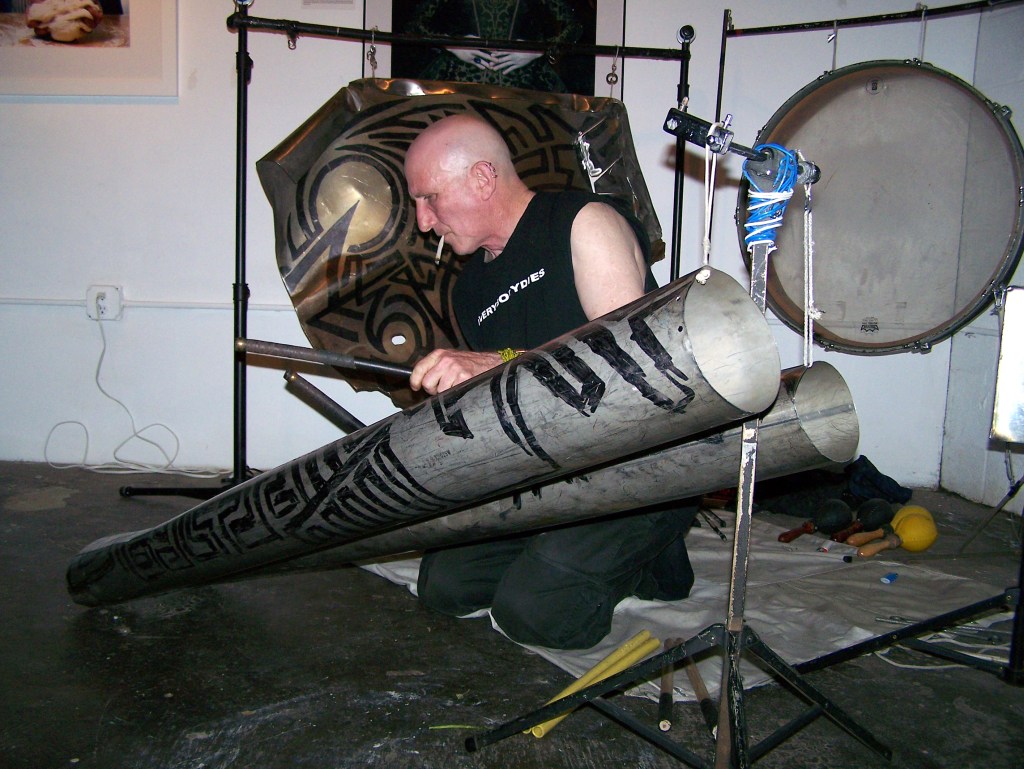
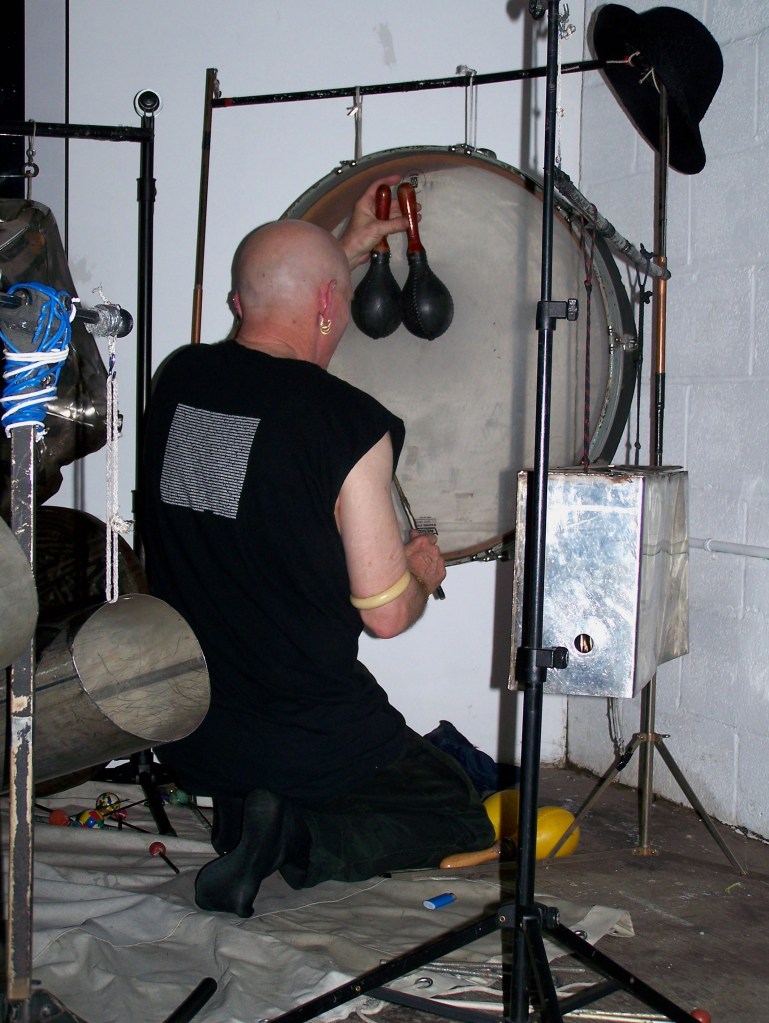
Z’ev performing at Eyedrum Art & Music Gallery, May 16, 2007. Photo by Chad Radford
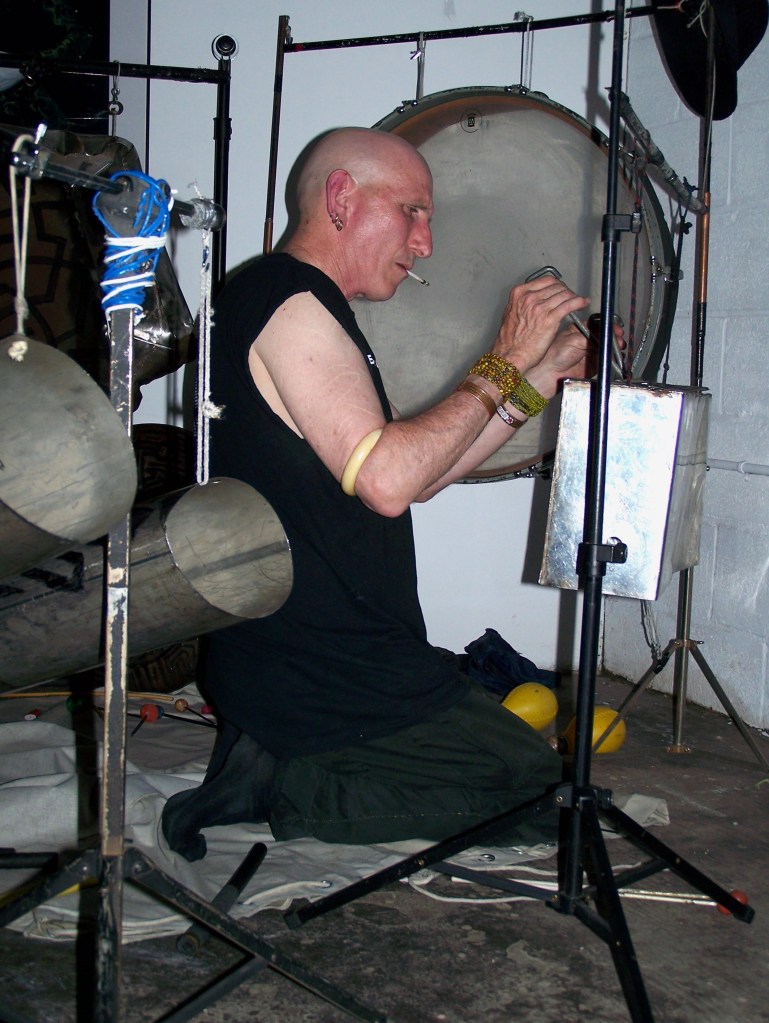
Stark black-and-white photographs of a man with intense focus, hammering at plastic containers, metallic tubes, and hunks of repurposed weapons of war. His head and face clean-shaven, and a cigarette dangling from his lower lip as he kneels—muscles locked—pounding metal rods and mallets on mangled bits of titanium and steel. This vision of percussionist and sound artist Z’ev (born Stefan Joel Weisser) was broadcast from the Bay Area to middle America and beyond in the pages of the Industrial Culture Handbook, published by punk and underground culture journal RE/Search in 1983.
RE/Search placed Z’ev alongside industrial music’s early pioneers Throbbing Gristle, NON, Cabaret Voltaire, and more. But as each of these other acts explored the dark aspects of society in the wake of the industrial revolution with subversive cunning, Z’ev communed with the mystical elements of the natural world. The sounds he created tuned into the deeper resonances of a planet hurtling through space, spinning in alignment with the unseen contours of the universe.
Industrial Culture Handbook
Association with industrial music was never disconcerting for him. “It was just a bunch of people coming from an art background, moving into a proto-punk kind of thing,” Z’ev explained over the phone during an interview in 2007. “My relationship with industrial music had to do with the instruments I was using. They were products of high technological industrialization.”
Z’ev utilized the scraps of industry to draw out both the gargantuan and the meditative qualities of metal, space, and time. He fully embraced the artistic notions of turning swords into plowshares, but most importantly, his performances and compositions honed the power of pure harmonics.
Be it with his earlier “wild style” live performances imbued with an intense physical show of force, or his more aurally-focused compositions that found balance in primitive rhythms and improvisation, Z’ev’s output had more in common with the tonal exploration of composers of massive minimalism such as Tony Conrad and Lustmord, or the techniques of Pauline Oliveros’ Deep Listening Band, rather than the dirge of groups like Einstürzende Neubauten or Test Dept., who utilize similar instrumentation. “I was never interested in people coming to see a violent thing happen, because it wasn’t violent; it was a powerful thing,” he explained.
Recalling reviews of early performances: One bay area journalist wrote that “he manipulates large, metal objects with the look of a concert pianist.” But in New York, a writer called him “a man who personifies violence in sound and vision,” and later asked “why does this remind me of a guy being jerked around by two vicious Doberman Pinschers?”
The latter review didn’t set well. “He’s probably someone who cowers during a thunderstorm,” Z’ev offered with an understated laugh. “Some people revel in a thunderstorm and others get scared. It’s an elemental thing and people’s relationship to them determines if it’s something scary or something to embrace.”
“Salts Of Heavy Metals”
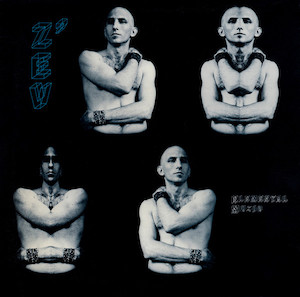
Early Z’ev recordings such as 1981’s Salts Of Heavy Metals (Infidelity Records) and 1982’s Elemental Music (Subterranean Records) summoned the hypnotic qualities of reverberating metal by guiding the clang and bang of his performance to harness the ghostly acoustic feedback swelling between each mallet strike—the rhythmic aural phenomena created by his homemade instruments interacting with the room itself.
Z’ev spent a lifetime studying music, the nature of sound, and spirituality from around the world, including Kabbalah and esoteric systems, and wrote a book titled Rhythmajik: Practical Uses of Number, Rhythm, and Sound. He also worked with the Fluxus Group, and was active in the Downtown Manhattan music scene of the ‘80s and ‘90s, as well as the West Coast’s avant-garde arts and music community, extending from his time attending the California Institute of the Arts.
“Elemental Music”
In 1980, he shared the stage with British goth-punks Bauhaus on their first headlining tour of the U.K. “We always used to hand pick our special guests and would look for unusual, stimulating, and challenging artists,” Bauhaus’ bass player and vocalist David J offered in an email. “We saw a film of Z’ev doing a performance where he was ‘playing the building,’ and also using his collection of plastic containers to great rhythmic effect. At the time, we were getting more rhythmic as a band so it was very complimentary to have him opening for us. I believe that he is something of a shaman.”
Over the years, Z’ev also collaborated with various composers, including live electronic music innovator Carl Stone, multi-instrumentalist Elliott Sharp, guitarist Glenn Branca, pianist Charlemagne Palestine, noise artist Merzbow, Genesis P. Orridge of Psychic T.V., Stephen O’Malley of Sunn O))), percussionist Jon Mueller, and dozens more.
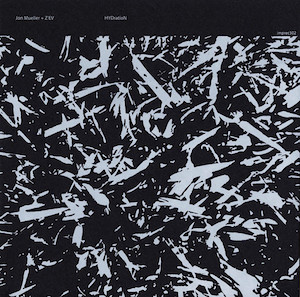
“HYDratioN”
Like many, Mueller discovered Z’ev after reading about him in RE/Search’s Industrial Culture Handbook. “When I read his article in ’87 or ’88, I remember it striking me as someone really living a different kind of life, and as a drummer, it was inspiring—mostly in that his ideas went far beyond drumming.”
A few years later, Mueller booked Z’ev to play a show in Milwaukee, where the two met. Later, Mueller released the Osso Exótico + Z’EV CD via the Crouton label.
“Years later, I shared another bill with him in Milwaukee, as part of the Milwaukee Noise Fest,” Mueller says. “That was a great night. We had dinner and really got to talk instead of just exchanging emails—his were typically brief. His set with the synthetic drum triggers manipulating the Jimi Hendrix video was a new direction for him, and I admired his dedication to finding ways to create.”
Mueller goes on to say: “My perception after meeting him didn’t change much, except realizing the possibilities that exist. Being young reading about someone, especially someone like Z’ev, you never assume that one day you’d meet them, let alone work with them.”
In 2009, Important Records released HYDratioN, a collaboration in which Mueller mailed Z’ev a collection of tracks—drums vibrated with gong and synth recordings, and other small percussion. According to the LPs sleeve, Z’ev “recreated” the source material to an extreme degree. How it was executed, though, remains a mystery. “It’s somewhat unclear what all happened on his end,’” Mueller says. “To me, it sounded different than what I sent him, but he said he ‘basically just mixed it.’”
A now scarce retrospective double CD released in 1991, titled 1968-1990: One Foot In The Grave (Touch), drew renewed interest in Z’ev. Dozens more releases followed, including a 2006 CD for Atlanta’s Blossoming Noise label, titled Symphony #2 – Elementalities.
“Symphony #2 – Elementalities”
But even in the digital era, many of his recordings remain frustratingly difficult to track down. As a result, more people have heard of Z’ev than have experienced his performances.
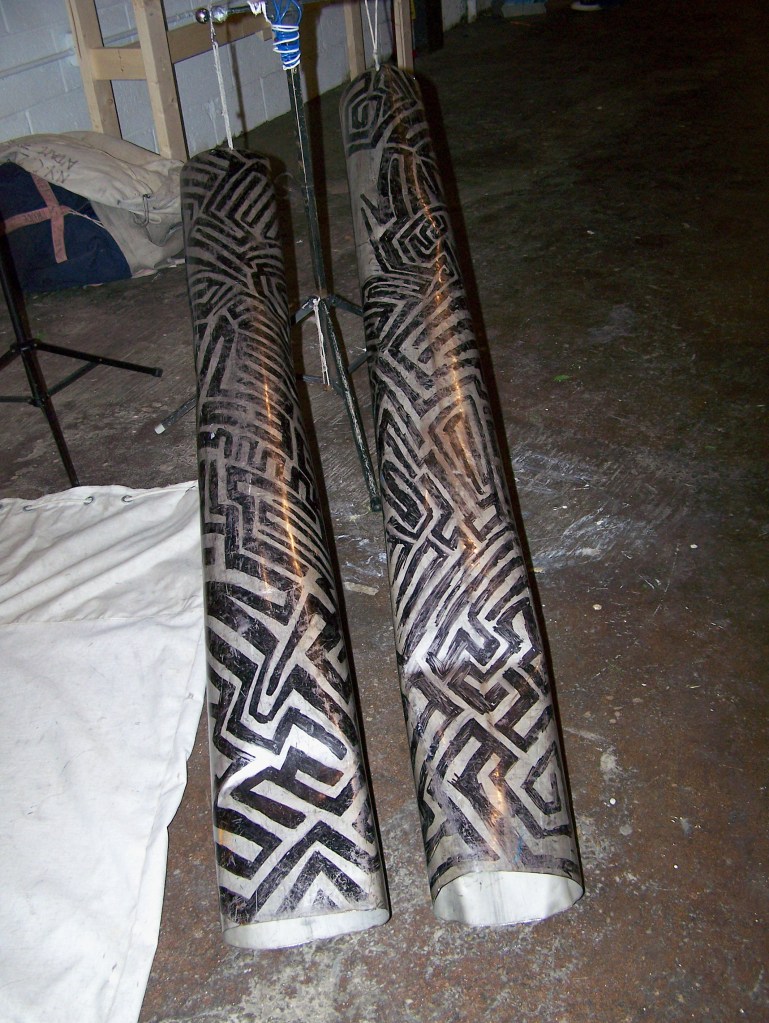
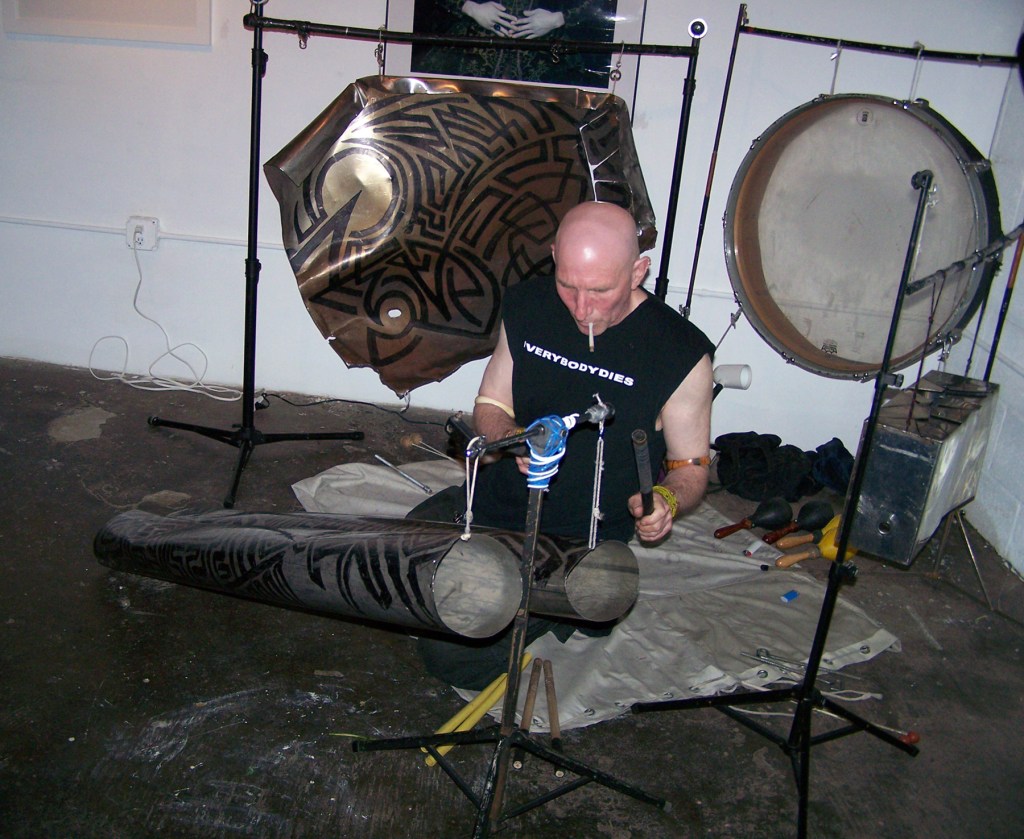
For his 2007 tour—his first proper trek playing shows across the United States—Z’ev’s inventory of instruments included steel sheets and boxes, titanium tubes, a gong made from a patio table bass, and a section from the tank of an 18-wheeler. Each is played with various mallets and maracas that have been altered with ball bearings.
His favorite metal is Titanium, which he discovered at a Bowing scrap yard in Seattle circa 1982 where he acquired surplus materials salvaged from the cooling system of missile silos from Triton submarines. “When the rocket shoots out of the sub you have to cool the interior of the silo or it would melt the submarine,” he adds with childlike enthusiasm. “Titanium can become white hot and maintain structural integrity. The more heat and pressure that’s used to create a metal, creates energy potential. When you hit titanium it amplifies the sonic energy it puts out.”
That sonic energy still rings out with unmatched power.
Z’ev was born on February 8, 1951. He passed away on December 16, 2017. He sustained injuries including a punctured lung and five broken ribs, after surviving a train derailment in Kansas. He was 66 years old.
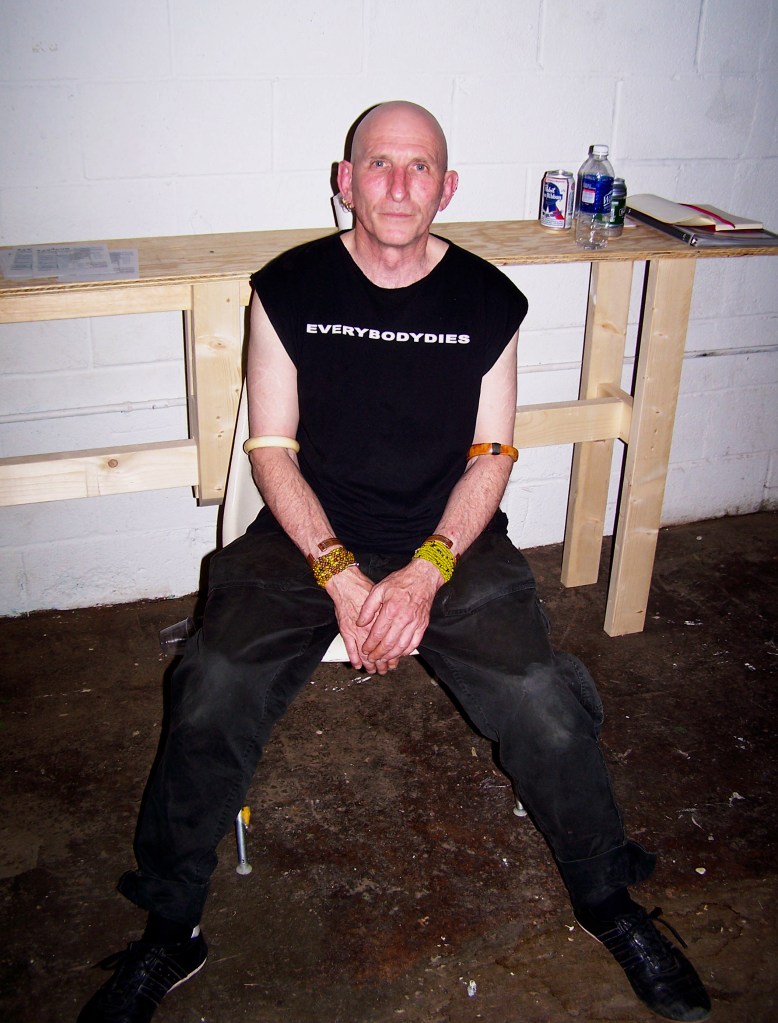
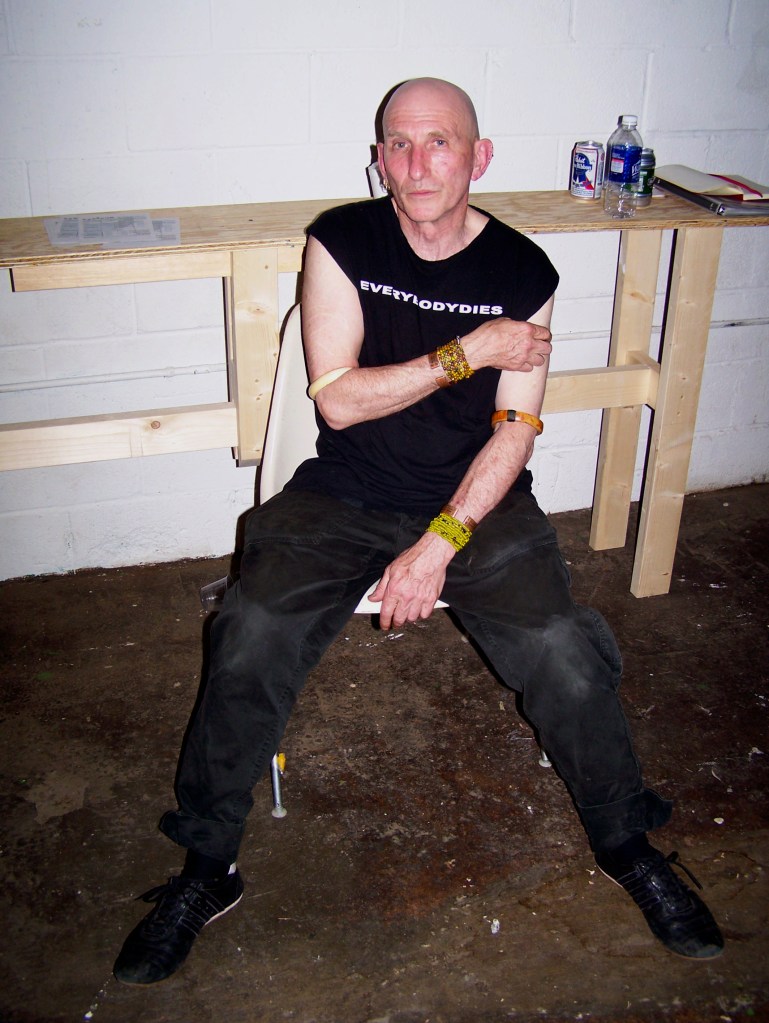
These photos were taken when Z’ev performed at Eyedrum Arts & Music Gallery on May 16, 2007. Mr. Natural, Black Meat, and Sikhara also performed.All photos by Chad Radford.
If you have enjoyed reading this article, please consider making a donation to RadATL.
Founders of some of Atlanta’s most beloved and remembered spaces will speak about how these organizations came into existence. Answering questions such as: What were the conditions that led to the founding of the space/project/organization? What was happening in Atlanta at that time? What goals did you set out to accomplish, and did you feel those goals were met? What can the current field of artist-run initiatives learn from this history?
Each talk will be moderated by a member of the community who experienced the initiative’s activities first-hand, and in several cases, who operated/participated in similar concurrent projects.
Saturday & Sunday, October 17-18, 2020. All panels hosted via Zoom. Free but registration required for each session. All registration links can be found at www.artpapers.org/events/founding-stories/
Eyedrum Art & Music Gallery has announced a new location opening in early 2021 at 515 Ralph David Abernathy Blvd., in a historic industrial corridor near the West End, Pittsburgh, Mechanicsville, and Adair Park.
In a press release issued September 29, Eyedrum states that this new location will feature a “flexible 3,000 square-foot interior including a small dedicated gallery, an outdoor stage, and a courtyard for programming.”
The press release also states that Eyedrum will carry on with its legacy as “a home to underserved, emerging artists, musicians, filmmakers, and writers. In times of uncertainty, members of the community need arts spaces now more than ever.”
In June of 2018, Eyedrum, along with fellow DIY arts and music space Mammal were forced to close after a nearby fire on Broad Street SW left one man dead. Soon after, both business were forced to leave their Downtown locations permanently.
Two years later, Eyedrum’s announcement comes as a beacon of hope for an underserved community of artists and musicians. In a 2011 CL cover story that I co-authored with Wyatt Williams, title Eyedrum: An Oral History, we described that scene as “those willing to embrace music and arts that are as contemptuous as they were conscientious. Indie rock acts as varied as Oneida, Don Caballero, and the Black Heart Procession to Simeon Coxe of the Silver Apples to DJ Cut Chemist all performed there amid exhibitions with titles such as The Penis Show, Switch, and Liquid Smoke.”
With the recent closure of the Bakery in Oakland City, Atlanta needs a venue that this community can call home, now more than ever.
515 Ralph David Abernathy Blvd.
Eyedrum’s new home sits adjacent to Parts Authority, an automobile parts and supplies facility.
Deisha Oliver, a member of Eyedrum’s board of directors, says the gallery and performance venue is renting “a 3,000 square foot portion of 515. The building owner has been so kind as to do the needed build out of our portion of that space.”
To keep Eyedrum’s endeavors moving forward, an effort to raise funds is underway, with plans to facilitate virtual programming, and to support the staff and curatorial budget for the next five years. A new website is planned for launch soon, which will offer membership options.











 Rad/ATL