Five Eight and the Ladies Of … ring in the holidays at Smith’s Olde Bar on Fri., Dec. 12

Five Eight photo by Marc Pilvinsky

Five Eight plays Smith’s Olde Bar on Friday, December 12, delivering a jolt of Athens-born punk and pop catharsis for the holiday season. 

Fresh off a year of renewed energy sparked by Marc Pilvinsky’s documentary Weirdo: The Story of Five Eight, the group released their first new single in over six years, a ramped up number titled “Take Me To the Skate Park.” A successful run at SXSW served as a sharp reminder that Five Eight’s fire still burns with undeniable force.


Now, Five Eight is one of the first 100 bands announced to play SXSW 2026. In the meantime, the group hits the Music Room stage with the force of a band that’s lived through triumph, tragedy, and chaos, only to come out swinging.


Their latest single, “I’m Alone,” arrived on Nov. 7, offering a sharp, emotional snapshot of the songwriting depth that has elevated Five Eight from an underdog to a bonafide Georgia music fixture. With a new album slated to arrive next Spring via hardcore label Static Era, the show offers a chance to catch the band as they embark on a bold new chapter.

Singer and guitar player Mike Mantione, bass player Dan Horowitz, guitarist Sean Dunn, and drummer Patrick “Trigger” Ferguson share the stage with the Ladies Of… featuring James Hall, whose hybrid of glam, punk, hillbilly boogie, and dark-edged poetry turns every set into a spectacle. Hall’s presence alone brings an electric gravity to the room—equal parts swagger, invocation, and celebration. Together, Five Eight and The Ladies Of… promise a holiday show that trades sentimentality for sweat, noise, and raw, communal release.

In the true spirit of the season, the Music Room will also feature a photo booth. There will also be blind contour drawings by artist Kayti Didriksen, adding a visual counterpoint to the evening’s sonic fireworks.

Before the show at Smith’s, Five Eight’s Mike Mantione and James Hall make a stop at Criminal Records on Thursday, December 4, hosting a listening party for their new holiday tune “Christmas Without You.”

The Criminal Records in store show is free. Music starts at 4 p.m.

For the Smith’s Olde Bar show, doors open at 7 p.m., showtime is 8 p.m. $20 (advance). $30 (day-of show). $48 (VIP pre show meet-and-greet, includes a signed poster).

If you have enjoyed reading this post, please consider donating to RadATL. Venmo to @Chad-Radford-6 or click on the PayPal link below.

Donate with PayPal

Das Damen and Bebe Buell play the Masquerade (Altar) on Friday, November 7

Das Damen photo by Charlotte Hysen

Das Damen plays the Masquerade’s Altar stage this Friday, November 7, bringing a night of post-punk, grunge, and rock ’n’ roll spectacle. The group’s name carries weight among late-’80s and early ‘90s noise-rock aficionados. Das Damen was the rare band that channelled the fuzzed-out psychedelic sprawl of Sonic Youth with the melodic instincts of the Meat Puppets.

Longtime Atlanta showgoers might recall one of their previous local appearances opening for Nirvana at the old Masquerade in October 1990—35 years ago. The following year, Das Damen disbanded, leaving behind a cult legacy of warped riffs and stoned-out, high-volume catharsis. Now, the later lineup is on the road playing a short Southeastern run that doubles as both a reunion and a rebirth.

For this tour, singer and guitar player Jim Walters, drummer Lyle Hysen, bass player David Motamed, and new guitarist Diego Ramirez are pulling from across the group’s entire catalog, revisiting standout moments from albums such as 1987’s Jupiter Eye, ’88s Triskaidekaphobe, and ’89s Mousetrap. They’ll also roll out a previously unreleased song that’s slated for a possible (or not possible) new LP with the working title Nobody Wants This.

After Das Damen’s proper set, the group will back up singer and songwriter Bebe BuellPlayboy Magazine’s November 1974 Playmate of the month, a fixture of NYC’s rock ‘n’ roll scene, and mother of actress Liv Tyler (daughter of Aerosmith frontman Steven Tyler). Buell’s set leans into classic rock ‘n’ roll energy, offering a counterpoint to Das Damen’s heavy grooves.

$26. 8 p.m. (doors). 9 p.m. (showtime). The Masquerade (Altar).
If you have enjoyed reading this post, please consider donating to RadATL. Venmo to @Chad-Radford-6 or click on the PayPal link below.
Donate with PayPal

After Words and Gardens Of … play Independent Distilling Company on Saturday, September 6

After Words at Excelsior Mill (pre-Masquerade). Photo by Sara Epstein.

Between July of 1987 and December of 1989, After Words played a crucial role in pushing Atlanta’s post hardcore scene into new musical terrain. Seminal hardcore band Neon Christ had called it quits a year earlier. In their wake, a new generation of musicians stepped up to carry their influence forward.

In the late ‘80s, After Words co-founding guitar player Brian Nejedly began booking shows while he was still in high school. “When the Metroplex shut down, that was the only all ages venue in town, so I just started looking for places that I could rent out to put on shows,” Nejedly says.

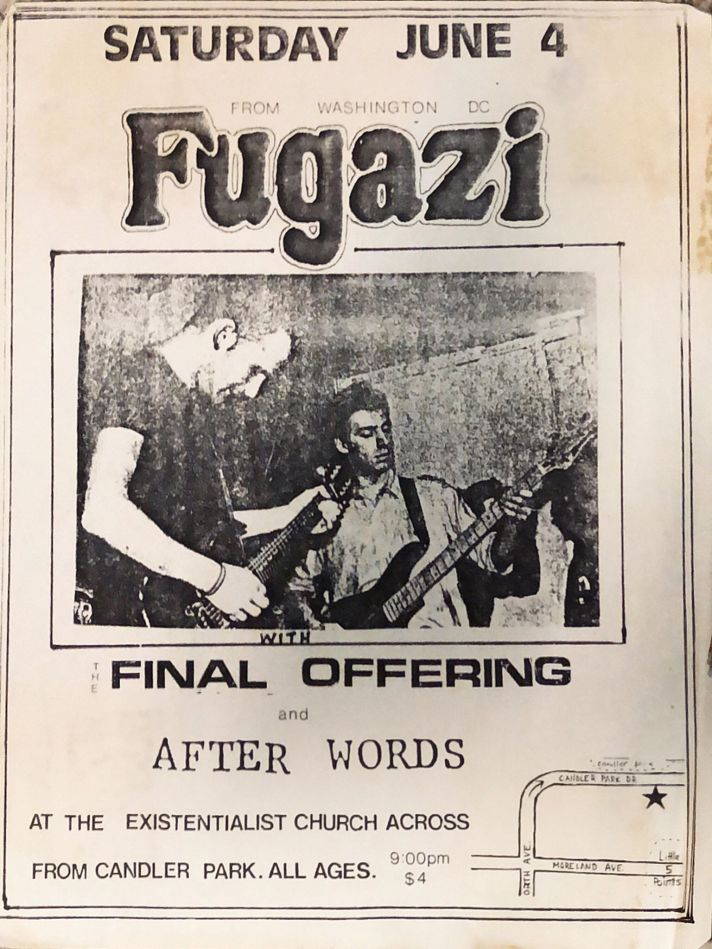
He booked Fugazi’s first Atlanta show at the First Existentialist Congregation in Candler Park. He booked Ignition, Soul Side, 7 Seconds and dozens of other acts. “Once I started booking shows, I realized that a lot of these bands had a list of people and places to call for shows in each town, and I was on that list,” Nejedly says. “For a while, I was the only guy in Atlanta on that list.”

Along the way, Nejedly sent After Words demo tapes out to pretty much every label that was on his radar. “I sent a demo to Cruz Records because we loved the band All,” he says. “We sent tapes to everyone, and Amanda MacKaye at Sammich Records wrote back.”

Amanda, sister of Ian (Dischord Records, Minor Threat, Fugazi, Coriky) and Alec (Ignition, Faith, and Hammered Hulls) MacKaye ran Sammich with Soul Side’s Eli Janney (Girls Against Boys). She offered to release the demo tape, making After Words the only band from outside of D.C. at the time to receive distribution through Dischord. 

The label’s approval validated Atlanta as a place where post-hardcore ideas could thrive, and it placed After Words on the same label as Soul Side, Shudder to Think, and Swiz.

Drop a needle on After Words’ record and Nejedly’s jagged guitar carries weight over vocalist Noel Ivey’s cathartic voice, and propulsive rhythms laid down by bass player Craig McQuiston and drummer Kevin Coley. Emotional urgency guides songs such as “Looking Back,” “Ghost Dance,” and “As I See It,” all bearing the intensity of an early emo sound. The songs were never about nihilism or aggression. They were about wrestling with meaning, memory, and self-understanding.


In February 2024, Nejedly revived After Words for a one-off show 35 years after the album’s release. Ivey, McQuiston, and Coley are no longer living in the area. So Nejedly formed a new lineup featuring Geoey Cook (Fiddlehead) on vocals and guitar, James Joyce (Cheifs, Car Vs. Driver, Blood Circuits) on drums, and Justin Gray (3D5SPD) on bass to bring renewed energy to the songs. 

In 2024, they locked in on an eight-song setlist—five from the original After Words LP, along with two other older numbers.

The two non-LP songs: “Things They Never Taught You” first appeared on The View: An Atlanta Compilation: 1984-1990, a cassette-only release that captured snapshots of the city’s underground post-hardcore and emo scene. Another song, titled “Without Answers” was documented during a 1989 Live at WREK session.


Earlier this year, the group recorded six songs with Tom Tapley at West End Sound—“Looking Back,” “As I See It,” “Without Answers,” “Third Party,” “Tell Me,” and “Ghost Dance.”

“We’re not doing anything different with the songs,” Nejedly says. “Pretty much keeping it true to the original with only minor changes. ‘Ghost Dance’ will always be my favorite,” he adds. “I think it’s the best song I’ve written and Noel’s lyrics were really good.”

Cook’s voice adds new dimensions to each song, adding depth and interplay. Joyce’s drumming locks into Gray’s bass lines with precision, adding heft, pushing each arrangement even further.

“We recorded it as a live studio session just for ourselves to document us getting together and playing these songs, but it came out so well Echodelick decided to release it,” Joyce says.

A release date for the record remains TBD.

What defined After Words in the beginning, and what continues to define the group now, is its place on the sonic landscape as early hardcore’s influence became diffuse and less severe. After Words proved that Atlanta was producing its own singular voices, capable of standing shoulder to shoulder with their peers in D.C., New York, Chicago, and elsewhere.

For Nejedly, the new recordings are about carving out relevance in the present tense, and honoring what the group built decades ago while refusing to let it calcify. For Cook, Joyce, and Gray, it’s about expanding on a framework that still has room to grow.

“After Words pivoted bands from Atlanta into a different direction in the early ‘90s,” says Joyce. “If you think about Fiddlehead or Freemasonry, Scout, or Car Vs. Driver, or the next wave of bands that followed them, they all changed course because of After Words.”

Moving forward, the group will play sporadic shows, but for now they aren’t writing any new material.

After Words. Photo by Brad Sigal.

If the late ’80s Atlanta scene was about carving out new space, After Words now stands as a reminder that the past can still fuel the present. The songs remain restless, powerful, and full of questions. That sense of questioning remains as vital now as it did when After Words record arrived in 1989.

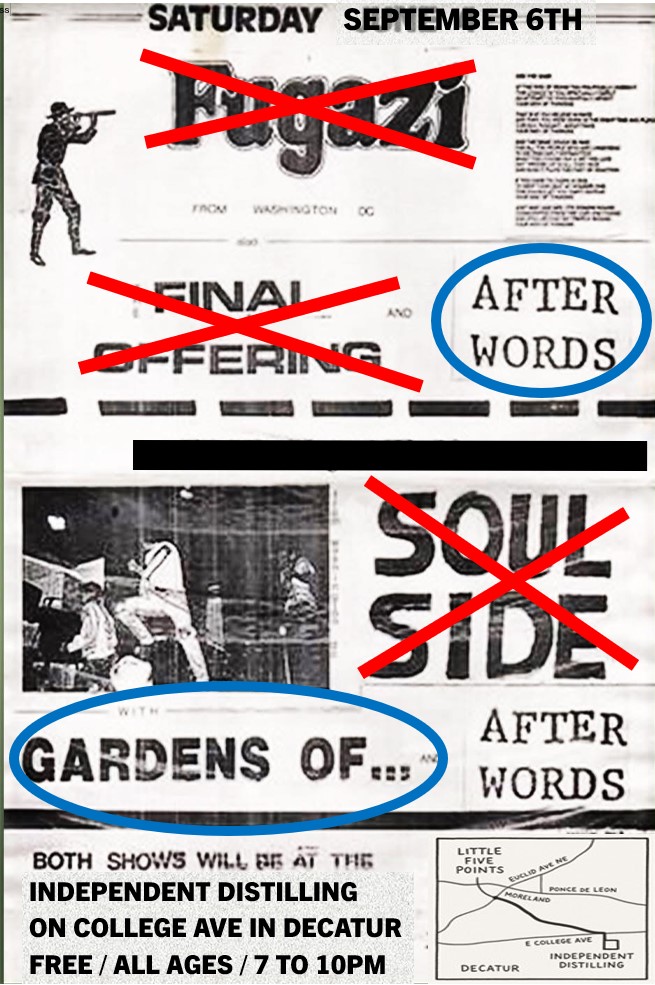
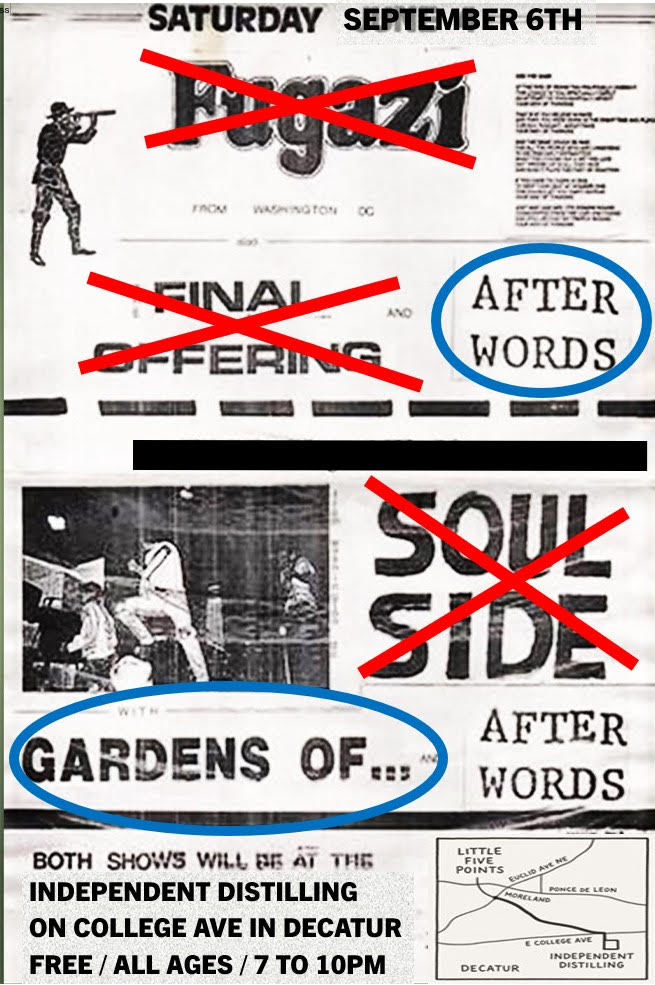
After Words plays with Gardens Of … on Saturday, September 6 at Independent Distilling Company in Decatur. Free. 7 p.m. (doors). 547 E College Ave., Decatur.

A version of this story appears in Record Plug Magazine‘s September 2025 issue.

If you have enjoyed reading this post, please consider donating to RadATL. Venmo to @Chad-Radford-6 or click on the PayPal link below.

Donate with PayPal

After Words and Gardens Of… play Independent Distilling Company on Saturday, September 6


After Words and Gardens Of… play Independent Distilling Company on Sat., Sept. 6. Free. All Ages. 7-10 p.m. 547 E College Ave, Decatur.

Atlanta’s mid-’80s hardcore staple Neon Christ played its final show in February of 1986. One day later, drummer Jimmy Demer, bass player Danny Lankford, and vocalist Randy DuTeau reconvened as Gardens Of… It was a new and ineffable post-punk outfit that thrived in the outer limits of punk and metal’s diffuse influence on underground and popular culture—well before the term “alternative” entered the canon.

“We never called it that,” Demer says. “We listened to a lot of Stooges and Black Sabbath at the time.”

Demer moved to guitar while Lankford remained on bass. Drummers and vocalists came and went. “We had lots of lineup changes and were never that great, but we played with the intensity of people who were sure they were great,” Demer adds.

Gardens Of… recorded one demo tape, but nothing was properly released. The group called it quits in ’89. Still, their presence on the local scene resonated—channeling punk and hardcore’s scorched earth ethos inward, transforming a confrontational sound into equal parts menace, groove, and rock ‘n’ roll. Their jagged, hypnotic sound peeled away the last layers of hardcore orthodoxy.

Now, 36 years later, Gardens Of… is back with a new lineup, new songs, and a more refined disposition.

During their original run, they shared stages with the Rollins Band, Social Distortion, Die Kreuzen, Bl’ast, Suicidal Tendencies, and like minded locals including Sabotortoise (who later became Melts), funk punk band Follow For Now, Mr. Crowes Garden (early Black Crowes), and No Walls featuring their former Neon Christ bandmate William Duvall, later of Alice In Chains. They also played with another DuVall band called the Final Offering, which featured Mike Dean of Corrosion of Conformity.

Gardens Of… also opened for Washington D.C. stalwarts Fugazi’s first Atlanta show at the First Existentialist Congregation in Candler Park, on June 4, 1988, along with After Words. After Words’ self-titled LP was released by Amanda MacKaye and Eli Janney’s Sammich Records in 1989. At the time, After Words were the only band from outside of Washington D.C. to receive distribution through Dischord Records.


“There were a couple dozen people there,” Demer says. “We had no idea what to expect from Fugazi. It was before they had released any music, and of course our minds were blown.”

Fast forward to the COVID era, and Demer was at home writing songs inspired by his early heroes. “It was time to get Gardens Of… together again to play this punk-metal stuff,” Demer says.

Lankford was in, and Brent Addison returned to drums. “He was the best of the four-five drummers we had back in the day,” Demer says. “We brazenly poached him from After Words.”

Vocalist Emily Lawson joined under unusual circumstances. At a karaoke party, Lankford and his wife Shelley heard her singing songs by Nine Inch Nails, Blondie, Prince, Beastie Boys, M.I.A., and the likes. “She sounded good and projected confidence,” Lankford says. “I invited her to sing in my basement—more informal, maybe less intimidating.”

Lawson had never played in a band, but revealed a powerhouse voice in new Gardens Of… numbers such as “Do It For the Kids,” featuring the lyrics: “Do it for believers squatting in abandoned factories / Do it for the cold case / Do it for its own majesty / For DRI and MDC / Do it for the ceremony / Do it for the summer sun / Do it, do it, do it for free.”

It’s a hard reset for a veteran act from a bygone era with nothing to prove. “We’re all better players now,” Demer says. “I had time during the pandemic to broaden my abilities as a guitar player and writer. The songs don’t sound like Dio or Black Flag, but they stand on their own nevertheless.”

A version of this story appeared in the July issue of Record Plug Magazine.

If you have enjoyed reading this post, please consider donating to RadATL. Venmo to @Chad-Radford-6 or click on the PayPal link below.
Donate with PayPal

TVAD takes on religion with their latest single, ‘The Island Song’

Raw and slowly burning tension runs through TVAD’s latest single, “The Island Song,” which takes shape as a stark meditation on the damage that mankind’s obsession with religion has inflicted upon the world.

With TVAD (Television After Death) recently paring down to a two-piece lineup, principal songwriter Dizzy Damoe—who prefers to not use his Christian-born name—handles guitar, synth, and vocal duties while working alongside bass player John Holloway.

Damoe is currently a member of Alanta’s purveyors of blackened doom and death metal Withered, and is a former member of sludge metal and post-hardcore acts Leechmilk, Sons of Tonatiuh, the Love Drunks, and Canopy. Holloway first made an impression in the bands Tabula Rasa and Of Legend.

“The Island Song” conjures an eerie atmosphere, built upon minor-key melodies and mechanical rhythms that recall the bleak romanticism of early Wax Trax Records releases, threaded through with brittle textures of post-punk and dark wave. Damoe’s guitar oscillates between shimmering ambience and sharp, metallic jabs, while Holloway’s bass carves out a grim undercurrent, grounding the song’s sprawling pace.

Cut from lyrics such as “They hunt, looking for a reason. The wolf, still eats all season. A child, may go hungry. But pray, and seek out your vision,” the song stares down organized religion with an unflinching eye. It’s tone is neither preachy nor dogmatic, but there are no minced words. Damoe delivers each line with a weary conviction, as though bearing witness to the long arc of history’s spiritual missteps. “The Island Song” doesn’t offer solutions, just stark reflection.

It’s a bold move — a track that walks a fine line between sonic exploration and thematic clarity. And for TVAD, it sets the stage for something bigger. If this is the first glimpse into the group’s forthcoming body of work, it’s clear they’re not pulling any punches.

TVAD’s next show is booked at 529 on June 12, which is Damoe’s birthday. A few more shows throughout the summer will be announced soon. Until then, press play on “The Island Song.”

If you have enjoyed reading this post, please consider donating to RadATL. Venmo to @Chad-Radford-6 or click on the PayPal link below.
Donate with PayPal

Melvins, Napalm Death, Weedeater, and Dark Sky Burial play the Masquerade on Sunday, April 27

MELVINS (left to right): Steven McDonald, Buzz Osborne, Dale Crover, and Coady Willis. Photo by Toshi Kasai

The Savage Imperial Death March thunders into Georgia when Melvins and Napalm Death co-headline a double dose of doom, noise, and grinding intensity.

On Sunday, April 27, Melvins and Napalm Death come together for a massive display of sound and fury on the Masquerade’s Heaven stage. On Tuesday, April 29, the same bill rolls into Athens’ 40 Watt Club, bringing chaos to the Classic City.

The tour falls on the heels of the February 2025 release of Savage Imperial Death March, a six-song collaborative LP released via Amphetimine Reptile Records. The six-song release is a crushing, howling monster of an album that finds both bands playing together, seamlessly merging Melvins’ sludge-soaked throb and Napalm Death’s relentless grind.

Melvins are also touring behind their latest release, titled Thunderball (Ipecac Recordings). It’s also the group’s most recent full-length released under the Melvins 1983 moniker, featuring Buzz Osborne, Mike Dillard, Ni Maitres, and Atlanta-based abstract electronic project Void Manes.

For this tour, King Buzzo’s riffs steer the ship, backed by the dual-drum assault of Dale Crover and Coady Willis and Steven McDonald’s fuzzed-out basslines. This incarnation of the band reignites the early Melvins aesthetic with renewed purpose and fire.

Meanwhile, Napalm Death continues its decades-long campaign of sonic obliteration, riding high on the aftershocks of 2022’s Resentment is Always Seismic–A Final Throw of Throes. Vocalist Barney Greenway remains a force of nature, while the band’s grindcore assault remains both savage and surgical.

North Carolina sludge lords Dark Sky Burial—a bleak, ambient-industrial project helmed by Napalm Death’s bass player Shane Embury—and Weedeater set the tone for each night’s proceedings.

$32.50 (advance). 6:30 p.m. (doors) at the Masquerade. This is an all-ages show.

$35. 6 p.m. (doors) at 40 Watt. Under 18 with parent or legal guardian.

If you have enjoyed reading this post, please consider donating to RadATL. Venmo to @Chad-Radford-6 or click on the PayPal link below.
Donate with PayPal

An Evening with Thurston Moore at The Tara: ‘Sonic Life’ book talk & ‘Desolation Center’ screening on Tuesday, December 10

Thurston Moore photo by Vera Marmelo

From the founding member of Sonic Youth, a passionate memoir tracing the author’s life and art—from his teen years as a music obsessive in small-town Connecticut, to the formation of his legendary rock group, to 30 years of creation, experimentation, and wonder.

https://www.acappellabooks.com/pages/events/1157/an-evening-with-thurston-moore-at-the-taraA Cappella Books welcomes Thurston Moore to The Tara to discuss his new book, Sonic Life: A Memoir, on Tuesday, December 10, at 7 p.m. Moore will speak with yours truly, Chad Radford, music writer and author of Atlanta Record Stores: An Oral History.

Following the conversation, The Tara will host a screening of director Stuart Swezey’s documentary film, Desolation Center, featuring performances by Sonic Youth, Minutemen, Meat Puppets, Swans, Redd Kross, Einstürzende Neubauten, and more. Moore will introduce the film.

Book Talk Ticket
Includes a signed paperback edition of Sonic Life and admission for the 7 p.m. book talk and signing. ($20 + tax)

Book Talk and Movie Ticket
Includes a signed paperback edition of Sonic Life, admission for the 7 p.m. book talk and signing, and the 8:30 p.m. screening of Desolation Center. ($36 + tax)

Movie Ticket
Admission to the 8:30 p.m. screening of Desolation Center. ($16 + tax)

About the Book
Thurston Moore moved to Manhattan’s East Village in 1978 with a yearning for music. He wanted to be immersed in downtown New York’s sights and sounds—the feral energy of its nightclubs, the angular roar of its bands, the magnetic personalities within its orbit. But more than anything, he wanted to make music—to create indelible sounds that would move, provoke, and inspire.

His dream came to life in 1981 with the formation of Sonic Youth, a band Moore co-founded with Kim Gordon and Lee Ranaldo. Sonic Youth became a fixture in New York’s burgeoning No Wave scene—an avant-garde collision of art and sound, poetry and punk. The band would evolve from critical darlings to commercial heavyweights, headlining festivals around the globe while helping introduce listeners to such artists as Nirvana, Hole, and Pavement and playing alongside such icons as Neil Young and Iggy Pop. Through it all, Moore maintained an unwavering love of music: the new, the unheralded, the challenging, the irresistible.

In the spirit of Just Kids, Sonic Life offers a window into the trajectory of a celebrated artist and a tribute to an era of explosive creativity. It presents a firsthand account of New York in a defining cultural moment, a history of alternative rock as it was birthed and came to dominate airwaves, and a love letter to music, whatever the form. This is a story for anyone who has ever felt touched by sound—who knows the way the right song at the right moment can change the course of a life.

About the Author
Thurston Moore is a founding member of Sonic Youth, a band born in New York in 1981 that spent 30 years at the vanguard of alternative rock, influencing and inspiring such acts as Nirvana, Pavement, the Yeah Yeah Yeahs, My Bloody Valentine, and Beck. The band’s album Daydream Nation was chosen by the Library of Congress for historical preservation in the National Recording Registry in 2006. Moore is involved in publishing and poetry and teaches at the Summer Writing Workshop at Naropa University in Boulder, Colorado. He divides his time between the USA and England.


About the Film
Desolation Center is the previously untold story of a series of early ’80s guerrilla music and art performance happenings in Southern California that are recognized to have inspired Burning Man, Lollapalooza, and Coachella, collective experiences that have become key elements of popular culture in the 21st century. The feature documentary splices interviews and rare performance footage of Sonic Youth, Minutemen, Meat Puppets, Swans, Redd Kross, Einstürzende Neubauten, Survival Research Laboratories, Savage Republic and more, documenting a time when pushing the boundaries of music, art, and performance felt almost like an unspoken obligation.

Directed by Stuart Swezey, the creator and principal organizer of these unique events, Desolation Center demonstrates how the risky, and at times even reckless, actions of a few outsiders can unintentionally lead to seismic cultural shifts. Combining Swezey’s exclusive access to never-before-seen archival video, live audio recordings, and stills woven together with new cinematically shot interviews, verité footage and animated sequences, Desolation Center captures the spirit of the turbulent times from which these events emerged.

If you have enjoyed reading this post, please consider making a donation to RadATL. Venmo to @Chad-Radford-6 or click on the Paypal link below.

Donate with PayPal

A few words from Record Plug Magazine about Corndogorama: The Musical

Corndogorama: The Musical. Photo by Sam Feigenbaum

Corndogorama is back! 

It’s been eight years since our friend David Railey—a veritable Vanna White to Atlanta’s indie rock scene—hosted the Corndogorama. The DIY summer music festival is known for its casual community-oriented atmosphere and marathon of local bands on stage.

This year’s resurrection may have seemed like a Record Plug event to the uninitiated. The magazine was a key sponsor and a curator of this year’s lineup, as we sought out and rallied the bands to play all three days—June 21-23, 2024. But make no mistake, Corndogorama is the brainchild of—and the birthday party celebrating—Railey’s decades-long tenure in Atlanta’s music scene. Remember his bands? American Dream? Ancient Chinese Secret? Casionova? Day Mars Ray? Jesus Honey? The list goes on. Corndogorama has endured countless ups and downs since it kicked off at Dottie’s on Memorial Drive way back in 1996.

This year was wrought with an equal number of ups and downs. But hey, we raised $2,515 for Upbeat: The Tigerbeat Foundation for musicians, a non-profit organization dedicated to getting struggling independent musicians back on their feet via an emergency grant program.

Over the years, my [Kip’s] bands (Haricot Vert,  Freemasonry, Chocolate Kiss, Clemente, Victory Hands, et al) have played various benefit shows. Oftentimes I never heard how the numbers turned out, so I wanted everyone to know what their collective efforts raised.

The attendance for Friday was decent, Saturday turned out great, and Sunday was a bust. But that’s okay. Three days in the June heat is a big ask. But the bands played on, and we appreciate every one of you who came out, said hello, and watched the show.

It was three days of musical triumphs and logistical catastrophes: No Corndog eating contest? No vendor tents? No flip-flop parade, no ass-kissing booth? No Topo Chico! That sucked! Oh well. It’s been nearly a decade since the Corndogorama went down, and some skills have to be relearned. We’ll be back next year stronger than ever.

Saturday’s crowd warmed our hearts, and it helped cover the whole weekend’s production costs. I [Kip] personally want to thank Amos, Van, and the whole  A Rippin Production crew for keeping everything running smoothly, despite Saturday’s murderous heat. They put in the work and kept the costs low to raise as much as possible for Upbeat. Thanks are also due to Shane Pringle, Tim Song, and Boggs Social & Supply, who selflessly took no money from the ticket sales. They worked the full weekend, relying on bar sales alone to cover their end. It’s a good thing y’all drank so much.

Shane’s band Bad Spell tore up the outdoor stage on Saturday.

Pabst Blue Ribbon was an excellent sponsor, donating kegs and money, and Music Go Round saved our tails by loaning us the outdoor backline. Topo Chico! Where were you? We waited for you with bated breath and hope in our hearts, but you left us hanging. 

Ups and downs. Maybe we’ll see you next year.

A sincere and exhaustive shout-out goes to all the bands that performed throughout the weekend; those who gave their time and delivered stellar performances reminded us of why we’re in this in the first place. And we know it’s a labor of love to practice even a short set, haul yourselves and your equipment across the city to the venue, put on a show under the squelching summer sun, and then break it all down, load it up, and lug it all back to the practice space.

Absolutely 100%, Corndogorama would not have been able to raise a single penny for Upbeat without your time and energy. We’re sending the most sincere thanks to all of you. There were too many bands to name here, but we see you, and we love you. All of you. Thank you for sticking by Corndogorama (see what we did there?). See you next year! Until then, check out Alexa Kravitz and Sam Feigenbaum’s photos from Corndogorama: The Musical. — Kip Thomas (with some help from Chad Radford)

If you have enjoyed reading this review, please consider donating to RadATL. Venmo to @Chad-Radford-6 or click on the PayPal link below.

Donate with PayPal

Melts and the strange case of ‘Salicoutin​ä​w’

Theo X of Melts. Photo by Jenn Brown.

The strange case of Melts’ long-lost album Salicoutin​ä​w begins in the winter of 1994. Drummer Andrew Barker, bass player Jo Jameson, and the group’s singer, guitar player, and principal songwriter Theo X had made the long haul from Atlanta to the snow-covered landscape of Minneapolis to record their full-length debut. After releasing the “667” b/w “Crusser” 7-inch single a year earlier on the Greensboro, NC label, 227 Records, the group was primed to cut the LP with 227. The label’s owner Jay Boone did the footwork, made the connections, and lined up a few days of studio time with engineer Tim McLaughlin at Amphetamine Reptile Recording Studios.

A few years earlier, the New York City-based noise rock outfit Helmet had become the subject of a major label bidding war. Ultimately, Helmet moved away from their home at AmRep to the more mainstream auspices of Interscope Records, to release their 1992 classic album Meantime. As a result of so many major labels clamoring to sign Helmet, AmRep Studios had become a well-funded, well-outfitted resource. Along the way, engineer Tim “Mac,” who also played bass with Minneapolis’ noise punk provocateurs Halo of Flies, had become a respected studio hand. 

“Some of the members of the bands Today is the Day, Mickey Finn, and Godplow had all spoken positively with us about recording with Tim Mac,” X says. The Melts frontman prefers using his pseudonym when discussing the band. “We were excited to work with someone who was well-versed in the language of recording loud and noisy music.”

After all, it was the early ‘90s. Nirvana was ascending to new commercial heights after releasing 1991’s breakthrough album Nevermind. The word “grunge” was splashed across newspaper and magazine pages worldwide, culminating in a clearly defined but increasingly clichéd sound and fashion trend—the grunge look.

Theo X at the L5P Pub circa 1991. Photo courtesy of Melts.

But beyond the mainstream’s myopic vision, an underground noise rock scene flourished, culminating in an era of sludgy, antagonistic, and guitar-heavy bands such as Cows, Unsane, Hammerhead, the Jesus Lizard, Skin Yard, Cherubs, Melvins, and more churning out raw rhythms and distortion that moved at the speed of molten lava.

The sheer sonic intensity of Melts’ thunderous rhythms wrapped in a penchant for debauched antics drew a wild, sometimes confrontational element out of the audiences who’d come to their shows.

Barker laughs when he recalls narrowly avoiding a scuffle one night when Melts shared the stage at Dottie’s with Cat Power and King Kill 33.

“We played the show and this guy got right up in my face,” Barker says. “He wanted to fight me or have me come back to his friend’s house so we could have a drum competition. He wanted to show that he was a better drummer than me. At first, I thought he was joking but it got a little intense until Jo stepped in and talked him down.”

On another night, Melts were kicked out of the Clermont Lounge for getting naked on stage and lighting a 500-count roll of Black Cat firecrackers during their set.

“The style of music we were playing wasn’t much of a genre yet,” X says. “We had a lot of good samaritans coming to us along the way telling us we were tuning our guitars wrong. The songs we recorded for the album are tuned in B. It’s low, and sound guys would come along and say things like, ‘Hey buddy, let me help you with that guitar so we can get it tuned the right way.”

In conversation, Jameson casually mentions the name Ernie Dale, pausing only for a second as X laughs. The former soundman for Little 5 Points’ fabled former music dive The Point, was well known for not putting up with foolishness of any kind. 

“Ernie is great, but if you had something that Ernie deemed to be a bad sound, he wanted to mentor you out of it,” Jameson says. “He couldn’t believe that we were intentionally making these sounds.”

Jo Jameson of Melts. Photo by Jenn Brown

Stories like these, coupled with the down-tuned guitars, heart-pounding drums, and the wide-eyed crawl of songs like “Grape,” “Jackdaw,” and “Cotton Hol” earned Melts a reputation as Atlanta’s answer to sludge metal pioneers the Melvins. But the 14 songs on Salicoutin​ä​w stamp in time a singularly creative and distinctly Southern group that defied expectations, rather than simply adhered to trends.


When promo CDs of Salicoutin​ä​w were mailed to college radio stations the album quickly gained traction. Salicoutin​ä​w even broke the CMJ LOUD 100 chart in 1994. But when a pressing plant failed to deliver the first pressing of finished CDs that had already been paid for, the high cost of working in the music industry in the ‘90s added up too quickly, and 227 Records went out of business. The promo CDs, featuring a primitive, last-minute cover illustration, had a greater reach than the finished product.

By the band’s estimation, maybe 100 copies of a later second pressing of the CD made it into the public’s hands. But it was too little too late. The group received boxes of CDs with the proper cover art, but any distribution 227 Records could’ve offered was long gone, and any steam the group had built up went with it. 

“I was blown away by Melts the first time I saw them,” Boone says. “I also adored them as individuals—still do! That’s why I have no animosity or was ever bitter about the shortcomings of the record. I still believe they could’ve done very well, but like so many things in life, shoulda, coulda, woulda isn’t worth dwelling on too much.”

With Melts, the 227 situation was only slightly better than the fate of their Athens labelmates Harvey Milk whose self-titled, Bob Weston-recorded debut album was shelved altogether. That album finally saw the light of day in 2010 when Hydra Head pressed it to vinyl.

Melts’s debut album has remained in obscurity ever since. 

“It derailed me,” Jameson says. “The tedium of working on a record—putting so much time and energy into it—and waiting for it to arrive was frustrating. Ultimately, Theo and I parted ways over it. I was pushing for us to rehearse and to play more shows. I was all of 24 years old and was a booger-eating moron. I had no idea how many roles [Theo] juggled with everything from negotiating the release to playing the music. As we’ve discussed in the last couple of years, we misunderstood what each other said,” he goes on to say. “I had quit the band in his eyes. I didn’t intend for that to happen, but whatever I said drew a line in the sand. He had so many responsibilities with this band. I was shortsighted about it. But we’re adults now, and 30 years later, I see it.”

Not long after Salicoutin​ä​w’s botched release the lineup dissolved. Jameson and Barker joined alternative country and Americana singer and songwriter Kelly Hogan’s band to release her debut album, The Whistle Only Dogs Can Hear. Jameson also did a stint playing with Archers of Loaf frontman Eric Bachmann in the band Crooked Fingers

Photo courtesy Andrew Barker.

Barker continued playing drums with the outsider jazz ensemble Gold Sparkle Band. He still regularly performs and collaborates with various artists around New York City.

From there, X kept Melts moving forward with new members over the years. In 2003 he moved to Fort Collins, CO where he started working with the psychedelic Americana outfit Little Darlings.

Now, 30 years later, a self-released double LP pressing of Salicoutin​ä​w has rekindled the group’s true power and allure, pushing the music and the English language into mysterious new realms of the imagination, while planting the band firmly in the present.

Jameson and X started playing music together in 1984 under the name Saboteur. They were high school kids by day, but their nights were spent practicing in X’s parents’ basement in Smyrna, crafting a hybrid of quasi-hair metal and thrash punk. By 1988, the band name morphed into Sabotortoise while they landed gigs at Atlanta’s storied downtown venue The Metroplex, opening up for nationally touring acts including LA Guns, Faster Pussycat, and Humble Pie.

Back then, X went by the moniker Ted Sunshine–different bands get different pseudonyms.

Melts was christened in 1990 when X and original drummer Tim Jordan recorded and released a cassette tape of early material titled As Noisy As We Want To Be.

Jo Jameson (from left), Theo X, and Tim Jordan of Melts. Photo by Steve Gaiolini.

Over the years, various members cycled through the group. In 1991, filmmaker Chad Rullman who later directed Mastodon’s “March of the Fire Ants” and “Iron Tusk” videos played bass in Melts. A year later, Jimmy Bower of NOLA sludge band EyeHateGod played bass for a stint.

Jameson’s initial run with Melts started in 1992 and lasted through Salicoutin​ä​w. In 2021 he was welcomed back into the group. Original drummer Tim Jordan also returned to the lineup.

Since his early teenage years, X’s writing style with lyrics and band names has remained somewhat impenetrable. Everything from changing the first band’s name to Sabotortoise to an album titled Salicoutin​ä​w to belting out songs titled “Vaccua 8 #3,” “Lessie,” and “Crusser,” X sculpts a jumble of words, letters, and numbers smashed together creating a wholly new mode of communication.

While pointing to the words on the album’s original cover, which is fully restored for the vinyl release, he explains them as though they are a Rosetta Stone to understanding his mashed-up style.

“On the cover you have ‘Sao’, like the Tao, and ‘sow’ like a mother pig,” X says. “You’ve got ‘Sally’ and then you’ve got cooties! And then chicken coop,” he says before phonetically singing, “Just like the white-winged dove sings a song, sounds like a chicken/Baby coop/Chicken coop. I borrow a lot of lyrics from Michael Jackson, George Michael, Madonna, and Stevie Nicks,” he goes on to say, “but I run them through a semantic discombobulator that turns them into some fresh pudding.”

To be sure, X’s lyrics evoke an absurdist’s sense of humor that lies somewhere in the vicinity of Marcel Duchamp’s dada-esque wordplay, Naked Lunch author William S. Burroughs’ cut-and-paste techniques, the Rev. Howard Finster’s primitive folk art, and an ecstatic Southern Baptist speaking in tongues. Still, his dynamics exist in their own avant-garde funhouse of meanings. Salicoutin​ä​w opens with “Weu know t’live must two/ Yer muther sells sunduh the blackiss/ But under won is a vacuum/ Every tin’shy.” 

When spelled out, the syntax appears to be nonsense, but it all makes perfect sense to him.

“It’s kind of like, before people were referring to music as emo, this was my version of that,” he laughs. “It certainly seems to have been very therapeutic.”

Jameson chimes in, adding in a deadpan voice: “You’ve just been granted unlimited access to step inside the mind of Theo X. Be careful in there.”

X continues describing his use of language as an amalgamation of emotions, energy, and warped synapses that he channels into Melts songs.

“My brain might have developed in a way that is slightly abnormal or has some sort of organic brain damage,” X says. “I have been around heavy metals, solvents, and thinners—in railroad car quantities—my whole life. Like, 50,000 square feet at a time in the middle of July and August with no ventilation. Also, my academic interests are in language and semantics, especially within religious texts.”

Melts circa 2024: Theo X (from left), Tim Jordan,
and Jo Jameson. Photo by Steve Gaiolini

During the COVID-19 pandemic, Jameson found himself listening to songs from Salicoutinäw after so many years. “I thought, ‘I really want to put a needle on these songs. Can we press just one or two copies so that I can have it on vinyl?’”

Pressing up such limited quantities of the record wasn’t feasible, but it started a conversation that brought X, Jameson, and Jordan together to play music. Their reconvening yielded a proper double LP release of Salicoutinäw. But there were hurdles to overcome before they had records in their hands. Chief among them was the artwork. 

In the late ‘80s and early ‘90s, the way to store big digital files for personal computers was on a removable 44- or 88-megabyte SyQuest drive. “It was about the size of an old 8-Track tape,” Jameson says.

They could be taken to Kinko’s, for example, where layout, design, and scanning were completed. The user would then pay for their time on the computer. The technology is long antiquated. After digging up X’s old SyQuest drive, the group’s friend, Record Plug Magazine’s Creative Director Andrew Quinn connected them with a specialist in California who was able to retrieve the files. After decades of gathering dust, everything was still in working order. Quinn led the efforts in reworking the album’s cover art and the insert, which includes a timeline of the band and everyone who was a part of it.

X, who produced Salicoutinäw made no alterations from the original recordings prior to handing them over to Morphius Records for vinyl production.

A record release party had to be booked. Barker played on the album, but Jordan is the band’s current drummer. X and Jameson delicately approached Jordan to float the idea of bringing Barker down from New York to maybe play three songs for the show. Jordan’s reply: “That sounds amazing! Let him play the whole show, I want to see that! I never saw Metls with Drew playing drums!”

The release party is booked at the Earl on Saturday, June 29, with Dropsonic and Magnapop sharing the bill.

As a historical document, pressing Salicoutin​ä​w on vinyl is a necessary step in correcting the past for Melts. It also gives the group solid ground to move forward once again. They pressed only 200 copies of the LP because “We think we can sell that many and not have them lying around for years,” Jameson says.

While they don’t have new material in the works, there is a tremendous backlog of older Melts songs that have never been recorded, including a follow-up album that X wrote, called Melts Inc., which was named after X watched all the episodes the “Melrose Place” spin-off series “Models Inc.”

“Because the first one failed so catastrophically to meet its audience, we
made a pact to work through some of the older rehearsal tapes and live
recordings before we say, ‘Let’s write a new song,’” X says. “We’ve been
rekindling some of that, and there is a lot of that stuff lying around, so there
is more to come.”

This story originally appeared in the June issue of Record Plug Magazine.


If you have enjoyed reading this review, please consider donating to RadATL. Venmo to @Chad-Radford-6 or click on the PayPal link below.

Donate with PayPal