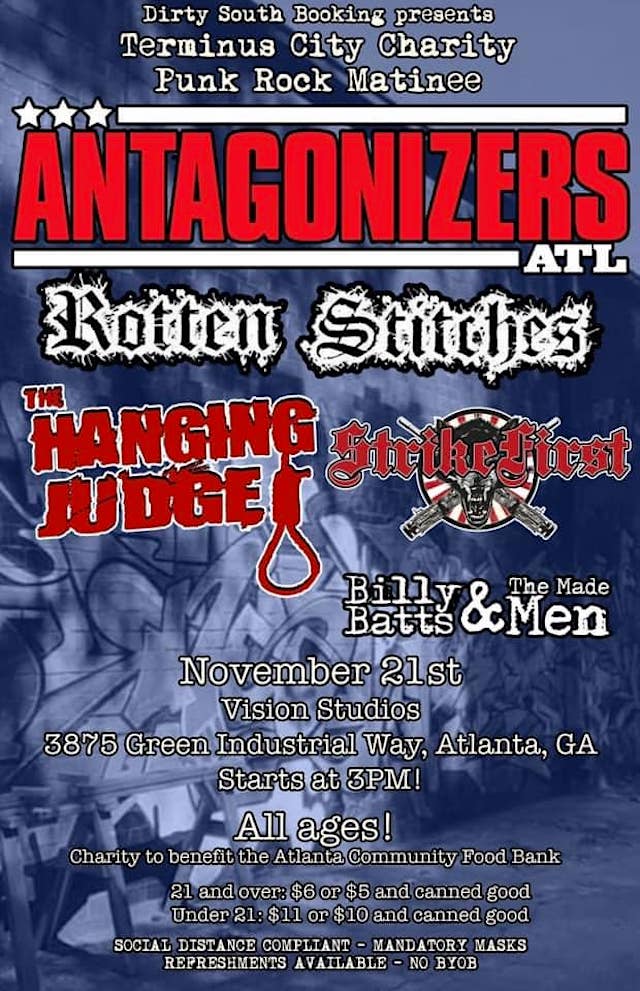
Antagonizers ATL, Rotten Stitches, the Hanging Judge, StrikeFirst, and Billy Batts & the Made Men play at matinee show at Vision Studios on Saturday, November 21.
This show is an Atlanta Community Food Bank benefit. Music starts at 3 p.m. Masks are required for entry. BYOB.
$6 (or $5 + canned goods) for 21+ $11 (or $10 + canned goods) for under 21
Withered and GG King play a live streaming benefit show to raise funds for The Earl’s staff. Friday, December 18. Donations packages are available for $10-$75. Music starts at 8 p.m.
If you have enjoyed reading this post, please consider making a donation to RadATL.
Antagonizers ATL are back with a new single, titled “Black Clouds.” It’s the first song to appear from the Atlanta street punk outfit’s sophomore album, Kings, due out in early 2021 via Pirates Press Records. The song picks up where the group left off with its 2016 debut, Working Class Street Punk. The message is powerful and direct: Build strength through self-reliance, and always maintain that time-honored PMA (positive mental attitude) no matter what obstacles life throws in your path.
The band’s indomitable spirit reemerges bolder than ever in “Black Clouds,” which comes to a head with the lyrics: “I see those black clouds overhead / Try to follow me until I’m dead / I close my eyes and laugh inside / Only the weak run and hide / I’m gonna swing to the left, swing to the right / Duck and dive ’till I’m out of sight / No damn clouds gonna hold me back / I’m on the move and I’m on the attack.”
“It can mean many different things to many different people,” says the group’s singer and frontman Bohdan Zacharyj. “We are all in different boats, just trying to stay afloat. No matter how hard you fight and how far you get ahead, there is always someone or something trying to keep you down. Use that as fuel to propel you farther, faster, and make you stronger.”
Zacharyj goes on to say the lyrics, “’Close my eyes and laugh inside’ serves as a moment for self-reflection, and a reminder to always stay the course,” he says. “When a horse wears blinders over its eyes it cannot see those who want it to fail.”
The 10-song album was produced and engineered by Matt Washburn of Ledbelly Sound. The group’s lineup has also shifted and expanded since releasing Working Class Street Punk. Bass player Wynn Pettitt and drummer Don Tonic join vocalist Zacharyj along with keyboard player Billy Fields, guitar player Richard Hendersön, and rhythm guitar player Eric Antell.
For “Black Clouds,” Matt Henson from Tacoma, Washington street punk outfit NOi!SE, joins in as a guest vocalist, underscoring the camaraderie and respect shared between the two bands. Henson, who is originally from Marietta, met Zacharyj when their bands played a show together in Seattle. They bonded over their mutual experiences in the Army’s Airborne Division, and even shared the A-side on a four-way split 7-inch for Pirates Press Records in 2019.
“I have found Matt to be a good friend over the years, and I thought this part on the record would be a perfect match for his vocal style,” Zacharyj says. “His band NOi!SE does a great job shining light on the armed forces, injustices, and fostering overall compassion for each other, and for humanity over all.”
Another song from the album that remains to be released, “Hold On, Hold Strong,” features a guest appearance by Monty NeySmith of the group Symarip. Keep an eye out for more information on their collaboration coming soon.
In the meantime, press play on “Black Clouds.” The song is also available as a picture flexi 7-inch free with any purchase from Pirates Press Records.
The specter of nuclear annihilation that hung over the Reagan era feels somewhat quaint now, in light of just how much President Trump’s draconian administration, the global pandemic, and the oppressive grind of social media have twisted up the American psyche circa 2020. Still, the 1980s were a fertile time for punk rock’s cultural growth on American soil.
In We’re Not Here to Entertain: Punk Rock, Ronald Reagan, and the Real Culture War of 1980s America, author and Connor Study Professor of Contemporary History at Ohio University Kevin Mattson delves into the golden era of hardcore, punk and DIY culture blooming in the shadow of the Gipper. Countering the oppressive forces of a conservative White House regime, a community bound by the music of groups such as the Dead Kennedys, the Dils, Minor Threat, the Avengers, Hüsker Dü, Bad Brains, Black Flag, and more was compelled to enact empowering social change that still resonates around the planet.
On Tuesday, September 29, Mattson will join GSU history professor and author John McMillian (Smoking Typewriters: The Sixties Underground Press and the Rise of Alternative Media in America, Beatles vs. Stones) and yours truly, music writer and editor Chad Radford, to discuss the book, the music, and more.
Aside from the two installments of his demonic classical song cycle, Black Aria I and II, Glenn Danzig has released only two recordings outside of the group context—not with the band Danzig, but as Glenn Danzig. In 1981, he reclaimed the Misfits’ “Who Killed Marilyn?” and “Spook City U.S.A” for a 7-inch single on his own Plan 9 Records. In 2020, he rolled out the disarmingly gentle Danzig Sings Elvis LP for Cleopatra Records, featuring 14 deep cuts from the catalog of the King of Kings.
When viewed as bookends of a nearly 40-year stretch of his career, both of these offerings illuminate a more mysterious, and a more human side of Danzig’s voice, presence, and persona.
The Misfits took their name from director John Huston’s 1961 film of the same name. When it comes to Elvis Presley’s influence, every punk kid in America recognized it the first time they dropped a needle on the Misfits’ 1982 LP Walk Among Us and heard that rockabilly werewolf howl unleashed in “I Turned into a Martian,” Vampira,” and “Night of the Living Dead.”
The film, The Misfits, was the last feature-length movie in which Marilyn Monroe starred before her untimely death—the culmination of depression and work-related exhaustion from trying to beat the public’s perceptions about her, chronic insomnia, and consuming prescription drugs upon drugs and alcohol.
Elvis left the building under similar circumstances. Both Presley and Monroe were such larger than life stars that their deaths have been surrounded by decades of speculation, rumor, and conspiracy theories.
This dark history and mythology is subconsciously transmitted when Danzig eases into the first lines of “Is It So Strange,” the opening number from Danzig Sings Elvis. His voice reveals subtle depth as he drops the Danzig facade that he has honed since the 1970s. There’s a sensitive, passionate human behind his barrel-chested bark, and he’s more of a multi-dimensional character than we’ve been led to believe.
Courtesy Evillive/Cleopatra
Danzig’s voice has softened over the years. The full-throttle yowl of “Mother,” “Her Black Wings,” “Dirty Black Summer,” “Kiss the Skull,” and “On A Wicked Night” has settled into a husky range. Here, a layer of reverb over his singing draws out honesty, frailty, and a pensive atmosphere in the album’s first single, a touching and ethereal rendition of “Always On My Mind” b/w “Loving Arms (alternative vocal).” Danzig’s spare guitar rhythms and percussion are brought to a fine point by Prong and longtime Danzig guitarist Tommy Victor’s leads, which underscore a self-styled and uncompromised elegance in re-imagining these tunes.
This can be a difficult pill to swallow for anyone waiting for the punk-metal hammer to drop. After all, there are live bootleg recordings floating around capturing the Misfits tearing into “Blue Christmas” in the early ‘80s. Danzig even called down the thunder with a ripping cover of “Trouble” for 1993’s Thrall: Demonsweatlive EP. So there’s a bit of a precedent for expectation to rock when it comes to this terrain. But Danzig Sings Elvis is a more introspective listen that embraces these songs’ original forms.
The album is executed with such matter-of-fact passion, and the songs are so deeply felt that it almost comes across as a novelty—at first. But Danzig’s interpretations perfectly combine his own soulful baritone with Presley’s drawn-out phrasing in songs such as “First in Line,”“Girl of My Best Friend,” and “Like a Baby.” So much so that it’s impossible to take in this record as anything other than a sincere homage, and a much needed break from the hard rock and heavy metal of latter era Danzig albums.
There is no mistaking the fact that Danzig is one of the greatest songwriters to rise above punk, hardcore, and metal, and his voice remains unmatched. If he has anything in common with Elvis Presley—and indeed Marilyn Monroe—it is an ability to find strength in being bold. What sets him apart, however, is a basic tenet of old school punk rock: Don’t give a damn about what anybody else makes of you. You’re not like the others. And when the rest of the herd cannibalizes itself, that’s when you thrive.
This is the message my antenna tuned into as a 13-year-old kid nodding along to “I Turned into a Martian.” It’s in the lyrics: “I walk down city streets on an unsuspecting human world. Inhuman in your midst, this world is mine to own, ’cause, well, I turned into a Martian. I can’t even recall my name!”
It’s a sentiment that resonates, albeit with a bit more resolve when he sings Elvis’ words as well: “And when you hear my name, you’ll say I’m from a strange world. But is it so strange to be in love with you?”
Nowhere on the album does this newly found energy burst with greater reverence than “Pocketful of Rainbows.” The song’s minimal arrangement, channeled through Danzig’s stylishly murky production, captures a glowing tension that feels as though the song could burst open at any moment. But the piano, percussion, and tremolo on the guitar sustain a vibe of hope and buoyancy.
Rare is the artist who can redefine their character so deep into a decades-long career. With DanzigSingsElvis, the voice and the man behind so much horror business with the Misfits, Samhain, and Danzig breaks the public’s perceptions about him, and breathes new life into his legacy. — Chad Radford
If you have enjoyed reading this review, please consider making a donation to RadTL.
There’s an energetic wisdom possessing every word of “Refine Me,” a new single and video from Harrisburg, Penn./Washington D.C. post-hardcore quintet Don’t Sleep. When the group’s frontman Dave Smalley sings, “You can wound but you can never kill me/You want me in a prison/Of your misconception/But I’ll keep breaking free/From your deception,” self-empowerment becomes the message and the means to rise above.
“Refine Me” is more a personal mantra than it is a political rant—part-Sun Tzu, part-Black Flag in its ruminations on gaining strength through facing adversity in life head on. Or as Smalley states: “It is important to be forged and refined by the flames of adversity. Let your enemies make you stronger.”
Smalley’s anthemic whooaaas and guttural voice project a lifetime of experience in hardcore—he sang with the brawny “Boston Crew” outfit DYS, in Washington D.C. He did a stint leading guitarist Brian Baker’s post-Minor Threat group Dag Nasty, and in Los Angeles he fronted the post-Descendents outfit ALL. He also sings with the recently rekindled L.A. hardcore staple Down By Law. Smalley’s presence alone embodies American hardcore’s melodic DNA. In “Refine Me,” his words are imbued with everlasting depth, resilience, and an openness that allows anyone within earshot to connect the dots and find their own meaning.
“One of the label guys suggested these words are important in today’s environment of folks struggling to ensure every person is treated with dignity and respect,” Smalley says. “I wrote the lyrics last year, and it’s really about personal struggle and overcoming that terrible feeling of betrayal, and coming out stronger on the other side. But if it applies to today, and can give someone hope to come through this current moment looking to be stronger and forged by today’s heat, I’m all for it,” he adds. “The best lyrics are the timeless ones, where the words impact the listener as a human being, but also can be applied to our human family as a whole, and apply to the world. Hopefully this song counts.”
In 2017, Don’t Sleep came out of the gate strong with the arrival of a self-titled EP (Unity Worldwide), followed a year later by the Bring The Light 7-inch (Reaper Records). The group hit the ground running with a string of Warped Tour dates, sharing stages with legacy harcore acts such as Sick Of It All, Madball, and Hare Krishna juggernaut Shelter. But after piquing so many ears the group has remained somewhat in the shadows. Of course, in 2018 Smalley was busy putting together Down By Law’s latest album All In (Kung Fu Records). He also releasedJoin The Outsiders (Little Rocket), the debut album from a new group he fronts with Spanish and Argentinian musicians dubbed Dave Smalley & the Bandoleros.
For Don’t Sleep, however, the downtime has been anything but idle. “Refine Me” heralds the September 4 arrival of the group’s debut full-length, Turn The Tide(Mission Two Entertainment). Smalley, alongside bass player Garrett Rothman, drummer Jim Bedorf, and guitarists Tom McGrath and Tony Bavaria have crafted a sound that expands beyond the tropes of classic hardcore with a balance of muscular riffs and angular rhythms over Smalley’s lyrical ruminations.
It’s a fresh take for a group that’s well aware of its hardcore roots, but isn’t willing to stay in one place for too long, or dwell on the past—literally and figuratively speaking. When the group hits its stride here, the music takes shape amid a powerful yet understated blend of visceral hooks and sophisticated instincts—the sound of five players going all in.
A laundry list of producers and engineers contributed to the album including Carson Slovak and Grant McFarland (August Burns Red), Walter Schreifels (Gorilla Biscuits, Quicksand, Youth of Today), Matt Holmes, and Battery singer Brian McTernan. The result is a sound that Smalley says was “a catharsis and a challenge” fleshing out. “It’s one I hope will have the same kind of impact for people that classic albums had for me when I was coming up.”
“Refine Me” offers just a glimpse at this new melodic identity the group has honed with Turn The Tide, promising a purgative and empowering blast of songs that are hellbent on a brighter future.
Check out some new releases from Missing Fink Records on the Friday Night live stream, June 26. The label is spinning some new vinyl offerings from Zombierella, the Hurricanes, Silent Horror, and more. Tune in at 9 p.m., and keep your eyes and your ears peeled for some free giveaways.
Colonel Records comes out of the gate strong with Protest & Survive, a friggin’ 42-track compilation of covers, rare, live, and unreleased songs that benefits ActBlue, and other legal aid organizations providing bail funds for protesters and activists who are rallying to fight police brutality.
GG King, WYMYNS PRYSYN, More, Hyena, All Night Drug Prowling Wolves, Mongo, and many more Atlanta-based punk, post-punk, hardcore, and garage rock acts dominate a tracklist that also includes songs by Fletcher C. Johnson, U.S. Prisms, and the likes. Check out the full tracklist below.
The Protest & Survive comp is available via Bandcamp. It’s also pressed in a limited edition of 50 cassette tapes. Grab one before they’re gone, and support those on the frontlines, pushing for positive and lasting social change.
Tracklist:
Douglas Graham: “Angela Davis”
Tropical Trash” “Messenger (Wipers cover)
GG King: “Melt On You”
Paralyzer: “Paranoid Youth”
Hyena: “Divisions”
Long Knife: “No Rule” (Leather Nun cover)
KPF: “Stress City”
Blackout: “Eating Gas”
Ryan Dino: “North Star”
WYMYNS PRYSYN: “Lifeform”
Neuflesh: “Coward World (Fuck 12)”
Tropical Trash: “Korgüll The Exterminator” (Voivod cover)
The Wilful Boys: “Muttley”
Bob Mann: “Can You Come Home”
Fletcher C Johnson: “Eventually”
Shaken Nature: “Pony Don’t Cry”
Rude Dude and the Creek Freaks: “World On Fire”
Groovy Movies: “If You Wanna Go”
Baby Shakes: “Down”
All Night Drug Prowling Wolves: “Not Messing Around”
Metalleg: “Ride Along”
Mongo: “Degenerate”
Paint Fumes: “Guess Who”
The Schamones (feat. Members of Paralyzer and All Night Drug Prowling Wolves): “I Wanna” (live Ramones cover)
Ladrones: “Remedio”
Snoopy and The Who?!: “My Regeneration”
Cuss: “The Cause”
More: “Hourglass” (Wurve cover)
Subcults: “Quarantine Dreams”
Jordan Jones: “New Year’s Eve”
Rikky IV: “Capable Of”
Bad Moods: “New Song About An Old Ghost”
Fuck Knights: “We’re All Essential”
U.S.PRISMS: “State Control” (Discharge cover)
Pagan Girls: “Chezron (Time Prescribes the Medicine)”
Space Program: “Smoke & Flames Engulfed The Secret Hideout”
A Drug Called Tradition: “Killing Game” (unreleased)
Warm Deltas: “Face of the Mountain”
Vow: “Endless Roads”
Brother Hawk: “No Room For Rust” (Live)
Thousandaire: “Thumb” (Dinosaur Jr. cover live)
Ian O’Neil: “Brown Eyed Handsome Man” (Chuck Berry cover)
Bob Glassley was a man out of time. He was a hardcore sleeper cell who reawakened in 2016 with the uncompromising spirit and forgotten insights of Los Angeles’ early ‘80s punk snarl…in Atlanta. And he arrived like a thief in the night.
James Joyce called me that summer to ask if I remembered or knew anything about an old punk band from California called the Cheifs. He explained to me that he had been tapped to play drums with a new version of the group and wanted to know if I was interested in doing a piece on them for Creative Loafing. It wasn’t long after that we were all gathered around a table at Manuel’s Tavern discussing the legend of the band, and listening to Bob’s stories about his involvement in the early West Coast hardcore punk scene. Absorbing so much Cheifs history and lore was like discovering another great band that had been there all along, albeit buried by the sands of time, now uncovered and brought into full view.
At the end of 1982 in a set of circumstances singular to Bob’s life, he stepped away from punk and playing music altogether. He traded his bass for a computer and never looked back. As a result, his knowledge and familiarity with punk was a perfectly preserved time capsule. It also fostered a beautiful state of arrested development; he knew West Coast punk circa 1978-1982, but nothing beyond that. However, he understood the art of the outsider, the art of being an individual driven by righteousness, and the self-reliance of punk before fashion and hairstyles eclipsed the lifestyle, and before mainstream attention introduced the elements of violence and intolerance that ultimately pulled the scene apart.
Bob’s return to music was a reaction to right-wing influences gaining a stranglehold on America. He took a no-bullshit political stance –– he was outspoken with his opinions, and punk gave him direction and purpose in the shadow of the Trump presidency. But Bob also projected a raw, down-to-earth wisdom, and a forgotten knowledge and etiquette that affected everyone with whom he crossed paths, from his bandmates to the faces in the crowd. While loading out after playing shows at The Earl and 529 in East Atlanta, he connected with homeless people who were asking for spare change. He treated everyone with dignity and respect.
With the new Cheifs lineup in place, the group gigged hard in Atlanta and eventually the Los Angeles area. Bob seemed to know, maybe subconsciously, that he didn’t have much time left on earth. Not wasting any time, the group played and recorded as quickly and as often as possible. Whenever Bob took the stage wearing a “We the People” T-shirt (brandishing an image of the Constitution of the United States), he embraced the audience, reveling in the moment and screaming defiantly into the void of mortality.
On Tuesday, October 17, 2017, Bob unexpectedly died of complications related to liver cancer. He had been diagnosed with the disease a mere two weeks prior. He was 58. The following Saturday the Cheifs were set to play a sold-out show at the Masquerade supporting the Descendents, a big coup for the new lineup. Just four nights after his death, the Descendents opened the show by unleashing the most powerfully cathartic blast of “Everything Sux” the group had ever performed.
During the encore, James, Brad, and Scott joined Milo and Karl on stage for one last send-off, playing four final Cheifs songs as a dedication to Bob, and to all that the new lineup had worked to create.
The four songs captured here are bookends to the Cheifs legacy. Both “1988” and “Heart In Chains” were originally written and performed by Bob’s pre-Cheifs band, Portland, Oregon’s Rubbers. On the B-side, “Alienated” is a new jam that Bob penned. Loosely based on a forgotten early Cheifs song, “Mechanical Man” was partially reconstructed from memory, and hammered into a new form by the current lineup.
The 7” single you now hold in your hands stamps in time the one-year period of intense creativity and rediscovery that Bob and the reignited Cheifs unleashed. The distillation of ’80s punk songwriting and hardcore’s graceful, physical melodies, filtered through a lens of contemporary production, is filled with a new fire and spirit, channeled into a lifetime of fierce, empowering, and truly timeless songs. Fuck cancer. Cheif Out! — Chad Radford
FREAK SCENE: Misanthropic Aggression is Tyler Peacock (left), Chris Hammer, and Jake Benedict. Photo by Alison Benedict.
“Alcoholic Polyneuropathic Freaks in Hell” — it’s a phrase that captures a colorful, albeit accurate, snapshot of most Georgians’ mental state as we grapple with the realities of returning to life after sheltering in place over the last month. It’s also the title cut from Misanthropic Aggression’s latest 7-inch on Boris Records.
On the heels of releasing 2018’sInability to CopeEP, bass player and lead vocalist Jake Benedict, drummer Tyler Peacock, and singer and guitarist Chris Hammer are back with three-songs that plunge the group’s blend of hardcore, thrash, black metal, death metal, and crust punk into much greater depths. Benedict’s low rumble and Hammer’s demonic shriek create an urgent tension over Peacock’s staccato rhythms. After live-streaming a 7-inch release party on April 20, Benedict took a few minutes to talk about the new songs and finding Misanthropic Aggression’s sound.
The Alcoholic Polyneuropathic Freaks In Hell 7-inch is Misanthropic Aggression’s first new release since 2018, correct?
Yes! The first thing we did after releasing Inability To Cope was to write the song “Blacklisted.” I had already written the guitar riff, so we started arranging it. We worked for about a year and wrote “Black Listed,” then “Retirement From Life (Last Day of Work),” then “Alcoholic Polyneuropathic Freaks In Hell.” Chris came up with the title for that one.
That song feels timely, as many Georgians are struggling with Governor Kemp easing up on the shelter-in-place order.
Yeah, because you’ve been at home for like a month, drinking too much, and you feel like you’re in hell!
We played with Sanguisugabogg at 529 on March 11, 48 hours before the shit hit the fan. The morning after, I got an email saying my son’s school is canceled effective Monday. He hasn’t been back since.
When we played on March 11, COVID-19 was already here. People were wigging out, about half the normal crowd was there, and people were already wearing masks. They were high-elbowing instead of high-fiving. It was a trippy night.
You know there’s a problem when even the crust punks are washing their hands!
Big time! There was a line out the bathroom door all night, just to use the sink!
“Retired From Life (Last Day Of Work)” is the second entry in a catalog of anti-active shooter songs. “Active Shooter Syndrome (A.S.S.)” from Inability To Cope was about the Mandalay Bay shooting in Las Vegas. I heard the news about it and wrote that song. “Retired From Life …” is about the poor guy who worked in the security shack at the FedEx facility in Kennesaw, maybe six-seven years ago. Basically, he was shot in the gut with a shotgun and lived, but he’s had 80-90 surgeries since then.
I thought about how lyricists like Chris Barnes from Cannibal Corpse write. As a kid, it was terrifying to read first-person perspective songs about being murdered. To twist it in with the urban style that we’ve always had I did a first-person narrative about being killed on the job. I was almost afraid to do it because it’s pretty controversial. But the lyrics are so clearly anti-shooter that it won’t come across like we were glorifying it. But it is supposed to be horrific.
Have you published the lyrics?
The lyrics aren’t posted anywhere yet. I’m such an amateur when it comes to actual music industry stuff. After the records are produced, your PR campaign starts. So as soon as you send off the masters the records get pressed. Then Perfect World Productions, who’s doing our PR, sends out press kits. Once the records come in they get sent out for distribution. Boris Records has distribution through MVD. That takes an additional four weeks. I didn’t know all that, and when we picked the April 20 release date I was working off of my DIY experiences: ‘The records will be here and we’ll get in the van and go!’ The 4/20 release date isn’t official. The distributor’s release date, and the reason it’s not on Spotify or anywhere else yet, is June 8. That’s when I think we’ll post the lyrics.
As soon as we finished this one we turned around and finished a new song for the next record. I want to write about COVID-19, but I need to approach it carefully. It’s a slippery slope talking about this virus; you could easily upset people’s political sensibilities, and I don’t want to be seen as a political band. So I’m figuring out how to approach it lyrically.
That’s tough. The anti-active shooter songs — talking about real-world incidents of gun violence — can easily be construed as being about gun control. It doesn’t get more political than that!
Yeah, it could be taken that way. Personally, I see a pattern of antisocial narcissism at work in these shooters — lonely, loser-types, incels who are incels because they have no personality. I noticed that a lot of them have these traits in common. That’s kind of what made me want to chronicle these incidents, and have more than one song about the subject. The title, “Active Shooter Syndrome,” is a play on “active shooter situation.” In my opinion, there seems to be a syndrome here.
What has changed for the group between these two releases?
It’s a cliché, but we’re figuring out our sound. We had this idea to mix five musical genres: punk, thrash, death metal, black metal, and crust. The first release leaned heavily toward punk and hardcore — we had the cover of SSD’s “Boiling Point.” There were hints of death metal, especially in the long musical section in “Herd Rejector/Unbound Descent,” which Chris composed. There are some sludgy parts, some death metal parts. With the new release we went for more of a first wave black metal sound. If you listen to the long section right after the first chorus in “Alcoholic … ,” it has a second wave, almost Gorgoroth or golden era Dark Thrown back-and-forth going on. Real grim black metal. There’s a lot going on in that song, and I don’t want to sound like I’m tooting my own horn, but I’m really proud of it.
MISANTHROPIC AGGRESSION: Chris Hammer (clockwise from left), Jake Benedict, and Tyler Peacock. Photo by Chad Radford
Tell me about the sample at the beginning of “Alcoholic …”
Chris did that. It’s the voice of James Dickey, who was a poet laureate in ‘66. He wrote Deliverance.
The lyrics for that song are two-pronged. I have developed alcoholic polyneuropathy, I guess from drinking liquor for 13 years. I’ve started getting real bad tingling in my hands and feet, my skin and scalp crawl, I break out in hives. So the lyrics are about my personal experiences with it, but it’s also a warning to learn better coping mechanisms than substances. It’s definitely in keeping with my amateur psychology that I like to incorporate.
At the end of “Alcoholic …” we take a hard left turn into a weird death metal theme, which is a riff that I wrote. Sometimes I’ll write parts for Chris, but in this song, the whole end, I said, “You do whatever the hell you want, man. These are the parts I wrote. This is the subject matter. Run with it.
Impetigo is a gore-grind band from Illinois, from the late ’80/early ‘90s. They rule, and their vocals have a real strong influence with all the echo and trippy, kind of rubber banding in and out that you hear.
ALCOHOLIC POLYNEUROPATHIC FREAKS IN HELL: Artwork by Warhead Art.
Who did the artwork?
The artwork was done by a Ukranian artist who goes by Warhead Art. He’s done three pieces for us — he did the centerpiece. Chris did the layout. The art is in the middle, and there’s a frame with little stars in the corners. Chris did those, and hand-drew the “Alcoholic Neuropathic Freaks In Hell” logo around it. The stars represent the synapses misfiring in your body due to alcoholic polyneuropathy. It’s what causes the pain, which I thought was a cool idea. The photo on the back with the bricks was taken at the ruins of an old civil war-era mill — Nickajack Creek — up near Smyrna.
The idea was to keep it real simple. No lyrics sheet, no insert, no thank you list. It’s just three songs. The whole thing is influenced by the old Amoebix, Anti Cimex 7-inches; real simple, old-school hardcore shit.