If you ever caught an earful of “Destroy All Music” on WREK-FM in the 1980s, flipped through the dog-eared pages of LowLife Magazine, or caught Glen Thrasher behind the counter at A Cappella Books, you already know: Glen didn’t just participate in Atlanta’s underground—he defined a large part of it, for a long time.
Thrasher passed away Saturday morning, May 3, leaving behind a secret legacy that pulses through every DIY show, noise set, and scribbled flyer that still dares to push Atlanta’s arts scene off the rails and into uncharted territory.
He was 66 years old.
In the early 1980s, Glen and co-host Ellen McGrail transformed “Destroy All Music” into a beacon of chaos and possibility over Georgia Tech’s 91.1 FM airwaves. No wave, free jazz, tape hiss, post-punk, and basement weirdness—nothing was too far out. The show carved space for unclassifiable sounds and stood as a lifeline for seekers and soundheads. McGrail and her partner Tony Gordon still co-host the show every Wednesday from 9-10 p.m., proliferating a testament to Thrasher’s curatorial nerve.
The Destroy All Music festivals that Glen and Ellen created gave a stage to the likes of Dirt, Lisa Suckdog, Freedom Puff, Col. Bruce Hampton, Tom Smith’s Peach of Immortality, Cake (Tracy Terrill), and Chattanooga’s Shaking Ray Levis—local and regional acts who existed outside the realm of mainstream music and culture.
LowLife Magazine issue no. 17.
From 1984 to 1992, Thrasher published LowLife, a Xeroxed, cut-and-paste document of Atlanta’s disreputable brilliance. It was more than a zine—it was a transmission from the city’s cultural underbelly. Fiction, comics, mail art, anti-authoritarian rants, interviews with skronk warriors and tape-traders—LowLife captured the friction and fire of a city in flux. Issue # 17 featured Magic Bone’s Debbey Richardson’s quiet smile on the cover, which is forever etched into the collective memory of anyone who ever scoured a punk distro table at any record show or zine fest.
Thrasher also played a role in the creation of Cat Power, playing drums behind Chan Marshall in the earliest iterations of the project. Glen once relayed that while playing music with Chan, they booked their first show, but did not yet have a name for the band. He called Chan who was working the cash register at Felini’s Pizza in Little 5 Points. Glen said, “We need to have a name, tell me something now or I’ll just make it up.” The customer waiting in line to order a slice of pizza was wearing a Cat Power Diesel trucker cap. She said to Glen, “Cat Power,” and the name stuck.
Thrasher later drifted north to New York in the ’90s before returning to Atlanta where he continued writing and working at A Cappella Books. Through it all, his compass never strayed from the outside path, and his critical wit never waivered.
I worked at A Cappella Books with Glen for years, where we spent long hours behind the counter, talking about politics, books, the music of Pere Ubu, Sonic Youth, the Dog Faced Hermans, Cecil Taylor, Mary Timony, and too many others to recall. He had an encyclopedic knowledge. He could be an intellectual antagonist in one moment, and a warm and engaging companion in the next. It was all in the interest of honest debate and raging against a cultural slide into right-wing politics and modern technology dulling our collective senses. “Why be any other way,” he once laughed, and it made him a true friend and mentor.
He didn’t just know where to find the good stuff—he was the good stuff. His year-end lists were impenetrably comprehensive: a treasure map for the eternally curious. I can’t count how many records, zines, or strange new ideas I encountered because Glen had the foresight—or the infectious enthusiasm—to share them.
Glen Thrasher was a beacon, a connector, a beautiful noise in a world that too often chooses silence. Atlanta’s underground has lost one of its true architects, but his work, his spirit, and his sonic fingerprints remain etched in the grooves of every misfit creation that follows.
Rest in power, Glen. The signal carries on.
If you have enjoyed reading this post, please consider donating to RadATL. Venmo to @Chad-Radford-6 or click on the PayPal link below.
James Brandon Lewis (left) and the Messthetics (Anthony Pirog, Joe Lally, and Brendan Canty). Photo by Shervin Lainez.
With their third and latest album, The Messthetics and James Brandon Lewis, Brendan Canty, Joe Lally, Anthony Pirog, and James Brandon Lewis deliver a compelling blend of jazz and post-hardcore inflections, where Lewis’s saxophone intertwines with rhythmic intensity and experimental tones.
Canty and Lally, best known as Fugazi’s drummer and bass player, infuse the album with their trademark energy anchored by deep grooves. Pirog adds layers of sonic texture amid challenging twists and turns.
Before making their way to Atlanta to play The Earl on March 26, Canty, Lally, and Pirog talked about the creative process behind the album, working with Impulse, and the ins and outs of their favorite songs on the album. Lewis was busy playing a show in Zurich.
How did you meet James Brandon Lewis and start playing music with him?
Anthony Pirog: I met James about 10 years ago during a recording session in New York that the drummer William Hooker organized. It was a quintet: William was on drums, Luke Stewart on bass, Jon Irabagon on sax, James on sax, and I was on guitar. It was for an album called Pillars… At The Portal.
James and I liked each other’s sounds. When the recording was over we went out and got something to eat and started talking. He asked me to record a couple of records with him and to do some touring with him in Europe and the US.
When the Messthetics were asked to play Winter Jazzfest in New York in 2019, I thought it would be a good idea to have James sit in with us. He played three songs, and almost every time we’ve been in New York after that he’s sat in with us.
Joe Lally: We had played the Winter Jazzfest, and it just happened. It was hard to understand what happened because it happened while we were playing live. It was great, but then it was over and James was gone. It’s not like we got to hang out and get to know him or spend any time with him. Later, we were back up there for a show at the Bell House and we asked him to play with us.
This time, we had a little more time to assess him joining us. We got to talk about the song that he would join us on, and what we might do backing him up. That little bit allowed us to get a handle on it, and it felt good. Then COVID happened and a bunch of time went by. It was awful and lonely. At the end of it, we were getting out and playing again, and we were doing a show at Union Pool. James asked us if we would contribute a track to the record he was doing at that time.
And that’s the song called “Fear Not” on his album called Eye of I.
Lally: That’s the song! At Winter Jazzfest, we played the electric Miles “Black Satin,” we did Anthony’s tune “Adonis Painter,” and we did “Serpent Tongue.” At Bell House we did “Serpent Tongue” and we did “Once Upon A Time,” which is a Sonny Sharrock piece.
Anthony told us the day before we went up to play New York that James said if we came up the evening before—if we got there early enough—we could record in Brooklyn. So we went up early and recorded that song with him. We didn’t know what he wanted us to do, but Anthony had played that song with him before.
Pirog: I had only played it once before with him in a quartet in Catania when we had our residency over there.
What did James bring out of the Messthetics?
Lally: We get to be more Mess-thetic!
Brendan Canty: We’re Messthastecising [laughs].
Lally: Playing with James has amplified everything that we’ve reached for and everything that we’re capable of doing, and he has helped us reach even farther.
Canty: Playing with James has allowed me to play a little louder, honestly. He also reinforces a lot of the melody lines that Anthony wrote and turns them into these beautiful soaring pieces.
Anthony and James are good at playing with each other and on top of each other in complementary ways where they sound like one instrument. Anthony supplies these beautiful bell-like transient sounds and James has this big warm body. I hope that doesn’t sound too sexy, but it’s true [laughs].
Lally: There’s a simplification going on within us as far as the writing goes. We’re kind of minimalizing everything to allow for creative ways to carve out spaces that allow James and Anthony to fill in. It’s not like it’s easier to write; it’s that it’s more clear.
Canty: There is a certain level of abandon to these songs which is pretty inspiring. I have always felt that while playing with Anthony. One of the great things about playing with him is that we’re playing on stage and suddenly he’s pushing us to go somewhere completely different just to support him on a journey into cacophony.
Some people view Anthonly as a virtuoso, but I also know that he is the ultimate noise artist. I love being pushed into all of these different areas. James does the same. When people show up and play with that level of commitment and that level of ambition in terms of exploring and pushing the room around a little bit it gets exciting quickly. Every moment of the gig I’m playing catch up, and I’m trying to go with them to these places. It’s a blast.
With Joe and I there’s like an ESP in terms of playing together. We just go there with them. It’s a liberating way to play.
How is releasing an album on Impulse different from working with Dischord Records?
Lally: It’s a hard thing to describe because we have spent all of our life at Dischord. This record has barely come out, so we don’t know what it’s like.
Everyone we’re dealing with at Impulse is nice. There’s a big team there. That’s different. Dischord has like five people that make up the label. At the same time, this is the first record I have done where I feel like it’s just going to go away into the world. With my other records, everything else I’m involved with, it’s like my friend has them. They live there. I know where they are, and they’re taken care of. I feel like they’re being protected. This is the first one that’s going out into the world and now it’s gone.
I have a lot of respect for so many of the artists that I love who were and still are on Impulse. Being on a label with Irreversible Entanglements is fantastic!
Canty: Without getting too much into the business side, we’ve been working with a great bunch of people who seem to listen to us and allow us to control every ounce of content that we want to put out into the world. I’ve made all the videos myself. We’ve shot everything. I edited them all.
What happened, Chad is that we made the record first. Then Impulse heard it and got us excited. I sent it to my friend at Impulse and they said “We totally want to put this out.” So the music came first. I said, “Let me talk to everybody about it. I talked with Ian [MacKaye] about it. He said, “This sounds awesome!”
Everybody was excited about it. It’s working out fine so far. As long as we can keep it on our own in terms of how it’s being presented. They haven’t messed with any of the audio bits at all, and we got to do everything we wanted to do with it.
They didn’t say boo to us about it, about the mixes, or about anything we used. We mastered it. We got Bob Weston to cut the lathes, and they’ve been creative about distribution. They’ve worked with us. So far so good.
Lally: Making this decision about stepping away from Dischord is a really weird idea. Even if it’s just for one record it’s a weird idea for me. At the same time, what we’ve made with James is really different. It’s not like the other Messthetics records. Frankly, it all happened so fast! Brendan passed it along to somebody who is now suddenly saying, “Impulse really likes this!” It was hard to try to do anything with anyone other than Impulse because I was thinking of James and Anthony. We had to do this for them. This is too good. This is the music they’ve worked really hard at making. A huge part of it for me was we have to do whatever we can to see if this can work, and it’s been worth it.
Canty: I want to add that in no way do I ever want this to be reflected upon as us being dissatisfied with Dischord.
Lally: Dischord has always been so supportive of us, and still continues to be family. Ian has always been open to his bands trying different things and answering questions. He gave us his blessing. Working with Impulse for this record is just that circumstantial. The opportunity came up and it felt like the right thing to do for Anthony and James. It’s something that happened at that particular moment. I seriously see us recording for Dischord in the future.
You’re also bringing James’ fans to Dischord, and Fugazi and Messthetics fans to Impulse.
Canty: That’s the thing that’s so interesting about all of this, it’s the dialogue that’s coming with it. Everywhere I book a show in Europe or the US, I’m asking, “Is it this kind of show? We were invited to play the Vancouver International Jazz Festival and the Winnipeg Folk Festival, Hillside Festival, Big Ears, Treefort Music Fest, and Primavera. We’re getting rock festivals, jazz festivals, and folk festivals. It truly makes me feel proud that we’re able to play all those things while making music that I think defies categories. … Even if it’s on a jazz label [laughs].
Anthony, you have worked with indie labels like Cuneiform Records and Sonic Mass. What’s it been like working with Impulse?
I can only say positive things. My first record came out on Cuneiform when I was 32 years old. That didn’t seem possible. Then, hooking up with Joe and Brendan and being on records that came out on Dischord never seemed possible. And now this. I feel incredibly lucky that I’ve been able to work with these outlets.
In the six degrees of separation game, you’re connected to everyone from Moor Mother to John and Alice Coltrane to Minor Threat.
Pirog: Yes, and we’re all still processing that.
Joe, do you have a favorite song on the record?
I hesitate to say, but there’s something about the first song, “L’Orso.” It was such a strange thing for us to get a hold of. I remember when Anthony presented the riff to us, I spent the rest of the day being frustrated about not understanding where I was in the riff. Every time I tried to play it, I was just like, “Oh my God, I almost have it, but where am I? What comes next? I was always so lost in it.
The next time we got together to play with Anthony, I was like, “I don’t know, man. I don’t know if this is entertaining to play. When I tried playing it for him, he said, “Wow, you kind of know it. I haven’t even learned it yet.” I felt like I was banging my head against the wall with it. It was just a different type of song for us. It was a hard one for us to get a grip on, and when we finally did it, it felt great.
Canty: “L’Orso” is one of my favorites to play. I always like the songs that feel like they’re pushing things a little farther than we’ve ever done before. And the melody that Anthony came up with for this one is ridiculous in the best possible way.
I love how understated it is, but it has this really tricky melody. Then James and Anthony destroy all the solos. It makes me happy. Beyond that, I like “Three Sisters” as a whole.
Anthony, what’s your favorite song on the record?
Before I talk about that, I want to say that Joe told that story about learning “L’Orso.” That song is really hard to play, and I wanted to throw that in there. I am very proud of that song, and I am very proud every time I get through the melody.
Brendan brought up “Three Sisters.” I believe that’s the first full song we wrote before we started talking with James—after taking a break during COVID.
And it’s funny because when I played that melody I was thinking of James. I was thinking that’s the kind of thing he would play or hear. He was on my mind even before we were having conversations about playing with him.
My favorite track on the record is “Boatly” because we wrote it together. My memory is that Joe had his baseline in the A section. Then we started playing the groove and I came up with the melody over that baseline. Then maybe the next practice or later in that rehearsal I started playing the chords in the B section. Brendan started singing to the chord, and that became the melody of the B section. Then in the outro, we just worked up this chord progression and we played it a little bit, but it was always like, “Ah, when James gets here he’ll start blowing over it”.
When we got through to that section in the studio, it just took off. During rehearsal, we never played it through the full arc of what it could be. It was like, “This will sound great. We’ll just do it in the studio.” That is my favorite moment on the record because of the overall arc of the piece. It goes where James and Brendan take it to when he’s pounding the rhythms out at the peak. I’m proud of that one.
GOLD SPARKLE BAND: Live at the Silver Ceiling circa 1997. Photo by Steve Pomberg
Gold Sparkle Band, one of the most influential and far-reaching ensembles to emerge from Atlanta’s underground music scene of the early ’90s, is returning to headline an evening at Eyedrum Art & Music Gallery on Saturday, October 14. The group’s deft compositions, improvisations, and live performances defined a sophisticated era for Atlanta’s underground music scene, alongside contemporaries such as Smoke, Cat Power, and the Rock*A*Teens. Decades later, the energy the group has wielded since 1994 still resonates within the more adventurous realms of the city’s outsider music and arts scenes.
This show marks the first in a series of events geared toward raising awareness for Eyedrum’s two-night 25th anniversary party happening the weekend of Nov. 11 and 12.
Since August of 1998, two of Gold Sparkle Band’s co-founding members, alto saxophone and reeds player Charles Waters and percussionist Andrew Barker have resided in New York City, where they remain musically active under different iterations of the group’s moniker—mostly as the Gold Sparkle Trio.
For the evening of their Eyedrum performance, Waters and Barker are returning to play two full sets with fellow GSB co-founder and trumpet player Roger Ruzow and longtime bass player Chris Riggenbach.
Other co-founding members, bass players Andrew Burnes and Joe Jamerson are no longer performing with the group. Saxophonist and flautist Rob Mallard, who was also a founding member of GSB, died in 2018.
Gold Sparkle Band. Photo by Thomas Tulis
“Charles and I still communicate pretty much every day,” Ruzow says. “He sends me new music that he’s working on all of the time—any genre that you can imagine. I send him new material pretty much every day as well. We have been talking about getting together to play another show down here for quite some time. When Randy Castello and Will Lawless from Eyedrym contacted us about playing their anniversary, it felt as though the time was right.”
For this show, Waters, Barker, Ruzow, and Riggenbach will perform the first set as a quartet. After that, they’ll lead a second set performing as the Gold Sparkle Big Band, an expanded version of the group that will include tenor sax player Ben Davis (Purkinje Shift, Edgewood Sax Trio, Teardrinker Salts), oboe player Robbie Hunsinger, Jason Casanova (4th Ward Afro Klezmer Orchestra) playing euphonium, flautist Anne Richardson, and pianist Chris Case—nine players total.
“Stylistically speaking, what sets these two performances apart is the extremely high caliber of musicians that are joining in for the large ensemble performance,” Ruzow says. “They will make it an absolute blow out no matter what the hell we decide on playing.”
Throughout the years, improvisation based around deconstructing traditional musical forms while straddling the avant-garde and solid grooves to create an evocative atmosphere has remained at the heart of GSB’s sound. Gold Sparkle Band has long wielded the talents of a world-class jazz unit. Each number is built upon a structured composition—mostly written by Waters—that’s used as a vehicle to drive the melody and the musical ideas that are brought to the fore, while also creating a form and context for the music. Improvisation launches from there, and the music can glide along in a linear, blues-based progression, or it can go full-on primal scream. It all depends on the moment in which the music is created.
The group has collaborated with likeminded musicians ranging from free jazz double bassist and Cecil Taylor cohort William Parker to Chattanooga’s the Shaking Ray Levis. The group’s New York-based members have even collaborated with lauded Chicago free jazz veteran Ken Vandermark for the 2004 CD, Brooklyn Cantos.
The music often sidles up to a simmering middle ground, easing in at first, then skittering to life with muscular, horn-punctuated grooves that barrel through numbers such as “Zodiac Attack” from the Fugue & Flowers album, and “People’s Republic” from Brooklyn Cantos.
Songs from releases such as 1995’s Earth Mover, 1997’s Downsizing, and 1999’s Nu-Soul Zodiac build on an ethos that resembles something of a punk rock aesthetic, although far beit from anything that can be easily categorized.
“Punk is a good touchstone, but what we’re creating is more like a contemplated combustion,” Ruzow says. “In previous years, when we were experimenting with punk aesthetics, it was all about us learning to command a particular energy and direction. Now, we have a slightly better understanding of that energy and how to turn it into something that we drive, rather than it driving us,” he adds. “It incorporates aspects from each of our lives, which are all very different, but connected by a compulsion to play music.”
Gold Sparkle Band playing the Jump Fest at Eyedrum in 2002. Photo by Thomas Tulis
Waters adds: “All of us come from sone kinda analog punk background. Our first bassist Andrew Burnes—he was a superstar and super vital in my process of becoming a ‘composer’—has his hands in the middle of all you describe. Our frequent guitatist Jer Wilms, now back in Atlanta, who worked in a million ensembles and then brought his genius to the Nuzion Big Band, is amazing. We are a band of collaborators and saboteurs, poets, ghosts, and some special sauce that jazz mostly doesn’t have. That is because we are a BAND! We’re a fucking band, and we play each others mistakes, we love each other—sometimes each others others and many in between. Gold Sparkle is a band and thats why we rock and have a future.”
During GSB’s mid-to-late ’90s Atlanta heyday the group could be seen on most nights tearing up stages everywhere from Homage Cafe and Dottie’s to the Moreland Ave. Tavern, the Point, Cotton Club, and Frijoleros. Gold Sparkle Band even shared the stage at the Highlander with John Zorn’s Masada—an ensemble playing compositions inspired by radical Jewish culture. “It was a life-changing experience,” says Ruzow, who now leads the 4th Ward Afro Klezmer Orchestra.
All of the aforementioned venues are long gone—relics of an everychanging cityscape that no longer exists.
The Star Bar, MJQ, and Eyedrum were also regular haunts for the group. But as Waters says, the group still has a future.
For this show, the group will delve into material from their early aughts albums including 2002’s Thunder Reminded Me and Fugues & Flowers.
“During our whole trajectory in New York City, which is semi taking for granted, me and Barker have worked a million gigs and we still love doing it,” Waters says. “Barker leads his trips, and I play my wacky garden chamber music. We just keep on with it.”
Throughout the ‘90s, GSB emerged as a Southern counterpart to the post-rock, indie rock, and free jazz sounds created by Midwestern acts such as Slint, Tortoise, and the Vandermark 5. In a single musical moment, the group’s live performances would unfurl with all the flare of a conventional jazz outfit before drifting into psychedelic clusters of skronk and wail. Each number intimating a cerebral sense of immediacy that defined an innovative and iconoclastic era of Atlanta’s underground music scene, and dovetailed with what was happening with the world at large.
That sound and vision remains as potent as potent as ever, and the future remains wide open.
On Oct. 12, two days before playing Eyedrum, Gold Sparkle Band’s members are hosting a workshop from 6-8 p.m., discussing a hands-on approach to live improvisational musical styles.
THE EDGEWOOD SAX TRIO: Ben Davis (from left), Jeff Crompton, and Bill Nittler. Photo by Jeff Crompton.
In December of 2022, the passing of baritone saxophonist Bill Nittler left a hole in the heart of Atlanta’s extended musical family.
As a tribute, his former Edgewood Saxophone Trio bandmates Jeff Crompton (alto) and Ben Davis (tenor) have launched a Gofundme campaign to release the group’s second full-length album, Heard.
Over the years, Nittler served as the Education Director for the Atlanta Young Singers youth choir. He also played a vital role performing with various jazz-based ensembles including Kingsized, Greasepaint, Nuzion Big Band, Lie And Swell, the 4th Ward Afro Klezmer Orchestra, Shaking Ray Levis, and more. He performed with Southern Culture on the Skids, and was known for crafting a bustling ska arrangement of Thelonious Monk’s “’Round Midnight” and an avant-garde take on the Butthole Surfers’ already twisted number “Cherub.”
Heard is the follow up to the Edgewood Sax Trio’s 2014 debut, Snake Nation, and marks the group’s final offering, which is expected to arrive this summer.
“I spent hours editing the existing studio material for side one of the LP,” says alto saxophonist and EST co-founder Jeff Crompton. “Some high-quality recordings from a live broadcast on Atlanta radio station WREK provided three of the tracks on side two. The final track is a special one—a live recording from our favorite gig ever: a 2015 concert at Atlanta’s Trinity House. The recordings have been expertly mastered by Chris Griffin of Griffin Mastering.”
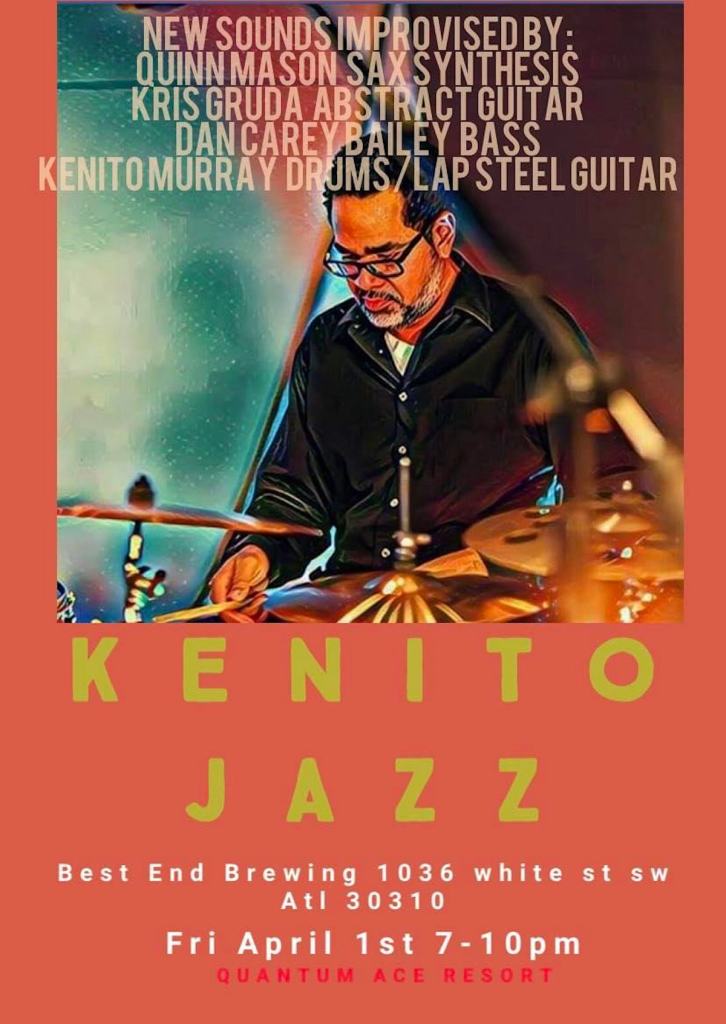
Kenito Murray leads an evening of improvisation at Best End Brewing Co. on Friday, April 1.
Percussionist Murray, along with Quinn Mason (tenor sax, keys), Kris Gruda (guitar), and Dan Carey Bailey (electric bass) will craft everything from trip hop and ambient sounds to jazz, Delta blues grooves, and dub beats.
Dan Carey Bailey (left) and Quinn Mason. Photo by Kenito Murray
Free. Music is live from 7-10 p.m. 1036 White St. SW (on the Westside BeltLine).
If you have enjoyed reading this post, please consider making a donation to RadATL.
Music In The Park founder Kebbi Williams. Photo courtesy Music In The Park.
On Thursday, December 10, at 7 p.m., Music In The Park celebrates 10 years of music and service to the community by highlighting Atlanta public school students and community youth as well as other local and international artists. This year, MITP brings its ever-evolving combination of artistic innovation and stellar performances—from a safe distance. To keep the community safe amid the ongoing COVID-19 pandemic, MITP is hosting a virtual festival.
Each year, MITP’s goal is to enlighten young performers and inspire vibrancy in communities through music and performing arts by encouraging young Atlanta-area musicians to pursue musical performance, composition, and production as a career. The festival also provides opportunities for professional musicians to be a part of the vital process of nurturing emerging talent while also providing a venue for musicians to collaborate with each other and connect with their audiences.
This year, MITP has expanded its program to Berlin and Germany, and created Cuban exchange programs for young musicians. The organization has also partnered with Atlanta’s Food Banks for food giveaway programs for those in need.
Music In The Park’s virtual festival lineup features: — Toma Fit Youth Hip-Hop Athletes — North Atlanta String Ensemble — Tierra Adentro Youth Flamenco (New Mexico) Ensemble w/ Westlake High School Drumline — Gallery 992 Sunday Jazz House Band — Saunders Sermons — Eli Maliki-(East Africa/Berlin) — Batila -(Congo/Berlin) — DJ Stan Zeff — Marlon Patton — Kebbi Williams More artists will be announced soon. Check out the Music In The Park Facebook event page for details on how to tune in to the live stream.
Tax-deductible donations to Music In The Park support the virtual festival and other ongoing programs. Check out www.musicintheparkatl.org for more information.
If you have enjoyed reading this post, please consider making a donation to RadATL.
At the core of both releases stands the duo of cello player and Past Now Tomorrow label owner Ben Shirley and mandolin player Majid Araim. Together, they’ve fleshed out a singular musical voice while employing an arsenal of instruments—cello, fiddle, mandolin, banjo, harmonica, recorder, piano, reed organ, Korg MS-20, percussion, walkie talkies, tapes, and radio—to explore a haunted and wildly shifting terrain of musical timbres and colors.
“We did a crazy experiment with a process of overdubbing,” Shirley says of the Whispers Of Night release. “We improvised the initial pieces, then we started overdubbing. But only one of us wore headphones: One of us was listening to and playing along with what was already in the can. The other was responding to what was happening in the room. We traded back and forth, and a submerged musical composition rose up out of the ether as we went along,” he adds.
They recorded the sessions for The Dead Blessing using both a 4-Track and a computer. When finished, they spent weeks mixing it all together before Ben Price at Studilaroche put the final mastering touches on the five cavernous pieces presented here.
For voice resolve [sic.], Araim and Shirley teamed up with Philadelphia-based percussionist Leo Suarez to record a stripped-down early morning improv session—Shirley stuck with his cello, and Majid with a mandolin, violin, and his voice. Press play on the opening number, “Morning Of A Georgia Faun,” and the session sputters to life. The opening number’s title alone calls to mind Shirley’s former band—Faun And A Pan Flute—and Georgia native and saxophonist Marion Brown’s pastoral 1970 album Afternoon Of A Georgia Faun (ECM). Both provide heady context, and the song serves as an excellent entrypoint for the album’s lush and quietly calamitous survey of Georgia’s avant-garde landscape. The music is beautiful, abstract, and reflexive as songs such as “Let The Fish Gossip,” and “Grass So Soft” draw out tension in a subtle cacophony of sounds summoned from the depths of the subconscious minds of three players who all have their antennae dialed into the same frequencies.
GEORGIA MORNING: Leo Suarez (left) and Majid Araim. Photo by Ben Shirley.
Prior to this session, Suarez, Araim, and Shirley had jammed together sporadically while Whispers Of Night was on the road playing shows around the country. In June of 2019, after Suarez played a show at the Magic Lantern, the three reconvened at 8 a.m. to roll tape. Ofir Klemperer recorded the session as they all locked in with their instruments. Aside from one small, imperceptible cut, the session went down as is.
“We consciously chose to make the trio not Leo + Whispers, as we conceived of it as each individual bringing their own independent voice to the group, rather than any sort of specific sound,” Shirley says.
Both the Whispers Of Night and Suarez + Araim + Shirley releases live on Past Now Tomorrow’s Bandcamp page. A limited edition of 50 copies of The Dead Blessing and voice resolve on CD can be found on the Bandcamp page as well—not for long, though. The sturdy, cardboard sleeves and hand-assembled cover art brings a tactile element to music that often eludes conventional terms. “I wanted to have a unifying aesthetic for this set of releases,” Shirley says. “I’m trying to still produce physical things, even though not many people buy them. This way I can make them at a low cost and keep the charge down. I use the least amount of plastic possible, and still have sturdy packaging with a spine on the side—working at WREK, I know that your CD is way more likely to get pulled off the shelf if it has a spine that looks interesting. That’s at least part of the idea.”
The Royal Krunk Jazz Orkestra. Photo courtesy Ropeadope Records.
Composer and trumpet player Russell Gunn leads the Afro-futuristic jazz big band the Royal Krunk Jazz Orkestra, featuring Dionne Farris, for a live-streaming performance at the Rialto Center for the Arts on Saturday, July 25. Music starts at 10 p.m.
Gallery 992‘s Sunday night free improv jams are back!
For the time being, every Sunday evening from 6-10 p.m., the weekly jam has moved just a few doors down to the lot near the corner of Ralph David Abernathy Blvd. and Peeples Street, where there’s plenty of space to get spaced out. Under the direction of alto saxophone player Quinn Mason and percussionist Dallas Dawson, an assemblage of the city’s finest players lock into each other for a massive and seemingly telepathic group improv blast before opening up the stage. They’ll play for as long as the law allows—the noise ordinance kicks in at 10 p.m.
In this new, temporary outdoor setting, the weekly jam has taken on a whole new vibe, summoning a rejuvenated sense of community spirit in the West End. These performances are about catharsis, purgation, and finding mental and spiritual balance in the shadow of a world in turmoil.
Witnessing so much energy, and engaging with live music on such visceral and cerebral levels, after so many months spent in lock down is a powerful and emotionally riveting experience that’s not to be taken lightly—you need it more than you know.
Bring a lawn chair—it’s outside, but wearing a mask and maintaining that six-feet of social distance makes everyone feel a safer, and little more comfortable.
W8ing4UFOs are still playing their scheduled shows at the Pilot Light. Stay tuned for more information.
As Knoxville, Tennessee prepares for the Big Ears Festival‘s annual pilgrimage of deep listeners descending upon the Marble City’s music venues March 26-29, more pieces are falling into place every day. Festivities for the 2020 gathering include an ever-growing film series and panel discussions, in addition to a lineup of bold musical innovators celebrating their singularly nuanced sounds. A rich lineup of heavy-hitters is on the calendar for this year, including German free jazz luminary, saxophone and clarinet player Peter Brötzmann, Tortoise guitar player Jeff Parkerand the New Breed, rock ‘n’ roll poet Patti Smith, Tuareg psych rocker Mdou Moctar, drone music architect Phil Niblock, British free jazz and Afrofuturist provocateur Shabaka Hutchings & the Ancestors, and more.
Amid the flurry of artists and activities on this year’s schedule, Atlanta boasts a particularly strong showing:
Mute Sphere, a group featuring former Faun and A Pan Flute guitarist David Gray, cello and fiddle player Ben Shirley, drummer John Gregg, and percussionist and synth player Chris Childs team up with vocalist Monique Osorio, crafting a blend of composed and improvised rock and modern classical sounds. Mute Sphere takes the Pilot Light stage on Thursday, March 26. 8 p.m. It’s free to anyone who can fit through the door, even if you don’t have a Big Ears pass.
The Rev. Fred Lane is currently setting the South ablaze with the arrival of Icepick To the Moon, his first album over 30 years. The album finds the Auburn, Alabama auteur backed by a group known as the Disheveled Monkey Biters, aka the Edgewood Saxophone Trio (Jeff Crompton, Ben Davis, and Bill Nittler). Rev. Fred Lane and the Disheveled Monkey Biters play The Standard on Friday, March 27. 9 p.m.
W8ing4UFOs photo by Karen Haim.
Coded deeply within W8ing4UFOs’ DNA is a dense and secret history of Atlanta music. Singer and guitarist Bill Taft, cellist Brian Halloran, and percussionist Will Fratesi’s time together reaches all the back to Cabbagetown in the early ‘90s, sharing stages with Southern firebrand Benjamin in the band Smoke. Producer, songwriter, and keyboard player Billy Fields is like the angel Virgil of Atlanta music, leading the way out of darkness into the light. His resume boasts a lifetime spent playing music with a variety of acts such as Follow For Now, Seek, Upstream, Lust, Arrested Development, Dionne Farris, and H.R. of Bad Brains’ Human Rights outfit. Alongside guitar player Sean Dunn of Athens’ indie rock outfit Five-Eight and viola player and Radon Recordings co-owner Katie Butler, the group creates a mighty sound steeped in the kind of steel-stringed anti-gospel defiance that can only be forged in the forgotten underbelly of the Southern Piedmont. W8ing4UFOs plays two shows at The Pilot Light — Friday, March 27 at 9 p.m., and Saturday, March 28 at 3 p.m.
Dust-To-Digital co-owner Lance Ledbetter joins Nathan Salsburg, curator of the Alan Lomax Archive, for a listening session and discussion of selected artists, repertoires, and site-specific musical communities, including archival recordings from Ledbetter’s nonprofit organization Music Memory. At Boyd’s Jig & Reel. Sunday, March 29. 2-3 p.m.






 Rad/ATL