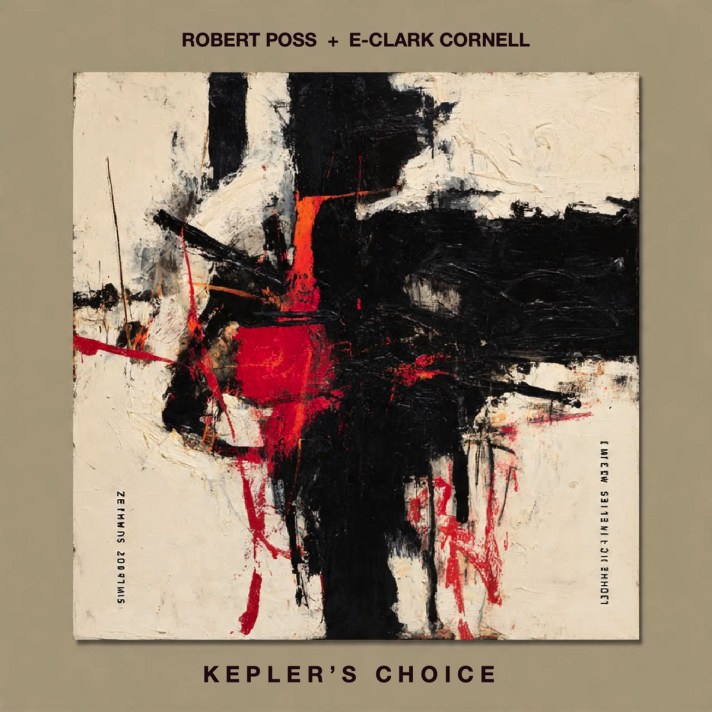
Like a slowly turning constellation coming into focus, Kepler’s Choice unfolds as a celestial dialogue between Robert Poss and Edward Clark Cornell, where time, tone, and texture align with sublime atmosphere.
Poss and Cornell’s pairing on Kepler’s Choice (No Sides Records) balances a stylistic overlap of their respective musical inflections. Poss is known as the guitar player and composer that led Band of Susans through the New York City rock avant-garde of the late ‘80s and mid-’90s. He has also played with Bruce Gilbert of post-punk luminaries Wire, and alongside minimalist composers Rhys Chatham and Phil Niblock. With the eight songs that make up Kepler’s Choice, Poss distills a lifetime of experiences into broad, glacial sheets of sound, where guitars, pianos, and electronic touches stretch into radiant, sustained worlds of sound.
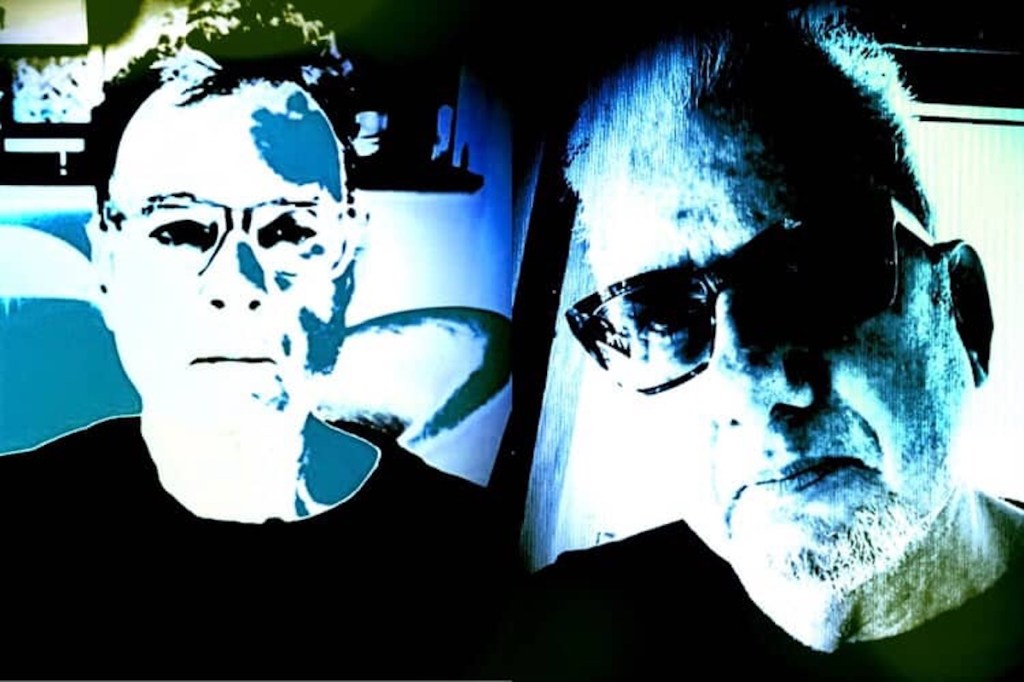
Cornell is a multimedia artist who co-founded La Ponto Ensemblo with German electronic composer Hans Dieter Schmidt. On Kepler’s Choice, Cornell weaves Poss’ mammoth elements into a more intricate web of tones that flicker to life, bloom, and quietly rearrange themselves from within. This exchange is the central engine that drives Kepler’s Choice, culminating in an album that is as vast and mysterious as the cosmos itself.
It’s tempting to trace a lineage from Poss and Cornell’s work together back to minimalist luminaries Steve Reich, Tony Conrad, La Monte Young, and Terry Riley. However, their bridge reaches a higher plain trodden by composers such as György Ligeti, Krzysztof Penderecki, and Iannis Xenakis. Cornell’s fascination with cluster chords—those dense, slowly shifting tonal masses—gives the music its inner tension. It comes through loud and clear in the album’s title track, where the initial tones accumulate almost imperceptibly. Soon, they grow, forming soft-edged walls of sound that evolve while gaining mass.
Their collaborative sensibilities reframe the album’s use of texture, minimalism and composition. Poss’ playing establishes a horizon line. Within it, Cornell introduces movement—small disruptions, subtle harmonic knots, and tones that hover just beyond the expected scale, creating entire worlds that exist out of time and place.
As immense and expansive as it all may be, there’s a story here about restraint, too. Cornell follows Poss’ emphasis on the “white keys”—a grounding in tonal simplicity—as a kind of sonic anchor, and a way of letting complexity emerge via chance, serendipity, and silence.
Elsewhere, on pieces such as “Russian Tea Room” and “Codified Betrayal,” the dynamic shifts in miniature. Sounds circulate, forming patterns that appear and dissolve while new strains of sonic texture emerge. Sustained, crystaline tones shape the music’s pacing and movements. But what defines Kepler’s Choice is the blending of Poss and Cornell’s approaches: Poss builds the environment while Cornell maps its internal systems. Together, they arrive at music that is conceptual and cosmic while remaining intensely human. By the time the music fades, Kepler’s Choice leaves behind a sense that its structures are still out there, slowly shifting, lingering in the outer regions of perception.
If you have enjoyed reading this post, please consider donating to RadATL. Venmo to @Chad-Radford-6 or click on the PayPal link below.


