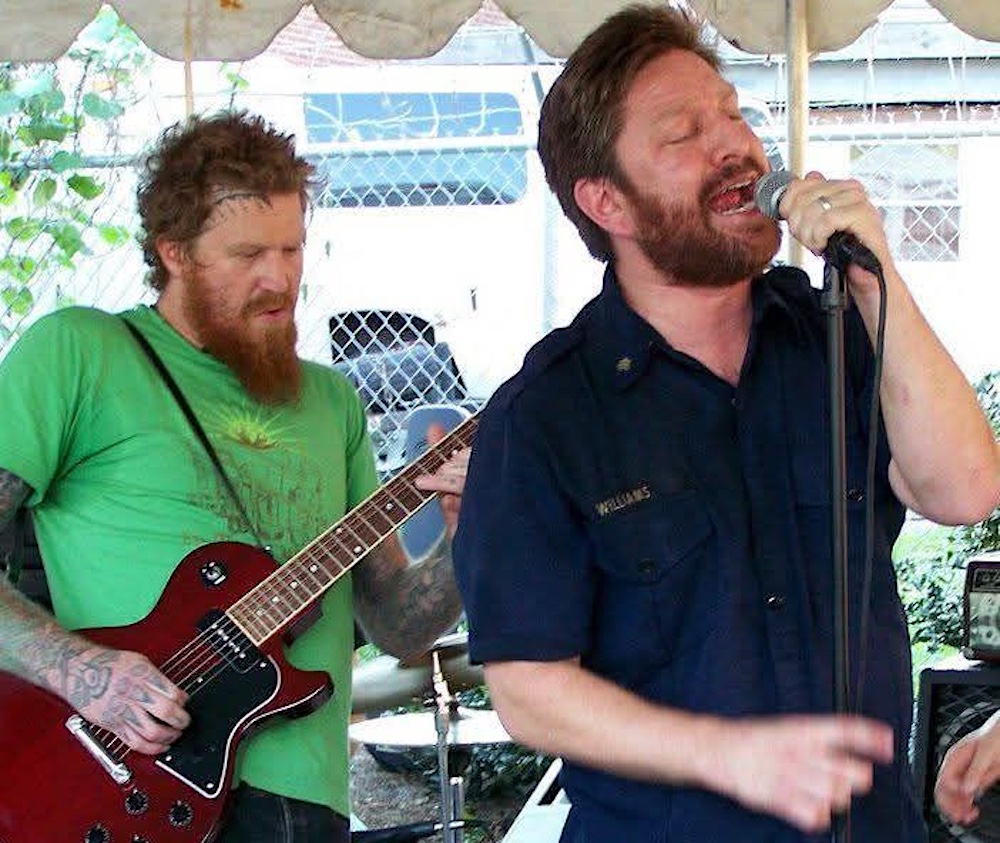
WEST END MOTEL: Brent Hinds (left) and Tom Cheshire. Photo by Chad Radford
West End Fest is the kind of gathering that Atlanta does best: a celebration of community, history, and one of the city’s most enduring creative forces, Brent Hinds. For decades, the guitar player, songwriter, and restless spirit whose work with Mastodon, Fiend Without A Face, Four Hour Fogger, and West End Motel shaped the heavy-fisted country, punk, hardcore, surf, and metal outer limits of Atlanta’s musical identity.
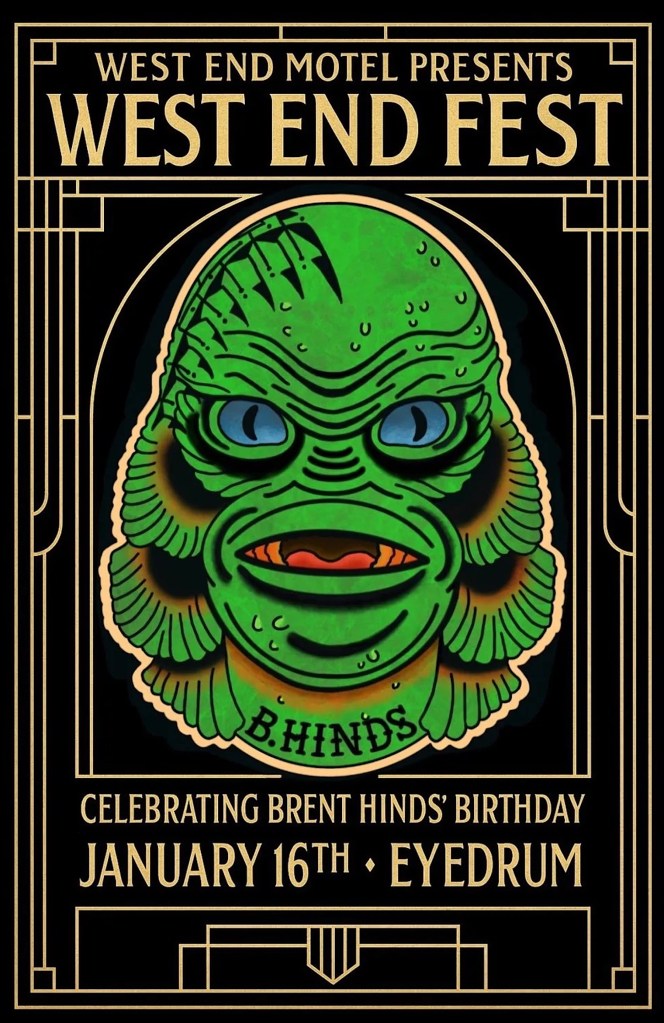
Hinds died in a motorcycle accident in August 2025. West End Fest celebrates his birthday kicking off at 3 p.m. with a full roster of music, toasts, and eulogies—equal parts heartfelt and hilarious—setting the tone for a day that’s as much about storytelling as it is about volume.
By 6 p.m., the amps are on and the music rolls through the evening, wrapping up by 11 p.m. with plenty of time for reconnecting, reminiscing, and raising as many glasses as one can muster with friends old and new.
The Night the Sky brings their expansive heft to the stage. Michael Rudolph Cummings (of Backwoods Payback) taps into raw, road-worn intensity. Ironbound, Lefty & His Right Hand Men, and the almighty W8ing4ufos add their own distinct flavors to the mix, before Black Daniels teams up with Kevn Kinney (of Dryvn N Cryin) for what’s sure to be a memorable collaboration. West End Motel closes out the night, grounding the celebration exactly where it belongs.
At its core, West End Fest is about honoring a creative lifer and the scene that grew up around him—a reminder that Atlanta’s music culture thrives in shared spaces, long drunken conversations, and nights like this one.
Raw and slowly burning tension runs through TVAD’s latest single, “The Island Song,” which takes shape as a stark meditation on the damage that mankind’s obsession with religion has inflicted upon the world.
With TVAD (Television After Death) recently paring down to a two-piece lineup, principal songwriter Dizzy Damoe—who prefers to not use his Christian-born name—handles guitar, synth, and vocal duties while working alongside bass player John Holloway.
Damoe is currently a member of Alanta’s purveyors of blackened doom and death metal Withered, and is a former member of sludge metal and post-hardcore acts Leechmilk, Sons of Tonatiuh, the Love Drunks, and Canopy. Holloway first made an impression in the bands Tabula Rasa and Of Legend.
“The Island Song” conjures an eerie atmosphere, built upon minor-key melodies and mechanical rhythms that recall the bleak romanticism of early Wax Trax Records releases, threaded through with brittle textures of post-punk and dark wave. Damoe’s guitar oscillates between shimmering ambience and sharp, metallic jabs, while Holloway’s bass carves out a grim undercurrent, grounding the song’s sprawling pace.
Cut from lyrics such as “They hunt, looking for a reason. The wolf, still eats all season. A child, may go hungry. But pray, and seek out your vision,” the song stares down organized religion with an unflinching eye. It’s tone is neither preachy nor dogmatic, but there are no minced words. Damoe delivers each line with a weary conviction, as though bearing witness to the long arc of history’s spiritual missteps. “The Island Song” doesn’t offer solutions, just stark reflection.
It’s a bold move — a track that walks a fine line between sonic exploration and thematic clarity. And for TVAD, it sets the stage for something bigger. If this is the first glimpse into the group’s forthcoming body of work, it’s clear they’re not pulling any punches.
TVAD’s next show is booked at 529 on June 12, which is Damoe’s birthday. A few more shows throughout the summer will be announced soon. Until then, press play on “The Island Song.”
If you have enjoyed reading this post, please consider donating to RadATL. Venmo to @Chad-Radford-6 or click on the PayPal link below.
MELVINS (left to right): Steven McDonald, Buzz Osborne, Dale Crover, and Coady Willis. Photo by Toshi Kasai
The Savage Imperial Death March thunders into Georgia when Melvins and Napalm Death co-headline a double dose of doom, noise, and grinding intensity.
On Sunday, April 27, Melvins and Napalm Death come together for a massive display of sound and fury on the Masquerade’s Heaven stage. On Tuesday, April 29, the same bill rolls into Athens’ 40 Watt Club, bringing chaos to the Classic City.
The tour falls on the heels of the February 2025 release of Savage Imperial Death March, a six-song collaborative LP released via Amphetimine Reptile Records. The six-song release is a crushing, howling monster of an album that finds both bands playing together, seamlessly merging Melvins’ sludge-soaked throb and Napalm Death’s relentless grind.
Melvins are also touring behind their latest release, titled Thunderball (Ipecac Recordings). It’s also the group’s most recent full-length released under the Melvins 1983 moniker, featuring Buzz Osborne, Mike Dillard, Ni Maitres, and Atlanta-based abstract electronic project Void Manes.
For this tour, King Buzzo’s riffs steer the ship, backed by the dual-drum assault of Dale Crover and Coady Willis and Steven McDonald’s fuzzed-out basslines. This incarnation of the band reignites the early Melvins aesthetic with renewed purpose and fire.
Meanwhile, Napalm Death continues its decades-long campaign of sonic obliteration, riding high on the aftershocks of 2022’s Resentment is Always Seismic–A Final Throw of Throes. Vocalist Barney Greenway remains a force of nature, while the band’s grindcore assault remains both savage and surgical.
North Carolina sludge lords Dark Sky Burial—a bleak, ambient-industrial project helmed by Napalm Death’s bass player Shane Embury—and Weedeater set the tone for each night’s proceedings.
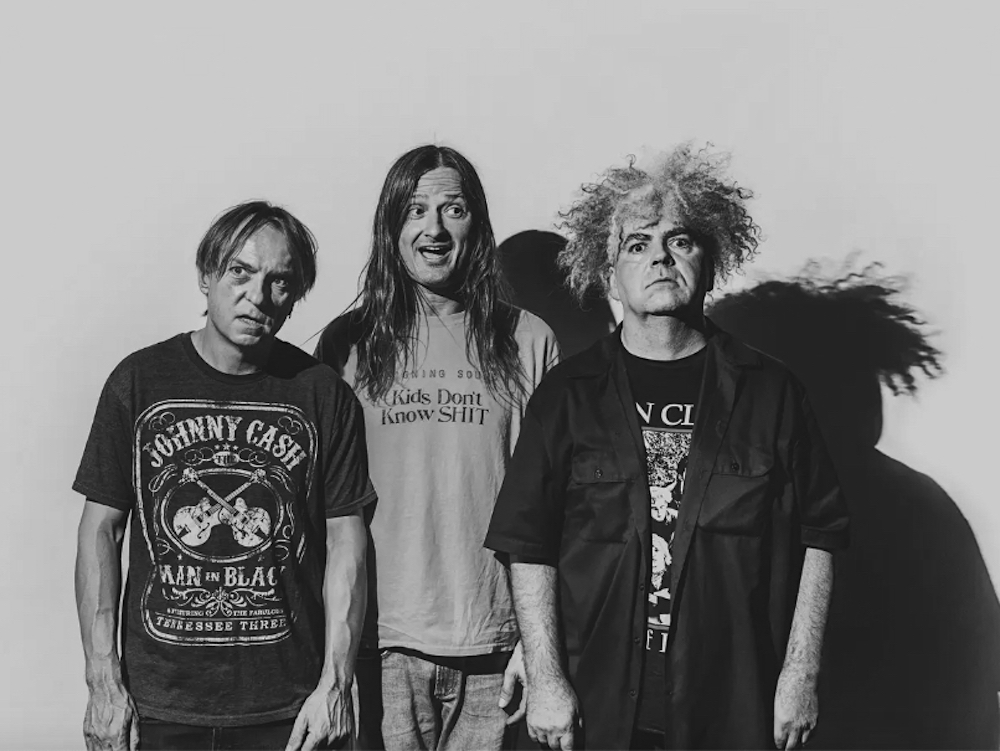
MELVINS: Dale Crover (left), Steven McDonald, and Buzz Osborne. Photo by Chris Casella.
The monolithic punk-metal speed and molasses dirges of the Melvins establish the group as both forerunners and contemporaries of the Pacific Northwestern musical underground of the early ‘90s. In the modern era, singer and guitarist Buzz Osborne, drummer Dale Crover, and current bass player Steven McDonald have continued pushing the group to creative new heights with 2022’s, Bad Mood Rising, followed by this year’s The Devil You Knew, The Devil You Know, featuring the original versions along with new recordings of the six songs from the Melvins’ debut 7-inch EP.
Now, Melvins have teamed up with Atlanta-based abstract electronic project Void Manes to unleash an homage to British industrial music luminaries Throbbing Gristle, titled Throbbing Jazz Gristle Funk Hits (Amphetamine Reptile Records). It’s an entirely electronic album—a first for the Melvins—featuring TG-inspired improv sessions and covers of songs such as “Sic Sick 60’s,” “Hot On the Heels of Love,” “Hamburger Lady,” and more. The first single is a thickened take on “Discipline 23,” which appears on the CD and on a flexi single that comes tucked inside the LP sleeve.
The video, created by Jesse Nieminen, builds on TG’s subversive late ‘70s mantra on dismantling the mechanisms of social and psychological control amid an era defined by misguided patriotism and technology gone awry. The more things change, the more they stay the same. Here, a minimalist blend of fascist imagery, made hollow under a sheen of maximum color saturation and distortion, pushes the Melvins’ vision of industrial overload to the nth degree. Press play above and get disciplined.
Throbbing Jazz Gristle Funk Hits is the latest in a loose but ongoing trend of paying homage to the confrontational and anti-commercial/pro-good-taste force that prompted British tabloids to label Throbbing Gristle “the wreckers of civilization.” “Heathen Earth” appears on the Melvins’ covers CD titled Everybody Loves Sausages. Head down the Discogs rabbit hole and there are more TG renditions by all parties involved to be discovered and devoured.
“Buzz talks a lot about giving people creative freedom and he’s right on about it,” Nieminen says. “There might be some discussion beforehand or none at all. For ‘Discipline,’ I had an idea, it turned into another, and I put it together. I didn’t ask for suggestions for it. I was free to do whatever I wanted and it was pretty close to what I envisioned from the start.”
Nieminen goes on to say: “We made the A Walk with Love and Death short film together. It was a conversation where we sat and riffed on ideas and edited it together. For Melvins TV they shot green screen in LA and sent stuff for me to do what I wanted,” he adds. “That grew from an idea where I was planning to shoot them in a studio with green screen backdrops and do a single music video in the style of those old German Beat Club episodes. Because of the pandemic it turned into Melvins TV and ballooned into 3.5 episodes.”
In a more recently released video for “Zyklon B Zombie,” Nieminen sets the songs fugue-like bouts of faux tropical rhythms and staccato electronic sounds to waves of billowing and blackened clouds, looped in a tussle of natural beauty rendered exquisitely for the simulacrum. It’s just a taste of what the album holds in store.
March of 2023 marked the 40-year anniversary of the Melvins’ first live performance. The group has spent much of the year celebrating by offering a slew of reissues and new releases, and playing shows around the world. The next Atlanta show is on Wednesday, September 27, at Variety Playhouse, where they’re playing 1991’s sprawling Bullhead LP in its entirety, along with more highlights from throughout the Melvins repertoire.
“We’ve been a band since 1983. We’ve never quit, we’ve never taken a break and stopped being a band, and I have seen people come and go from the highest heights to the lowest lows—death, resurrection, and more death,” Osborne says. “In the art world that I am in, there is a war of attrition; whomever is the last man standing is the winner. So far it’s me, with no end in sight.” READ MORE FROM MY OCTOBER 2022 FLAGPOLE MAGAZINE FEATURE STORY.
Void Manes is performing opening sets at several of the Southern Melvins/Boris shows. Keep your fingers crossed that they tear into some of the Throbbing Jazz … material on stage.
ROT: Kevin Cornelius (left) and Corey Pallon. Photo courtesy Boris Records
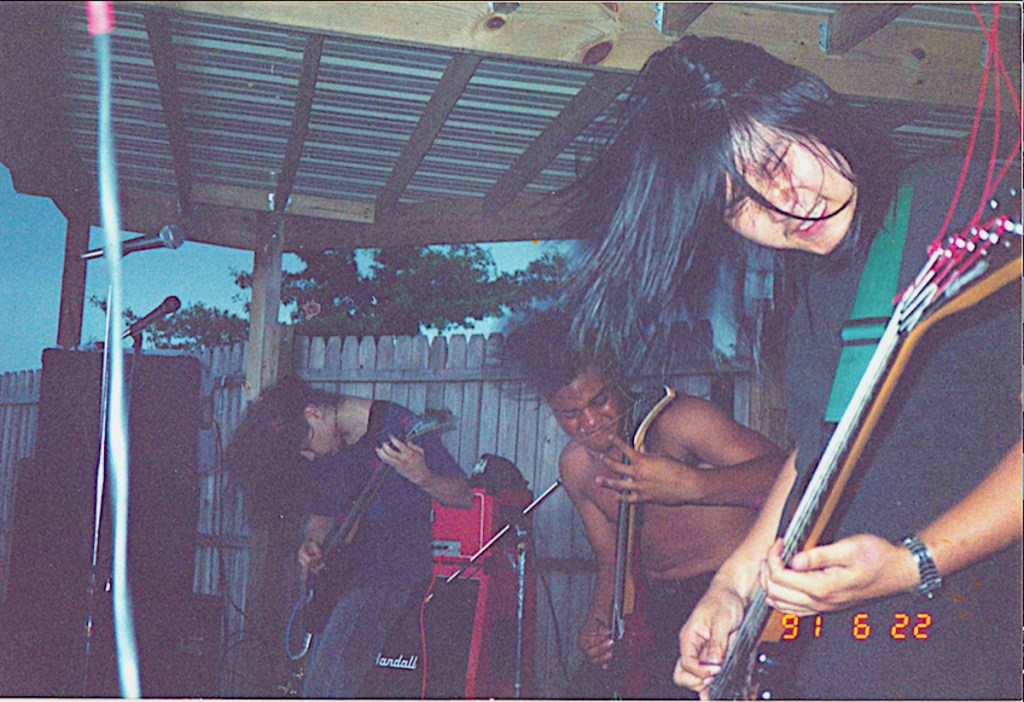
The story of Rot is the story of four friends—outsiders—fighting for survival amid Atlanta’s unforgiving music scene of the late 1980s and early ‘90s. Drummer Corey Pallon, guitar player Richard Googe, bass player James Liu, and vocalist, guitar player, and principal songwriter Kevin Cornelius lived in musical, cultural, and geographic isolation. Metal was a rising force amid the Reagan/Bush era, but Rot’s musical style looked far beyond the eyeliner and Aqua-net that antagonistic audiences in the southeastern United States demanded.
Rot drew power from the same down-tuned dirges of Swedish death metal luminaries Entombed as well as early Carcass and the concentrated grindcore riffage of Napalm Death’s debut album Scum.
Cornelius, Pallon, Googe, and Liu played the music that was written in their bones, capturing a portrait of a place, a time, and an attitude, driven by unrelenting darkness. The group’s would-be legendary status was constantly at odds with a litany of socio-political hurdles that came from every direction. The scene was stalked by a diabolical skinhead crew at nearly every turn. As a band that included two Asian members, guitarist Googe and bass player Liu, and Cornelius, a Black frontman, Rot found itself in the crosshairs, subjected to real violence and torment. The group played as though their lives depended on it, and often times it did.
On stage and in the practice space, Cornelius progressed quickly on guitar, rising from beginner status to death metal master within just 18 months. Working alongside his bandmates, he wrote and recorded gnarly odes of putrescence during the early gestation period of grindcore and death metal. He also experimented with a whispered vocal style that Nuclear Holocaust later made famous with their 1991 album Dawn of Satan’s Millennium.
ROT LIVE: Liu (from left), Cornelius, and Googe.
Upon arrival, Rot’s demo tape, Diabolus (The Unholy Rot), promised great things to come. Songs bearing titles such as “Mutilation of the Christians,” “Pray To Death,” and “Parasitic Withdrawal” were and still are unrelenting in their raw intensity of sound and bleak musical textures.
The demo tape has lied in obscurity for more than 32 years, existing only as a grainy video buried deep on the Youtube. Now, Boris Records has pressed the first official vinyl release of Diabolus (The Unholy Rot), unleashing one of the most strikingly raw and gutteral death metal recordings to ever come from the Atlanta scene.
The album places a remastered recording of Rot’s original four-song demo EP alongside two previously unreleased cuts, “Baphomet” and “Violent Beast.” There’s also a recently unearthed live recording filling out the B-side. Really, though, it’s John Mincemoyer’s in-depth storytelling in the liner notes that adds depth, context, and a human element to the story of these four friends, illustrating the countless hurdles and seemingly insurmountable odds they faced, and the extremely hard, fast, and loud music they created during their brief but fiery existence.
If you have enjoyed reading this interview, please consider making a donation to RadATL. Venmo to @Chad-Radford-6 or click on the Paypal link below.
Atlanta has always provided the quintessentially weird and William Faulkner-esque Southern experience that Russian Circles’ guitar player Mike Sullivan hopes for every time the group passes through town on tour.
“I do and I don’t remember Russian Circles’ first show in Atlanta,” Sullivan says of the Chicago post-metal trio’s initial stops in town, supporting their 2006 debut album, Enter.
“We always played at the Drunken Unicorn back then,”he says. “I remember at one of those early shows that we played, Brent Hinds from Mastodon rolled up pretty early in the evening. He was riding a small BMX bike and he was tripping on mushrooms. That is exactly what you want from Atlanta,” he laughs. “And that was before any of us even knew Brent! He was there to say hi to someone else who happened to be there for the show that night.”
It’s fitting, then, that just over a decade later, Russian Circles’ musical trajectory carried the group from tearing up the stage for a sweat-soaked circle pit at the Drunken Unicorn to performing under the majestic stars of The Fox Theater, opening for Mastodon in 2017.
On October 29, Russian Circles return to Atlanta, this time playing a show at Terminal West supporting the group’s eighth and most recent full-length album, Gnosis (Sargent House Records).
Drop a needle into the record’s swirling orange vinyl grooves, and songs with titles such as “Tupilak,” “Conduit,” and the album’s title track weave together a rapturous opening salvo that is as heavy as it is pure.
Each song rises and falls with screaming, oceanic riffs and gut-pummeling rhythms in an ever-growing compositional sophistication that places the group on a tier that’s far beyond the post-metal continuum.
The guitars, drums, and bass swarm and move in ominous motions, as though they were guided by a hidden hand reaching out from somewhere deep within their collective subconscious. But as Sullivan asserts, these songs are among the group’s most meticulously arranged yet.
Throughout the album’s later songs— “Vlastimil,” “Ó Braonáin,” “Betrayal,” and “Bloom”—buzzing textures coalesce around massive and doom-laden imagery, painting a portrait of a society in decay.
The bleak beauty and the darkness that binds each song together eclipses all of Russian Circles’ previous offerings, delivering a record that is as furious as it is inquisitive, conjuring a mysterious aura of spiritual anxiety that takes shape as a singular work of understated impressionism.
The title itself, Gnosis, is the Greek word for knowledge, which often appears in religious texts denoting a deeper understanding of the universe that is arrived at only through direct engagement with the divine.
“And what is the divine?” Sullivan asks while pushing the conversation closer toward the album’s unrequited mystical angst. “What if we got it all wrong?” He asks. “What if we misinterpreted elements of faith and spirituality? What if we misinterpreted the Bible? What if we’re taking away the wrong message?”
In the end, there are no answers waiting to reveal themselves within the album’s monstrous roar and crushing rhythms, only a profound sense of reckoning with the unknown.
“That’s something that’s personal, and it’s different for each person, but it’s all tied to this idea of spiritual knowledge,” Sullivan says.
Russian Circles’ co-founding members, Sullivan and drummer Dave Turncrantz have been friends since growing up together in St. Louis.
According to lore, they’re both lifelong hockey fans, and they took the name for the band from an ice hockey practice drill.
Turncrantz is a former drummer with fellow St. Louisan heavy rockers Riddle of Steel.
Bass player Brian Cook is also from St. Louis. He has performed in These Arms Are Snakes, Botch, and played bass in Sullivan’s previous instrumental math rock outfit Dakota/Dakota. Cook joined Russian Circles in 2009, replacing original bass player Colin DeKuiper.
Over the years, Russian Circles has undergone a tremendous creative evolution that balances the lilting strings and metallic aggression that forms the backdrop for 2011’s album, Empros. For 2013’s album Memorial, the group enlisted the voice of gothic-folk vocalist and songwriter Chelsea Wolfe, who expands the group’s dynamic with her voice on the album’s self-titled closing track.
Written and recorded during the 2020 COVID-19 pandemic, the songs on Gnosis turn inward, capturing a singularly troubled time for the group, and for the rest of the world.
Quarantine orders kept each of the group’s members behind closed doors, creating an environment in which no one was playing music or writing together at all: No practicing, no jamming, no happy accidents, and no opportunity for mutual organic growth. So rather than building songs out of ideas and fragments that were captured live and in the moment, fully formed demos were written and recorded in Sullivan, Cook, and Turncrantz’s respective isolation. Later, they shared their songs with each other and paired the material down to create a stylistically physical and visceral release.
“Gnosis was 100-percent written in our own worlds,” Sullivan says. “It was like, you construct a song on a blank grid, and parts are added, which is a way more immersive experience, as far as presenting a full arrangement: Here are additional guitars. Here’s how it will transition to the next part. It’s a completely different and more controlled approach for us. Before, it was kind of like, we would get together and just hope that something good would happen, which is kind of terrifying,” he laughs. “The songs on our first album, Enter, were just me and Dave jamming together in a room. Now, whenever we get together, we know what we’re working on. There are plenty of ideas to choose from. And if we don’t wanna work on one, there are even other ideas we can start hammering away at yet.”
The bass and drums for Gnosis were tracked at Electrical Audio in Chicago by Kurt Ballou, who also recorded the guitar and synth parts at God City Studio in Salem, Massachusetts. Ballou also engineered and mixed the album at God City.
Gnosis is the third record that Russian Circles has made with Ballou, following 2016’s Guidance and 2019’s Blood Year. It’s also the second album for which the group divided its time between Electrical Audio and God City.
“God’s City is great because we go there and Kurt has the home field advantage,” Sullivan says. “There are so many pedals, and so many different toys to play with, and different amps. As a guitar player, I’ll never complain about heading over to God City. It makes the record way more diverse sounding, just knowing all of the gizmos that he has to play with there. Kurt is also really familiar with Electrical Audio, and he just knows what to do instinctively, and he knows how to manipulate all the rack gear and everything,” Sullivan adds. “He has preferences for mics and compressors, and a lot of it goes off of Dave’s performances and tuning and Kurt excelling at what he does. What those two came up with is the best drum tone we could have captured.”
One of the more compelling moments of Gnosis, takes shape minutes into the album’s title track. The guitar kicks in on a delayed stereo effect, revealing wholly new dynamics and greater depths in the album’s sonic dimensions. It’s an effect that’s mirrored in the album’s closing number, “Bloom,” and was also used in the song “Campaign,” which opens Russian Circles’ 2008 album, Station (Suicide Squeeze).
“It’s interesting when you start utilizing stereo manipulation,” Sullivan says. “It opens up the field just a bit more. Just now, we were jamming during practice, and Dave had in his ear monitors so that he could hear himself playing. All of the drums were in mono whereas the guitar was stereo panned. Ideally, you wouldn’t want mono drums by any means, but having it there opened up the guitars. When some things are in stereo and some things are mono, it makes the mix deeper. The instruments hit your ear differently, and in a really exciting way.”
Back in 2008, when the group recorded the album Station, their engineer at the time, Matt Bayles, as Sullivan recalls, said ‘Let’s utilize some stereo action here,’ which is how the technique became a part of the group’s repertoire.
“That was the first time we did that, I was like, ‘Wow, this is like a little bit of stereo magic. This is awesome,” Sullivan says. “Now, we’re starting to consider how that technique is something we should be doing live, making the most of it, and not just reserving it for records.”
Part of Russian Circles appeal lies in its style and how the group adapts its brand of instrumental dirges to a more traditional songwriting style, as they do with “Vlastimil,” where the group expands upon its already colossal sound, while reinventing its own musical techniques.
The chemistry between the band’s members and Ballou is clearly on display throughout the album. His approach to production and engineering dovetails with the tension that builds throughout Gnosis’ serrated and gargantuan epics.
As such, the nature of their working relationship positions Ballou as something of a fourth member of the group. His presence has become key to Russian Circles’ creative evolution and success.
“If you find people that you have chemistry with, that’s a huge gift,” Sullivan says. “Do not throw that away.”
Together, their work has yielded a late body of work that is greater than the sum of Russian Circles’ parts, even though those parts are quite impressive, summoning a sense of the divine on their own terms as they illustrate the complexity of the group’s songs and history.
This story originally appeared in the October print issue of Record Plug Magazine.
If you have enjoyed reading this post, please consider making a donation to RadATL.
MASTODON: Bill Kelliher (left), Troy Sanders, Brann Dailor, and Brent Hinds. Photo by Clay Patrick McBride
On Halloween eve, Mastodon unleashed its 8th proper studio album, Hushed and Grim (Reprise). The album’s sprawling 15-songs distill the group’s legacy as the pride of Atlanta metal, and a force of nature the world over, into a punishing, real-time reflection on death, sorrow, and reclamation.
From the moment the album’s first single, “Pushing the Tides” arrived, the brutal power on display made it clear that Mastodon was coming out of the gate strong. Guitar players Bill Kelliher and Brent Hinds, drummer Brann Dailor, and bass player Troy Sanders channeled their anguish over the loss of their friend and former manager Nick John, who died from cancer in 2018, into a serpentine musical saga.
Within weeks, “Pushing the Tides” was nominated for a “Best Metal Performance” Grammy. In the meantime, the group has remained on the road playing shows across the U.S.
Dailor took a few minutes between tour stops to talk about how the ideas and imagery behind Hushed and Grim came together to form an emotionally hefty and gorgeously articulated new chapter for Mastodon.
Over the years we’ve had conversations about each new Mastodon album, and there’s often an element of the band confronting death—losing someone close—and dealing with it in a real-time kind of way. I recognize this in Hushed and Grim, but the album also feels empowered.
When you start writing an album, maybe you find out that you have less control than you imagined you did. It just starts to unfold, and maybe in the back of your head you’re thinking, “We need to be heavier, faster, and crazier.” Then the things that you naturally gravitate toward are slower, darker, and deeper. Then you think, “Maybe this is actually the vibe.”
It starts to reveal itself, and it really is the manifestation of what we’re going through during that moment in time. Nothing happens in a vacuum. When you’re creating something, the emotions that you’re experiencing with whatever you’re dealing with in life will ride in tandem with that.
Going into Hushed and Grim, We weren’t feeling too good as a group. So during the writing process, wallowing in those feelings led to what the album sounds like. Anything that sounded remotely happy was kicked out immediately. It was like, “No! I’m not happy. Get rid of that.”
Maybe by the end of the album it becomes empowered — it gets there eventually. For me, it’s a tough listen. It puts me back in these places that weren’t fun to go through, but it was necessary to get through it.
I don’t know what’s going on with us, but for the last bunch of albums, I don’t know if we’re cursed or something … I don’t believe in curses, but I’ll just say it to be fun. From Crack the Skye on, it seems like every time we go into the writing process somebody close to us fucking dies. So word to the wise, don’t be close friends with anyone in Mastodon.
In that pure songwriterly way, Hushed and Grim has multiple meanings. I first saw it as a pandemic reference. … In the early days of the pandemic I even heard someone describe Atlanta’s streets as “hushed and grim.”
Actually, I stole it from Gone With the Wind. I’ve had the title in the back of my head for a long time.
Gone With the Wind was my sister’s favorite movie, and we used to watch it every time it came on. I just really liked that phrase. It’s on a title card halfway through the film, after Sherman burns Atlanta to the ground. You see this massive crane shot over downtown Atlanta, and you see thousands of dead soldiers. Scarlett is running around tending to the wounded that are lying in the street.
Sometimes when a tragedy takes place it’s not people running around screaming. It’s quiet and there’s this acceptance that something terrible is happening, and it’s quiet. When our former manager Nick John had gone into home hospice care we all flew to L.A. to see him one last time, and to say goodbye. He was asleep in a hospital bed, his mom was there, his sister, his wife and some close friends. “Hushed and grim” was the perfect phrase to explain the feeling in that house that day.
So the Atlanta connection, the connection to Nick John in that specific circumstance, and the fact that I felt like it encapsulated the sound of the album being quieter, melancholy, and more sparse really resonated with me. … At least it’s more sparse than maybe we’ve ever been. We’ve hinted at it over the years, but this one really goes in on that slower, more methodical, take-our-time kind of thing.
From the beginning, when I was first hearing the riffs, writing the stuff with the guys, and putting it together, I had this black and gray color palette that I felt was lending itself to the album. I could see black and gray with a touch of gold. That’s the initial conversation I had with Paul Romano about doing the cover. I didn’t have anything else but the color palette.
Song-for-song, the variety goes beyond a lot of what Mastodon has done in the past. Was it your intention to make an album that’s a little more complex?
No, I think that’s the result of having more time to work on it. There was no tour looming. In the past, there’s always something we have to go and do. I don’t want to say that it rushes things, because early on we wrote Leviathan in like three months. But we had a lot of time with this one. We worked on it, and kept coming back to our garden of songs and watering them and watering them. We poured over these things like a barista in a San Francisco coffee shop [laughs]. We really took our time making sure certain parts are what we wanted them to be, building on bridges, and getting into the nooks and crannies that maybe we wouldn’t have discovered if there was a hard time constraint.
Even during Crack The Skye, it was like, “Ok, we need to go play Bonnaroo now.” It’s a mind shift to go from writing and pouring over new songs to practicing “Crystal Skull” and “Blood and Thunder.” So it’s the result of being able to stay in writing mode longer, without any hope of going on tour, ‘cause that wasn’t happening! It was like, “In fact, your industry will be the last one to come back. So now, we’re out here trying to figure it out while staying safe and making sure that our tour can happen. Just yesterday we had a scare with a false positive. This could all be taken down so easily, and everybody goes back home and loses hundreds of thousands of dollars.
That’s the general mood everywhere right now.
Yeah, it’s all hanging on by a thread, but we’re hoping for the best. Getting back to your question, we’re probably most known for complex arrangements. Anytime we come up with something that’s lesser than, people are surprised. But if a simple song reveals itself and we dig it, we’ll go for it. We don’t put on the idea that we have to be proggy all the time, or that every song has to have a thousand riffs, and within those riffs there are hundreds of little riffs. A lot of the time we’re taking stuff away, saying to ourselves, “My God, this song has five bridges. What is going on here?”
It also feels like the band has mastered working at West End Sound and Ember City Studio. Emperor Of Sand through Hushed and Grim encapsulates an era for Mastodon’s sound that has developed since the studio was built. You know how to get the best possible results out of that room.
Yeah, we’re comfy-cozy in there. And if we didn’t have the studio we wouldn’t have been able to make the record. We couldn’t fly to L.A. or anywhere else to record because of the pandemic. Getting David Bottrill to say yes and come to Atlanta and live there for three months while we worked on it was paramount.
The album’s cover is a departure for Mastodon, both in color and orientation — it’s kind of a landscape image.
Yeah, it has Nick John as the Green Man in the middle of the tree. It is expansive; that’s the middle panel of a nine-panel piece by Paul. We were both on the same page as far as having a twisted tree be the main focus, and that it would reveal the seasons as you go around. So the panels are the different seasons. And there are all sorts of Easter eggs in there that Paul takes from the lyrics and song titles, and whatever any of the band members offer. He always fits everything in somewhere. There’s a reference to Jakuchu’s “Elephant and Whale” diptych in there. There’s all sorts of fun stuff in there. I wanted the fan base to know when they saw the cover art that, at least in my perception, they were getting something different. So we wanted it to be a departure, and to look different from the rest of the album covers, while reflecting the mood of the album.
Nick John as the Green Man: I tend to think of the Green Man mythology as being about regeneration, or it being about a new beginning. Is that part of what you are projecting with the artwork?
My whole made up afterlife mythology was that your soul enters the heart of a living tree. In order to say goodbye, it lives there for a whole calendar year, and experiences the seasons to reflect on the life that you had. And that’s how you’re able to say goodbye to the natural world.
… As if we needed any more afterlife mythologies, here’s one more for you! [laughs]
If you have enjoyed reading this interview, please consider making a donation to RadATL.
Before the weekend gets underway, be advised that hometown metal titan Mastodon has rolled out a new video for the song “Pushing the Tides.”
It’s the first look and listen to the upcoming ninth album, Hushed and Grim, out October 29 via Reprise Records, just in time for Halloween. It’s a scorcher, too—a new number with a touch of that old Leviathan vibe right out of the gate.
The album was produced by David Bottrill (Peter Gabriel, Rush, Tool) and features a guest appearance by Soundgarden guitarist Kim Thayil. More info coming soon. In the meantime, press play and click the album cover below, courtesy of Paul Romano (Remission, Leviathan, Call of the Mastodon, BloodMountain, Crack The Skye), for pre-order info.
If you have enjoyed reading this article, please consider making a donation to RadATL.








 Rad/ATL