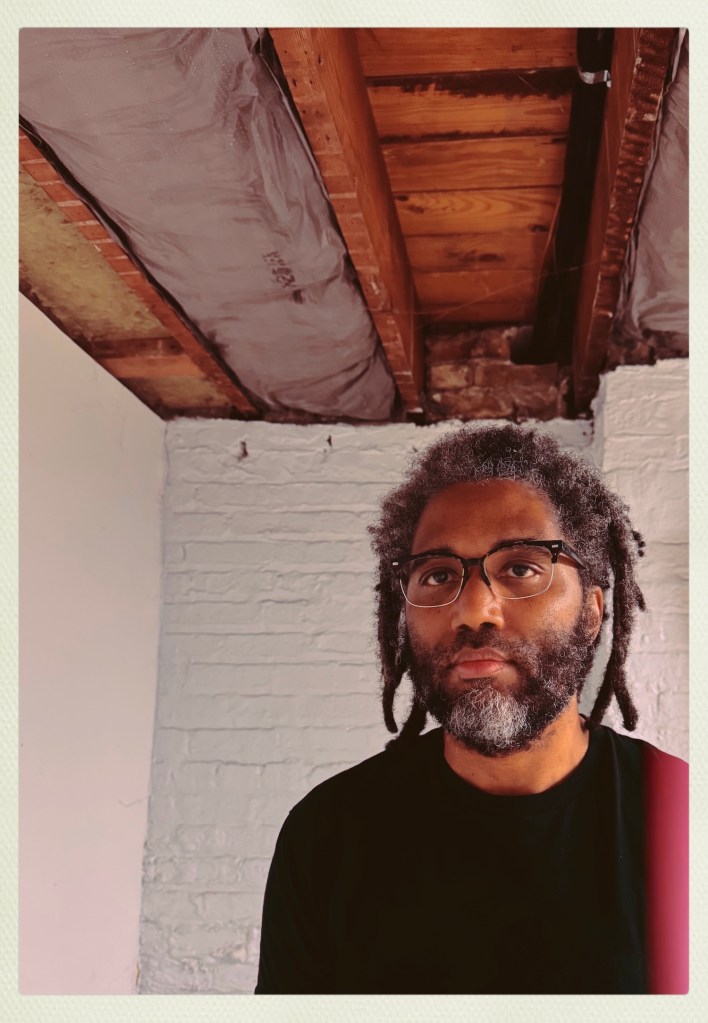
Multi instrumentalist Che Arthur is a Chicago-based artist touring in support of his fourth and most recently released solo album, Describe This Present Moment (Past/Future Records). Having recently wrapped up a month-long European tour doing live sound and opening for Bob Mould, Arthur brings a modern take on raw hardcore velocity, and intense punk songwriting to Waller’s Coffee on Wednesday, January 28.
For this show, Arthur is joined by Athens indie rock stalwarts Five Eight and Atlanta post-punk statesmen Victory Hands.
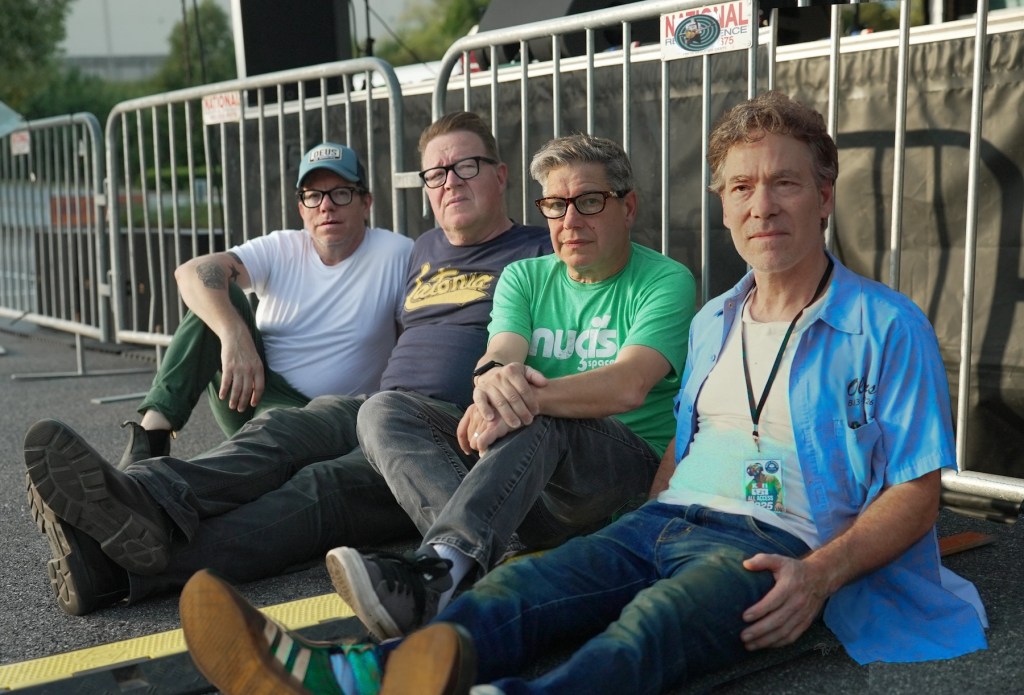
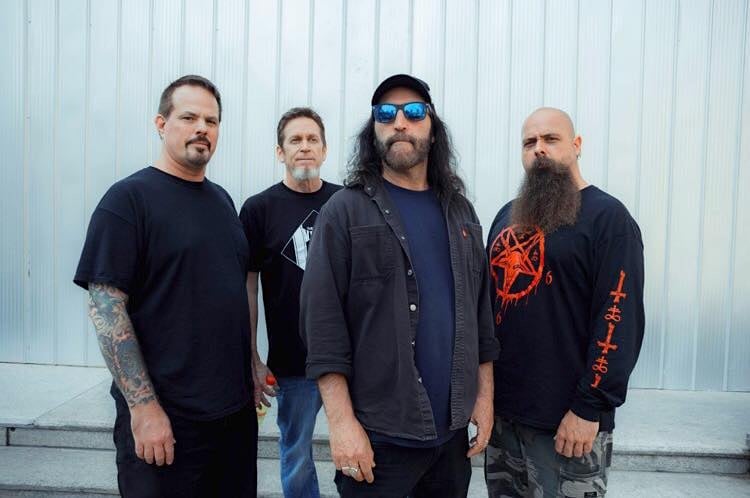
Five Eight. Photo by Marc Pilvinsky.
Five Eight is still riding high after touring the Southeastern U.S. from Austin to Asheville to Tampa with their critically-acclaimed feature length documentary film, Weirdo: The Story Of Five Eight. The group’s ninth studio album, Help A Sinner, is due out in March via Static Era Records.
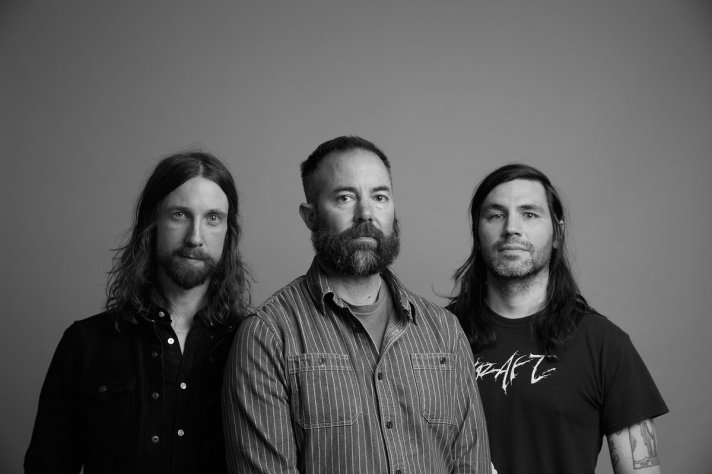
Victory Hands. Photo by Ryan Williams.
Victory Hands is prepping to record their upcoming release, a “watergatefold” double LP titled Cavett. The album builds upon VH’s theme of crafting lyrics using transcripts taken from disgraced former U.S. President Richard M. Nixon’s nefarious recordings of conversations about his enemies in the media—journalists! The release date for Cavett (as in Dick) remains TBD, as the album is currently being recorded. Come get a sneak peek at the songs.
If you can’t make it out for the the show at Waller’s, you can catch Che Arthur in Athens on Jan. 30 at Normal Bar with David Barbe of Sugar and Mercyland.
Check out Sugar’s latest single, “Long Live Love” below.
If you have enjoyed reading this post, please consider donating to RadATL. Venmo to @Chad-Radford-6 or click on the PayPal link below.
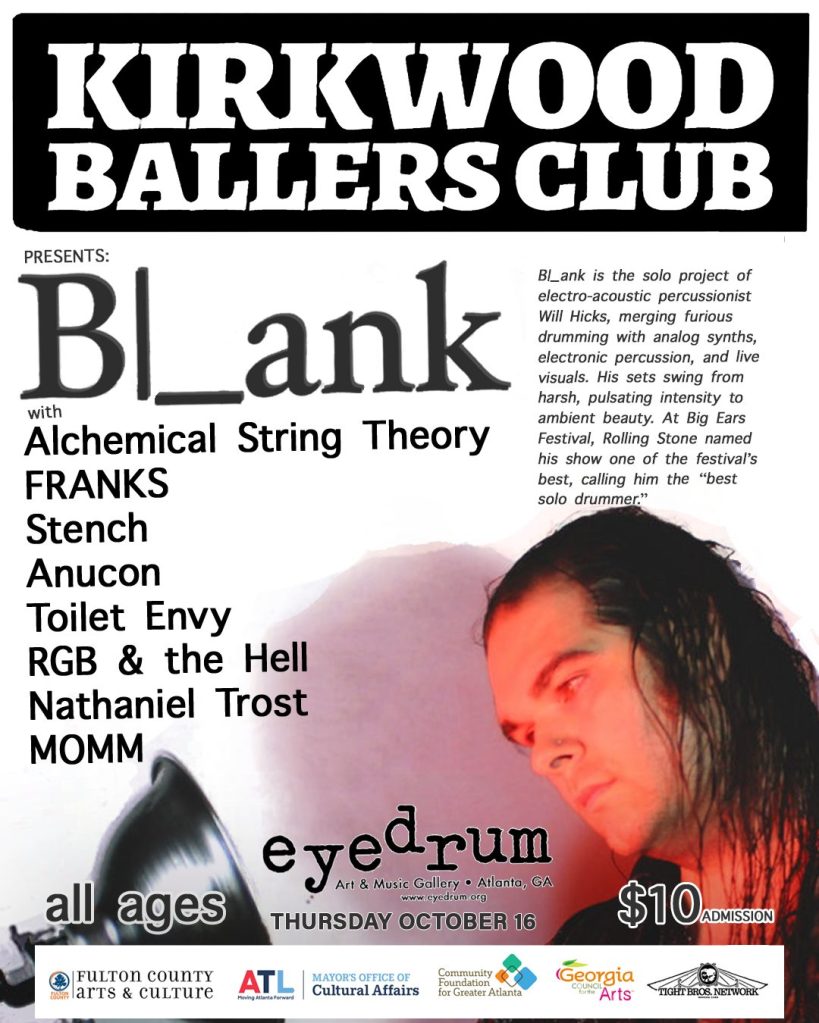
Every third Thursday of the month, Kirkwood Ballers Club takes over Eyedrum with an open forum for experimental, improvisational, and otherwise adventurous musicians and performance artists. It is the long-standing home to Atlanta’s avant-garde, experimental, and DIY musical underground. This month’s KBC takes place on Thursday, October 16. The lineup for the evening features a headlining performance by Bl_ank, the solo project of Portland Oregon’s electro-acoustic percussionist Will Hicks.
Alchemical String Theory, FRANKS atl, Stench, Anucon, Toilet Envy, RGB & the Hell, Nathaniel Trost, and Momm are also on the bill.
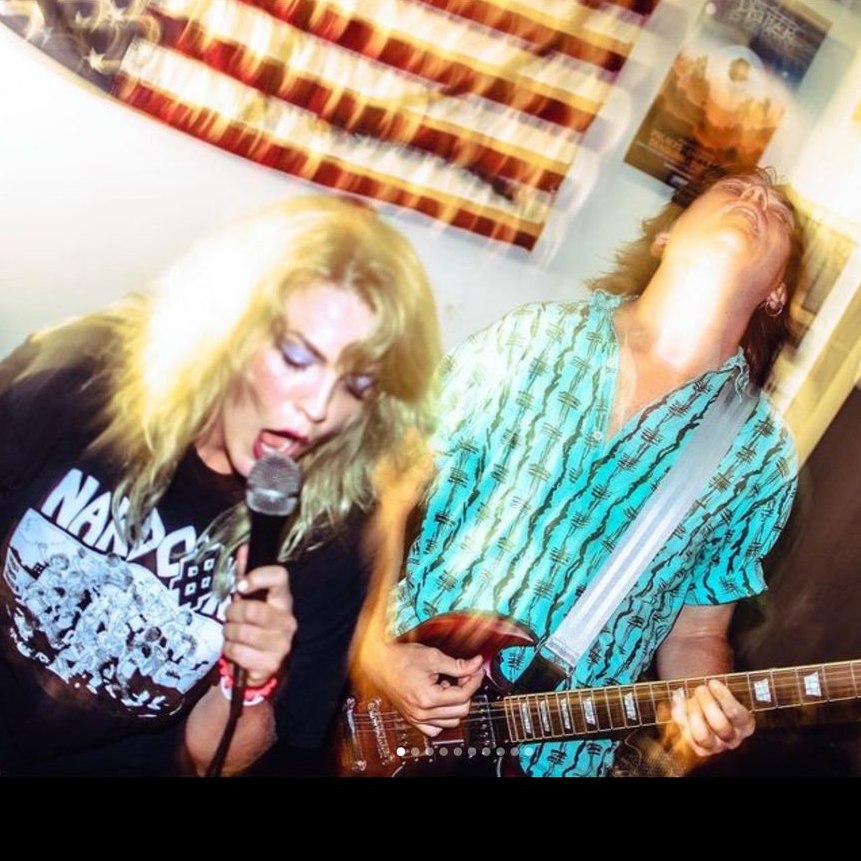
FRANKS atl. Photo by Ben Garden.
FRANKS atl, the two-piece collaboration featuring Frank Schultz (formerly of Duet For Theremin and Lap Steel) and B. Frank Holleran (W8ing4UFOs, ex-Smoke), are releasing a debut album, titled Ode to Lucenay’s Peter. They’re also hosting a Bandcamp release party on Oct. 19. Press play below for an enticing teaser of what they have in store.
MELVINS (left to right): Steven McDonald, Buzz Osborne, Dale Crover, and Coady Willis. Photo by Toshi Kasai
The Savage Imperial Death March thunders into Georgia when Melvins and Napalm Death co-headline a double dose of doom, noise, and grinding intensity.
On Sunday, April 27, Melvins and Napalm Death come together for a massive display of sound and fury on the Masquerade’s Heaven stage. On Tuesday, April 29, the same bill rolls into Athens’ 40 Watt Club, bringing chaos to the Classic City.
The tour falls on the heels of the February 2025 release of Savage Imperial Death March, a six-song collaborative LP released via Amphetimine Reptile Records. The six-song release is a crushing, howling monster of an album that finds both bands playing together, seamlessly merging Melvins’ sludge-soaked throb and Napalm Death’s relentless grind.
Melvins are also touring behind their latest release, titled Thunderball (Ipecac Recordings). It’s also the group’s most recent full-length released under the Melvins 1983 moniker, featuring Buzz Osborne, Mike Dillard, Ni Maitres, and Atlanta-based abstract electronic project Void Manes.
For this tour, King Buzzo’s riffs steer the ship, backed by the dual-drum assault of Dale Crover and Coady Willis and Steven McDonald’s fuzzed-out basslines. This incarnation of the band reignites the early Melvins aesthetic with renewed purpose and fire.
Meanwhile, Napalm Death continues its decades-long campaign of sonic obliteration, riding high on the aftershocks of 2022’s Resentment is Always Seismic–A Final Throw of Throes. Vocalist Barney Greenway remains a force of nature, while the band’s grindcore assault remains both savage and surgical.
North Carolina sludge lords Dark Sky Burial—a bleak, ambient-industrial project helmed by Napalm Death’s bass player Shane Embury—and Weedeater set the tone for each night’s proceedings.
Since 1982, Dirty Rotten Imbeciles (D.R.I.) have circled the globe, playing a break-neck blend of hardcore, punk, and thrash metal crossover forged amid Houston’s skate-punk scene of the Reagan era. The group’s sound culminates with recordings such 1985’s Dealing With It, 1988’s Four Of A Kind, and the 2015’s criminally overlooked But Wait … There’s More! EP. Co-founding members vocalist Kurt Brecht and guitarist Spike Cassidy have remained at the front of the stage, leading an ever-shifting rhythm section. After keeping the band on the road for more than 40 years, D.R.I.’s anti-commercial, anti-authoritarian values are symbolized by the group’s trademark running man logo—an emblem that signifies the whiplash fury the group has commanded for decades. In the pit, the ferocity remains unmatched. This marks the group’s rescheduled 40-year anniversary show.
Photo courtesy Loony!
San Antonio’s Metalriser, Atlanta punx Stripper Cult, and hardcore/nardcore skatepunk outfit Loony get the party started.
Atlanta has always provided the quintessentially weird and William Faulkner-esque Southern experience that Russian Circles’ guitar player Mike Sullivan hopes for every time the group passes through town on tour.
“I do and I don’t remember Russian Circles’ first show in Atlanta,” Sullivan says of the Chicago post-metal trio’s initial stops in town, supporting their 2006 debut album, Enter.
“We always played at the Drunken Unicorn back then,”he says. “I remember at one of those early shows that we played, Brent Hinds from Mastodon rolled up pretty early in the evening. He was riding a small BMX bike and he was tripping on mushrooms. That is exactly what you want from Atlanta,” he laughs. “And that was before any of us even knew Brent! He was there to say hi to someone else who happened to be there for the show that night.”
It’s fitting, then, that just over a decade later, Russian Circles’ musical trajectory carried the group from tearing up the stage for a sweat-soaked circle pit at the Drunken Unicorn to performing under the majestic stars of The Fox Theater, opening for Mastodon in 2017.
On October 29, Russian Circles return to Atlanta, this time playing a show at Terminal West supporting the group’s eighth and most recent full-length album, Gnosis (Sargent House Records).
Drop a needle into the record’s swirling orange vinyl grooves, and songs with titles such as “Tupilak,” “Conduit,” and the album’s title track weave together a rapturous opening salvo that is as heavy as it is pure.
Each song rises and falls with screaming, oceanic riffs and gut-pummeling rhythms in an ever-growing compositional sophistication that places the group on a tier that’s far beyond the post-metal continuum.
The guitars, drums, and bass swarm and move in ominous motions, as though they were guided by a hidden hand reaching out from somewhere deep within their collective subconscious. But as Sullivan asserts, these songs are among the group’s most meticulously arranged yet.
Throughout the album’s later songs— “Vlastimil,” “Ó Braonáin,” “Betrayal,” and “Bloom”—buzzing textures coalesce around massive and doom-laden imagery, painting a portrait of a society in decay.
The bleak beauty and the darkness that binds each song together eclipses all of Russian Circles’ previous offerings, delivering a record that is as furious as it is inquisitive, conjuring a mysterious aura of spiritual anxiety that takes shape as a singular work of understated impressionism.
The title itself, Gnosis, is the Greek word for knowledge, which often appears in religious texts denoting a deeper understanding of the universe that is arrived at only through direct engagement with the divine.
“And what is the divine?” Sullivan asks while pushing the conversation closer toward the album’s unrequited mystical angst. “What if we got it all wrong?” He asks. “What if we misinterpreted elements of faith and spirituality? What if we misinterpreted the Bible? What if we’re taking away the wrong message?”
In the end, there are no answers waiting to reveal themselves within the album’s monstrous roar and crushing rhythms, only a profound sense of reckoning with the unknown.
“That’s something that’s personal, and it’s different for each person, but it’s all tied to this idea of spiritual knowledge,” Sullivan says.
Russian Circles’ co-founding members, Sullivan and drummer Dave Turncrantz have been friends since growing up together in St. Louis.
According to lore, they’re both lifelong hockey fans, and they took the name for the band from an ice hockey practice drill.
Turncrantz is a former drummer with fellow St. Louisan heavy rockers Riddle of Steel.
Bass player Brian Cook is also from St. Louis. He has performed in These Arms Are Snakes, Botch, and played bass in Sullivan’s previous instrumental math rock outfit Dakota/Dakota. Cook joined Russian Circles in 2009, replacing original bass player Colin DeKuiper.
Over the years, Russian Circles has undergone a tremendous creative evolution that balances the lilting strings and metallic aggression that forms the backdrop for 2011’s album, Empros. For 2013’s album Memorial, the group enlisted the voice of gothic-folk vocalist and songwriter Chelsea Wolfe, who expands the group’s dynamic with her voice on the album’s self-titled closing track.
Written and recorded during the 2020 COVID-19 pandemic, the songs on Gnosis turn inward, capturing a singularly troubled time for the group, and for the rest of the world.
Quarantine orders kept each of the group’s members behind closed doors, creating an environment in which no one was playing music or writing together at all: No practicing, no jamming, no happy accidents, and no opportunity for mutual organic growth. So rather than building songs out of ideas and fragments that were captured live and in the moment, fully formed demos were written and recorded in Sullivan, Cook, and Turncrantz’s respective isolation. Later, they shared their songs with each other and paired the material down to create a stylistically physical and visceral release.
“Gnosis was 100-percent written in our own worlds,” Sullivan says. “It was like, you construct a song on a blank grid, and parts are added, which is a way more immersive experience, as far as presenting a full arrangement: Here are additional guitars. Here’s how it will transition to the next part. It’s a completely different and more controlled approach for us. Before, it was kind of like, we would get together and just hope that something good would happen, which is kind of terrifying,” he laughs. “The songs on our first album, Enter, were just me and Dave jamming together in a room. Now, whenever we get together, we know what we’re working on. There are plenty of ideas to choose from. And if we don’t wanna work on one, there are even other ideas we can start hammering away at yet.”
The bass and drums for Gnosis were tracked at Electrical Audio in Chicago by Kurt Ballou, who also recorded the guitar and synth parts at God City Studio in Salem, Massachusetts. Ballou also engineered and mixed the album at God City.
Gnosis is the third record that Russian Circles has made with Ballou, following 2016’s Guidance and 2019’s Blood Year. It’s also the second album for which the group divided its time between Electrical Audio and God City.
“God’s City is great because we go there and Kurt has the home field advantage,” Sullivan says. “There are so many pedals, and so many different toys to play with, and different amps. As a guitar player, I’ll never complain about heading over to God City. It makes the record way more diverse sounding, just knowing all of the gizmos that he has to play with there. Kurt is also really familiar with Electrical Audio, and he just knows what to do instinctively, and he knows how to manipulate all the rack gear and everything,” Sullivan adds. “He has preferences for mics and compressors, and a lot of it goes off of Dave’s performances and tuning and Kurt excelling at what he does. What those two came up with is the best drum tone we could have captured.”
One of the more compelling moments of Gnosis, takes shape minutes into the album’s title track. The guitar kicks in on a delayed stereo effect, revealing wholly new dynamics and greater depths in the album’s sonic dimensions. It’s an effect that’s mirrored in the album’s closing number, “Bloom,” and was also used in the song “Campaign,” which opens Russian Circles’ 2008 album, Station (Suicide Squeeze).
“It’s interesting when you start utilizing stereo manipulation,” Sullivan says. “It opens up the field just a bit more. Just now, we were jamming during practice, and Dave had in his ear monitors so that he could hear himself playing. All of the drums were in mono whereas the guitar was stereo panned. Ideally, you wouldn’t want mono drums by any means, but having it there opened up the guitars. When some things are in stereo and some things are mono, it makes the mix deeper. The instruments hit your ear differently, and in a really exciting way.”
Back in 2008, when the group recorded the album Station, their engineer at the time, Matt Bayles, as Sullivan recalls, said ‘Let’s utilize some stereo action here,’ which is how the technique became a part of the group’s repertoire.
“That was the first time we did that, I was like, ‘Wow, this is like a little bit of stereo magic. This is awesome,” Sullivan says. “Now, we’re starting to consider how that technique is something we should be doing live, making the most of it, and not just reserving it for records.”
Part of Russian Circles appeal lies in its style and how the group adapts its brand of instrumental dirges to a more traditional songwriting style, as they do with “Vlastimil,” where the group expands upon its already colossal sound, while reinventing its own musical techniques.
The chemistry between the band’s members and Ballou is clearly on display throughout the album. His approach to production and engineering dovetails with the tension that builds throughout Gnosis’ serrated and gargantuan epics.
As such, the nature of their working relationship positions Ballou as something of a fourth member of the group. His presence has become key to Russian Circles’ creative evolution and success.
“If you find people that you have chemistry with, that’s a huge gift,” Sullivan says. “Do not throw that away.”
Together, their work has yielded a late body of work that is greater than the sum of Russian Circles’ parts, even though those parts are quite impressive, summoning a sense of the divine on their own terms as they illustrate the complexity of the group’s songs and history.
This story originally appeared in the October print issue of Record Plug Magazine.
If you have enjoyed reading this post, please consider making a donation to RadATL.
With a new lineup in place and functioning like a well-oiled machine, OFF! is back on the road supporting the group’s first album in eight years, Free LSD (Fat Possum Records).
With Free LSD, Circle Jerks’ frontman Keith Morris, guitar player Dimitri Coats, bass player and Atlanta expat Autry Fulbright II (…And You Will Know Us By The Trail of the Dead), and drummer Justin Brown (Herbie Hancock, Thundercat) have crafted a vibrant and essential art-punk rumination on the end times.
Earlier this year, I spoke with Keith Morris while he was passing through town with the Circle Jerks. This is what he had to say about the new album:
“We listened to a lot of Throbbing Gristle, Hunting Lodge, Can, Einstürzende Neubauten, Herbie Hancock’s Head Hunters, Miles Davis. We spent time with a character named Enid Snarb who was in Bastard Noise and Man Is the Bastard. He turned us on to some of George Harrison’s work after he visited India.
Our engineer mixer guy worked with Kyuss and he mixed over half of Spiritualized’s Ladies and Gentlemen We’re Floating In Space. We went to a lot of different places, rather than the Bad Brains, Blue Öyster Cult, and Stiff Little Fingers.
Autry Fulbright is playing bass, and he co-manages Thundercat. Our drummer Justin Brown plays drums with Thundercat, so now we’ve got a jazz drummer playing rock, and you’ll hear it. There are times when he’s all over the place, and we really have to pay attention to what he’s doing to play what we’re playing.
If your mind is free enough, and you’re able to see all of the different colors that we’re using, you’ll get it. There’ll be a lot of people that don’t, but we have no control over that.”
Bob Mould is on the road for this “Solo Electric: Distortion and Blue Hearts Tour.” Before playing at City Winery on October 12, Mould took a few minutes to talk about returning to life in America after spending some time in Berlin, experiencing socio-political deja vu, and to reflect on his years with Sugar and Hüsker Dü.
Your current tour is titled the “Solo Electric: Distortion and Blue Hearts,” which sounds pretty straight forward. Are you playing a pretty comprehensive setlist?
Blue Hearts was the fifth album for Merge Records that was recorded with the same rhythm section—Jason Narducy on bass and Jon Wurster on drums—and with the same engineer, Beau Sorenson. Blue Hearts came out in September 2020. Obviously nobody was touring at that point.
In October of 2020, the Distortion box sets started coming out on Demon Records in the UK. It was a 30-year career retrospective that took from the first solo album, Workbook, all the way through Sunshine Rock, which was the fourth solo album with Merge. In the fall of 2021, myself, Jon, and Jason did a pretty quick North American tour. Since then, I’ve mostly been doing solo electric stuff, touching on everything from Hüsker Dü and Sugar and the solo albums up to Blue Hearts.
The expense of touring is pretty high right now, and tours are still getting canceled left and right because people are getting sick. So for the time being, the solo electric thing is the easiest way for me to tour.
Most of the press that Blue Hearts has received hangs on it being about your return to the States after living in Berlin for a few years, and getting an eyeful of how much things had changed in a very short time.
The first half of Blue Hearts feels like a return to Hüsker Dü songwriting form.
Yeah, I felt like the fall of 2019 was a lot like the fall of 1983. The country was pretty unhinged, and sadly it seems to have gotten worse.
Staying in the fall of 2019, I’d been spending a lot of time in Germany. I was aware of what was happening in America, but when you come back to the US and you’re surrounded by 24-hour news cycles, and just all of the insanity that is America when things get like this, it felt very similar to my state of mind and my state of being, and how I saw the world back in 1983. It made me think about what I was doing back then, what the environment was like at the time. Most importantly, I was thinking about how I approached my work and the messages at that time, and how little resources a band like Hüsker Dü had in 1983.
The songs on Blue Hearts are more influenced by the reflection of those times and how it seemed like it was deja vu all over again.
The songwriting was pretty direct, pretty political, pretty economical. The record is pretty fast and furious, so it got me thinking about how limited resources in 1983 led me to write and record—making it brief. Not dragging it out, not hiring an orchestra from Prague. Just the three of us in a room banging this stuff out?
So 1983 was the Ronald Reagan era and 2020 was the Trump era. What differentiates these times?
Social media.
Through the ‘80s, we saw the ascent of Reagan, the Hollywood celebrity but, unlike Trump, Reagan was the governor of California. He had knowledge of how the political system worked. But televangelism was huge then—the moral majority. It was the beginning of HIV/AIDS, the cutting of mental health services in cities. That specific … Tony Fauci at NIH. It’s frightening to me some of the callbacks, whether it’s COVID or evangelicals, and all the sway that they hold over the Republican party. These are all things that I’ve seen before. It didn’t go well last time, and we’ve lost a million people to COVID in America.
At my advanced age, I did not think I would have to go through this yet one more time.
Did these songs come out of you pretty quickly?
Yeah. When I settled back in at the end of 2019, it did not take a lot of effort to look around and write what I know, write what I see. The song “American Crisis” had been kicking around for a couple years. That was the first track anybody heard off the album, but I actually wrote the music and the words for that in Berlin. Those lyrics took five minutes to write. There’s nothing sophisticated about it at all.
The remainder of the record; some of the music had been written in Berlin, but a lot of the words, and most of the music was written pretty quickly at the end of 2019. I went out and did about three weeks of solo touring at the beginning of 2020, tried out a bunch of the songs, and then we recorded the album in February of 2020, and had it wrapped up by the middle of March. That was when everything shut down.
“American Crisis” is the first song that you wrote for this album?
Yeah, that’s the North Star of the record. I had that one already put together in Berlin, probably later in 2018, and I just sort of followed the motif. The rest of the stuff came pretty easily.
“Next Generation” sounds like classic Bob Mold to me. Of course, I see what sets it apart from some of your other eras of songwriting.In terms of the strength of the song, though, I want to place it alongside something like Hüsker Dü’s “Sorry Somehow,” or maybe even “Hoover Dam” by Sugar. When you’re putting demos together, do you have a sense of when you’ve got a hit on your hands?
To me, that one falls closer to the mid-to-late ‘80s stuff I was writing. As a writer, I sort of look at it and go, “Oh, that would’ve been a Flip Your Wig song.”
When I’m working on stuff, I sort of know. I mean, I have x number of ways and x number of styles in which I write. I sort of know when a song is coming in that first 15 minutes if it’s going to either be a type A or a type X song. Then, it’s just a matter of wrapping it up and tucking in all the corners. I’ve got different styles of pop songs, punk songs, folk songs, songs with strings, songs that lean more on keyboards.
It’s sort of like, you get a couple free throws, you’ve rehearsed your free throws. You know how many dribbles you have, and where you’re gonna toss the ball.
Does it feel like there’s an uptick in interest in your songwriting right now?
I think people are still interested in what I do, both the work that I’ve done and the work I’m doing now. There are a lot of people that won’t be there in the future when another album comes out. In terms of politically charged punk music right now, a lot of the things that are coming out of the UK—a band like Idles being the main one that most people know, or Fontaines DC and stuff like that.
I’ve been a bit surprised that art in America hasn’t been as reactive as I thought it would be. Perhaps I’m not seeing it. Maybe it’s further underground than where I hang out, but for music specifically, it feels like more stuff has come out of the UK lately that is addressing the socio-political divisions we’re going through.
Maybe it’s because I’m in Georgia, but Mercyland recently released their long lost record, We Never Lost A Single Game. That’s been the subject of many conversations recently, and I’ve had more people talk with me about Sugar and Hüsker Dü this year than maybe ever before. Maybe that’s because people are talking about Mercyland’s record, which brings Sugar, Bob Mould, and Hüsker Dü into the conversation. Also, September was the 30th anniversary of Copper Blue.
That’s right! Hopefully I get to spend some time with David [Barbe] while I’m in town.
I think Copper Blue is just such a very disciplined, but really exciting pop record. I’m always happy that people have good things to say about it, and that every now and then it takes on a new life.
It’s tight and concise in ways that were very different from Hüsker Dü.
Oh … Hüsker Do was like a bunch of planes trying to take off the same way all at once. That was a completely different beast. Hüsker Dü was so loose and constantly rushing forward in the tempo. That was what people loved about that band. For me, discipline came my way when I started working with my recently deceased colleague Anton Fier, who played drums on both Workbook and Black Sheets of Rain. Working with Anton was where I learned how to study things. He was an amazing drummer. He was a real stickler for time and keeping things pretty strict. Sugar was the next iteration of the rhythm section, and we brought that discipline to the studio. Live, sugar was pretty wild.
What really set Hüsker Dü apart from many of the other bands of the era, like Black Flag, T.S.O.L., X, etc. was the savage tone of the guitar.
It was. And with Hüsker, with Sugar, and with Jon and Jason, it’s the power trio. The guitar tone has to cover a lot of ground and fill in a lot of spaces. That’s something that Pete Townsend had to do with the Who, and something Hendrix had to do. It’s a certain style of playing where you have to be a really good rhythm player, but also be able to sneak lead guitar in there as well, and as you said, it was a unique tone that was necessary given that it was the only guitar. The tone that I’ll be using on these solo shows is not very far away from that tone. So calling it the Distortion and Blue Hearts tour is a pretty literal description of what’s on tour right now.
If you have enjoyed reading this interview, please consider making a donation to RadATL.
Tav Falco and Giuseppe Sangirardi. Photo courtesy Prime Mover Media.
Tav Falco is something of a renaissance man. The singer, guitar slinger, author, and provocateur began his extraordinary career in a cotton loft on the banks of the Mississippi River in 1979. It was there that he chain sawed a guitar into pieces during a performance art act. Since then, his notoriously outsider musical outfit Panther Burns has included everyone from Big Star singer and guitarist Alex Chilton to Minutemen and fIREHOSE bass player Mike Watt and Nick Cave and the Bad Seeds drummer Toby Dammit.
These days, Falco calls Bangkok, Thailand his home. For Panther Burns 2022 U.S. tour, the group’s lineup is rounded out by bass player Giuseppe Sangirardi, guitar player Mario Monterosso, and drummer Walter Brunetti.
Over the decades, the Arkansas-born auteur has mastered a singularly primitive motif. Blues rhythms carry his less-than-pitch-perfect singing, creating an off-center momentum in which songs feel as though they could tumble apart at any moment. But he always reins them in, creating a marvelous avant-garde tension on the stage. In recent years, his sound has expanded to incorporate elements of cabaret and tango performances, which underscore his latest five-song EP, Club Car Zodiac.
Before his cabaret-infused blend of Memphis rock ‘n’ roll takes over the the Earl for an evening of music and mystery, Falco took a few minutes to talk about how the new EP came together.
Panther Burns are back on the road after surviving the global pandemic!
Yes, and these are the first shows that we have played since the height of the pandemic, when we played a contagion-controlled event at the Il Castello Della Spizzichina in Italy, and that was July 31, 2021. Now, we’re out supporting our Club Car Zodiac EP, which came out for Record Store Day’s Black Friday, and it’s a highly personal recording.
What makes this such a personal recording for you?
I wrote three of the songs, “Dance Me to the River,” “Tango Primavera,” and “La Brigantessa,” which I sing in English. I wrote “La Brigantessa” for a cabaret artist in Rome, Adèl Tirant. I saw her perform with La Conventicola degli Ultramoderni. When I met her I was so impressed with her that I wrote this song for her. In Italian, “La Brigantessa” translates as “a lady thief.” We got to know one another and she sings the chorus of the song that you hear on the recording. I am so very happy with how that recording turned out, and I hope people will listen to it.
The lineup on the record also includes Mike Watt playing some bass. You also have Didi Wray playing guitar. Were you all in a room playing and recording together or were these songs done remotely?
Mike Watt initiated this recording during lockdown. He said, “Let’s do a couple of songs and put out a single.” I thought, why not? So we recorded the entire record remotely. When I got into it I wasn’t happy with the vocals I was getting. So I ordered a large diaphragm microphone, and once that came the vocals started happening for me—and my software. So I said, “This is sounding pretty good, I’m gonna do some more songs for this record. I wrote one, called “COVID Rebel Girl.” It was highly electrified, but that one did not make it onto the record because everyone but Mike Watt thought my playing on the song was just way too bizarre.
So it’s just five songs, but it’s a rather dense recording. Didi Wray is a tango surf guitarist from Argentina. She plays on “Dance Me to the River.” That is a very personal song; lockdown was a very lonely period for me, and I delved into my interior life. I brought out a lot of what was floating around in the dark waters of my unconscious. That song is set in Paris, on the banks of the Seine. It’s a personal statement about separation, betrayal, unrequited love, a sense of loss, bewilderment, and general confusion. It was the end of a period of my life that had gone on for quite some time—the shattering of a relationship—and I wanted to treat it artistically. Doing that was a kind of catharsis.
Then there is “House of the Rising Sun.”
Yes, and that is a song that I have always wanted to do. In fact, most vocalists attempt their version of it at one time or another throughout their career. I thought it was time for me to do my own version. I did ok with it. I’m not unhappy with that track.
“Tango Primavera,” is the last song on the EP, and it’s a rewrite of an Ettore Petrolini recording from the 1930s, the cabaret artist from Rome.
Petrolini has a song called “Tango Roman,” which means Roman tango. I heard it performed in Rome by Maria Freitas in the cabaret La Conventicola degli Ultramoderni.
Maria performed that in the same cabaret that Adèl Tirant performs in and Mirkaccio Dettori plays the piano.
I had done a small show there with Panther Burns, and I became enchanted with this cabaret in the San Lorenzo district, which is the working class district of Rome, where Pier Paolo Pasolini lives.
I went back to Rome after the tour and said, “I would like to perform here.” They asked, “What would you like to do?” I said, “I would like to sing and dance with a dancing cane and a Matta Low hat—the straw hat, like French singer, actor Maurice Chevalier wore.
So I started working on some songs and rehearsing, and I came across “C’est mon Gigolo,” in French, by the 1930s cabaret artist Damia. So I got an English translation from some radio people in Paris, and I put together an arrangement in French and English that I brought to the cabaret. We do it in three languages now: French, English, and Mirkaccio sings it in Italian. It is the original gigolo song, not the one that Louis Prima had a hit with in the ‘50s by grafting together the original song with “I Ain’t Got Nobody.” I’m not interested in that. I’m interested in the original, which is a very dark and expressionistic song. It’s an admonition to the gigolo of what will happen in the end.
I also brought in the Irving Berlin number “Puttin’ On The Ritz,” which has some racial overtones in today’s world. But that’s the song. I sing it, and anybody who’s heard it won’t deny that tune. And I do “Brazil,” which I do with Panther Burns, and “St. Louis Blues,” the W.C. Handy number that I recorded on Behind the Magnolia Curtain. After this tour, I will return to Rome and continue doing that under the adopted persona, L’Ultimo Gigolo, the Last Gigolo. That is my character, and I’ll bring it to America in 2023, probably as a Cabaret of Daggers, musical theater piece. We’re developing that in Memphis, with Mario Monterosso who will be the producer, as he has been the producer for my last four albums, and the lead guitar player and arranger in Panther Burns and on Tav Falco solo records.
Mario has a new record out called Take It Away on Org music. It’s a record of instrumentals from which he’ll be playing six tunes in Atlanta, prefacing the Panther Burns performance. Don’t miss that! It’s really outstanding what Mario is doing with these instrumentals.
Yes, I took the photograph that appears on the front cover of that book.
That photograph came up in our conversation. Robert said that you gave him some advice about writing, filmmaking, and anything else, and that was to just jump in and do it.
I think he’s talking about what I learned from William Eggleston. I was learning photography from William, and I asked, “How do you do this, Bill?” He said, you just have to jump in the middle and work your way out. That’s what Robert’s referencing, and that is true.
It’s good to prepare. Technique is important. Learn your instrument and learn your craft: If you are an actor you learn your body and your voice, but that will take you so far. You can learn from a mentor. You can learn in a school. You can be self-taught. You can start from the beginning of an itinerary that’s going to take you to a certain level of ability and control. Or you can just jump in the middle and figure it all out. That’s the way I did photography. That’s the way I did music and theater, and to an extent, film. It may not be the best way, but it’s one way.
In doing that you learn to rely on and to draw from intuitive sources rather than a dogmatic plan of some kind. Only now, after all this time, am I looking at music theory. I’ve started to study that because, Chad, I do not know a note from a molecule, at least not until recently.
Now I have an understanding of the concepts that go all the way back to the classic modes of music and poetry. It’s exciting, but I don’t know if it will help me as a musician or as an artist. It may help me on an intellectual level of some kind, and maybe on a subliminal secondary level. But I don’t see it having any direct effect on what I do. It might help me choose the chords that are more pleasing without having to do trial and error all the time, which is how I normally do it.
I want to communicate with musicians, and I want to do so in the language that I understand. And I want to have a better understanding of musical structure and dynamics in terms of notation, frequency, vibration, and how the musical scale and tonal parameters of music are understood. I’m making progress, but putting it into practice is not so easy.
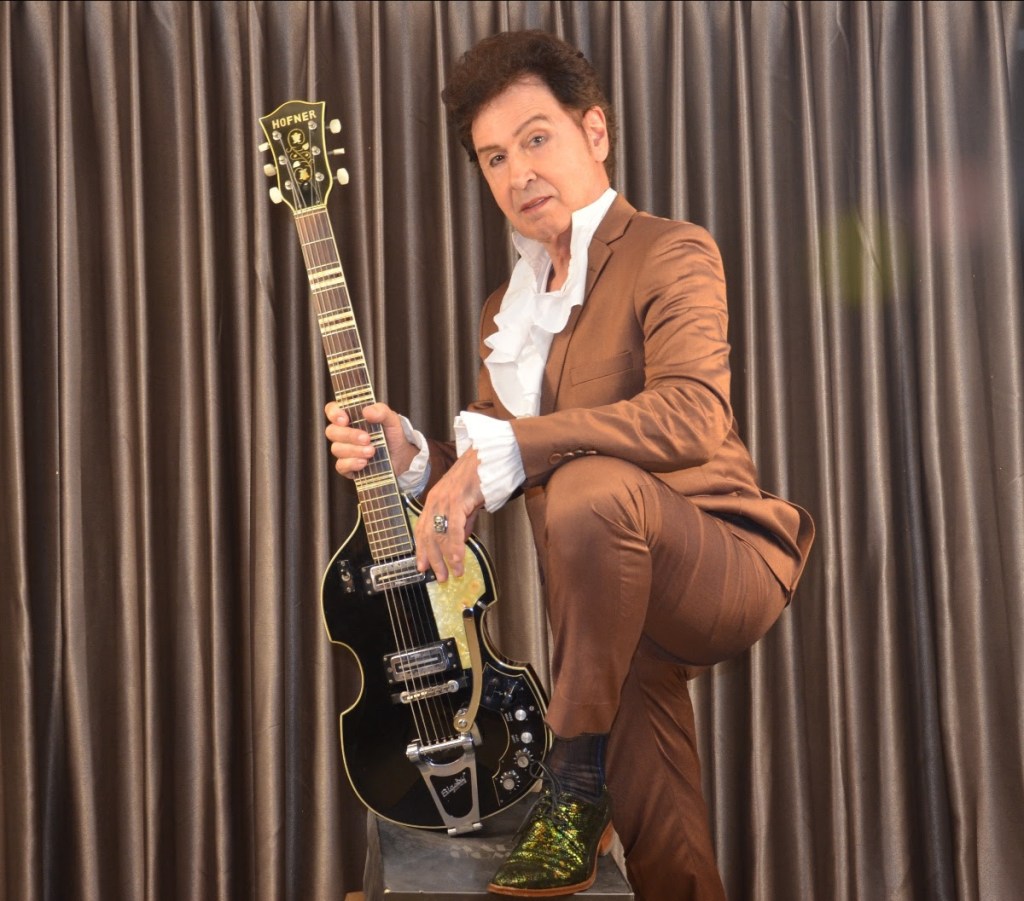
Singer, guitarist, author, and all-around renaissance man Tav Falco brings his legendary, cabaret-infused Memphis rock ‘n’ roll outfit Panther Burns to The Earl for an evening of music and mystery.








 Rad/ATL