Happy New Year! West End Motel kicks off the new year with a new jam, appropriately titled, “New Year’s Day.”
Singer and co-writer Tom Cheshire offers up some intel on the song’s words and meaning:
‘Well New Year’s Eve has always been a celebration of just another year being alive, and this year it rings truer than ever. Yesterday, my friend Rob Kincheloe sent me a text saying ‘Happy New Year, if you’re alive you won.’
With ‘New Year’s Day,’ I wanted to write a love song, with a sense of humor in it, and a sense of hope. We always talk about these New Year’s resolutions but they only seem to last a week or two. That’s why there are lyrics in the verse like ‘I know I’ve made mistakes but this time we’re gonna be great,’ and ‘Talk to me on New Year’s Day, I’ll find a place for us to stay,’ and ‘This year is for me and you, all the things that we’re gonna do.’
I also wanted it to be a nod to ’70s soul. I was channeling Motown and the Jam when I started writing it. But Ben Thrower, who wrote it with me, said without realizing it we were flirting with the sounds of early E Street band.
Either way, I love the way it came out. I love the New Year’s horn riff that Ben Davis plays at the end. I guess it is a celebration of being alive and maybe finding love again.’
“New Year’s Day” is the fourth single from West End Motel’s ongoing campaign to roll out a new single each month till Spring. After that, they’ll turn around the fourth proper West End Motel full-length album.
Check out the previous singles:
If you have enjoyed reading this post, please consider making a donation to RadATL.
Tune in to Drivn N Cryin‘s Facebook page on Christmas night to catch Kevn Kinney performing live in his attic! Kevn is a pillar of Atlanta music. He has the stories and he has the songs that place a sometimes rugged, always poignant spin on the past as well as the here and now.
The music starts at 8 p.m. He’ll plays some Drivin N Cryin classic cuts, some deep cuts, a few newer numbers, some solo joints, and maybe even a cover or two.
In the meantime, press play below to hear my April 2019 podcast interview in which Kinney talks about reconnecting with Drivin N Cryin’s first LP, the group’s most recent album, Live the Love Beautiful, and looking within himself to find true happiness.
Entertainment, for most intents and purposes, fell silent after releasing its 2009 debut album, Gender (Stickfigure Records, Adistant Sound, and Duchess Archive). Aside from playing shows in the Southeastern U.S., sharing stages with Modern English in 2016-17, the gothic-leaning post-punk outfit has remained far from the public eye for nearly 11 years.
In October 2020, two of the group’s founding members, Trey Ehart (vocals, guitar, bass, and synthesizer) and Bari Donovan (drums and percussion), along with Entertainment’s latest addition Jim Groff (synth) emerged from the void with a new single, titled “Maggot Church.” From the song’s hissing salvo — a deluge of sonic light and shadow — “Maggot Church’s” stark, effects-laden doom and ambiance are pierced by Ehart’s spectral moans of catharsis. Released with a handful of remixes by INHALT, Delphine Coma, and SubVon, aka producer and former March Violets guitar player Tom Ashton, “Maggot Church” is an empowered number cut from rhythmic grooves and distortion, and charged with intensity. It’s a twisted and contemptuous song that expands upon the group’s brand of gothic rock with an evolved and atmospheric makeover. It’s also the first cut from an upcoming two-part EP to be released in early 2021, titled Horror Parts 1 and Part 2. While preparing for the first EP’s January arrival, Ehart took a few minutes to talk about what the group has been up to for the last decade, and what Entertainment has in store for the future.
The two-part EP that you have in the works is called Horror. The video for “Maggot Church” opens with a quote from intro to the old television show “Tales From the Darkside.” I bring this up to get your thoughts on the EP’s title and the concepts that are at work here. … After watching “Maggot Church” I went down the Youtube rabbit hole, watching episodes of “Tales From the Darkside,” “Friday the 13th,” etc.
Those shows brought out a sense of chasing those childhood thrills of terror and elation at the same time.
I have always been obsessed with the intro to “Tales from the Darkside” — the negative trees, the way the music bends as the world turns dark, and the underlying context of the narration. In a weird way it helped shade the lens through which I see the world. There’s definitely that sense of terror and wonder, something dark lurking beyond you, mixed with childish wonder and elation, but there’s also a harsh existential truth buried beneath it.
Stephen King has a quote: “True horror is the coming undone of something good.” That, to me, is the essence of where we are as a band. When we started coming back out, suddenly I was hit with a lot of people affirming to me, for the first time, that we were something good, and we had completely come undone underneath that. The childish sense of blind self-assuredness had devolved into a sense of doubt, a black cloud hanging over me, like a Kafkaesque maze of conflict. Combine that with my love of camp B-movie horror from the ’80s, and that’s where we’re coming from now.
ENTERTAINMENT: Bari Donovan (left), Trey Ehart, and Jim Groff. Photo by Will Weems.
What prompted you to get the band back together and continue moving forward?
We never really officially broke up, but after touring behind Gender for two years our bass player Tommy bassist left. I moved back to Atlanta from Athens, and we struggled to regain momentum and maintain a reputation. We were working with DISARO Records, which was a huge accomplishment for us, but I lost faith and direction in our songwriting and position. We did meet our synth player Jim during this time though, and played SXSW twice, trying to find a new way forward. But our live presence almost completely dropped off, and I spent time working with Kris Sampson on nurturing our sound through recordings. Pretty soon the indie goth scene that we’d seen and been a part of in New York and Los Angeles started taking off in Atlanta, and I was asked to DJ at a few nights. I also started seeing more like minded musicians at the DKA nights at 529, and Silk Wolfs’ goth nights. That’s also when I started to realize we had a very underground cult following here. But the big moment was in 2016 when we got the opportunity to open for Modern English on the Southeastern dates of their Mesh & Lace Tour. So we grabbed Jen von Schlichten from Black Lodge and Hymen Moments, and went from nothing to the biggest tour of our career. It was unbelievable, we had everything and nothing to prove, and had to rely solely on the strength of our songs and live presence. We came back to Atlanta completely rejuvenated, played two sold-out shows at The EARL in one day, where half the crowd thought we were from the UK, and then we crashed back down to earth, went back out with Modern English in 2017, this time working with Henry Jack from Weary Heads by way of a connection through Dead Register, and we naturally started re-working and improving newer material. Once we came back from that tour we decided it was time.
How did you come work with Tom Ashton at SubVon Studio. Has working with him helped you realize anything new or different about your songwriting and the group’s sound and vision?
I met Tom through a mutual friend at a Peter Murphy show in Atlanta. Then we ran into each other again backstage at the Modern English show at the Earl, and again at the March Violets reunion show at the Masquerade, and the dots started to connect for me. I’m pretty shy when it comes to promoting our music, but once we started re-working our newer material I found the courage to reach out to him for help mixing and mastering the material Kris Sampson had helped us work up with the overdubs we did. He’s been a huge source of support and understanding for us. I originally approached him in a very nonchalant way, but March Violets is the ultimate street cred, and a very different approach from the way we do things. He has really helped to teach me strength and how to desaturate — to lean into the atmosphere of a song but also mind the hook — and to trust myself.
Do you feel like Entertainment is part of a larger community of like minded bands in Atlanta? I ask mostly because I have seen bands like Tears For The Dying and Hip To Death working with Tom Ashton as well. All three of these bands are quite different, aesthetically speaking, but there is an underlying thread of commonality — darkness, post-punk, gothic tendencies. Do you think of these bands as kindred spirits?
I’m pretty sure I introduced them to him, if I remember correctly. I love all those bands. We have all circled each other for years, and worked together pretty frequently. But there’s definitely a more concrete scene developing Out of SubVon, where we all have a place we can work. Honestly, I can remember seeing Hip To Death terrify kids at frat bars in Athens, and I’ve always admired Tears For The Dying from the time they used to rehearse next to us and Snowden in a warehouse off Howell Mill Road. And I think we’ve all developed separately, but we’re all hitting a certain level at the same time.
A little more than a decade has passed since Entertainment released Gender. Aesthetically speaking, how have things changed over time?
Not much, weirdly. I think I’m more inclined to be appealing now, much to the relief of the band. I still look to the artsy tension of bands like the Virgin Prunes and Bauhaus for inspiration, but I’m more interested in allowing people to enjoy us without having to be confronted. Leaning more into Japan and Psychedelic Furs. We were recently referred to as “the bastard child of Swans and Duran Duran,” rather than just “the sound of death,” so I think we’re moving in the right direction.
Do you have a favorite song amid all of the new material?
We have so much unreleased stuff at his point it’s hard to say. If you asked the band I think we’d all say something different, but our upcoming third single, “An Alter of Remembrance,” and the track “Distance” are two we tend to gravitate toward.
Have any of the remixes surprised you or revealed something about the music that you didn’t expect?
Yeah definitely! We’ve been lucky to have so many talented people support us and completely transform our songs. I love hearing how other musicians interpret and manipulate us. At times I am surprised and horrified at how desperate the solo tracks sound, or how small changes can really pull a chorus together in a much more accessible way. They really help put possibilities in place as we decide what the next sound is and get out of our heads.
Do you have a release date in mind for the EPs to arrive?
We have one more single before Horror Part 1 comes out, we’re waiting on a few remixes for that. Then Part 1 comes out in January and a third single and Part 2 come out in February.
If you have enjoyed reading this interview, please consider making a donation to RadATL.
Music In The Park founder Kebbi Williams. Photo courtesy Music In The Park.
On Thursday, December 10, at 7 p.m., Music In The Park celebrates 10 years of music and service to the community by highlighting Atlanta public school students and community youth as well as other local and international artists. This year, MITP brings its ever-evolving combination of artistic innovation and stellar performances—from a safe distance. To keep the community safe amid the ongoing COVID-19 pandemic, MITP is hosting a virtual festival.
Each year, MITP’s goal is to enlighten young performers and inspire vibrancy in communities through music and performing arts by encouraging young Atlanta-area musicians to pursue musical performance, composition, and production as a career. The festival also provides opportunities for professional musicians to be a part of the vital process of nurturing emerging talent while also providing a venue for musicians to collaborate with each other and connect with their audiences.
This year, MITP has expanded its program to Berlin and Germany, and created Cuban exchange programs for young musicians. The organization has also partnered with Atlanta’s Food Banks for food giveaway programs for those in need.
Music In The Park’s virtual festival lineup features: — Toma Fit Youth Hip-Hop Athletes — North Atlanta String Ensemble — Tierra Adentro Youth Flamenco (New Mexico) Ensemble w/ Westlake High School Drumline — Gallery 992 Sunday Jazz House Band — Saunders Sermons — Eli Maliki-(East Africa/Berlin) — Batila -(Congo/Berlin) — DJ Stan Zeff — Marlon Patton — Kebbi Williams More artists will be announced soon. Check out the Music In The Park Facebook event page for details on how to tune in to the live stream.
Tax-deductible donations to Music In The Park support the virtual festival and other ongoing programs. Check out www.musicintheparkatl.org for more information.
If you have enjoyed reading this post, please consider making a donation to RadATL.
Elzig didn’t have nothin’ to do with that Danzig Sings Elvis LP that came out back in April. But the Southern-fried lord of the left-hand path knows how to celebrate when those blue snowflakes start fallin’! On Friday, December 18, at 9 p.m. there’ll be a whole lotta shakin’ goin’ on when the Demon King tears into the collective greatest hits of both Danzig and Elvis—steeped in skulls and rhinestones.
America’s favorite sideshow couple, Captain & Maybelle, brighten up the holiday season with a set of sword-swallowing laughs and old-world oddities. You saw them at “Ripley’s Believe It or Not!,” on “America’s Got Talent,” and “Wife Swap.” Now catch them live and in the flesh. $10. 9 p.m. The Dixie Tavern, 2349 Windy Hill Rd SE #130, Marietta.
If you have enjoyed reading this post, please consider making a donation to RadATL.
The album was originally released by the Atlanta-based Rob’s House Records and features cover art by Bradford Cox of Deerhunter. “Wife Eyes” captures the Coathangers‘ original lineup of singer and guitar player Julia Kugel, bass player Meredith Franco, drummer Stephanie Luke, and keyboard player Candice Jones’ primal blend of vampy garage-punk and ramshackle angularity.
For the vinyl hounds, the record is being pressed on “confetti crush splatter,” “neon strawberry banana pinwheel,” and “wreckless” (blue-green) colored vinyl editions—500 copies each.
In the meantime, press play on “Wife Eyes.”
If you have enjoyed reading this post, please consider making a donation to RadATL.
As promised, West End Motel is back with a new song for November.
This month, the group unveils “Raisinha,” a Brent Hinds-penned numbed that’s dedicated to his wife. “Raisinha” features Hinds taking the lead on vocals and guitar, while Tom Cheshire and Ben Thrower come in for the back up chorus. It’s a love song that ebbs into some power pop terrain, exploring a smoother and more blissful approach in ways that West End Motel hasn’t really embraced before. The songs is also a rich counterpoint to West End Motel’s most recently released singles, “All The Witches,” which arrived in October, and “New Wave Kid,” which arrived in September.
“Raisinha” is part of a larger work in progress. The plan is for West End Motel to drop a new single each month for the next several months. After that, the group will turn around the fourth proper West End Motel full-length album. In the meantime, press play above.
If you have enjoyed reading this article, please consider making a donation to RadATL.
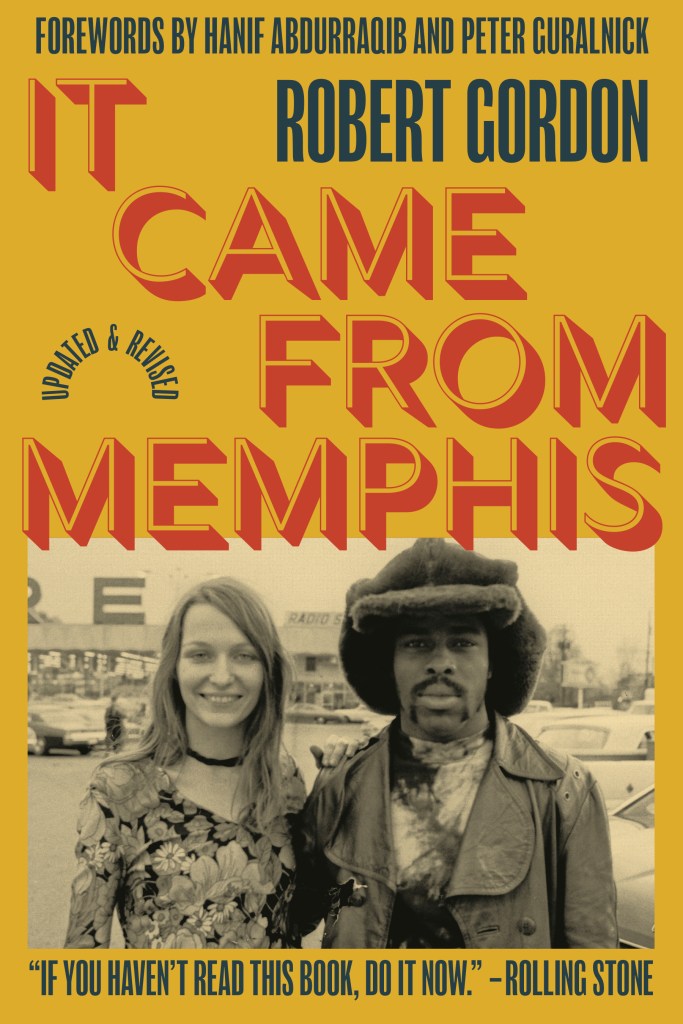
On Thursday, November 12, I spoke with Grammy and Emmy-winning author and filmmaker Robert Gordon about the updated 25th anniversary edition of his book It Came From Memphis (Third Man Books).
Originally published in 1995, It Came From Memphis tells the stories of bold and outlandish characters who brought life to the city’s cultural outer limits—characters that likely won’t won’t be found in other books. Yet each one embodies the indelible spirit of Memphis’ haunting beauty. From the 1950s through the early ’80s, DJ Dewey Phillips, professional wrestler Sputnik Monroe, and groundbreaking artists, musicians, and outsiders such as Alex Chilton, Furry Lewis, Tav Falco, Misty Lavender, Jim Dickinson, and more, are bound by an impressionistic thread, forever weaving them together in time and place. Gordon’s blend of interviews, spellbinding ruminations, and first-hand accounts come together in tales filled with gritty realism and spectral Southern ambiance.