Thousandaire: Operating under ideal conditions

THOUSANDAIRE: Andrew Wiggins (from left), Tom Bruno, and Chad LeBlanc.
Photo by Mike White of Deadly Designs

Ideal Conditions is an indie rock album that’s rife with layers of sonic textures, all distilled to a point of perfection, or at least Andrew Wiggins’ vision of what perfection should be for Thousandaire’s sound. “I think it all comes back to consistency,” he says over the phone while traveling from Baltimore to Philadelphia to play a show just a few days before releasing Ideal Conditions, the group’s second full-length recording.

It’s the definitive statement so far of Thousandaire’s musical DNA and the vocational drive that Wiggins has spent a lifetime honing, while maintaining control over every aspect of the music.

Wiggins is the vocalist, guitar player, and principal songwriter for Thousandaire. He is also the majordomo overseeing all creative and technical facets of the band in pretty much every situation imaginable.

In conversation, he offers a recent revelation that he’s had about leading the group, which includes bass player Chad LeBlanc and drummer Tom Bruno, while traveling up the East Coast and Mid-Atlantic states for this latest round of touring.

“We play the same, we sound the same, and we have the same amount of fun no matter what,” he says. “We’ve played in front of a hundred people and we’ve played in front of five people on this tour. We’ve played with everything mic’d up, and we’ve played with the most minimal set up, from a vocal PA in a tiny dive bar to setting up in a record store with a portable PA, and we’ve played with the same intensity. Despite these variables, it sounds just as good in any situation. That is very intentional for us,” he adds. “I have worked really hard to make that, and I didn’t want the record to be any different.”

Of course, Wiggins is pulling from decades of experience that encapsulate everything from playing and touring with a range of bands, including math rock outfit Blame Game and noisy post-punk groups HAWKS and Wymyns Prysyn. He has also spent time composing noise with his solo project Caesium Mine. Wiggins has also spent years doing live sound and mixing touring bands in venues including the Earl and 529. He also spends most of his days building fuzz pedals and repairing vintage guitars and amps at his self-run Moreland Magnetics business. “All of that experience goes into making this worthwhile for the 30 minutes we’re playing music,” he says.

Press play on Ideal Conditions and the opening number “No Good” channels an intense live band vibe, taking cues from like minded ‘90s rock acts such as Silkworm, Chavez, Dinosaur Jr., and the Meat Puppets. Asymmetrical guitar solos and fugue-like moments in rhythm take shape amid songs such as “Promise” and “Coward,” and in an older number, titled “Sgt. Billy.” Throughout each one of these numbers, extended compositions blend layered walls of sound and lyrics that are often contemplative, self-conscious, and always heartfelt.

Even at their most melodic and briskly paced moments, Thousandaire’s songs feel haunted and disquieted. Much of the inspiration behind the group’s self-titled 2020 debut album was sparked by Wiggins embracing a freshly sober lifestyle after years of consumption. Ideal Conditions reaches beyond the previous album’s blueprint as Wiggins tightens his focus on the art of crafting the music itself.


Thousandaire was probably the best creative outlet for me to get out a lot of what I was feeling at the time, whether that was intentional or not,” he says. “I don’t need to get really personal in my songs. I have a therapist,” he laughs. “I don’t really need to use music as therapy, and all of my lyrics are hypothetical. But it is a vibe that I can’t really avoid. On the new record, there’s a little bit less of that. Time has put some distance between me and those feelings.”

In more recent years, lyrics have moved closer to the forefront of Wiggins’ mind as he has continued writing songs. The strength of the sound, the songs, the performances that keep him truly and naturally motivated.

“I used to get really frustrated about writing lyrics until one day, I was talking about it with our old drummer Adam Weisberg, after he’d moved to New York,” Wiggins recalls. “Both of us are fans of Cass McCombs, and Adam said, ‘I bet that dude gets out of bed every morning and writes lyrics all day long, whereas you get up and make fuzz pedals all day. So don’t worry about it so much, you’ve got other stuff going,” Wiggins laughs.

The raw and serrated tones and distortion of songs such as “Bar Song,” “Your Gold Teeth III,” and Ideal Conditions’ title track are instantly arresting, drawing strength from each one of their respectively visceral and emotionally stirring melodies.

“I listen to a lot of records, and I think what’s best for what I want is both consistency and intimacy,” he says. “We recorded this record as live as possible, and I want to put the listener in the room with these songs, instead of putting the listener in a balcony seat in a huge 2000-person arena where there’s a symphony that has all kinds of bells and whistles going on. There’s something to be said about those kinds of records, but it’s just not Thousandaires’ vibe.”

Wiggins owns all of the gear the band uses. He’s worked closely with drummer Bruno and bass player LeBlanc to customize each of their instruments’ singularly abrasive snarls.

Damon Moon at Standard Electric Recorders in Avondale Estates also worked closely with Wiggins to summon and recreate the sounds that Wiggins had stuck in his head, and to carve them out into real-world songs.

In this process, it’s the ability to adapt that sets Thousandaire apart. 

“It’s the way we set up the equipment, the way everything sounds, the way we interact with whoever is doing sound. To me, it’s all about eliminating variables and stuff that you can’t control. If you get used to not having all the bells and whistles, like if all we did was play Terminal West where we have a huge production and a top line sound system, and then go play some record store, dive bar, or something where everything isn’t necessarily up to spec. If you can’t play your songs the same way that you play them on a big stage, then you fail.”

This extends to capturing the group’s sound on vinyl, or in the case of their latest offering, it’s on cassette. And what you hear is the culmination of Thousandaire playing under ideal conditions. 

This story appears in the January 2023 issue of Record Plug Magazine.

If you have enjoyed reading this post, please consider making a donation to RadATL.

Donate with PayPal

Kevn Kinney, ‘Think About It’


“Think About It.” It’s a simple, evocative phrase with the potential to mean just about anything that anyone can project onto the words. Is it meant as a cautionary tale? A prompt to let wisdom from experience sink in? Or is it simply the act of being left alone with one’s thoughts, looking back on a life in songs.

The title for Kevn Kinney’s 10th solo album is only the doorway into a collection of songs that move at a dreamlike pace. Sink a needle into the album’s pearly white-vinyl grooves and the atmosphere grows thick with internal dialogue, self-effacing humor, and lonesome ruminations. For this latest offering, Kinney embraced the solitude of life under quarantine conditions to summon a deeply personal album. Melancholy wit and memories collide in layers of rich string and piano arrangements that coalesce in songs with titles such as “Catching Up To Myself,” “Stop, Look, Listen, Think,” and “Half Mast.”

The A side favors primarily acoustic performances with jazz and folk leanings. Laur Joamets’ longing pedal steel in “Catching Up To Myself” and “Wishes” are matched with David Barbe’s production, which wholly ties together the album’s glowing and introspective tone.

In the opening title track, Kinney slows down the pace to in a devilish aside: “Ask yourself, should I? Could I?” His questions paint an image that hangs in the air long after the album has stopped spinning. It could be an internal narrative coming from the perspective of a beloved family dog who’s eyeballing a piece of food on the kitchen counter. Or it could be an existential quandary between two folks sitting next to each other at a bar, about to make a bad decision. Whatever the case may be, all are mile markers on the road to determining one’s place in the world, and the answers never come easily.

Throughout the album, a coterie of Georgia music royalty, including Peter Buck and Bill Berry (R.E.M.), Laur Joamets (Sturgill Simpson, Drivin’ N’ Cryin’), Brad Morgan (Drive-By Truckers), bass player extraordinaire Kevin Scott, and more play with subtlety and nuance. Their presence on the record demonstrates Kinney’s impeccable taste in selecting sidemen. Peter Buck plays his original R.E.M. 12-string Rickenbacker throughout the album’s B side, picking up a jangle-rock pace. But it’s Kinney’s poetic, lyrical portraits of the situations and the people he’s encountered along the way that bring the music to life. Kinney has long lived something of a troubadour lifestyle, both as a solo artist and performer and while singing and playing guitar with Drivin’ N Cryin.’ His experiences crown the 11 songs that make up Think About It. Each number emerges from a seemingly bottomless wellspring of memories of navigating long drives on the road and the kind of barroom conversations that take place between the soundcheck and showtime.

There is a veiled autobiographical tone swaying between the somber frustrations of “Wishes,” “Half Mast” and the album’s closer, a Southern take on an Irish a cappella ballad called “Never The Twain Shall Meet.” The closing number absolutely pulls the air out of the room. But it’s the sly and confident swing of “Shapeshifter Grifter” that is the heart and soul of Think About It. As the song’s spoken word jazz musings unfold it’s clear that this is the catchiest tribute to Sun Ra, Howlin’ Wolf, and Col. Bruce Hampton the world has witnessed yet. “Think of a number between one and a hundred!” All the answers lie within.

If you have enjoyed reading this review, please consider making a donation to RadATL.

Donate with PayPal

Bill Nittler’s final recordings: The Edgewood Sax Trio’s ‘Heard’ 

THE EDGEWOOD SAX TRIO: Ben Davis (from left), Jeff Crompton, and Bill Nittler. Photo by Jeff Crompton.

In December of 2022, the passing of baritone saxophonist Bill Nittler left a hole in the heart of Atlanta’s extended musical family.

As a tribute, his former Edgewood Saxophone Trio bandmates Jeff Crompton (alto) and Ben Davis (tenor) have launched a Gofundme campaign to release the group’s second full-length album, Heard.

Over the years, Nittler served as the Education Director for the Atlanta Young Singers youth choir. He also played a vital role performing with various jazz-based ensembles including Kingsized, Greasepaint, Nuzion Big Band, Lie And Swell, the 4th Ward Afro Klezmer Orchestra, Shaking Ray Levis, and more. He performed with Southern Culture on the Skids, and was known for crafting a bustling ska arrangement of Thelonious Monk’s “’Round Midnight” and an avant-garde take on the Butthole Surfers’ already twisted number “Cherub.”


Heard is the follow up to the Edgewood Sax Trio’s 2014 debut, Snake Nation, and marks the group’s final offering, which is expected to arrive this summer.

“I spent hours editing the existing studio material for side one of the LP,” says alto saxophonist and EST co-founder Jeff Crompton. “Some high-quality recordings from a live broadcast on Atlanta radio station WREK provided three of the tracks on side two. The final track is a special one—a live recording from our favorite gig ever: a 2015 concert at Atlanta’s Trinity House. The recordings have been expertly mastered by Chris Griffin of Griffin Mastering.”

Donations are being accepted now. $20 gets you a copy of the record and covers shipping charges. Click here to read more about the project.

If you have enjoyed reading this post, please consider making a donation to RadATL.

Donate with PayPal

Upchuck rising!

UPCHUCK: Photo by Marlon Garcia.

What at first feels like irony quickly fades as Upchuck’s vocalist and frontwoman KT and guitar player Mikey, laugh while explaining how spending time on the road with Melbourne’s garage punk provocateurs Amyl & the Sniffers instilled in them a sense of discipline.

“It’s true,” Mikey says. “We learned a lot from them in terms of professionalism and staying on point just by watching how they put on shows from the business end of things. We learned what it’s like playing bigger venues, how production goes, and how important it is that we show up on time.”

KT agrees, adding, “It really is a whole different game. You have to make some serious decisions if you’re going to keep stepping it up. How far do you want to take this? I learned there’s a balance between how lit do you want to get each night before you go on stage and how much do you want to deliver. I learned that there can be a natural, kinetic energy between peeps when you are on tour together, and that we can learn from each other.”

Both Mikey and KT’s voices collide, clipping each other out during a Zoom interview. Shaky connections stutter, freeze, and leap back to life—Mikey is in his car, holding his phone in his lap while driving home after a day spent working on the set of a new Exorcist film. KT keeps her phone in her hand while wandering in and out of darkened rooms in her home. For brief, fleeting moments the image of her face emerges from the glowing contrasts of the computer screen only to disappear again back into the inky darkness for the duration of our conversation. But she never misses a beat while talking, cracking herself up, laughing at her own answers, despite her sincerity. Then, a chime and another voice joins the Zoom, second guitar player Hoff announces his presence, by explaining that he’s dialing into our Zoom chat from work. “I’m listening, and I’ll might have some input here and there, but I’m running up and down stairs,” he says.

Chaos rules Upchuck—at least when viewed from the outside—following the example of their outrageous Aussie compatriots Amyl and the Sniffers, who’s early single “Some Mutts (Can’t Be Muzzled)” barked the song’s title as a primordial battle cry. Later, the same group closed out their second and most recent album, 2021’s Comfort To Me, with a song titled “Snakes,” in which singer Amy Taylor declares in her banshee howl, “Worked at the IGA, now I’mma famous cunt.”

For now, though, Upchuck’s members still punch a clock. All of this comes into perspective when parsing out the group’s hard, fast rise amid Atlanta’s disjointed, pre-pandemic local music scene.

The group came out of the gate strong in 2018, packing out DIY venues such as the Bakery’s original Warner Street location near the Adair Park and Oakland City neighborhoods, and the Drunken Unicorn on Ponce de Leon Avenue, with wall-to-wall mosh pits that sent bodies flying through the air like missiles.

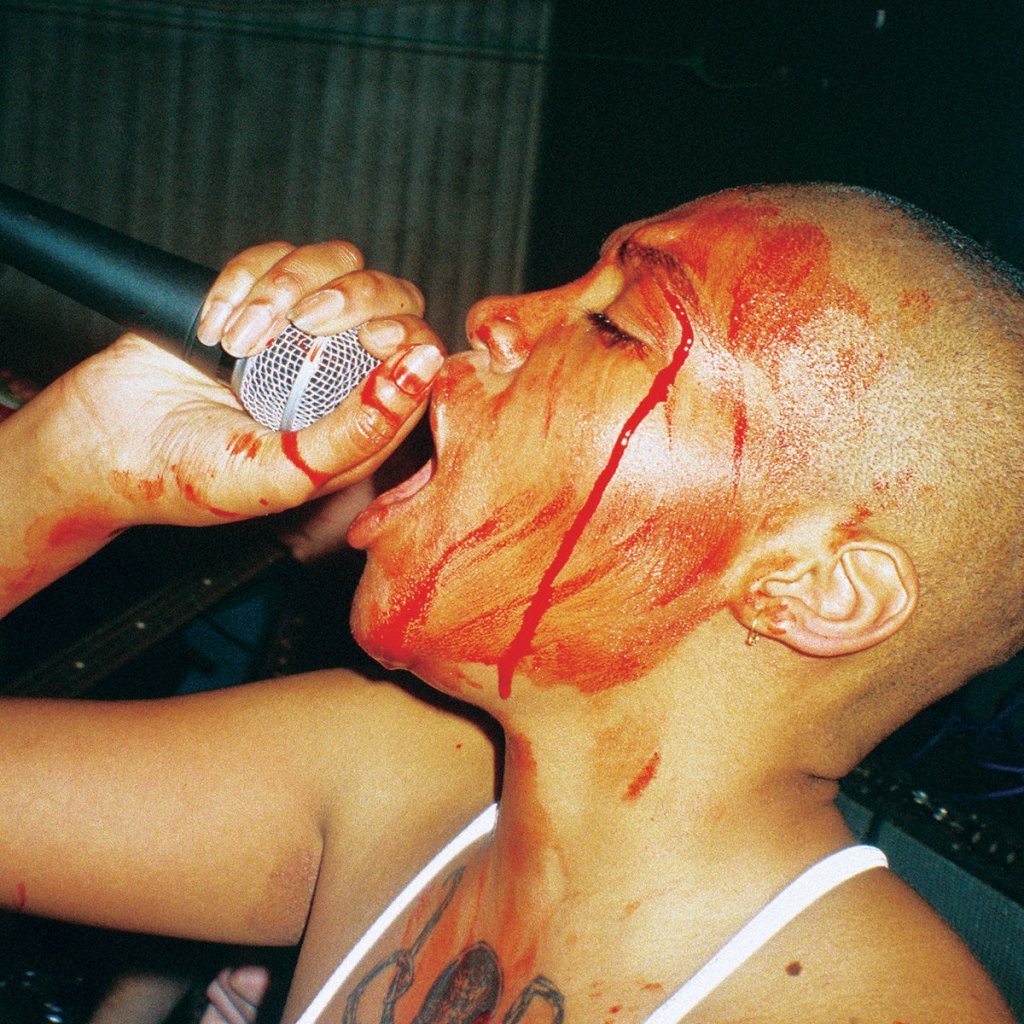
KT of Upchuck on the cover of “Sense Yourself.” Photo by Nathan Davenport.

On September 30, 2022, Upchuck unveiled its debut album Sense Yourself via the Brooklyn-based indie label Famous Class Records.

The album was two years in the making, and arrived bearing a vibrant image of KT, screaming into a microphone with blood oozing down the sides of her face and hands. It is an instantly arresting image, captured by photographer Nathan Davenport, and shot only seconds apart from Marlon Garcia’s image on the cover of the group’s “Upchuck” b/w “In Your Mind” 7-inch single. It’s a pic that has become synonymous with the group’s fun and feral energy. The whirlwind of fury kicked up during their live shows as the group tore through early songs bearing titles such as “Shakin,’” “Wage of War,” and Upchuck’s fiery self-titled anthem captured the attention of everyone from the local hardcore scene to dispassionate indie rockers and beer-swilling college kids from all walks of life.


Sense Yourself is an album that’s teeming with the sounds of swaggering danger and youthful abandon, all embodying a deeply ingrained sense of innocence. It’s a celebration of intensity that reaches a fever pitch while traversing a shared, collective experience for listeners, a seemingly insurmountable task in the modern era.

Other songs such as “Boss Up,” “In Your Mind,” “Our Skin,” and “Facecard” coalesce around a forward-leaning momentum that has kept the group forging confidently ahead this year, all the while bolstering the spirit of Atlanta’s young, underground rock music scene onto the national and international radar. If ever there was a candidate for Atlanta’s 2022 album of the year, Sense Yourself is it, its thunderous rhythms reaching larger crowds from coast to coast nearly every day since it arrived. The album’s searing energy is matched only by its bounding urgency fueled by equal parts contempt for a broken society and camaraderie within the band’s ranks.


“These boys are my family, and Mikey is literally like my big bro,” KT laughs. “We all love each other unconditionally, and my POV is that this will never change. Someone would literally have to do something crazy to bring that to an end, but that will never happen because we’re all cool beings and we value each other so much.”

Aesthetically speaking, there is no realm that Upchuck does not touch. KT (Kaila Thompson), Mikey (“Spuzz Dangus”), Hoff, bass player Armando Arrieta, and drummer Chris Salado’ songs are driven by a defiantly creative blend of post-punk, hip-hop, and indie rock energy that’s channeled through a haze of distortion.

They prefer to identify themselves only by their first names, and to the ire of promoters around the country, the group’s social media presence is kept to a bare minimum. Upchuck has no Facebook page. No Twitter, and no Tik Tok. Just an Instagram account that allows them to project just enough about themselves to remain compelling to those who are genuinely interested in the music, and their numbers are growing.

“The songs are always changing when we play them live,” Mikey says. “Maybe it’s that the rhythm is different, or we’ll cut it short in a certain way. Change up the lyrics. Even the old songs we change up to keep things fresh—keep things from getting boring.”

KT continues his thought, adding that the changes are always unspoken. “Communication with us all has literally come down to just a look. We’ll all look at each other, and it’s like, ‘Aight, I know exactly what you’re saying.’ We all know what to do.”

“Hoff adds that he and Mikey have been jamming together since pre-Upchuck days, and developed the group’s shared musical instincts together. “We practiced the songs that we had for six months before we even played a show with them, so we kind of already know what to anticipate when we go into a song.”

This kind of interaction between band members during practice is one thing, but expounding upon that in front of a crowd of hundreds of people or more is something different. But it’s an instinct that the group’s members have continuously honed. “I feel like if that kind of energy and communication doesn’t happen during practice, it definitely won’t happen on stage.”

That energy translates across the board. “Perdido,” is sung entirely in Spanish by drummer Chris, and builds energy around the phrase: “Hago lo que quiero”—”I do what I want.”

The album’s title track also carries the explosive energy to a new level. The quick intro catches audiences off guard, as the rooms they play visibly come alive based on the riff alone. “That’s definitely by design,” Hoff says.

Photo by Alec Pugliese.

One of the album’s more introspective numbers, “Facecard,” finds KT taking on the superficiality of modern America: “The trifling yuppie fuck, comes out beyond the cut to try and low ball, low ball,” KT sings.

“It’s always on the setlist and it’s definitely a breather for me,” she adds. “It’s also one of those tracks where people hear the riff and start reacting immediately.”

The connection with Amyl and the Sniffers was born in July of 2019. The group was coming to the States and had booked a show at The Earl. Upchuck’s manager Randy Castello of the Tight Bros. Network seized the opportunity to lobby for them to open the show. He sent over a link to Upchuck’s demo tape on Bandcamp. “Amy Taylor responded almost immediately,” Castello says. “She was like, ‘Yes, definitely add them to the show!’”

Afterward, Taylor and her bandmates approached Upchuck, asking them if they wanted to play just a few more shows together. “It actually turned out to be a lot more shows together,” Mikey says,” and we both played the biggest show that either of our bands have played to date, at Brooklyn Steel in May.”

The show pushed the 1,800-capacity venue nearly to the breaking point, and opened up a whole new audience for Upchuck.

As 2023 approaches, the group is preparing to record its sophomore album for Famous Class. While the exact details as to where and with whom they’re recording remain a closely guarded secret for the time being, they’re heading to California in February to capture it all on tape.

“We’re definitely gonna keep working with Famous Class, regardless,” Hoff says. “Cyrus [Lubin] at Famous Class has given us so much creative freedom and trust, and aside from a few minor tweaks here and there, doesn’t mess with what we do at all.”


Mikey adds, “The songs that we’re recording are songs that we’ve been playing pretty much just as long as everything that’s on the first record, so the two should fit together really well.”

Teetering on the axis of punk, hip-hop, and indie rock, a sense of discovery, and the power of youthful energy, the new music contained within these songs—either live and in the moment or on record—is intoxicating to the end.

If you have enjoyed reading this post, please consider making a donation to RadATL.

Donate with PayPal

This story also appears in the December issue of Record Plug Magazine.

Tav Falco: L’Ultimo Gigolo on the songs that make up Panther Burns latest EP, ‘Club Car Zodiac’

Tav Falco and Giuseppe Sangirardi. Photo courtesy Prime Mover Media.

Tav Falco is something of a renaissance man. The singer, guitar slinger, author, and provocateur began his extraordinary career in a cotton loft on the banks of the Mississippi River in 1979. It was there that he chain sawed a guitar into pieces during a performance art act. Since then, his notoriously outsider musical outfit Panther Burns has included everyone from Big Star singer and guitarist Alex Chilton to Minutemen and fIREHOSE bass player Mike Watt and Nick Cave and the Bad Seeds drummer Toby Dammit.

These days, Falco calls Bangkok, Thailand his home. For Panther Burns 2022 U.S. tour, the group’s lineup is rounded out by bass player Giuseppe Sangirardi, guitar player Mario Monterosso, and drummer Walter Brunetti. 

Over the decades, the Arkansas-born auteur has mastered a singularly primitive motif. Blues rhythms carry his less-than-pitch-perfect singing, creating an off-center momentum in which songs feel as though they could tumble apart at any moment. But he always reins them in, creating a marvelous avant-garde tension on the stage. In recent years, his sound has expanded to incorporate elements of cabaret and tango performances, which underscore his latest five-song EP, Club Car Zodiac.

Before his cabaret-infused blend of Memphis rock ‘n’ roll takes over the the Earl for an evening of music and mystery, Falco took a few minutes to talk about how the new EP came together.

Panther Burns are back on the road after surviving the global pandemic!

Yes, and these are the first shows that we have played since the height of the pandemic, when we played a contagion-controlled event at the Il Castello Della Spizzichina in Italy, and that was July 31, 2021. Now, we’re out supporting our Club Car Zodiac EP, which came out for Record Store Day’s Black Friday, and it’s a highly personal recording.

What makes this such a personal recording for you?

I wrote three of the songs, “Dance Me to the River,” “Tango Primavera,” and “La Brigantessa,” which I sing in English. I wrote “La Brigantessa” for a cabaret artist in Rome, Adèl Tirant. I saw her perform with La Conventicola degli Ultramoderni. When I met her I was so impressed with her that I wrote this song for her. In Italian, “La Brigantessa” translates as “a lady thief.” We got to know one another and she sings the chorus of the song that you hear on the recording. I am so very happy with how that recording turned out, and I hope people will listen to it. 

The lineup on the record also includes Mike Watt playing some bass. You also have Didi Wray playing guitar. Were you all in a room playing and recording together or were these songs done remotely? 

Mike Watt initiated this recording during lockdown. He said, “Let’s do a couple of songs and put out a single.” I thought, why not? So we recorded the entire record remotely. When I got into it I wasn’t happy with the vocals I was getting. So I ordered a large diaphragm microphone, and once that came the vocals started happening for me—and my software. So I said, “This is sounding pretty good, I’m gonna do some more songs for this record. I wrote one, called “COVID Rebel Girl.” It was highly electrified, but that one did not make it onto the record because everyone but Mike Watt thought my playing on the song was just way too bizarre. 

So it’s just five songs, but it’s a rather dense recording. Didi Wray is a tango surf guitarist from Argentina. She plays on “Dance Me to the River.” That is a very personal song; lockdown was a very lonely period for me, and I delved into my interior life. I brought out a lot of what was floating around in the dark waters of my unconscious. That song is set in Paris, on the banks of the Seine. It’s a personal statement about separation, betrayal, unrequited love, a sense of loss, bewilderment, and general confusion. It was the end of a period of my life that had gone on for quite some time—the shattering of a relationship—and I wanted to treat it artistically. Doing that was a kind of catharsis. 

Then there is “House of the Rising Sun.”

Yes, and that is a song that I have always wanted to do. In fact, most vocalists attempt their version of it at one time or another throughout their career. I thought it was time for me to do my own version. I did ok with it. I’m not unhappy with that track.

“Tango Primavera,” is the last song on the EP, and it’s a rewrite of an Ettore Petrolini recording from the 1930s, the cabaret artist from Rome. 

Petrolini has a song called “Tango Roman,” which means Roman tango. I heard it performed in Rome by Maria Freitas in the cabaret La Conventicola degli Ultramoderni. 

Maria performed that in the same cabaret that Adèl Tirant performs in and Mirkaccio Dettori plays the piano. 

I had done a small show there with Panther Burns, and I became enchanted with this cabaret in the San Lorenzo district, which is the working class district of Rome, where Pier Paolo Pasolini lives.

I went back to Rome after the tour and said, “I would like to perform here.” They asked, “What would you like to do?” I said, “I would like to sing and dance with a dancing cane and a Matta Low hat—the straw hat, like French singer, actor Maurice Chevalier wore.

So I started working on some songs and rehearsing, and I came across “C’est mon Gigolo,” in French, by the 1930s cabaret artist Damia. So I got an English translation from some radio people in Paris, and I put together an arrangement in French and English that I brought to the cabaret. We do it in three languages now: French, English, and Mirkaccio sings it in Italian. It is the original gigolo song, not the one that Louis Prima had a hit with in the ‘50s by grafting together the original song with “I Ain’t Got Nobody.” I’m not interested in that. I’m interested in the original, which is a very dark and expressionistic song. It’s an admonition to the gigolo of what will happen in the end. 

I also brought in the Irving Berlin number “Puttin’ On The Ritz,” which has some racial overtones in today’s world. But that’s the song. I sing it, and anybody who’s heard it won’t deny that tune. And I do “Brazil,” which I do with Panther Burns, and “St. Louis Blues,” the W.C. Handy number that I recorded on Behind the Magnolia Curtain. After this tour, I will return to Rome and continue doing that under the adopted persona, L’Ultimo Gigolo, the Last Gigolo. That is my character, and I’ll bring it to America in 2023, probably as a Cabaret of Daggers, musical theater piece. We’re developing that in Memphis, with Mario Monterosso who will be the producer, as he has been the producer for my last four albums, and the lead guitar player and arranger in Panther Burns and on Tav Falco solo records. 

Mario has a new record out called Take It Away on Org music. It’s a record of instrumentals from which he’ll be playing six tunes in Atlanta, prefacing the Panther Burns performance. Don’t miss that! It’s really outstanding what Mario is doing with these instrumentals. 

TAV FALCO: Photo by Eugene Baffle

I did an interview with Robert Gordon during the pandemic, about his book, It Came from Memphis ..

Yes, I took the photograph that appears on the front cover of that book.

That photograph came up in our conversation. Robert said that you gave him some advice about writing, filmmaking, and anything else, and that was to just jump in and do it

I think he’s talking about what I learned from William Eggleston. I was learning photography from William, and I asked, “How do you do this, Bill?” He said, you just have to jump in the middle and work your way out. That’s what Robert’s referencing, and that is true. 

It’s good to prepare. Technique is important. Learn your instrument and learn your craft: If you are an actor you learn your body and your voice, but that will take you so far. You can learn from a mentor. You can learn in a school. You can be self-taught. You can start from the beginning of an itinerary that’s going to take you to a certain level of ability and control. Or you can just jump in the middle and figure it all out. That’s the way I did photography. That’s the way I did music and theater, and to an extent, film. It may not be the best way, but it’s one way. 

In doing that you learn to rely on and to draw from intuitive sources rather than a dogmatic plan of some kind. Only now, after all this time, am I looking at music theory. I’ve started to study that because, Chad, I do not know a note from a molecule, at least not until recently.

Now I have an understanding of the concepts that go all the way back to the classic modes of music and poetry. It’s exciting, but I don’t know if it will help me as a musician or as an artist. It may help me on an intellectual level of some kind, and maybe on a subliminal secondary level. But I don’t see it having any direct effect on what I do. It might help me choose the chords that are more pleasing without having to do trial and error all the time, which is how I normally do it.

I want to communicate with musicians, and I want to do so in the language that I understand. And I want to have a better understanding of musical structure and dynamics in terms of notation, frequency, vibration, and how the musical scale and tonal parameters of music are understood. I’m making progress, but putting it into practice is not so easy.

Tav Falco & His Panther Burns, Twisty Cats, and Georgie Harris play The Earl on Friday, September 23. $18. 8 p.m. (doors). 8:30 p.m. (show).

Catch Panther Burns again at Fleetwoods in Asheville on Sept. 24 and in Chattanooga at Cherry Street Tavern on Sept. 25.

If you have enjoyed reading this interview, please consider making a donation to RadATL.
Donate with PayPal

Klimchak and Stuart Gerber bring ‘LeBeato Lounge: Water Wonderland’ to the McDonough Tunnel on Sunday, May 15

Stuart Gerber (left) and Klimchak. Photo courtesy Klimchak

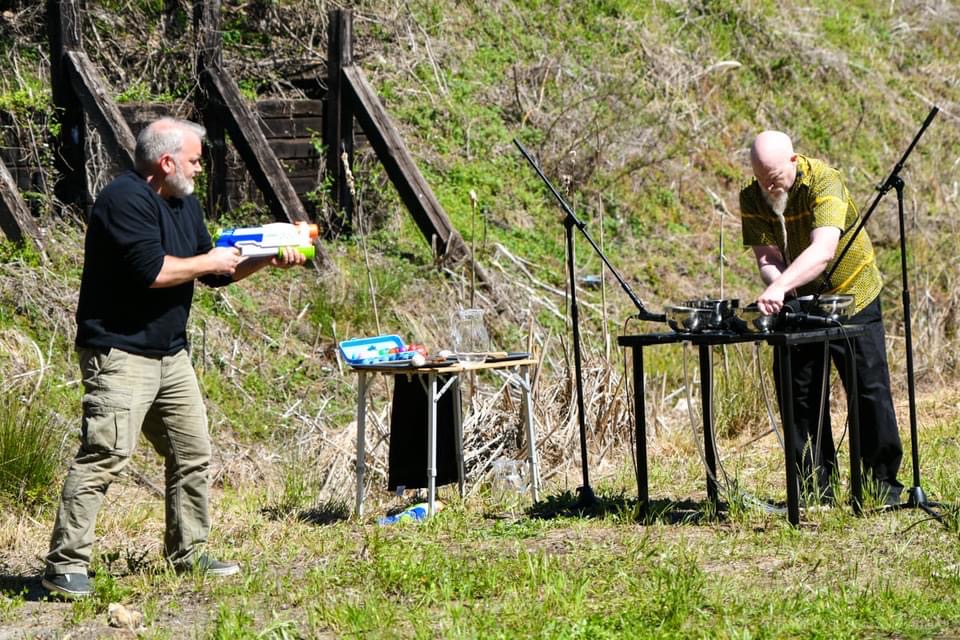
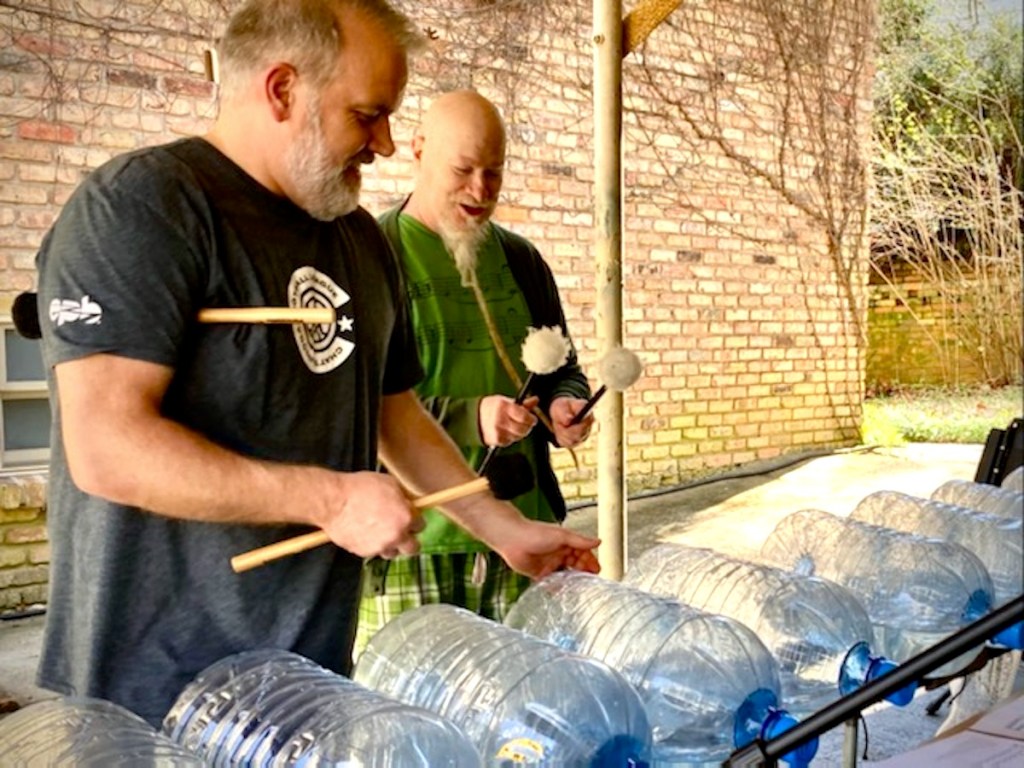
Composer, percussionist, and longtime Atlanta sound sculptor Klimchak is bringing everything, including the kitchen sink, to the McDonough Tunnel on the Southside BeltLine on Sunday, May 15.

The performance, titled LeBeato Lounge: Water Wonderland, is part of the Art on the Atlanta BeltLine series, and will feature three water and percussion-based works performed live: “Waterphonics” and “Bowled Over,” both accompanied by GSU associate professor of percussion and founder of the new music ensemble Bent Frequency Stuart Gerber. A third piece, titled “When You Whistle, It’s Not Work,” will also be performed solely by Klimchak.

It will be an evening of deep listening and engaging rhythms, as both Klimchak and Gerber explore the vast and mysterious sonic qualities of the former train tunnel by way of various homemade percussion instruments, bows, electronic manipulations, bowls filled with various levels of water, and a working sink on a cart for a wet and wild journey into sound.

… And if you are a truly old school Atlanta music head, you’ll remember the tunnel from the freak-folk and noise shows that Matthew Proctor (Hubcap City, Pony Bones) organized there in the early aughts — when the BeltLine was a looming reality, the tunnel had train tracks running through it, and it was a fairly secluded location.

Free. Music starts at 3 p.m. 95 Milton Ave. SE (between Milton Ave. and the I-75 / I-85 underpass on the BeltLine).

If you have enjoyed reading this post, please consider making a donation to RadATL.

Donate with PayPal

Victory Hands ‘Braden’ 7-inch release party with MTN ISL, Skin Jobs, and Scratch Offs at Sabbath Brewing on Sunday, May 15

Victory Hands play the “Braden” 7-inch release party at Sabbath Brewing in EAV on Sunday, May 15. MTN ISL, Skin Jobs, and Scratch Offs also perform.

This show will mark Scratch Offs’ debut performance, so get there early.

… And if you don’t already know, Victory Hands releases are all named after journalists who were blacklisted by former President Richard M. Nixon leading up to his impeachment. Hence the titles of their previously released singles, “Bishop,” “Bernstein,” and “Anderson.”

Free. 2 p.m. (doors). 3 p.m. (show). 530 Flat Shoals Ave. SE.


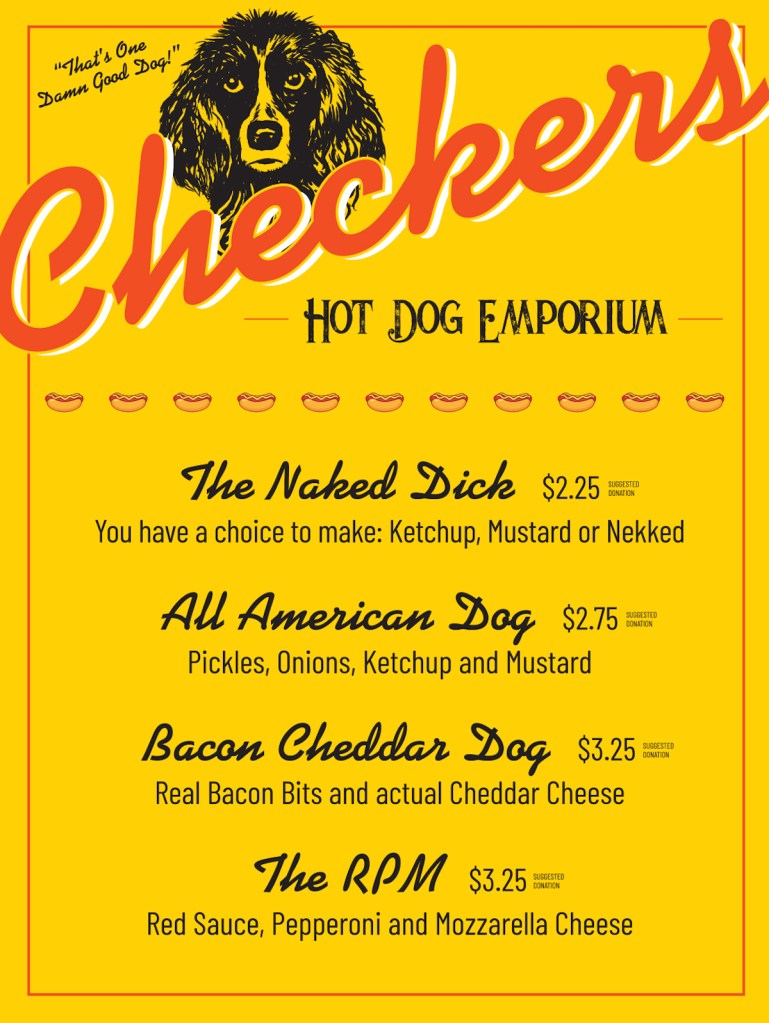
Checkers Hot Dog Emporium will also be on deck. Check out Tricky Dick-themed menu suggestions below. … And yes, there will be veggie dogs for the veggie folks!


If you have enjoyed reading this post, please consider making a donation to RadATL.

Donate with PayPal

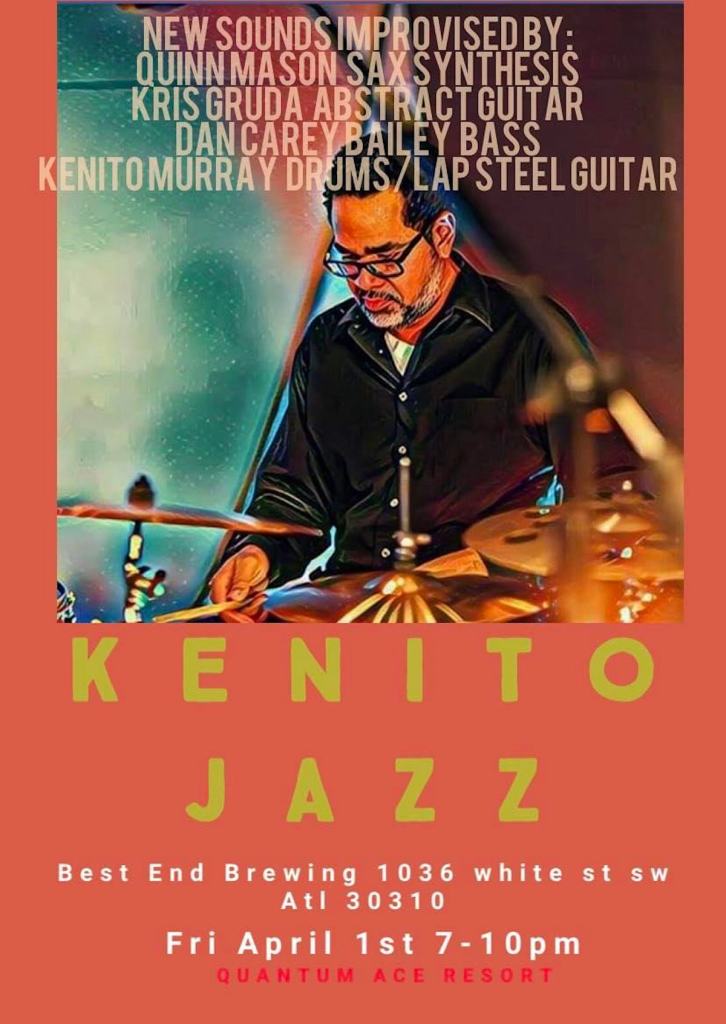
New Sounds Improvised by Quinn Mason, Kris Gruda, Dan Carey Bailey, and Kenito Murray at Best End Brewing on Friday, April 1

Kenito Murray leads an evening of improvisation at Best End Brewing Co. on Friday, April 1.

Percussionist Murray, along with Quinn Mason (tenor sax, keys), Kris Gruda (guitar), and Dan Carey Bailey (electric bass) will craft everything from trip hop and ambient sounds to jazz, Delta blues grooves, and dub beats.

Dan Carey Bailey (left) and Quinn Mason. Photo by Kenito Murray


Free. Music is live from 7-10 p.m. 1036 White St. SW (on the Westside BeltLine).

If you have enjoyed reading this post, please consider making a donation to RadATL.

Donate with PayPal

Kim Gordon’s ‘No Home Tour’ feat. Mary Lattimore comes to Variety Playhouse on Thurs., March 24

Kim Gordon photo by Natalia Mantini.

Kim Gordon‘s (Sonic Youth, Body/Head) “No Home Tour” feat. Mary Lattimore comes to Variety Playhouse on Thurs., March 24. $30-$59. 7 p.m. (doors). 8 p.m. (show).

Tickets go on sale for the general public on Fri., Jan. 28. Pre-sale begins Thurs., Jan. 27 at 10 a.m. Use code: KIMG22

If you have enjoyed reading this post, please consider making a donation to RadATL.
Donate with PayPal