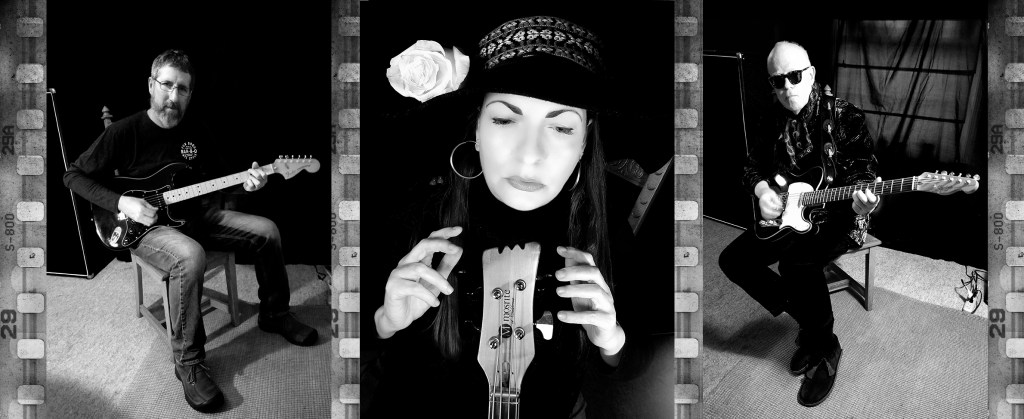
Three years in the making, Total Peace’s self-titled debut album comes out of the gate strong with volume and urgency. What began as a neighborly chat between Michelle Williams and Matt Cherry during the peak of COVID isolation turned into a full-fledged band grounded in old school human interaction and no-frills songwriting.
Cherry is best known for slinging layered and complex guitar parts in the psychedelic post rock outfit Maserati. Here, he trades his effects pedals for a bass and a microphone. His voice is heavy, tuneful, and raw in songs such as “Taped Up,” “Trance,” and “Slipped.” It’s a bold pivot that calls to mind the ramped up energy of Gang of Four’s Entertainment! and the introspective back-and-forth between Tom Verlaine and Richard Lloyd throughout Television’s Marquee Moon—all driven by the sheer exuberance of the Stooges’Self-titled LP. The riffs are bold and the rhythms are undeniable, reveling in the power of repetition.
Guitarists Williams and Craig Gates and drummer Greg Stevens round out the lineup with a compelling synergy. Stevens and Williams share roots in Atlanta’s early aughts indie rock band Red Level 11. Their chemistry grounds the record’s driving pulse, as they thrive on stripped-down dynamics—no synths and no nonsense.
There is no concept at work here per se, but Cherry says, “Michelle and I are neighbors in Inman Park. She has a bunch of historical documents about people and events on our street in the 1910s and 1920s that we thought were interesting. Several of the songs are loosely about those things. Other songs,” he goes on to says,” “are about different topics ranging from fictional characters to various midlife crises and dark thoughts.”
Recorded live at Maze Studios in Reynoldstown with engineer Ben Etter (Erasure, Washed Out, Nikki and the Phantom Callers) and mastered by Joel Hatstat (Bambara, We Vs. the Shark, Liz Durrett), this self-titled debut leans into its compact and hook-laden energy. “Tom Talbot,” “Mold Blue” and “Be Free” dance on a tightrope between post-punk tension and anthemic release. There’s a visceral joy in cranking it up for the sake of catharsis, and Total Peace hits like a welcome jolt of electricity.
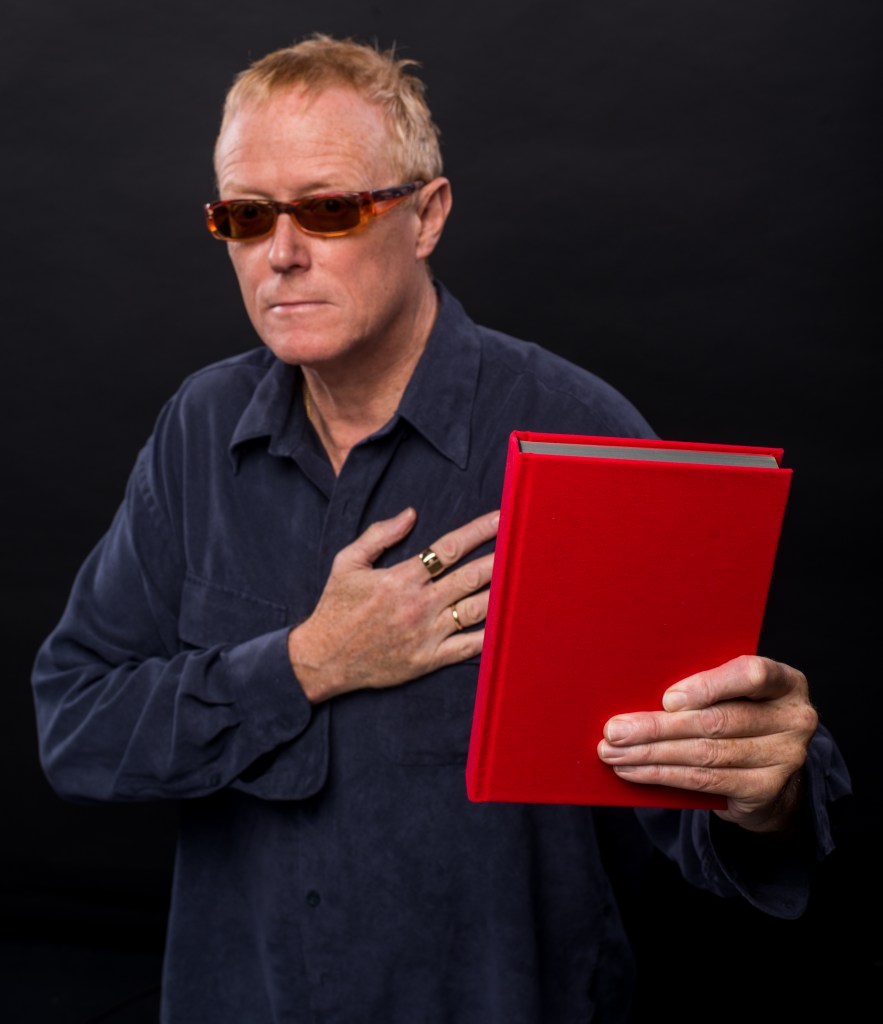
David J—co-founder of Bauhaus and Love and Rockets—returns to Avondale Estates for a solo appearance supporting his new poetry collection, titled Rhapsody, Threnody, and Prayer, while playing music from his elegiac new LP, The Mother Tree.
It’s a seated, BYOB affair taking place in a small studio setting, that finds the legendary bass player marking a new and vulnerable chapter in his career. Both David J’s new book and album are tributes to his late mother, Joan Nancy Haskins, each one reflecting on decades of introspection, artistry, and grief processed through the lenses of music and verse. Over five atmospheric tracks, The Mother Tree conjures soundscapes for his poetry to drift through—at once dramatic and meditative, full of memory and emotional ballast.
Mike Lynn (left), Lisa King, and Jeff Calder. Photo courtesy The Hot Place
The Hot Place opens the show. The long-running psychedelic darkwave group led by vocalist and bass player Lisa King and Swimming Pool Q’s guitarist Jeff Calder. Rounded out by Mike Lynn (Betty’s Not a Vitamin), the trio will offer stripped-down interpretations of songs from their 2023 self-titled album. Expect acoustic arrangements that lean into the band’s more ethereal inflections, with King also sharing selections from her own poetry collection Dark Queens and Their Quarry.
David J
The connection between David J and the Hot Place runs deep. The two have toured together playing living room gigs throughout the Southeast, and their creative paths have intersected on multiple projects over the years. This performance promises to continue that synergy in a setting designed for careful listening and thoughtful reflection.
Advance tickets are $50, and are required. There will be no tickets sold at the door, and seating is limited. Doors open at 7 p.m. All-ages are welcomed with accompaniment. Respect the neighbors and don’t park in the adjacent driveway.
If you have enjoyed reading this post, please consider donating to RadATL. Venmo to @Chad-Radford-6 or click on the PayPal link below.
If you ever caught an earful of “Destroy All Music” on WREK-FM in the 1980s, flipped through the dog-eared pages of LowLife Magazine, or caught Glen Thrasher behind the counter at A Cappella Books, you already know: Glen didn’t just participate in Atlanta’s underground—he defined a large part of it, for a long time.
Thrasher passed away Saturday morning, May 3, leaving behind a secret legacy that pulses through every DIY show, noise set, and scribbled flyer that still dares to push Atlanta’s arts scene off the rails and into uncharted territory.
He was 66 years old.
In the early 1980s, Glen and co-host Ellen McGrail transformed “Destroy All Music” into a beacon of chaos and possibility over Georgia Tech’s 91.1 FM airwaves. No wave, free jazz, tape hiss, post-punk, and basement weirdness—nothing was too far out. The show carved space for unclassifiable sounds and stood as a lifeline for seekers and soundheads. McGrail and her partner Tony Gordon still co-host the show every Wednesday from 9-10 p.m., proliferating a testament to Thrasher’s curatorial nerve.
The Destroy All Music festivals that Glen and Ellen created gave a stage to the likes of Dirt, Lisa Suckdog, Freedom Puff, Col. Bruce Hampton, Tom Smith’s Peach of Immortality, Cake (Tracy Terrill), and Chattanooga’s Shaking Ray Levis—local and regional acts who existed outside the realm of mainstream music and culture.
LowLife Magazine issue no. 17.
From 1984 to 1992, Thrasher published LowLife, a Xeroxed, cut-and-paste document of Atlanta’s disreputable brilliance. It was more than a zine—it was a transmission from the city’s cultural underbelly. Fiction, comics, mail art, anti-authoritarian rants, interviews with skronk warriors and tape-traders—LowLife captured the friction and fire of a city in flux. Issue # 17 featured Magic Bone’s Debbey Richardson’s quiet smile on the cover, which is forever etched into the collective memory of anyone who ever scoured a punk distro table at any record show or zine fest.
Thrasher also played a role in the creation of Cat Power, playing drums behind Chan Marshall in the earliest iterations of the project. Glen once relayed that while playing music with Chan, they booked their first show, but did not yet have a name for the band. He called Chan who was working the cash register at Felini’s Pizza in Little 5 Points. Glen said, “We need to have a name, tell me something now or I’ll just make it up.” The customer waiting in line to order a slice of pizza was wearing a Cat Power Diesel trucker cap. She said to Glen, “Cat Power,” and the name stuck.
Thrasher later drifted north to New York in the ’90s before returning to Atlanta where he continued writing and working at A Cappella Books. Through it all, his compass never strayed from the outside path, and his critical wit never waivered.
I worked at A Cappella Books with Glen for years, where we spent long hours behind the counter, talking about politics, books, the music of Pere Ubu, Sonic Youth, the Dog Faced Hermans, Cecil Taylor, Mary Timony, and too many others to recall. He had an encyclopedic knowledge. He could be an intellectual antagonist in one moment, and a warm and engaging companion in the next. It was all in the interest of honest debate and raging against a cultural slide into right-wing politics and modern technology dulling our collective senses. “Why be any other way,” he once laughed, and it made him a true friend and mentor.
He didn’t just know where to find the good stuff—he was the good stuff. His year-end lists were impenetrably comprehensive: a treasure map for the eternally curious. I can’t count how many records, zines, or strange new ideas I encountered because Glen had the foresight—or the infectious enthusiasm—to share them.
Glen Thrasher was a beacon, a connector, a beautiful noise in a world that too often chooses silence. Atlanta’s underground has lost one of its true architects, but his work, his spirit, and his sonic fingerprints remain etched in the grooves of every misfit creation that follows.
Rest in power, Glen. The signal carries on.
If you have enjoyed reading this post, please consider donating to RadATL. Venmo to @Chad-Radford-6 or click on the PayPal link below.
Raw and slowly burning tension runs through TVAD’s latest single, “The Island Song,” which takes shape as a stark meditation on the damage that mankind’s obsession with religion has inflicted upon the world.
With TVAD (Television After Death) recently paring down to a two-piece lineup, principal songwriter Dizzy Damoe—who prefers to not use his Christian-born name—handles guitar, synth, and vocal duties while working alongside bass player John Holloway.
Damoe is currently a member of Alanta’s purveyors of blackened doom and death metal Withered, and is a former member of sludge metal and post-hardcore acts Leechmilk, Sons of Tonatiuh, the Love Drunks, and Canopy. Holloway first made an impression in the bands Tabula Rasa and Of Legend.
“The Island Song” conjures an eerie atmosphere, built upon minor-key melodies and mechanical rhythms that recall the bleak romanticism of early Wax Trax Records releases, threaded through with brittle textures of post-punk and dark wave. Damoe’s guitar oscillates between shimmering ambience and sharp, metallic jabs, while Holloway’s bass carves out a grim undercurrent, grounding the song’s sprawling pace.
Cut from lyrics such as “They hunt, looking for a reason. The wolf, still eats all season. A child, may go hungry. But pray, and seek out your vision,” the song stares down organized religion with an unflinching eye. It’s tone is neither preachy nor dogmatic, but there are no minced words. Damoe delivers each line with a weary conviction, as though bearing witness to the long arc of history’s spiritual missteps. “The Island Song” doesn’t offer solutions, just stark reflection.
It’s a bold move — a track that walks a fine line between sonic exploration and thematic clarity. And for TVAD, it sets the stage for something bigger. If this is the first glimpse into the group’s forthcoming body of work, it’s clear they’re not pulling any punches.
TVAD’s next show is booked at 529 on June 12, which is Damoe’s birthday. A few more shows throughout the summer will be announced soon. Until then, press play on “The Island Song.”
If you have enjoyed reading this post, please consider donating to RadATL. Venmo to @Chad-Radford-6 or click on the PayPal link below.
Patrick Ferguson recalls the instant when a life-affirming revelation hit him while he was lost in his thoughts recently.
The moment struck him while he and his fellow bandmates in Athens’ post-grunge, post-punk, and indie rock outfit Five Eight were sitting around their house, fielding questions from filmmaker and decades-long fan Marc Pilvinsky.
“I remember looking around and thinking, ‘Wow, is it good to be here,” Ferguson says. “It’s great to get old with these guys beside me. It’s amazing to me that anyone cares, but I’m just so glad to be alive and to have these guys as friends. What a journey!”
Ferguson plays drums for Five Eight. The group formed circa 1988, and Ferguson joined shortly after, settling into a current lineup that includes singer, guitar player, and frontman Mike Mantione, guitarist Sean Dunn, and bass player Dan Horowitz. Since then, the group has turned out driving rhythms that punctuate aggressive and melodic songs bearing titles such as “Behead Myself,” “She’s Dropping the Bomb,” and “Weirdo.” Each number is guided by the band members’ personal struggles with mental health, coping with the complexities of human relationships, and overcoming the standards of a flawed music industry.
All of these elements combine in Five Eight, yielding tales of a band that has garnered an intense local following over the years, but mainstream success has remained frustratingly out of reach. Despite a seemingly insurmountable obstacle course that the band has navigated over its 36-year career, the group’s principal players remain disarmingly optimistic.
Pilvinsky lived in Athens between 1991 and 1997. At the time, R.E.M. had already broken worldwide. A new generation of bands were playing in Athens, ranging from the dark sludge and Southern depravity of Harvey Milk and the Martians to the atmospheric pop of Now It’s Overhead, and the rich Americana of Vigilantes of Love. Pilvinsky wrote about music for Athens’ arts and entertainment weekly Flagpole Magazine, and even served as the paper’s Music & Film Editor between 1995 and 1997.
He was immersed in the local music scene. “Over and over, I would see these life-changing shows happening on a Tuesday night at the 40 Watt Club, with 50 other people in the audience,” he says.
There were other clubs putting on shows as well, such as The Shoebox (later called The Atomic Music Hall), and The High Hat Club. Whenever Five Eight played they always sold out the club. Hundreds of people were blown away every time they played.
“The idea that a band could do that and then not go on to have a career as full-time musicians was surprising,” Pilvinsky says.
For him and many others, Five Eight was primed to ascend to the stadium-sized fame of ‘90s alternative rock stardom alongside the likes of Nirvana, Pearl Jam, Wilco, and more.
But it hasn’t happened yet.
“Five Eight’s records are great,” Pilvinsky goes on to say. “Their songs are great. Everything about them is great, and they have an interesting story.”
After leaving Athens, Pilvinsky spent time living in Dallas, TX, and later in Los Angeles, building a career as a film editor. His IMDB page shows credits for his work on behind-the-scenes specials—bonus content accompanying films from Tim Burton’s Alice In Wonderland to Tyler Perry’s Madea Goes To Jail.
In 2013, he returned to Atlanta with his wife and kids, and was looking for a film project to peruse outside of his day job.
Earlier, back in 1994, while he was writing for Flagpole, Pilvinsky had interviewed Five Eight for a story when their album Weirdo was newly released.
“I went to their practice space and interviewed all four of them together, which was a huge mistake,” Pilvinsky says. “I was a pretty green journalist, but they just steamrolled over me. They were probably sick of doing interviews. I couldn’t get a straight answer out of anybody. They were just entertaining themselves with lies, essentially.”
But he never stopped being a fan of their songs. “They kept making better and better records,” Pilvinsky adds. “So I walked away from that thinking, ‘Okay, we’re not gonna be friends, but I love this band and I’ll just enjoy them from afar.”
At some point, Mike Mantione sent Pilvinsky a Facebook friend request. “I thought, there’s absolutely no way he remembers me,” he says. “I was the music editor of Flagpole for two years. This guy doesn’t know who I am.”
In 2014, Five Eight’s Weirdo album from 1994 was being remixed and remastered for a rerelease with five extra songs.
Pilvinsky reached out to say hello, and to say: “Just so you know, I make music videos and short films. If you guys have any video needs, let’s talk!”
First, they created a short, 20-minute documentary about why the Weirdo LP had to be remixed and remastered. At the time of its release, Nirvana’s Nevermind was dominating the music world. Five Eight’s label, Sky Records wanted the album to sound more like Nirvana, so they took a recording that had already been mixed and mastered by Dave Barbe, and did a second remastering job on the finished product, which essentially blew a hole in the middle sound information.
Filming that project led to Pilvinsky working on other short pieces with the group’s members, including a video for the song “Thanksgiving 1915” by Mantione’s other band Bad Ends.
As the longer Weirdo documentary unfolds, the story of Five Eight emerges telling the story of the band’s long and tangled career.
The story begins with frontman Mantione suffering a nervous breakdown, believing that he was the anti-Christ incarnate. This landed him in an in a mental health facility. Despite the doctors’ urgings, Mantione’s mother took him out of the institution. Soon after, he started playing music, which became a means for coping with his situation.
From there, the band’s story is a roller-coaster ride of extreme highs, frustrating lows, missed opportunities, and a revolving lineup.
From there, the band’s story is a rollercoaster ride of extreme highs, frustrating lows, career near misses, and a revolving door for band members.
Drummer Mike Rizzi played played on the Good Nurse and the Black album, He also played drums when the group toured with R.E.M. in 1999.
When Rizzi left the group, Ferguson returned to his place behind the kit.
Guitar player Dunn left the group in ‘98, but rejoined Five Eight during the making of Your God Is Dead To Me Now in 2011.
“I have not been the easiest person to play with and somehow Marc seemed to find a way to make sense of why the band has stuck together,” Mantione says. “I would say we have grown closer in some ways having weathered the 1990 major label frenzy that surrounded the indie college rock scene that we grew up in. I think our optimism, our almost childlike naïveté in the power of music to transform lives is why we’re still at it and I know Marc understands that.”
The documentary is filled with friends and contemporary artists— Bill Berry of R.E.M., Amy Ray of the Indigo Girls, Patterson Hood of Drive-By Truckers, Kevn Kinney of Drivin ’N’ Cryin, Vanessa Briscoe-Hay of Pylon, and producer David Barbe of Mercyland—testifying to the group’s strengths.
There is also a striking sense of humor woven throughout the film.
Participating in the film has sparked more activity for the group, hinting at more to come. There is a new album recorded and ready to be released in 2025. There’s also talk of a best-of album materializing down the line, which would be apropos, as the film could introduce Five Eight to a new audience. It also has the potential to cast new light on a band that’s become a staple of Athens indie rock scene.
“During the insanity of the grunge explosion, Five Eight missed a lot of opportunities, and we talk about that in the film, but somehow all of that now feels like the hand of providence on our shoulder,” Ferguson says. “I am so grateful for the life I have now. I love going to band practice. I love these guys I play music with. We still get to make records and play shows, and yeah, it’s not to stadiums full of people or whatever, but we’re all still alive. None of us are on “Celebrity Rehab,” he adds. “Nobody cares if we’re a little thin on top and thick in the middle. The incredible freedom that’s allowed us is such a gift.”
The Garden Club at Wild Heaven West End is hosting a screening of Weirdo: The Story of Five Eight on Friday, February 14. The band is playing a live set following the film, and Mike Mantione’s mom is leading an audience Q&A.
If you have enjoyed reading this post, please consider donating to RadATL. Venmo to @Chad-Radford-6 or click on the PayPal link below.
This story originally appeared on the September 2024 issue of Record Plug Magazine.
86: Max Koshewa (from left), Ken Schenck, and Mac McNeilly. Photo by Mary Alexander.
Chunklet Industries is dusting off a crucial piece of Atlanta’s post-punk and new wave past with an online reissue of 86’s first two singles. The trio—featuring Mac McNeilly (before his seismic drumming found a home in the Jesus Lizard), Ken Schenck’s jagged guitar lines, and Max Koshewa’s brooding bass—captured a restless energy that redefined the city’s underground music scene in the early ’80s.
“Useless” and “Behind My Back” were recorded at Southern Sound in Knoxville, Tenn. in July of 1983. “Youth Culture” and “Inside” were laid down a year later 1984. Both singles were originally released via Knoxville’s short-lived indie label OHP Records. Placed together here, both singles channel the urgency of the era while hinting at the band’s singular presence in Atlanta.
Audio restoration duties for this new issue fell to Jason NeSmith at Chase Park Transduction, where the songs were delicately digitized from the original vinyl 7-inches. NeSmith applied subtle de-clicking and EQ adjustments, preserving the grit and urgency of the recordings while amplifying their visceral punch.
86: Max Koshewa (from left), Ken Schenck, and Mac McNeilly. Photo by Mary Alexander.
While 86 is often remembered as the band that gave McNeilly his start, these singles cement the group’s place as a vital force in Atlanta’s music history. And this is only the beginning: Chunklet reportedly has a trove of unreleased recordings from the 86 archives queued up for release later this year.
If you have enjoyed reading this post, please consider donating to RadATL. Venmo to @Chad-Radford-6 or click on the PayPal link below.
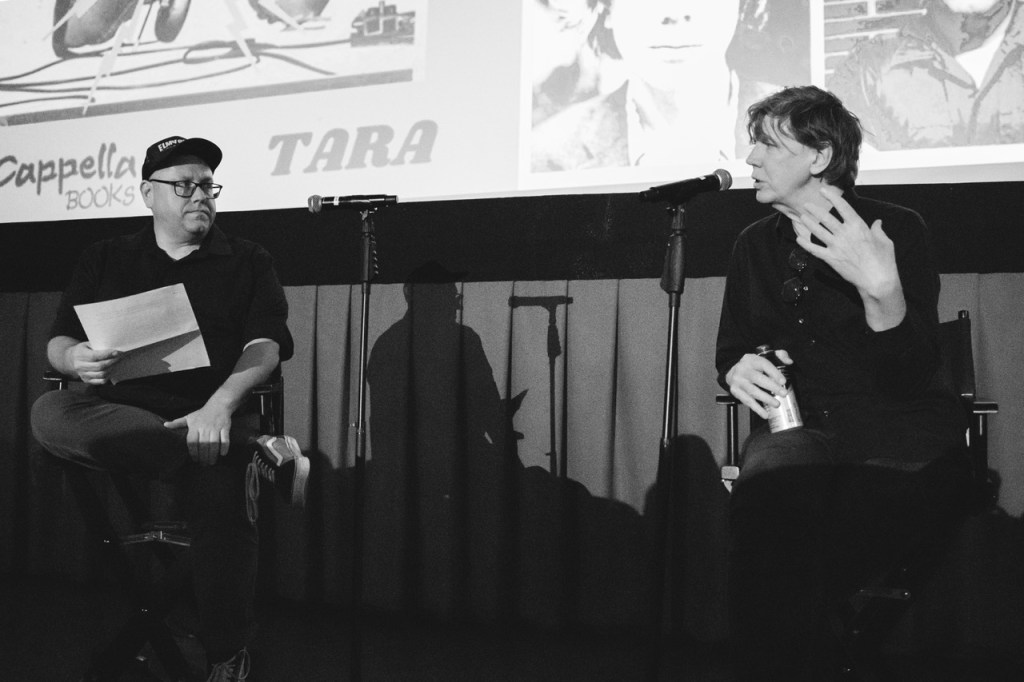
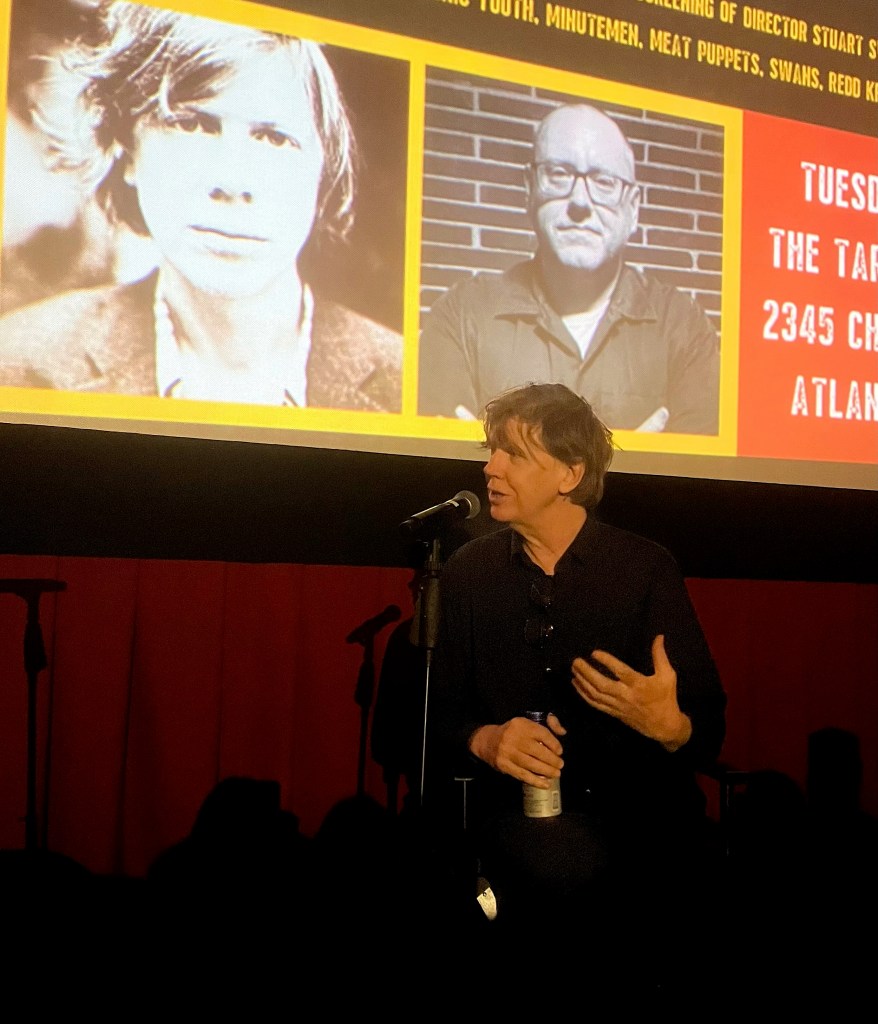
Thurston Moore at the Tara Theater. Photo by Jeff Shipman
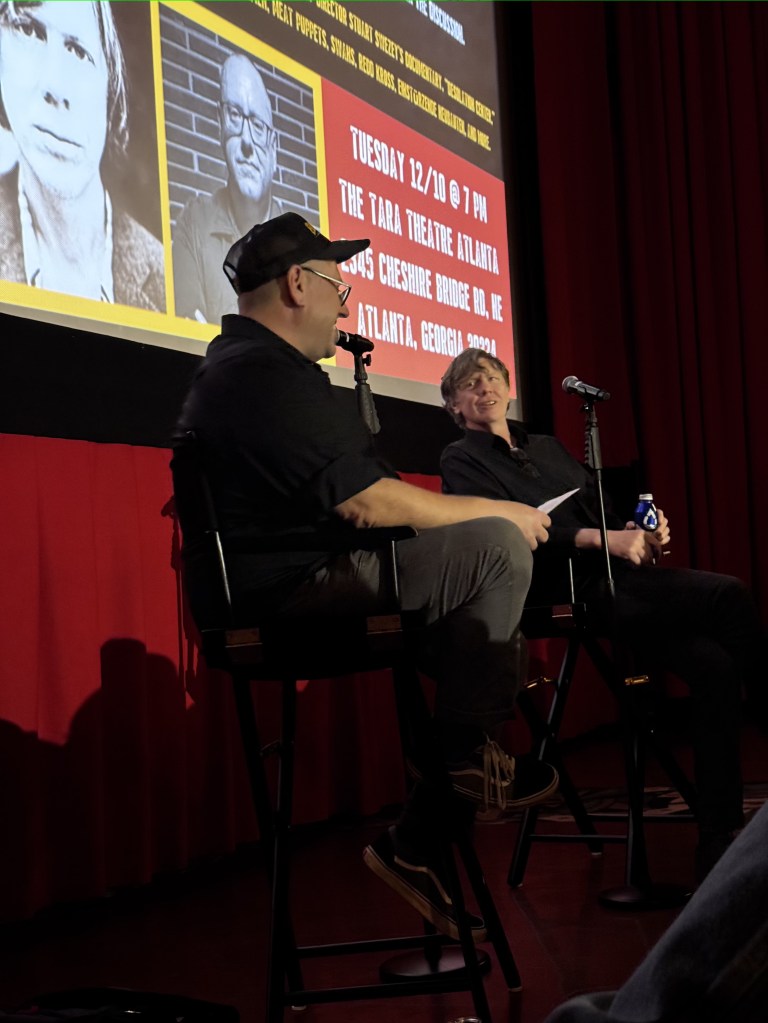
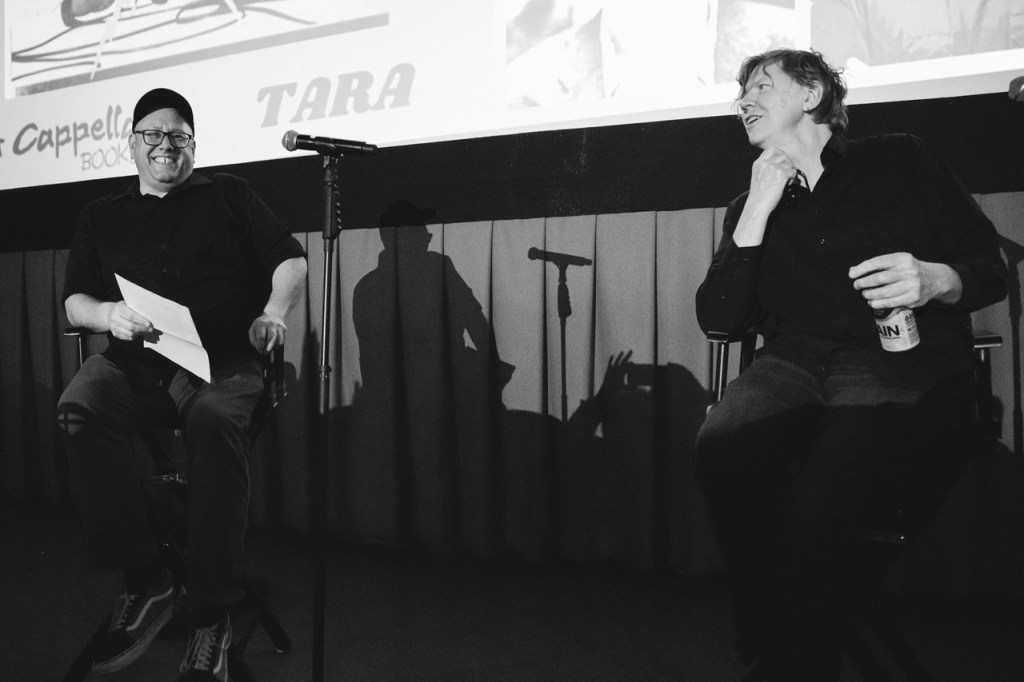
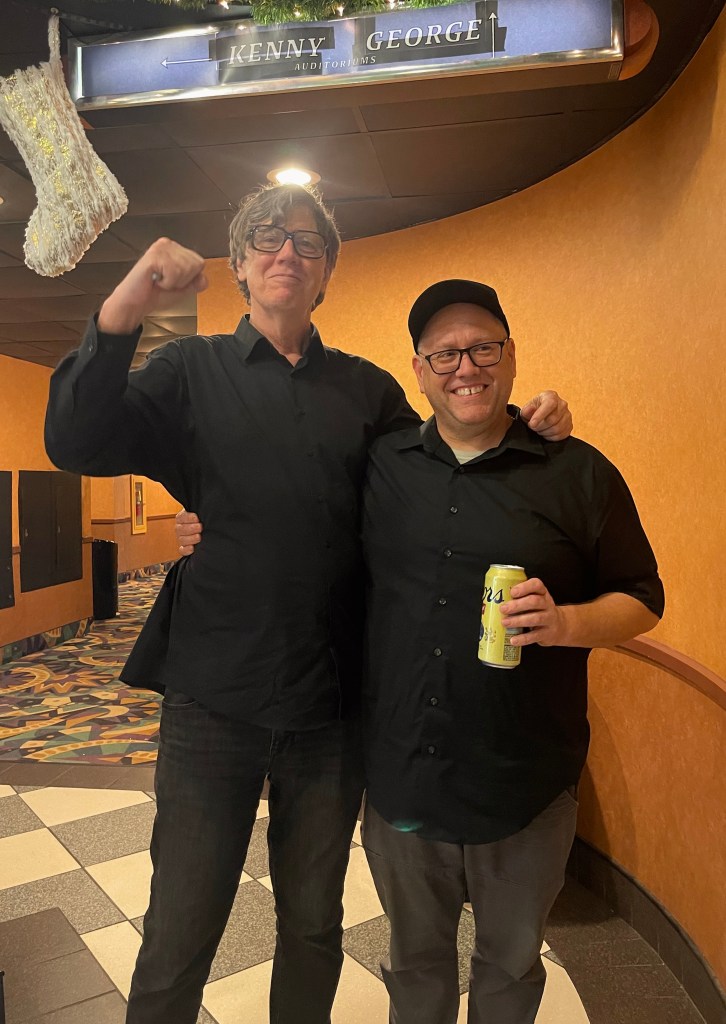
A fun and dynamic evening unfolded at the Tara Theater on Tuesday, December 10, as Thurston Moore appeared in conversation with yours truly, Atlanta music writer Chad Radford.
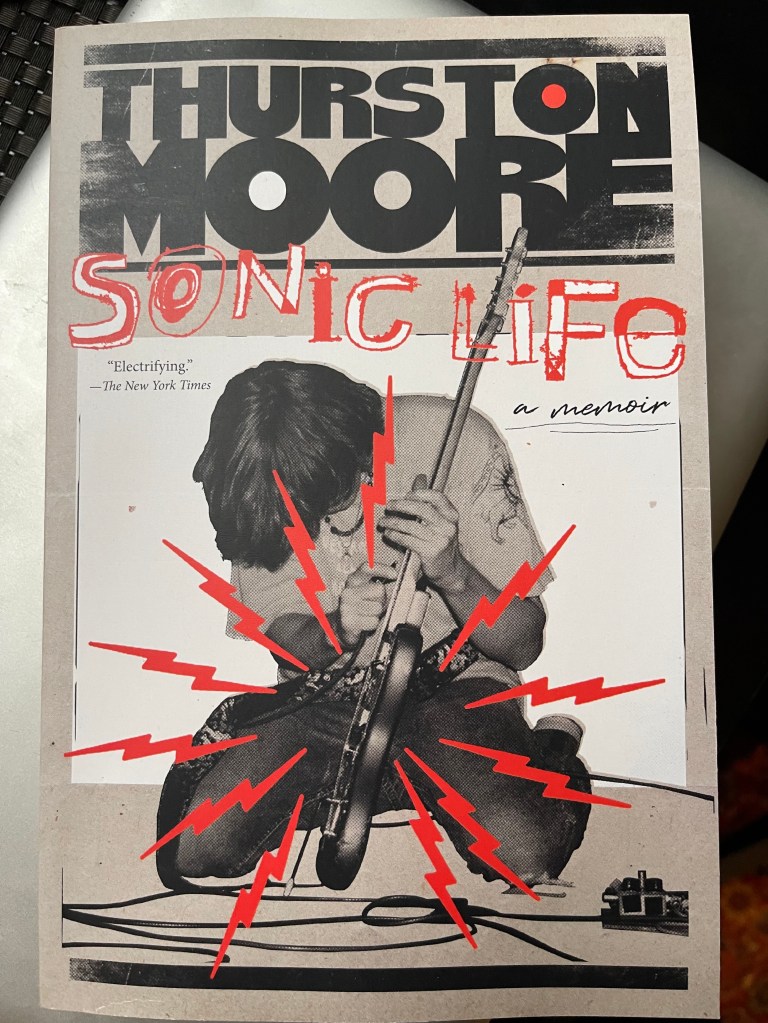
Introduced by Randy Gue, Assistant Director of Collection Development & Curator of Political, Cultural, & Social Movements for Emory University’s Rose Library, and presented by A Cappella Books, the night was anchored by Moore’s 2023 memoir, Sonic Life. He also reflected on a career that reshaped the alternative and underground musical landscapes of the 1980s, ‘90s, and beyond. In a candid exchange, Moore opened up about the forces that inspired Sonic Youth, navigating the post-punk and no wave underbelly of New York City and the ferocious hardcore emanating from Los Angeles in the early 1980s.
Moore also relived heading out on the road with his Sonic Youth bandmates–Lee Ranaldo, Kim Gordon, and original drummer Bob Bert–for their first out-of-town trek. The “Savage Blunder Tour” carried Sonic Youth and Swans from New York to Atlanta culminating with a deranged performance at the legendary 688 Club.
Later, Moore revealed how writing Sonic Life freed up his mental space, and paved the way into a new creative chapter. His latest album under his name, Flow Critical Lucidity, stands as a testament to this state of mind, blending his signature dissonant guitar textures, rhythms, and space with introspective clarity.
The conversation ranged from the personal to the esoteric, touching on topics like the divisive Faith/Void split 12-inch on Dischord Records, a perennial argument-starter among D.C.’s hardcore purests. Moore’s infectious enthusiasm for such musical touchstones reminded everyone why he remains a revered cultural figure.
Moore also recounted Sonic Youth’s participation in Stuart Swezey’s legendary Desolation Center concert series, playing the 1985 Gila Monster Jamboree in the Mojave Desert. He described the surreal experience of channeling their avant-garde energy into a setting as raw and untamed as the music itself. This set the stage for the night’s closing event: a screening of “Desolation Center,” the documentary that chronicles Swezey’s revolutionary desert concerts.
The evening offered a rare chance to glimpse into Moore’s world through his own words and to explore the intersections of music, memory, and creative reinvention.
Check out a gallery of images from the evening below.
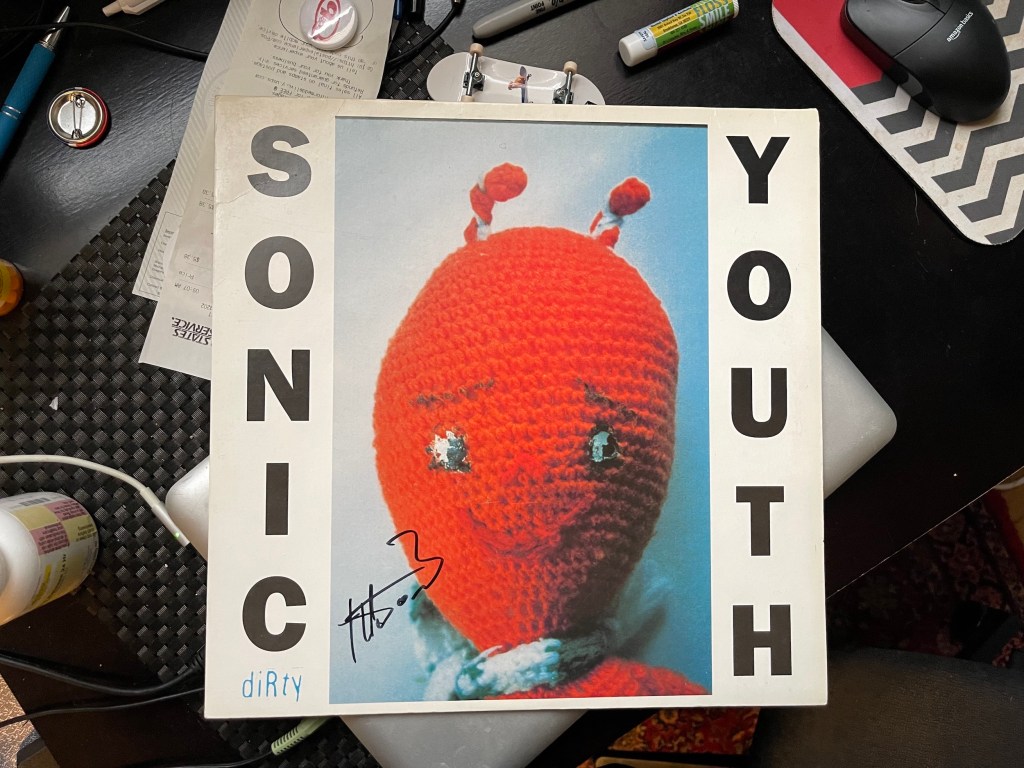
Thurston Moore. Photo by Jeff ShipmanPhoto by Jeff ShipmanPhoto by Jeff ShipmanPhoto by Jeff ShipmanRandy Gue. Photo by Jeff ShipmanSonic LifeSonic LifeSonic LifeThurston Moore photo by Laura HuntChad Radford (left) and Thurston Moore. Photo by Jeff ShipmanThurston Moore and Chad Radford. Photo by Todd PloharskiThurston Moore. Photo by Jeff ShipmanChad Radford (left) and Thurston Moore. Photo by Todd PloharskiThurston Moore. Photo by Jeff ShipmanThurston Moore with his dogs Apollo and Vinkenoog. Photo by Jeff Shipman Chad Radford (left) and Thurston Moore. Photo by Jeff ShipmanPhoto by Todd PloharskiChad Radford (left) and Thurston Moore. Photo by Jeff ShipmanThurston Moore (left) and Chad Radford. Photo by Kristin Anderson“Dirty!” Photo by Chad Radford
If you have enjoyed reading this post, please consider donating to RadATL. Venmo to @Chad-Radford-6 or click on the PayPal link below.
From the founding member of Sonic Youth, a passionate memoir tracing the author’s life and art—from his teen years as a music obsessive in small-town Connecticut, to the formation of his legendary rock group, to 30 years of creation, experimentation, and wonder.
Following the conversation, The Tara will host a screening of director Stuart Swezey’s documentary film, Desolation Center, featuring performances by Sonic Youth, Minutemen, Meat Puppets, Swans, Redd Kross, Einstürzende Neubauten, and more. Moore will introduce the film.
A note on the THREE types of tickets available for this event:
Book Talk Ticket Includes a signed paperback edition of Sonic Life and admission for the 7 p.m. book talk and signing. ($20 + tax)
Book Talk and Movie Ticket Includes a signed paperback edition of Sonic Life, admission for the 7 p.m. book talk and signing, and the 8:30 p.m. screening of Desolation Center. ($36 + tax)
Movie Ticket Admission to the 8:30 p.m. screening of Desolation Center. ($16 + tax)
About the Book Thurston Moore moved to Manhattan’s East Village in 1978 with a yearning for music. He wanted to be immersed in downtown New York’s sights and sounds—the feral energy of its nightclubs, the angular roar of its bands, the magnetic personalities within its orbit. But more than anything, he wanted to make music—to create indelible sounds that would move, provoke, and inspire.
His dream came to life in 1981 with the formation of Sonic Youth, a band Moore co-founded with Kim Gordon and Lee Ranaldo. Sonic Youth became a fixture in New York’s burgeoning No Wave scene—an avant-garde collision of art and sound, poetry and punk. The band would evolve from critical darlings to commercial heavyweights, headlining festivals around the globe while helping introduce listeners to such artists as Nirvana, Hole, and Pavement and playing alongside such icons as Neil Young and Iggy Pop. Through it all, Moore maintained an unwavering love of music: the new, the unheralded, the challenging, the irresistible.
In the spirit of Just Kids, Sonic Life offers a window into the trajectory of a celebrated artist and a tribute to an era of explosive creativity. It presents a firsthand account of New York in a defining cultural moment, a history of alternative rock as it was birthed and came to dominate airwaves, and a love letter to music, whatever the form. This is a story for anyone who has ever felt touched by sound—who knows the way the right song at the right moment can change the course of a life.
About the Author Thurston Moore is a founding member of Sonic Youth, a band born in New York in 1981 that spent 30 years at the vanguard of alternative rock, influencing and inspiring such acts as Nirvana, Pavement, the Yeah Yeah Yeahs, My Bloody Valentine, and Beck. The band’s album Daydream Nation was chosen by the Library of Congress for historical preservation in the National Recording Registry in 2006. Moore is involved in publishing and poetry and teaches at the Summer Writing Workshop at Naropa University in Boulder, Colorado. He divides his time between the USA and England.
About the Film Desolation Center is the previously untold story of a series of early ’80s guerrilla music and art performance happenings in Southern California that are recognized to have inspired Burning Man, Lollapalooza, and Coachella, collective experiences that have become key elements of popular culture in the 21st century. The feature documentary splices interviews and rare performance footage of Sonic Youth, Minutemen, Meat Puppets, Swans, Redd Kross, Einstürzende Neubauten, Survival Research Laboratories, Savage Republic and more, documenting a time when pushing the boundaries of music, art, and performance felt almost like an unspoken obligation.
Directed by Stuart Swezey, the creator and principal organizer of these unique events, Desolation Center demonstrates how the risky, and at times even reckless, actions of a few outsiders can unintentionally lead to seismic cultural shifts. Combining Swezey’s exclusive access to never-before-seen archival video, live audio recordings, and stills woven together with new cinematically shot interviews, verité footage and animated sequences, Desolation Center captures the spirit of the turbulent times from which these events emerged.
If you have enjoyed reading this post, please consider making a donation to RadATL. Venmo to @Chad-Radford-6 or click on the Paypal link below.
Pylon Reenactment Society is fronted by Vanessa Briscoe Hay, whose voice brought Pylon’s kinetic energy to a fine point in the early ‘80s. With PRS, she fronts a wholly new group rounded out by guitar player Jason NeSmith, bass player Kay Stanton (Supercluster, Casper & the Cookies), and drummer Gregory Sanders (Casper & the Cookies). With their recently released debut album, Magnet Factory, the group expands upon Pylon’s angular style with a more pastoral approach in songs like “Educate me, ” “3 x 3, ” and “Fix It.”
Maybe they’ll roll out the seasonal hit (?), “Christmas Daze,” which materialized around this time last year.
Is/Ought Gap embodies the wild side of the no-frills ethos that fueled Athens’ heyday. “Artsy Peace and Love,” “Lucky 7,” “He Said,” and so many other ramped up numbers are defined by singer Bryan Cook’s razor-tongued and fun-loving invectives.
This show is a victory lap for Is/Ought Gap, who’s playing songs from this year’s long overdue discography LP, SUA, released via Happy Happy Birthday To Me Records.
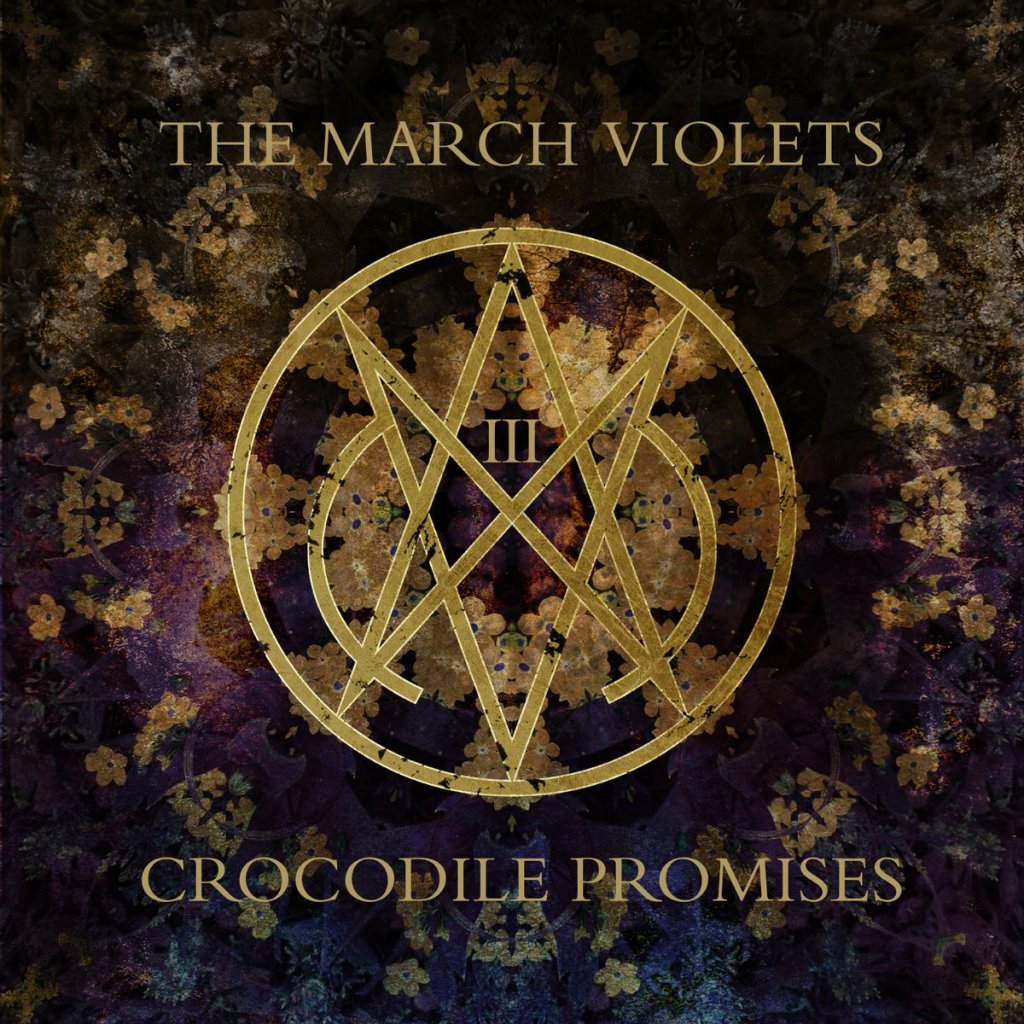
After more than a decade between releases, the March Violets return with Crocodile Promises, a sleek and muscular new album that is as much a return to the group’s classic gothic rock and post-punk form as it is a bold step forward. The secret to the Violets’ success has long been their penchant for crafting undeniably catchy songs that thrive in an atmosphere of rich imagery and ambiance. Press play on the ‘80s hits: “Walk Into the Sun,” “Snakedance,” “Grooving In Green,” “Crow Baby,” et al. The art of balancing complex harmonies and melodies with lyrics steeped in perfectly compelling abstraction is the March Violets’ strong suit. For Crocodile Promises, core members vocalist Rosie Garland and guitar player Tom Ashton were joined by former Violets bass player Mat Thorpe (also of the group Isolation Division). Together, they fleshed out nine new numbers at Ashton’s SubVon Studios in the rural countryside near Athens, Georgia, where Ashton produced the record.
Crocodile Promises opens with “Hammer the Last Nail,” a song that’s bound by billowing and shadowy textures that slowly open up to reveal the album’s vast and majestic palette. Thick and undulating guitar riffs and constrictive hooks match Garland’s bewitching traipse into modern terrain. “Bite the Hand” and “Virgin Sheep” kick up the energy with a full-bore punk charge.
The “Kraken Awakes” and “Mortality” are slow-burners invoking tales of revenge and deceit. “This Way Out,” builds into a roaring and hypnotic groove, with its thumping beats and Garland’s pointed delivery.
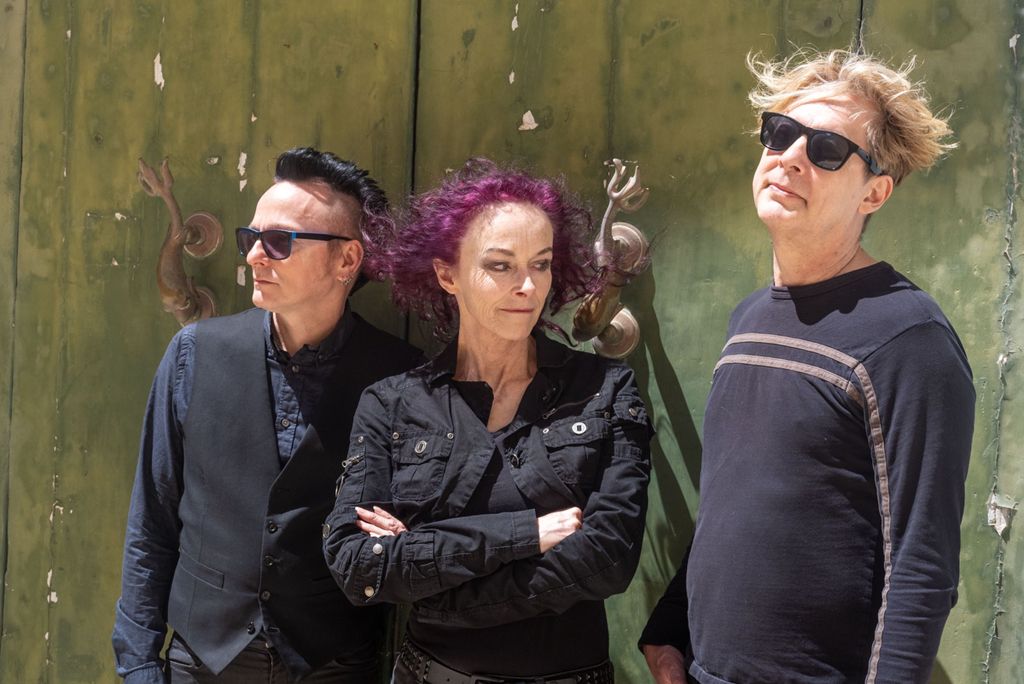
The March Violets: Mat Thorpe (from left), Rosie Garland, and Tom Ashton. Photo courtesy Jace Media.
There’s a real sense of urgency at work in Crocodile Promises. The production is as subtle as it is sweeping when it needs to up the intensity, pushing heaviness, real-world angst, and aggression into new dark realms, alternating between understated tension and unleashed power.
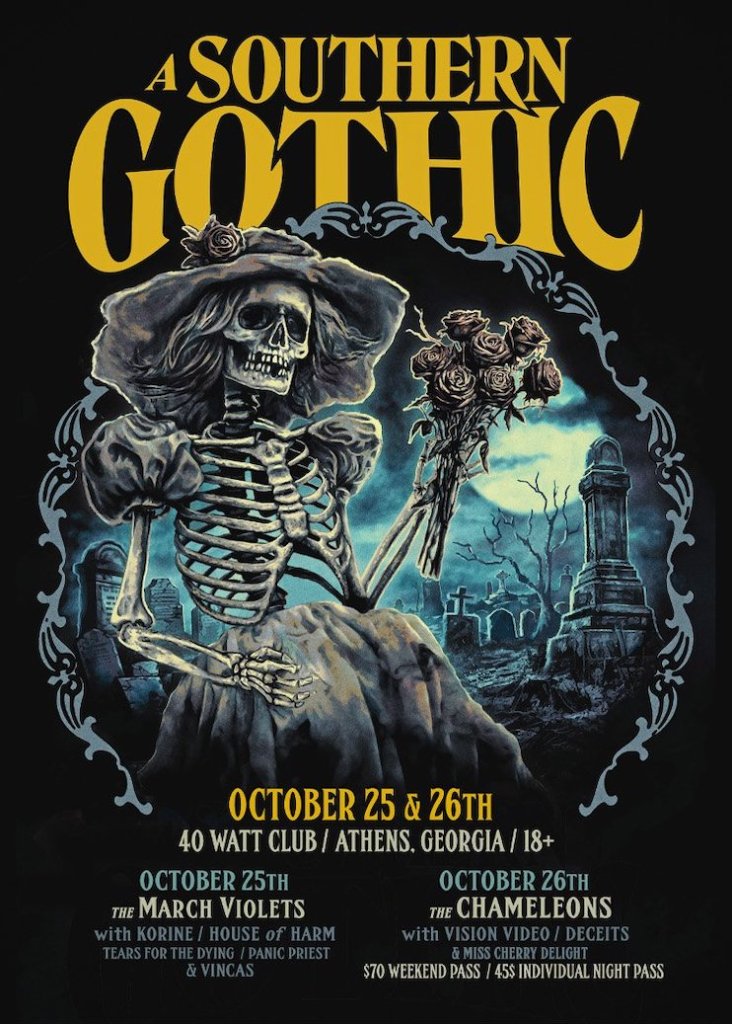
Friday, October 25 March Violets, Korine, Tears for Dying, House Of Ham, Vincas, Panic Priest, and Miss Cherry Delight. Find Friday night tickets here.