Alcoholic Polyneuropathic Freaks In Hell! A conversation with Jake Benedict of Misanthropic Aggression

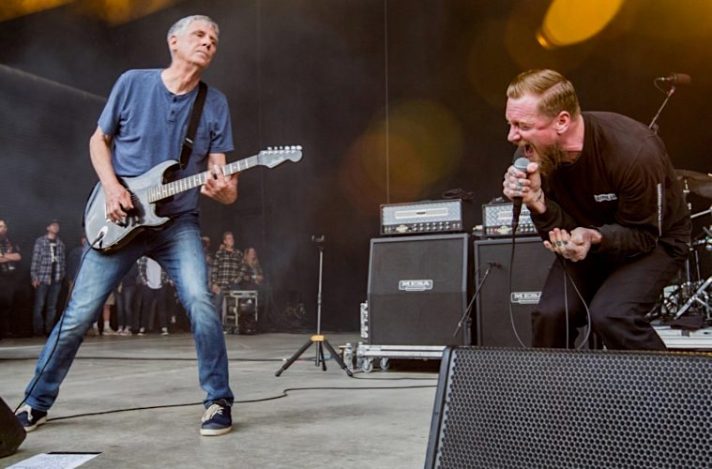
FREAK SCENE: Misanthropic Aggression is Tyler Peacock (left), Chris Hammer, and Jake Benedict.
Photo by Alison Benedict.


“Alcoholic Polyneuropathic Freaks in Hell” — it’s a phrase that captures a colorful, albeit accurate, snapshot of most Georgians’ mental state as we grapple with the realities of returning to life after sheltering in place over the last month. It’s also the title cut from Misanthropic Aggression’s latest 7-inch on Boris Records.

On the heels of releasing 2018’s Inability to Cope EP, bass player and lead vocalist Jake Benedict, drummer Tyler Peacock, and singer and guitarist Chris Hammer are back with three-songs that plunge the group’s blend of hardcore, thrash, black metal, death metal, and crust punk into much greater depths. Benedict’s low rumble and Hammer’s demonic shriek create an urgent tension over Peacock’s staccato rhythms. After live-streaming a 7-inch release party on April 20, Benedict took a few minutes to talk about the new songs and finding Misanthropic Aggression’s sound.

The Alcoholic Polyneuropathic Freaks In Hell 7-inch is Misanthropic Aggression’s first new release since 2018, correct?

Yes! The first thing we did after releasing Inability To Cope was to write the song “Blacklisted.” I had already written the guitar riff, so we started arranging it. We worked for about a year and wrote “Black Listed,” then “Retirement From Life (Last Day of Work),” then “Alcoholic Polyneuropathic Freaks In Hell.” Chris came up with the title for that one.

That song feels timely, as many Georgians are struggling with Governor Kemp easing up on the shelter-in-place order. 

Yeah, because you’ve been at home for like a month, drinking too much, and you feel like you’re in hell!

We played with Sanguisugabogg at 529 on March 11, 48 hours before the shit hit the fan. The morning after, I got an email saying my son’s school is canceled effective Monday. He hasn’t been back since.

When we played on March 11, COVID-19 was already here. People were wigging out, about half the normal crowd was there, and people were already wearing masks. They were high-elbowing instead of high-fiving. It was a trippy night.

You know there’s a problem when even the crust punks are washing their hands!

Big time! There was a line out the bathroom door all night, just to use the sink!

“Retired From Life (Last Day Of Work)” is the second entry in a catalog of anti-active shooter songs. “Active Shooter Syndrome (A.S.S.)” from Inability To Cope was about the Mandalay Bay shooting in Las Vegas. I heard the news about it and wrote that song. “Retired From Life …” is about the poor guy who worked in the security shack at the FedEx facility in Kennesaw, maybe six-seven years ago. Basically, he was shot in the gut with a shotgun and lived, but he’s had 80-90 surgeries since then.

I thought about how lyricists like Chris Barnes from Cannibal Corpse write. As a kid, it was terrifying to read first-person perspective songs about being murdered. To twist it in with the urban style that we’ve always had I did a first-person narrative about being killed on the job. I was almost afraid to do it because it’s pretty controversial. But the lyrics are so clearly anti-shooter that it won’t come across like we were glorifying it. But it is supposed to be horrific.


Have you published the lyrics?

The lyrics aren’t posted anywhere yet. I’m such an amateur when it comes to actual music industry stuff. After the records are produced, your PR campaign starts. So as soon as you send off the masters the records get pressed. Then Perfect World Productions, who’s doing our PR, sends out press kits. Once the records come in they get sent out for distribution. Boris Records has distribution through MVD. That takes an additional four weeks. I didn’t know all that, and when we picked the April 20 release date I was working off of my DIY experiences: ‘The records will be here and we’ll get in the van and go!’ The 4/20 release date isn’t official. The distributor’s release date, and the reason it’s not on Spotify or anywhere else yet, is June 8. That’s when I think we’ll post the lyrics.

As soon as we finished this one we turned around and finished a new song for the next record. I want to write about COVID-19, but I need to approach it carefully. It’s a slippery slope talking about this virus; you could easily upset people’s political sensibilities, and I don’t want to be seen as a political band. So I’m figuring out how to approach it lyrically.

That’s tough. The anti-active shooter songs — talking about real-world incidents of gun violence — can easily be construed as being about gun control. It doesn’t get more political than that!

Yeah, it could be taken that way. Personally, I see a pattern of antisocial narcissism at work in these shooters — lonely, loser-types, incels who are incels because they have no personality. I noticed that a lot of them have these traits in common. That’s kind of what made me want to chronicle these incidents, and have more than one song about the subject. The title, “Active Shooter Syndrome,” is a play on “active shooter situation.” In my opinion, there seems to be a syndrome here.

What has changed for the group between these two releases?

It’s a cliché, but we’re figuring out our sound. We had this idea to mix five musical genres: punk, thrash, death metal, black metal, and crust. The first release leaned heavily toward punk and hardcore — we had the cover of SSD’s “Boiling Point.” There were hints of death metal, especially in the long musical section in “Herd Rejector/Unbound Descent,” which Chris composed. There are some sludgy parts, some death metal parts. With the new release we went for more of a first wave black metal sound. If you listen to the long section right after the first chorus in “Alcoholic … ,” it has a second wave, almost Gorgoroth or golden era Dark Thrown back-and-forth going on. Real grim black metal. There’s a lot going on in that song, and I don’t want to sound like I’m tooting my own horn, but I’m really proud of it.

MISANTHROPIC AGGRESSION: Chris Hammer (clockwise from left), Jake Benedict, and Tyler Peacock.
Photo by Chad Radford


Tell me about the sample at the beginning of “Alcoholic …”

Chris did that. It’s the voice of James Dickey, who was a poet laureate in ‘66. He wrote Deliverance.

The lyrics for that song are two-pronged. I have developed alcoholic polyneuropathy, I guess from drinking liquor for 13 years. I’ve started getting real bad tingling in my hands and feet, my skin and scalp crawl, I break out in hives. So the lyrics are about my personal experiences with it, but it’s also a warning to learn better coping mechanisms than substances. It’s definitely in keeping with my amateur psychology that I like to incorporate.

At the end of “Alcoholic …” we take a hard left turn into a weird death metal theme, which is a riff that I wrote. Sometimes I’ll write parts for Chris, but in this song, the whole end, I said, “You do whatever the hell you want, man. These are the parts I wrote. This is the subject matter. Run with it.

Impetigo is a gore-grind band from Illinois, from the late ’80/early ‘90s. They rule, and their vocals have a real strong influence with all the echo and trippy, kind of rubber banding in and out that you hear.

ALCOHOLIC POLYNEUROPATHIC FREAKS IN HELL: Artwork by Warhead Art.


Who did the artwork? 

The artwork was done by a Ukranian artist who goes by Warhead Art. He’s done three pieces for us — he did the centerpiece. Chris did the layout. The art is in the middle, and there’s a frame with little stars in the corners. Chris did those, and hand-drew the “Alcoholic Neuropathic Freaks In Hell” logo around it. The stars represent the synapses misfiring in your body due to alcoholic polyneuropathy. It’s what causes the pain, which I thought was a cool idea. The photo on the back with the bricks was taken at the ruins of an old civil war-era mill — Nickajack Creek — up near Smyrna. 

The idea was to keep it real simple. No lyrics sheet, no insert, no thank you list. It’s just three songs. The whole thing is influenced by the old Amoebix, Anti Cimex 7-inches; real simple, old-school hardcore shit.
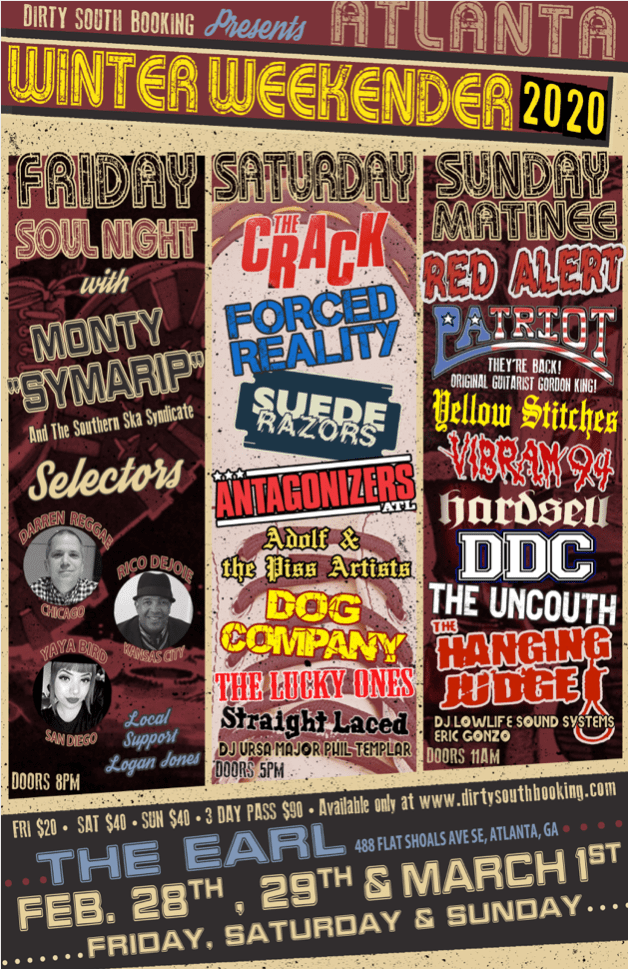

Winter Weekender 2020 feat. Monty Neysmith of Symarip and the Southern Ska Syndicate, Antagonizers ATL, and more Feb. 28-March 1

The annual Winter Weekender returns to the Earl for three days of oi, ska, and street punk revelry.

Friday, February 28 (Soul Night)
Monty Neysmith of Symarip and Southern Ska Syndicate perform the 1969 Skinhead Moonstomp LP and more + DJs Yaya Bird, Rico, Darren Reggae, and Logan Jones.

Saturday, February 29 (5 p.m. – Midnight)
Straight Laced, the Lucky Ones, Dog Company, Adolph and the Piss Artists (A.P.A.’s first show in 10 years), Antagonizers ATL, Suede Razors, Forced Reality, and the Crack.

Sunday, March 1 (Matinee show, Noon-6 p.m.)
The Hanging Judge, the Uncouth, Drink & Destroy Crew (DDC), Hardsell, Vibram 94 (25-year reunion feat. Carl and Phil Templar), Yellow Stitches, Patriot, and Red Alert.
Single-day and weekend tickets are available now via Dirty South Booking

Dinosaur Jr. plays The Masquerade November 13

Photo by Cara Totman.

Dinosaur Jr. plays Heaven at The Masquerade. Saturday, November 13. $31 (adv). 7 p.m. (doors). 75 Martin Luther King JR Dr. SW. 404-577-8178. www.masqueradeatlanta.com.

Pre-sale for seated tickets begins Thurs., March 11 at 12 p.m. Eastern.
Venue pre-sale begins Wed., March 17 at 10 a.m. Eastern.
Tickets go on sale for general public on Fri., March 19 at 10 a.m. Eastern.

J., Lou, and Murph are back with a new album, titled Sweep It Into Space, due out April 23. Click here to pre-order a copy.


If you have enjoyed reading this article, please consider making a donation to RadATL!

Donate with PayPal

‘Flagpole’ feature: With Mike Vallely on Vocals, Black Flag Flies Again in

BLACK FLAG: Greg Ginn (left) and Mike Vallely. Photo by Rob Wallace.

Mike Vallely was just 14 years old the first time he saw Black Flag play live. It was October 1984, at City Gardens in Trenton, NJ. The group was in the midst of a particularly creative year that yielded three bedrock West Coast hardcore punk albums—Slip It InMy WarFamily Man—and a blistering live tape, Live ’84.

“Henry Rollins was fronting the band then, and seeing them play that show was a life-affirming moment for me,” Vallely says. “It changed my life, but more so, I say it was life-affirming, because it made me feel like, ‘OK, I can continue on my own path. I can do what I want to do in this life… Rollins, as the frontman of the band, really embodied that spirit.” Read the full story at Flagpole.

‘Decline of Western Civilization’ director Penelope Spheeris on the pain of reliving the past, and the noble cause of helping others

Penelope Spheeris photo by Suzanne Allison

Between December 1979 and May 1980, director Penelope Spheeris shot The Decline of Western Civilization, documenting the exploits of Black Flag, the Germs, X, the Circle Jerks, and the denizens of L.A.’s early punk scene. The film spawned two sequels, 1988’s The Decline of Western Civilization Part II: The Metal Years, and 1998’s The Decline of Western Civilization III—each offering a look into the lives of musicians in various states of desperation. Spheeris’ Decline trilogy changed the world’s perceptions of punk and metal forever. Although she achieved mainstream success directing later films such as Wayne’s World, The Beverly Hillbillies, and The Little Rascals, it is her work with Decline that defines her career.

Spheeris took a few minutes to talk about the pain of reliving the past, reconnecting with her daughter, and the noble cause of helping other people.

The mark of a truly timeless work of art is that you can revisit it 35 years later and find new meaning and relevance, maybe in wholly different ways than what you originally intended. How has the meaning of The Decline of Western Civilization changed for you?

Having done the films so long ago—I really shied away from watching them for so many years. I asked my daughter if she would come to work for me. She said she would but only if I released the Decline movies first. I thought, ‘Oh God, what a nightmare.’ But what has been very gratifying is to experience other people watching them 20 and 30 years later. That, for me, is astounding. When I look at them, I don’t think that I did something profound, but that is what other people say. I was just making movies about subjects I was interested in. They kind of turned out, all these decades later, to be interesting to other people. It’s been a real weird trip, I’ll tell you that.

I get the impression that you feel some anxiety over these films. Why do you say it was a nightmare to revisit them?

Anxiety … That’s an understatement. I have a lot of anxiety over these films. If you think about it, as a filmmaker or as any kind of creative person, you want to have the product of your creativity seen by other people, and hopefully appreciated. For me, so many of the movies I’ve done—certainly Decline I and III, not so much with II—were not really ever seen on a legitimate platform. Decline I was bootlegged to death. People passed it around like underground contraband for decades because it wasn’t in distribution. It was extremely painful for me to go back and deal with these movies because, on a subconscious level, they brought up a lot of pain. That pain was that people couldn’t see my work; people who seemingly were interested in it.

That happened with a film I did with Sharon and Ozzy, We Sold Our Souls for Rock ‘n’ Roll. Nobody got to see it. It happened with Dudes, which I did with Jon Cryer and Flea. It happened with The Boys Next Door that I did with Charlie Sheen. I had a long history of making movies that didn’t get seen. On the other hand, when I would do a comedy, it would definitely be seen. Especially Wayne’s World.

The thing to be said is that it’s hard to hide truly brilliant work. Even without distribution, I found a bootleg of Decline I in Omaha, Neb., in the early ’90s. That film put a face on punk rock for me and many others. It also made my relationship with the music more complicated—I had to put my life’s situation into context. I learned more about myself from Decline than I did from Wayne’s World—even though Wayne’s World is a fun movie.

Yeah, and the anxiety that comes along with putting out a box set is that, like you, I personally identify a lot more with the Decline movies than I do with the studio comedies. So I wanted it to be done right. When I am dead and gone, I want the right piece of physical items there to represent what they are. Once you do it, it’s done. It’s not like I can redo that. So that’s why there was so much trepidation involved with doing it. Now it’s like okay, you did it. Now you can die.

That has to be sort of rewarding.

What’s rewarding is that it’s no longer bearing down on me like a big dark cloud. For that, I really have to thank my daughter. Without her, I would have just died without doing it. I swear to God. It was just painful. Just watching the movies brought up so many memories, and she kept coming up with more pieces for the extras, which included a lot of interviews with me and with people I know from way back in the day. It was just hard to look at it. It’s like having your life flash before you. I just like to keep moving forward. I don’t like to look back. That’s why they never got put out before.

When you look back over the films—all three of them—are there subjects that stand out for you, or that you walked away from with some insight?

For Decline I, when I look at that movie I think, jeez, it’s pretty amazing that so many elements of today’s young people’s lives originated way back then. Now everybody has their tattoos and tight jeans and they have their haircuts, and it all started back then. So many social trends and philosophical ways of thinking started back then. So, for those reasons, I’m glad I was able to document all of that.

I don’t think there’s a profound lesson to be learned in Decline II except for trying to make it for the wrong reasons is stupid. That’s a pretty easy one.

For me, Decline III is the most important film of my entire career. It made me realize that I don’t want to be working in Hollywood anymore. There are more important things in life, and I should go help homeless kids, which is what I have done. If you go see it, bring a Kleenex, because it’s a heartbreaker. It was so hard to get it released because it is extremely sad. It reveals some really terrible domestic situations that happen with young kids that make them leave their homes and go live in the streets. Those are my buddies. Those are my family — the Decline III kids. Those are the people I’m close to.

There’s a kid named Eugene in that first film. I don’t have the same kind of anger in me, but I found him to be such a compelling character. How did you find him, and do you ever cross paths with him? Do you know how his life turned out?

He was friends with the HB kids—Huntington Beach, surfer punks. I saw Eugene up on the Slash office’s roof and I asked if he would be interviewed for the film. He kept saying no, but finally I talked him into it. He was 14 years old at that time. And he is very compelling. That’s why he starts the movie out. Today he lives in Berlin. I just sent him his 50 year-old birthday present. He’s a very good friend. He’s a folk singer. He’s known now as Euge From the Coast. He’s very happy in Berlin, and we email each other about once a week.

How have these films played a role in your relationship with your daughter Anna?

We sure do know each other a lot better after spending four years in the same room together!

Were the two of you estranged before this project?

In a way. When she was Four years old, her father died from a heroin overdose. So I raised her as a single parent. I think it wasn’t until it hit me in the face that addiction is extremely genetic. Five years ago, she had a drug problem that could have ended very tragically. We were fortunate enough that it didn’t. She wrecked a car with a kid in it. But she did a really good job with rehab and I said, “You have to come to work for me.” I wanted to keep an eye on her and make sure she didn’t relapse. She said she would do it, but we had to do Decline. You never know if something is bad or good until some time has passed. It was the most horrible thing in my life to deal with my daughter having that problem. But from out of that mess came this thing that people appreciate quite a bit—this box set for the DVDs.

She had been in touch with so many of the people who’ve been in the movies. She’s quite in touch with the people from Decline I and II. Whereas I’m the Decline III woman here. Those are my friends.

Honestly, Anna deserves 90% of the credit for the movies being seen again. I did the movies way back, but they would have never been seen in this form by so many people if she hadn’t virtually put a gun to my head and said you have got to do this. It was daunting and horrible. I would avoid it at all costs. She was down there with three editors at one time, sorting things out. She would have to drag me down to the editing room because I didn’t want to deal with it. For that, I am extremely grateful that she made me do it. She was so smart about so many things. She uncovered a lot and was like an archaeologist. A lot of the old tapes and old formats wouldn’t even play. She had to go and borrow chunks of equipment from friends—a DAT player—because nothing else would play them. She just kept going and going and going.

I could definitely see the evolution with the punks between Decline I and III. In Decline III, each individual was so much more tolerant, and kind, and not mean to the people that might be different from them. So there was some sort of evolution going on there. Flea is in Decline III and describes the original L.A. punk scene as being like an experimental art scene. Whereas in Decline III, even though everybody looks the same, physically, it’s not an art scene anymore. It’s pure and dire survival, and there ain’t no room for art in that world.

I think about those scenes from the first film and how all of the Black Flag guys lived in that church. That seemed dire…

It was fun dire. They were embracing their homelessness. They just had a different take on it. It wasn’t hurtful for them. It was fun. For the kids in Decline III, it’s painful.

What I learned from Decline III in getting to know those kids and their background: We don’t have any more noble assignment in life than helping our children and doing the right thing for them. These kids come from alcoholic and drug-addicted families that fought all the time and threw them out in the street.

It doesn’t make me feel good to sit down and have lunch with some major studio executive. Who gives a shit? It’s so vapid. What makes me feel good is being a foster parent. Staying in touch with my Decline III buddies, and going to these various cities and selling posters and donating the money to homeless shelters for kids. That, to me, is what makes life good. The rest of that jerk off stuff is so unnecessary. It’s funny to me that people get into such a frenzy to come to Hollywood and say “I have to make it in Hollywood!” Are you kidding me? No, you don’t! I guess I can say that because I kinda sorta made it, but not really. It doesn’t have any meaning next to helping people.

— Chad Radford

A version of this interview previously appeared in Creative Loafing.

Photographer Lyle Owerko’s ‘The Boombox Project’ offers lessons in urban Americana

Photo courtesy Lyle Owerko.

While nursing his morning coffee in his Tribeca apartment, Lyle Owerko‘s voice perks up over the phone as he recounts the chain of events that led to the creation of his first photography book, The Boombox Project. Subtitled, “The Machines, the Music, and the Urban Underground,” the book is more than just a collection of photos that fetishize the so-called “ghetto blasters” or “ghetto briefcases,” a term Spike Lee dismisses for its racist connotations in the book’s forward. At its core, The Boombox Project is both an oral history and an anthropological study. In the late 1970s and early ’80s, hip-hop, punk, and new wave were all at a flash point. The one thing that tied them all together was the ever-present but often-overlooked icon of the times—the boombox.

Owerko’s boombox series shows off the sleek designs and battle scars of this once ubiquitous machine. In the book, he juxtaposes his crisp color photos, which are set against a stark white backdrop, with a collection of historical images that illustrate the boombox’s cultural significance. Owerko likens its role to a “sonic campfire” around which people would gather to laugh, dance, tell stories, and exchange ideas.

To accentuate the reverential photos, Owerko conducted interviews with a cross-section of voices from the times: DJs, producers, and several generations of New York City hip-hop artists, including Fab 5 Freddy, LL Cool J, DJ Spooky, and Adam Yauch, aka MCA, of the Beastie Boys.

But before Owerko becomes too engrossed in tales of nostalgia, urban Americana, and his own passion for these antiquated pieces of stereo machinery, he relates the dark tale that ultimately helped fuel The Boombox Project. In late summer 2001, Owerko returned to New York for a photo assignment after a six-week stint in Africa. Visible from his living room, Owerko had always thought of the World Trade Center as the metaphorical tree in his front yard. “I could look at the towers and tell what the weather was going to be like by how much of them that I could see,” he says.

On the morning of Sept. 11, 2001, he was up early, jet-lagged, and still functioning on Africa time when he heard the first plane slam into a tower. He hadn’t yet unpacked his camera bag, so he grabbed his gear and raced toward the buildings to see what was happening. “I composed a shot that showed one tower that was still virgin and untouched next to the other tower that had this gaping hole in the side of it,” Owerko recalls. “I put the sun behind myself and composed these two shots of the tower with the sun in the perfect lighting position, and that put me in the perfect place to catch the second plane hitting.”The image he captured of the second plane hitting the World Trade Center appeared on the Sept. 13, 2001, cover of TIME magazine, just 48 hours after the attack. In 2005, the American Society of Magazine Editors ranked it as one of the 40 most important magazine covers of the last 40 years.

Accolades aside, witnessing such death and destruction was traumatic for Owerko. But in the years following the 9/11 attacks, when the War on Terror was in full swing, the idea for The Boombox Project began to grow. “When everyone else was showing the worst side of mankind, I thought why not try to find something that really shows the best of mankind?” Owerko says.

The project was initially conceived as a series of 40 to 50 portraits of boomboxes, with a plan to have someone write an introduction, which Owerko hoped would lead to a book deal. But as the photos materialized, he began to see the boom box as a larger metaphor for free speech, empowerment, innovation of youth culture, and the powerful effects of pop culture on the voices of many generations.

Throughout the book, Owerko combines vivid color photography of various boom box designs, with portraits of dancers, rappers, and rock musicians, ranging from LL Cool J and the Beastie Boys to Bruce Springsteen and the Clash to shape a coherent and surprising narrative of the machine’s history and legacy.

In addition to its social, political and historical contexts, the book traces the equally intriguing evolution of boombox aesthetics.

“I was falling in love with the objects, and I wanted to celebrate the fact that they were beat up,” he says. “At the time of the photos we were really just being bombarded with so much militaristic imagery, that when I was designing the images, the boomboxes took on sort of a militaristic look themselves, and they had lived through an embattlement of the times—the late ’70s and early ’80s—that was a really tough time in America’s history.”

Owerko claims to own somewhere in the neighborhood of 50 boom boxes, many of which will be on display with the traveling exhibit accompanying the book tour. The artist bubbles with childlike enthusiasm when he talks about some of his favorite makes and models. “My favorite is the Sharp GF-9696,” Owerko says. “That one and the Rising 20/20, which was the first mint vintage one that I found.”

The boombox gracing the book’s cover now resides in London’s Victoria and Albert Museum as part of its permanent collection. “It’s a great-looking box with the crash bars on it,” he adds. “It looks mean.”

“Boomboxes are a kind of hidden archaeology for me,” says experimental hip-hop/trip-hop turntablist/producer DJ Spooky, who contributes to the book’s oral history. “I had forgotten how influential they are until I saw Lyle’s book. I don’t have a particular, specific boombox favorite. I just live through the memories that Lyle’s book brings back.”

A version of this story was first published by CL, Atlanta. June 21, 2011, when the Owerko’s show appeared at Jackson Fine Art Gallery.

If you have enjoyed this article, please consider making a donation to RadATL.

Donate with PayPal