David J—co-founder of Bauhaus and Love and Rockets—returns to Avondale Estates for a solo appearance supporting his new poetry collection, titled Rhapsody, Threnody, and Prayer, while playing music from his elegiac new LP, The Mother Tree.
It’s a seated, BYOB affair taking place in a small studio setting, that finds the legendary bass player marking a new and vulnerable chapter in his career. Both David J’s new book and album are tributes to his late mother, Joan Nancy Haskins, each one reflecting on decades of introspection, artistry, and grief processed through the lenses of music and verse. Over five atmospheric tracks, The Mother Tree conjures soundscapes for his poetry to drift through—at once dramatic and meditative, full of memory and emotional ballast.
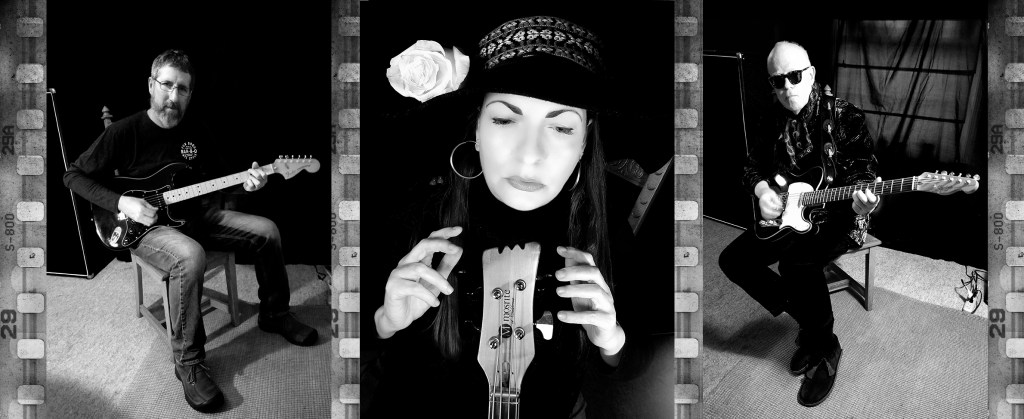
Mike Lynn (left), Lisa King, and Jeff Calder. Photo courtesy The Hot Place
The Hot Place opens the show. The long-running psychedelic darkwave group led by vocalist and bass player Lisa King and Swimming Pool Q’s guitarist Jeff Calder. Rounded out by Mike Lynn (Betty’s Not a Vitamin), the trio will offer stripped-down interpretations of songs from their 2023 self-titled album. Expect acoustic arrangements that lean into the band’s more ethereal inflections, with King also sharing selections from her own poetry collection Dark Queens and Their Quarry.
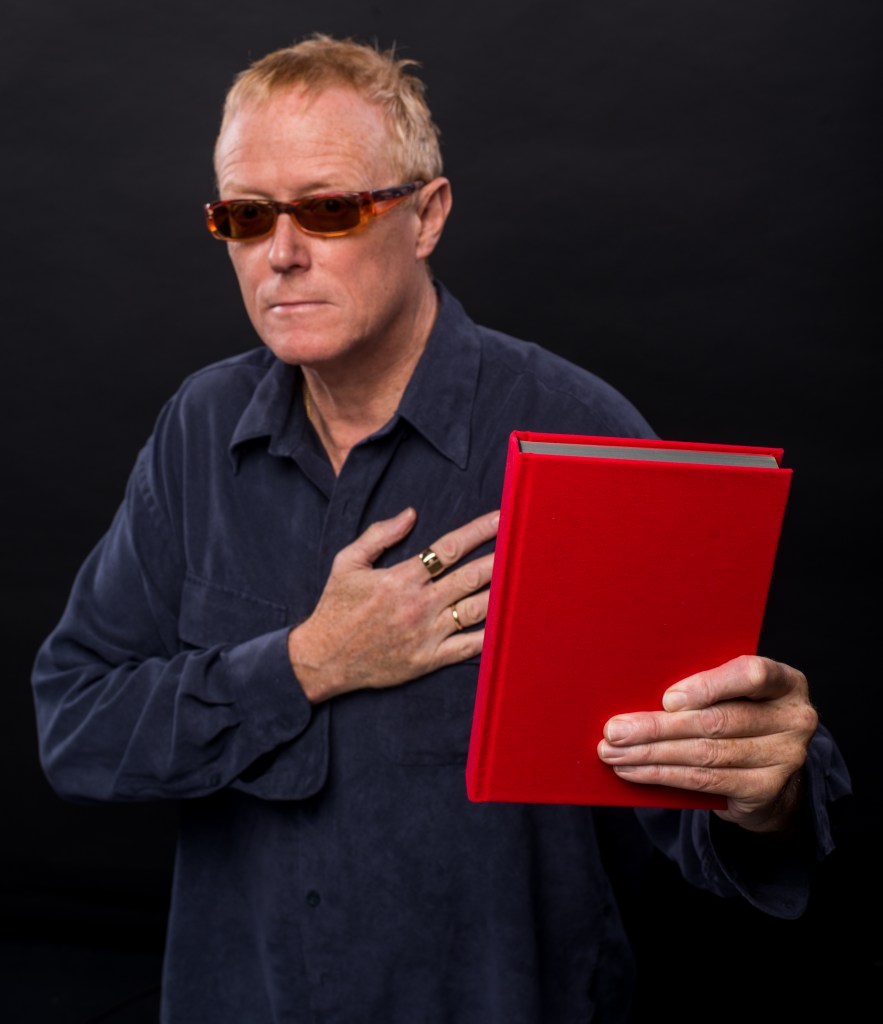
David J
The connection between David J and the Hot Place runs deep. The two have toured together playing living room gigs throughout the Southeast, and their creative paths have intersected on multiple projects over the years. This performance promises to continue that synergy in a setting designed for careful listening and thoughtful reflection.
Advance tickets are $50, and are required. There will be no tickets sold at the door, and seating is limited. Doors open at 7 p.m. All-ages are welcomed with accompaniment. Respect the neighbors and don’t park in the adjacent driveway.
If you have enjoyed reading this post, please consider donating to RadATL. Venmo to @Chad-Radford-6 or click on the PayPal link below.
If you ever caught an earful of “Destroy All Music” on WREK-FM in the 1980s, flipped through the dog-eared pages of LowLife Magazine, or caught Glen Thrasher behind the counter at A Cappella Books, you already know: Glen didn’t just participate in Atlanta’s underground—he defined a large part of it, for a long time.
Thrasher passed away Saturday morning, May 3, leaving behind a secret legacy that pulses through every DIY show, noise set, and scribbled flyer that still dares to push Atlanta’s arts scene off the rails and into uncharted territory.
He was 66 years old.
In the early 1980s, Glen and co-host Ellen McGrail transformed “Destroy All Music” into a beacon of chaos and possibility over Georgia Tech’s 91.1 FM airwaves. No wave, free jazz, tape hiss, post-punk, and basement weirdness—nothing was too far out. The show carved space for unclassifiable sounds and stood as a lifeline for seekers and soundheads. McGrail and her partner Tony Gordon still co-host the show every Wednesday from 9-10 p.m., proliferating a testament to Thrasher’s curatorial nerve.
The Destroy All Music festivals that Glen and Ellen created gave a stage to the likes of Dirt, Lisa Suckdog, Freedom Puff, Col. Bruce Hampton, Tom Smith’s Peach of Immortality, Cake (Tracy Terrill), and Chattanooga’s Shaking Ray Levis—local and regional acts who existed outside the realm of mainstream music and culture.
LowLife Magazine issue no. 17.
From 1984 to 1992, Thrasher published LowLife, a Xeroxed, cut-and-paste document of Atlanta’s disreputable brilliance. It was more than a zine—it was a transmission from the city’s cultural underbelly. Fiction, comics, mail art, anti-authoritarian rants, interviews with skronk warriors and tape-traders—LowLife captured the friction and fire of a city in flux. Issue # 17 featured Magic Bone’s Debbey Richardson’s quiet smile on the cover, which is forever etched into the collective memory of anyone who ever scoured a punk distro table at any record show or zine fest.
Thrasher also played a role in the creation of Cat Power, playing drums behind Chan Marshall in the earliest iterations of the project. Glen once relayed that while playing music with Chan, they booked their first show, but did not yet have a name for the band. He called Chan who was working the cash register at Felini’s Pizza in Little 5 Points. Glen said, “We need to have a name, tell me something now or I’ll just make it up.” The customer waiting in line to order a slice of pizza was wearing a Cat Power Diesel trucker cap. She said to Glen, “Cat Power,” and the name stuck.
Thrasher later drifted north to New York in the ’90s before returning to Atlanta where he continued writing and working at A Cappella Books. Through it all, his compass never strayed from the outside path, and his critical wit never waivered.
I worked at A Cappella Books with Glen for years, where we spent long hours behind the counter, talking about politics, books, the music of Pere Ubu, Sonic Youth, the Dog Faced Hermans, Cecil Taylor, Mary Timony, and too many others to recall. He had an encyclopedic knowledge. He could be an intellectual antagonist in one moment, and a warm and engaging companion in the next. It was all in the interest of honest debate and raging against a cultural slide into right-wing politics and modern technology dulling our collective senses. “Why be any other way,” he once laughed, and it made him a true friend and mentor.
He didn’t just know where to find the good stuff—he was the good stuff. His year-end lists were impenetrably comprehensive: a treasure map for the eternally curious. I can’t count how many records, zines, or strange new ideas I encountered because Glen had the foresight—or the infectious enthusiasm—to share them.
Glen Thrasher was a beacon, a connector, a beautiful noise in a world that too often chooses silence. Atlanta’s underground has lost one of its true architects, but his work, his spirit, and his sonic fingerprints remain etched in the grooves of every misfit creation that follows.
Rest in power, Glen. The signal carries on.
If you have enjoyed reading this post, please consider donating to RadATL. Venmo to @Chad-Radford-6 or click on the PayPal link below.
Raw and slowly burning tension runs through TVAD’s latest single, “The Island Song,” which takes shape as a stark meditation on the damage that mankind’s obsession with religion has inflicted upon the world.
With TVAD (Television After Death) recently paring down to a two-piece lineup, principal songwriter Dizzy Damoe—who prefers to not use his Christian-born name—handles guitar, synth, and vocal duties while working alongside bass player John Holloway.
Damoe is currently a member of Alanta’s purveyors of blackened doom and death metal Withered, and is a former member of sludge metal and post-hardcore acts Leechmilk, Sons of Tonatiuh, the Love Drunks, and Canopy. Holloway first made an impression in the bands Tabula Rasa and Of Legend.
“The Island Song” conjures an eerie atmosphere, built upon minor-key melodies and mechanical rhythms that recall the bleak romanticism of early Wax Trax Records releases, threaded through with brittle textures of post-punk and dark wave. Damoe’s guitar oscillates between shimmering ambience and sharp, metallic jabs, while Holloway’s bass carves out a grim undercurrent, grounding the song’s sprawling pace.
Cut from lyrics such as “They hunt, looking for a reason. The wolf, still eats all season. A child, may go hungry. But pray, and seek out your vision,” the song stares down organized religion with an unflinching eye. It’s tone is neither preachy nor dogmatic, but there are no minced words. Damoe delivers each line with a weary conviction, as though bearing witness to the long arc of history’s spiritual missteps. “The Island Song” doesn’t offer solutions, just stark reflection.
It’s a bold move — a track that walks a fine line between sonic exploration and thematic clarity. And for TVAD, it sets the stage for something bigger. If this is the first glimpse into the group’s forthcoming body of work, it’s clear they’re not pulling any punches.
TVAD’s next show is booked at 529 on June 12, which is Damoe’s birthday. A few more shows throughout the summer will be announced soon. Until then, press play on “The Island Song.”
If you have enjoyed reading this post, please consider donating to RadATL. Venmo to @Chad-Radford-6 or click on the PayPal link below.
MELVINS (left to right): Steven McDonald, Buzz Osborne, Dale Crover, and Coady Willis. Photo by Toshi Kasai
The Savage Imperial Death March thunders into Georgia when Melvins and Napalm Death co-headline a double dose of doom, noise, and grinding intensity.
On Sunday, April 27, Melvins and Napalm Death come together for a massive display of sound and fury on the Masquerade’s Heaven stage. On Tuesday, April 29, the same bill rolls into Athens’ 40 Watt Club, bringing chaos to the Classic City.
The tour falls on the heels of the February 2025 release of Savage Imperial Death March, a six-song collaborative LP released via Amphetimine Reptile Records. The six-song release is a crushing, howling monster of an album that finds both bands playing together, seamlessly merging Melvins’ sludge-soaked throb and Napalm Death’s relentless grind.
Melvins are also touring behind their latest release, titled Thunderball (Ipecac Recordings). It’s also the group’s most recent full-length released under the Melvins 1983 moniker, featuring Buzz Osborne, Mike Dillard, Ni Maitres, and Atlanta-based abstract electronic project Void Manes.
For this tour, King Buzzo’s riffs steer the ship, backed by the dual-drum assault of Dale Crover and Coady Willis and Steven McDonald’s fuzzed-out basslines. This incarnation of the band reignites the early Melvins aesthetic with renewed purpose and fire.
Meanwhile, Napalm Death continues its decades-long campaign of sonic obliteration, riding high on the aftershocks of 2022’s Resentment is Always Seismic–A Final Throw of Throes. Vocalist Barney Greenway remains a force of nature, while the band’s grindcore assault remains both savage and surgical.
North Carolina sludge lords Dark Sky Burial—a bleak, ambient-industrial project helmed by Napalm Death’s bass player Shane Embury—and Weedeater set the tone for each night’s proceedings.
The great Brent Hinds—former Mastodon guitar player and mastermind behind such prolific acts as West End Motel (featuring the songwriting talents of Tom Cheshire of the Rent Boy, All Night Drug Prowling Wolves, and TCB), Fiend Without A Face, and Dirty B & the Boys—takes over the Garden Club at Wild Heaven for an evening of Southern fried surf punk, country, and monster movie rock ‘n’ roll. This show brings a veritable sampler of Hinds’ various projects from throughout the years together on one stage for a night of beauty and depravity that’s not for the faint of heart.
86: Max Koshewa (from left), Ken Schenck, and Mac McNeilly. Photo by Mary Alexander.
Chunklet Industries is dusting off a crucial piece of Atlanta’s post-punk and new wave past with an online reissue of 86’s first two singles. The trio—featuring Mac McNeilly (before his seismic drumming found a home in the Jesus Lizard), Ken Schenck’s jagged guitar lines, and Max Koshewa’s brooding bass—captured a restless energy that redefined the city’s underground music scene in the early ’80s.
“Useless” and “Behind My Back” were recorded at Southern Sound in Knoxville, Tenn. in July of 1983. “Youth Culture” and “Inside” were laid down a year later 1984. Both singles were originally released via Knoxville’s short-lived indie label OHP Records. Placed together here, both singles channel the urgency of the era while hinting at the band’s singular presence in Atlanta.
Audio restoration duties for this new issue fell to Jason NeSmith at Chase Park Transduction, where the songs were delicately digitized from the original vinyl 7-inches. NeSmith applied subtle de-clicking and EQ adjustments, preserving the grit and urgency of the recordings while amplifying their visceral punch.
86: Max Koshewa (from left), Ken Schenck, and Mac McNeilly. Photo by Mary Alexander.
While 86 is often remembered as the band that gave McNeilly his start, these singles cement the group’s place as a vital force in Atlanta’s music history. And this is only the beginning: Chunklet reportedly has a trove of unreleased recordings from the 86 archives queued up for release later this year.
If you have enjoyed reading this post, please consider donating to RadATL. Venmo to @Chad-Radford-6 or click on the PayPal link below.
Photo courtesy The Chunklet Music Preservation Project.
Since forming the The Chunklet Music Preservation Project in 2022, Henry Owings has gathered a massive arsenal of rich and oftentimes overlooked Georgia and Southern musical history from Reconstruction times to the chitlin circuit, college rock, punk, hardcore, hip-hop, and beyond. More than 26,000 postcards, photographs, flyers, newspaper ads, and more have been scanned and added to the Chunklet archive.
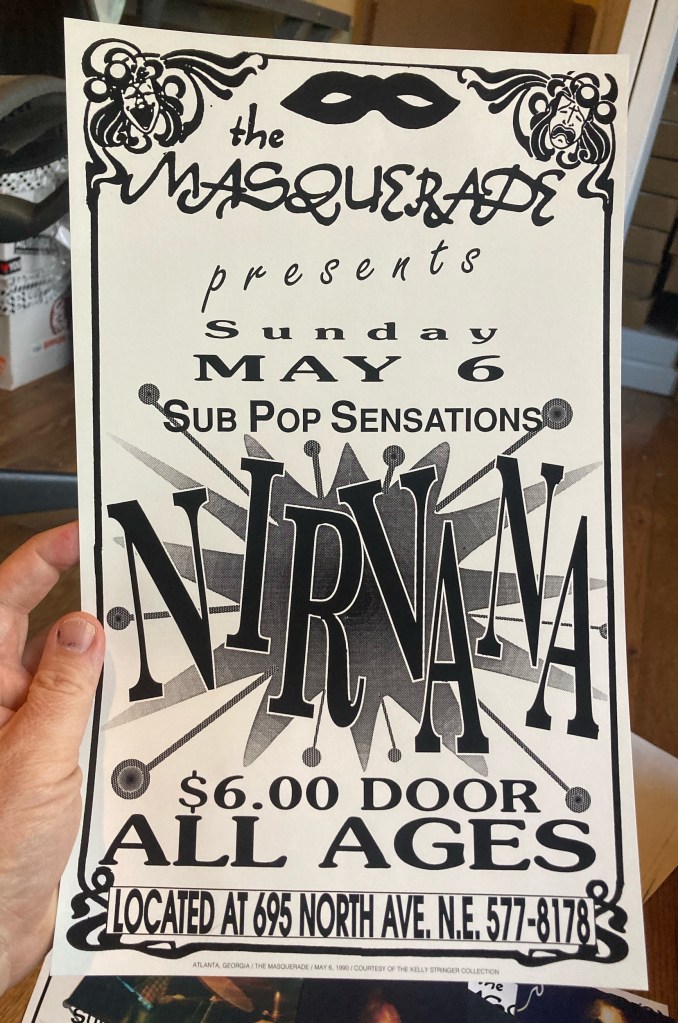
This Saturday, December 21, Ella Guru Records will host an unveiling of a limited-edition postcard set documenting Nirvana’s first Atlanta show on May 6, 1990 in Heaven at the Masquerade. The 12-postcard set offers a snapshot of Kurt Cobain, Krist Novoselic, and Chad Channing’s fiery ascent. This was Nirvana pre-Dave Grohl, performing on one of Atlanta’s most storied stages.
“I’ve been fortunate to scan over 26,000 pieces of primarily Southern ephemera, and when special things come across the scan bed, I tend to take note,” Owings says.
“So I have any one of a number of collections that I’ve been given permission to use: R.E.M. at Piedmont Park ‘82, the B-52’s at Memorial Hall ‘78, Talking Heads at the Agora. But I just thought to myself if I can do this concept with any band it’s Nirvana—or the Beatles, but that’s impossibly rare—and let’s just see how it either comes together or falls apart. I’m curious to see how it does.”
Victoria Nicholson, a Wax ‘n’ Facts alum and music superfan, was at the show with her point-and-shoot camera, capturing eleven ethereal photos of Nirvana from the side of the stage.
Photo courtesy The Chunklet Music Preservation Project.
Heaven in the Masquerade’s original location was around a 1,000-1,300 capacity venue. It is estimated that 150-200 people were in attendance for this show. It was a from the sold-out arenas the band would soon command on the heels of releasing Nevermind.
Kelly Stringer, another attendee that night, had the foresight to snag a flyer off the wall and a small calendar advertising upcoming shows at the Masquerade. Together, these artifacts tell the story of a band on the brink of stardom, performing for a crowd that barely filled the room at the Masquerade’s former North Avenue location.
Owings has restored these relics, compiling them into a machine-numbered edition of 50 postcards with a restored version of the flyer.
Stop by Ella Guru from noon to 3 p.m. and grab a set—along with a margarita or two. All proceeds benefit the Chunklet Music Preservation Project.
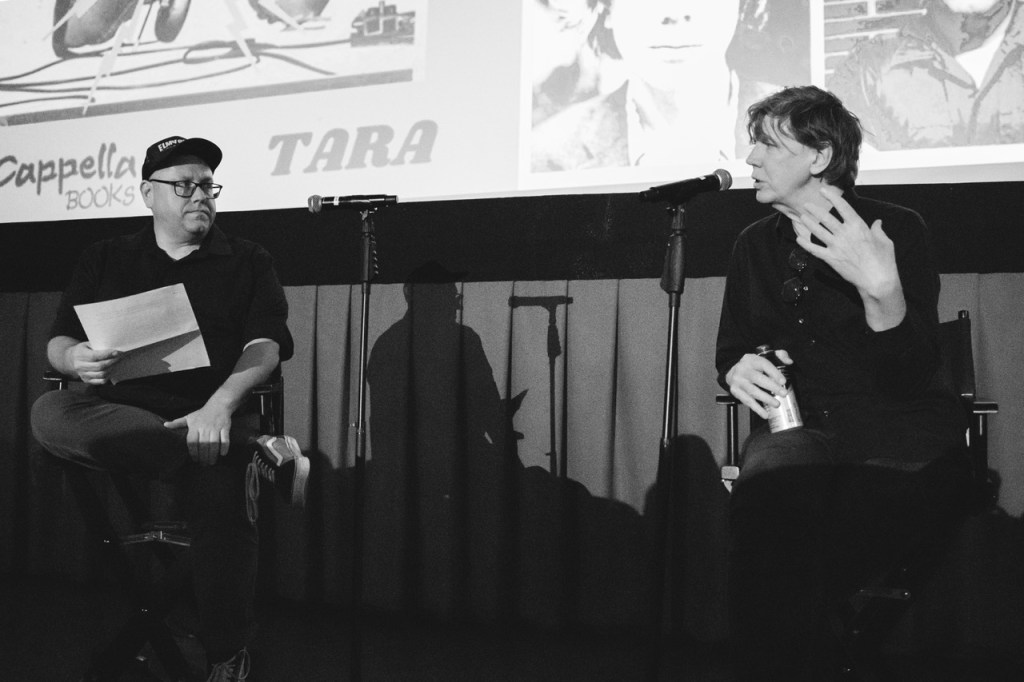
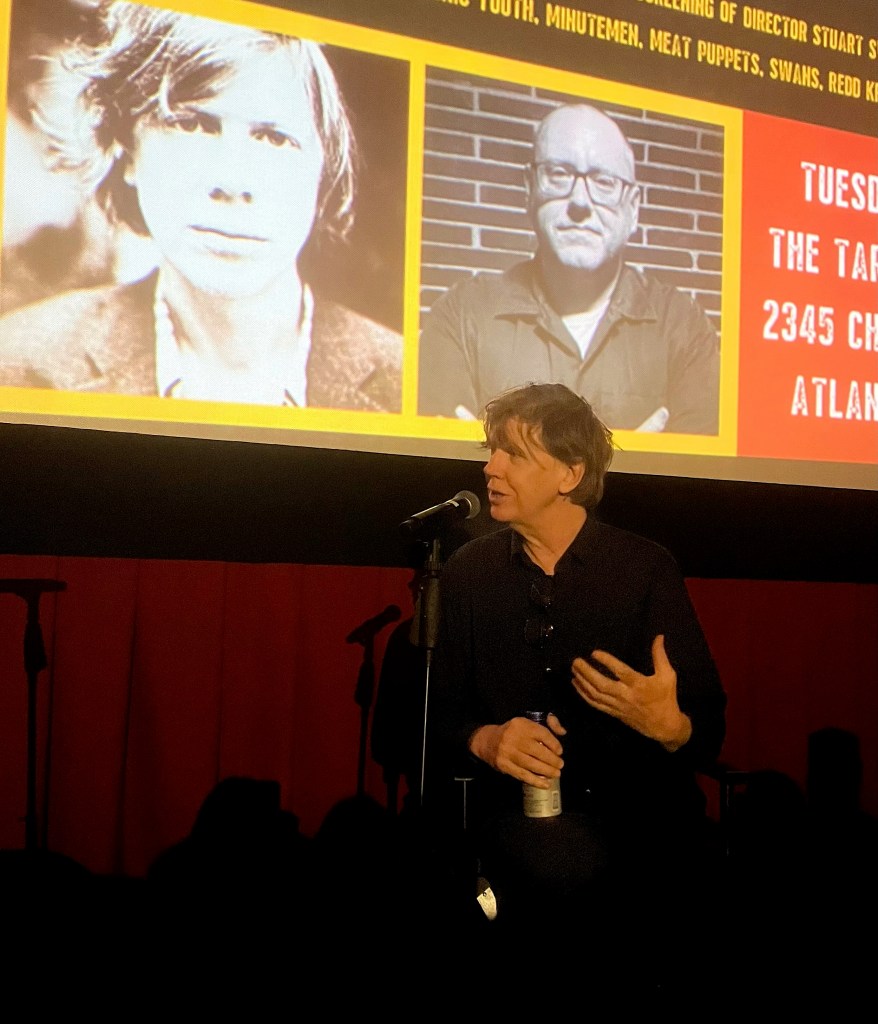
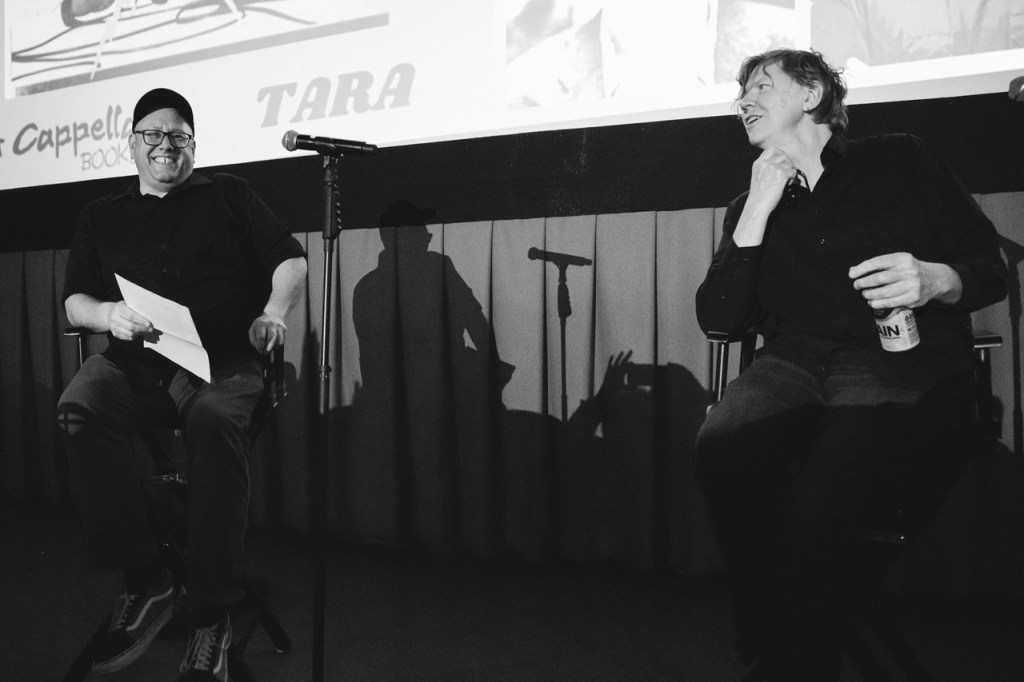
Thurston Moore at the Tara Theater. Photo by Jeff Shipman
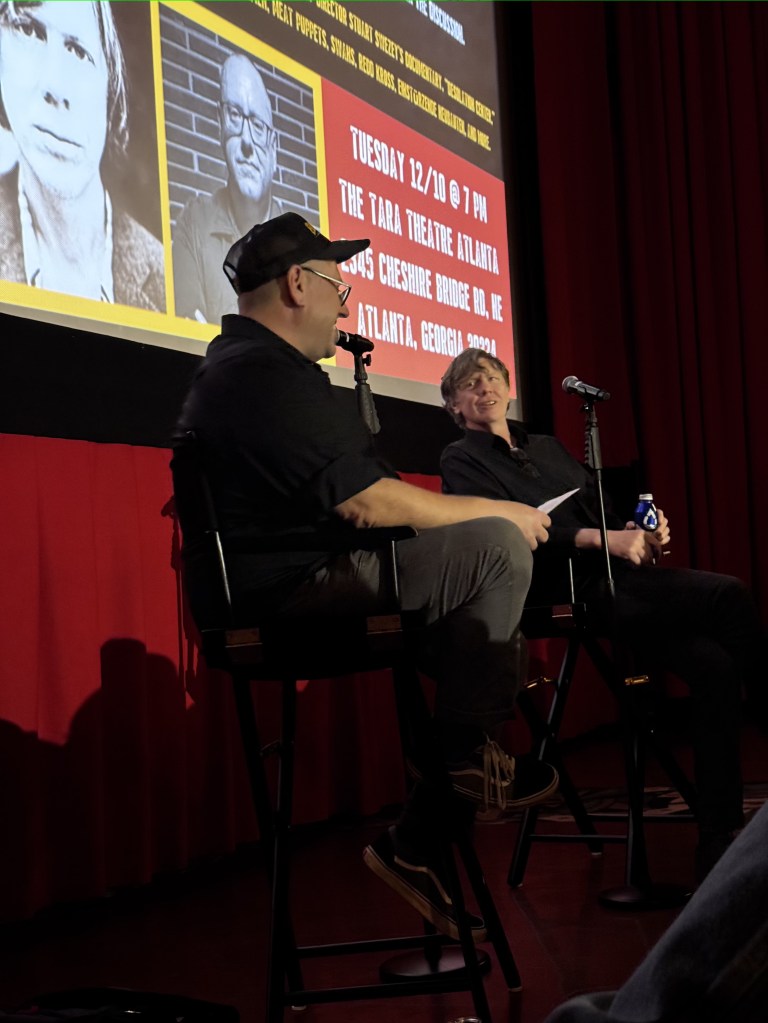
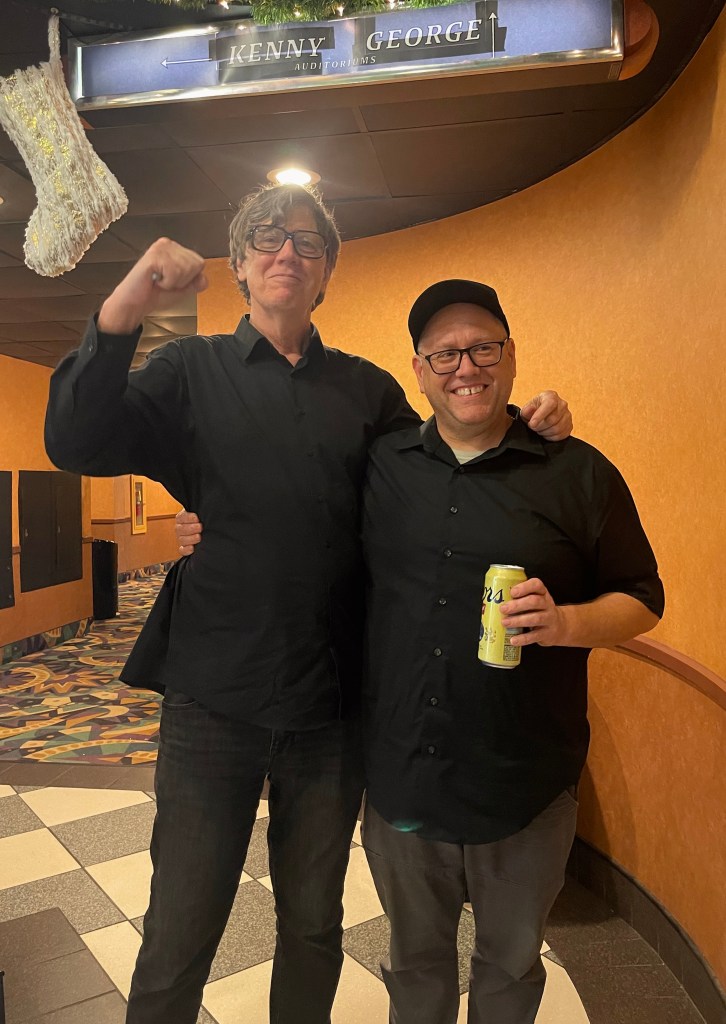
A fun and dynamic evening unfolded at the Tara Theater on Tuesday, December 10, as Thurston Moore appeared in conversation with yours truly, Atlanta music writer Chad Radford.
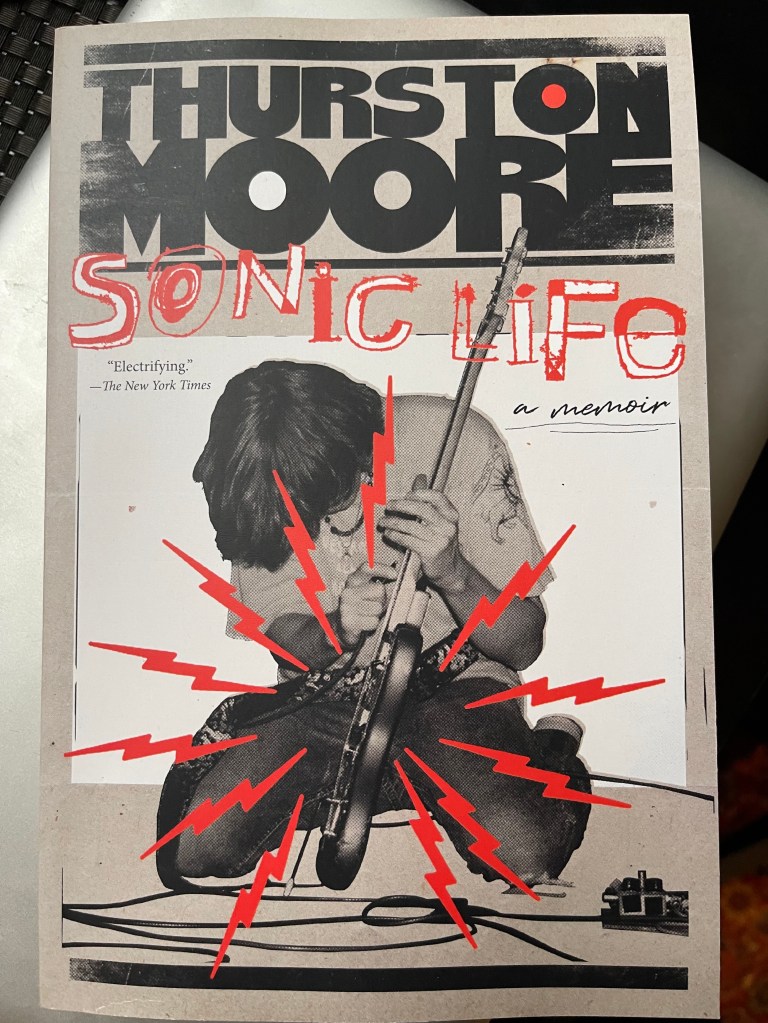
Introduced by Randy Gue, Assistant Director of Collection Development & Curator of Political, Cultural, & Social Movements for Emory University’s Rose Library, and presented by A Cappella Books, the night was anchored by Moore’s 2023 memoir, Sonic Life. He also reflected on a career that reshaped the alternative and underground musical landscapes of the 1980s, ‘90s, and beyond. In a candid exchange, Moore opened up about the forces that inspired Sonic Youth, navigating the post-punk and no wave underbelly of New York City and the ferocious hardcore emanating from Los Angeles in the early 1980s.
Moore also relived heading out on the road with his Sonic Youth bandmates–Lee Ranaldo, Kim Gordon, and original drummer Bob Bert–for their first out-of-town trek. The “Savage Blunder Tour” carried Sonic Youth and Swans from New York to Atlanta culminating with a deranged performance at the legendary 688 Club.
Later, Moore revealed how writing Sonic Life freed up his mental space, and paved the way into a new creative chapter. His latest album under his name, Flow Critical Lucidity, stands as a testament to this state of mind, blending his signature dissonant guitar textures, rhythms, and space with introspective clarity.
The conversation ranged from the personal to the esoteric, touching on topics like the divisive Faith/Void split 12-inch on Dischord Records, a perennial argument-starter among D.C.’s hardcore purests. Moore’s infectious enthusiasm for such musical touchstones reminded everyone why he remains a revered cultural figure.
Moore also recounted Sonic Youth’s participation in Stuart Swezey’s legendary Desolation Center concert series, playing the 1985 Gila Monster Jamboree in the Mojave Desert. He described the surreal experience of channeling their avant-garde energy into a setting as raw and untamed as the music itself. This set the stage for the night’s closing event: a screening of “Desolation Center,” the documentary that chronicles Swezey’s revolutionary desert concerts.
The evening offered a rare chance to glimpse into Moore’s world through his own words and to explore the intersections of music, memory, and creative reinvention.
Check out a gallery of images from the evening below.
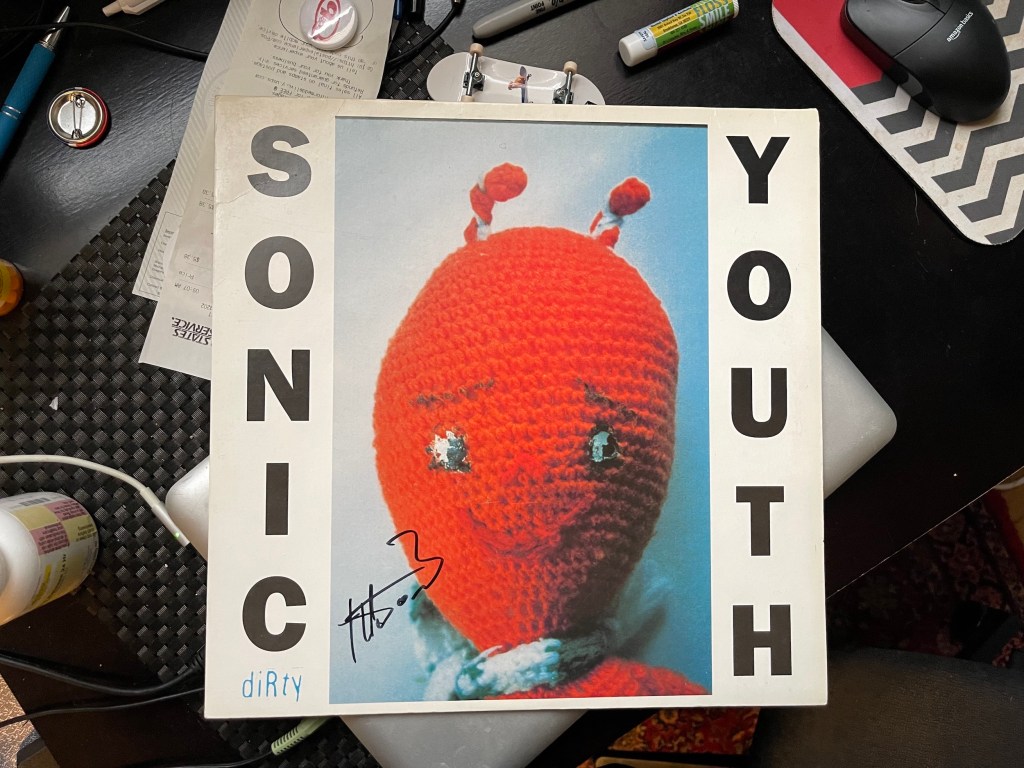
Thurston Moore. Photo by Jeff ShipmanPhoto by Jeff ShipmanPhoto by Jeff ShipmanPhoto by Jeff ShipmanRandy Gue. Photo by Jeff ShipmanSonic LifeSonic LifeSonic LifeThurston Moore photo by Laura HuntChad Radford (left) and Thurston Moore. Photo by Jeff ShipmanThurston Moore and Chad Radford. Photo by Todd PloharskiThurston Moore. Photo by Jeff ShipmanChad Radford (left) and Thurston Moore. Photo by Todd PloharskiThurston Moore. Photo by Jeff ShipmanThurston Moore with his dogs Apollo and Vinkenoog. Photo by Jeff Shipman Chad Radford (left) and Thurston Moore. Photo by Jeff ShipmanPhoto by Todd PloharskiChad Radford (left) and Thurston Moore. Photo by Jeff ShipmanThurston Moore (left) and Chad Radford. Photo by Kristin Anderson“Dirty!” Photo by Chad Radford
If you have enjoyed reading this post, please consider donating to RadATL. Venmo to @Chad-Radford-6 or click on the PayPal link below.
From the founding member of Sonic Youth, a passionate memoir tracing the author’s life and art—from his teen years as a music obsessive in small-town Connecticut, to the formation of his legendary rock group, to 30 years of creation, experimentation, and wonder.
Following the conversation, The Tara will host a screening of director Stuart Swezey’s documentary film, Desolation Center, featuring performances by Sonic Youth, Minutemen, Meat Puppets, Swans, Redd Kross, Einstürzende Neubauten, and more. Moore will introduce the film.
A note on the THREE types of tickets available for this event:
Book Talk Ticket Includes a signed paperback edition of Sonic Life and admission for the 7 p.m. book talk and signing. ($20 + tax)
Book Talk and Movie Ticket Includes a signed paperback edition of Sonic Life, admission for the 7 p.m. book talk and signing, and the 8:30 p.m. screening of Desolation Center. ($36 + tax)
Movie Ticket Admission to the 8:30 p.m. screening of Desolation Center. ($16 + tax)
About the Book Thurston Moore moved to Manhattan’s East Village in 1978 with a yearning for music. He wanted to be immersed in downtown New York’s sights and sounds—the feral energy of its nightclubs, the angular roar of its bands, the magnetic personalities within its orbit. But more than anything, he wanted to make music—to create indelible sounds that would move, provoke, and inspire.
His dream came to life in 1981 with the formation of Sonic Youth, a band Moore co-founded with Kim Gordon and Lee Ranaldo. Sonic Youth became a fixture in New York’s burgeoning No Wave scene—an avant-garde collision of art and sound, poetry and punk. The band would evolve from critical darlings to commercial heavyweights, headlining festivals around the globe while helping introduce listeners to such artists as Nirvana, Hole, and Pavement and playing alongside such icons as Neil Young and Iggy Pop. Through it all, Moore maintained an unwavering love of music: the new, the unheralded, the challenging, the irresistible.
In the spirit of Just Kids, Sonic Life offers a window into the trajectory of a celebrated artist and a tribute to an era of explosive creativity. It presents a firsthand account of New York in a defining cultural moment, a history of alternative rock as it was birthed and came to dominate airwaves, and a love letter to music, whatever the form. This is a story for anyone who has ever felt touched by sound—who knows the way the right song at the right moment can change the course of a life.
About the Author Thurston Moore is a founding member of Sonic Youth, a band born in New York in 1981 that spent 30 years at the vanguard of alternative rock, influencing and inspiring such acts as Nirvana, Pavement, the Yeah Yeah Yeahs, My Bloody Valentine, and Beck. The band’s album Daydream Nation was chosen by the Library of Congress for historical preservation in the National Recording Registry in 2006. Moore is involved in publishing and poetry and teaches at the Summer Writing Workshop at Naropa University in Boulder, Colorado. He divides his time between the USA and England.
About the Film Desolation Center is the previously untold story of a series of early ’80s guerrilla music and art performance happenings in Southern California that are recognized to have inspired Burning Man, Lollapalooza, and Coachella, collective experiences that have become key elements of popular culture in the 21st century. The feature documentary splices interviews and rare performance footage of Sonic Youth, Minutemen, Meat Puppets, Swans, Redd Kross, Einstürzende Neubauten, Survival Research Laboratories, Savage Republic and more, documenting a time when pushing the boundaries of music, art, and performance felt almost like an unspoken obligation.
Directed by Stuart Swezey, the creator and principal organizer of these unique events, Desolation Center demonstrates how the risky, and at times even reckless, actions of a few outsiders can unintentionally lead to seismic cultural shifts. Combining Swezey’s exclusive access to never-before-seen archival video, live audio recordings, and stills woven together with new cinematically shot interviews, verité footage and animated sequences, Desolation Center captures the spirit of the turbulent times from which these events emerged.
If you have enjoyed reading this post, please consider making a donation to RadATL. Venmo to @Chad-Radford-6 or click on the Paypal link below.
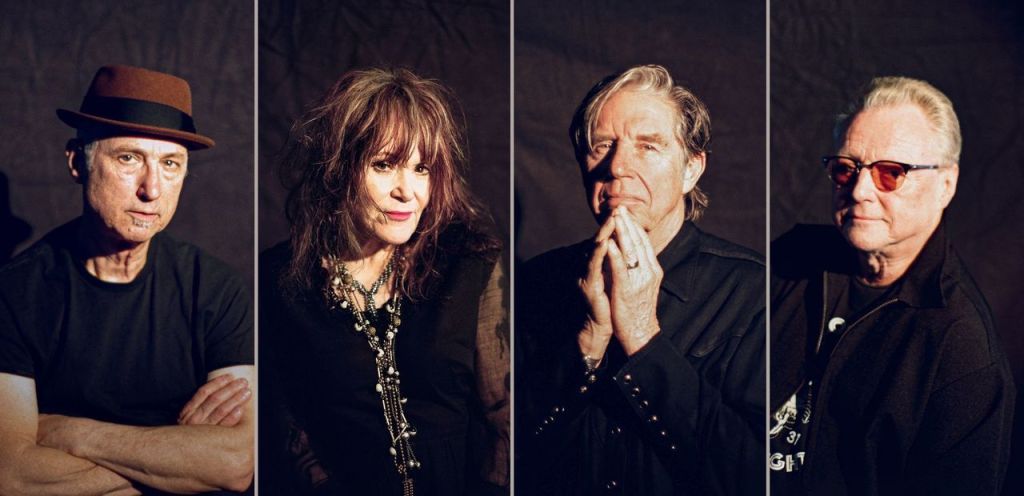
SMOKE & FICTION: From left, DJ Bonebrake, Exene Cervenka, John Doe, and Billy Zoom of the band X. Photo by Gilbert Trejo
X takes the stage at Variety Playhouse this Sunday, October 27, as part of the group’s farewell tour, supporting their latest—and final—album, Smoke & Fiction. It’s the culmination of a long legacy in red-blooded American punk and rock ‘n’ roll, featuring the original lineup of singer Exene Cervenka, singer and bass player John Doe, guitar player Billy Zoom, and drummer DJ Bonebrake. Since forming in the summer of ‘77, X has stood as the cornerstone of Los Angeles’ first-wave punk scene. Now, 47 years later, the group is taking one last bow.
Smoke & Fiction’s June 2024 release arrived with news that the band was hanging it up for good. The album is stacked with themes of finality and reflection woven throughout singles such as “Big Black X,” which nods to their early days as punk upstarts, to other songs such as “Sweet ’til the Bitter End” and “Ruby Church,” which revisit the romantic tensions that have always simmered in X’s greatest hits.
Smoke & Fiction finds X pushing their sound into the beyond and back, with deeper, darker textures, tones, and arrangements.
Zoom’s rock ‘n’ roll twang and raw punk edges, coupled with Bonebrake’s tight rhythms, ground the album, but it’s Doe and Cervenka’s balance of dissonance and harmony—urgent, commanding, and yearning—that brings it all back home. If this really is the end, X is bowing out with the same fire and fierce integrity that made the group a legend in the first place.



















 Rad/ATL