Drivin’ N Cryin’ and Lynx Deluxe’s roots are deeply intertwined, reaching back nearly to the beginning of both groups.
Naturally, Lynx Deluxe’s rendition of “(Whatever Happened to) The Great American Bubble Factory?”—the latest single to arrive from the 100-song Let’s Go Dancing: Said the Firefly to the Hurricane, A Compilation Celebrating the Songs of Kevn Kinney—is filled with nods to both groups’ shared past. Their cover of the songs also casts new light on the glorious nuances of Kinney’s songwriting, illuminating just how emotionally powerful an instrument he possesses.
In the summer of 1981, Drivin’ N Cryin’s bass player Tim Nielsen and drummer Paul Lenz started playing music together as the rhythm section for Atlanta pub rock/punk outfit the Nightporters. The group, which also included singer and guitar player Andy Browne, carved a path through Georgia’s burgeoning underground punk and new wave scenes, sharing stages with legendary acts such as the Clash, REM, and the Replacements.
The Nightporters infused unabashed angst and joy in equal measures into their three-minute, three-chord songs with titles such as “Mona Lisa,” “Dreamin,’” and “West of Eden,” detailing their teenage worldview—yes, some of them were still in high school at the time. Browne was only 15 years old when the group started.
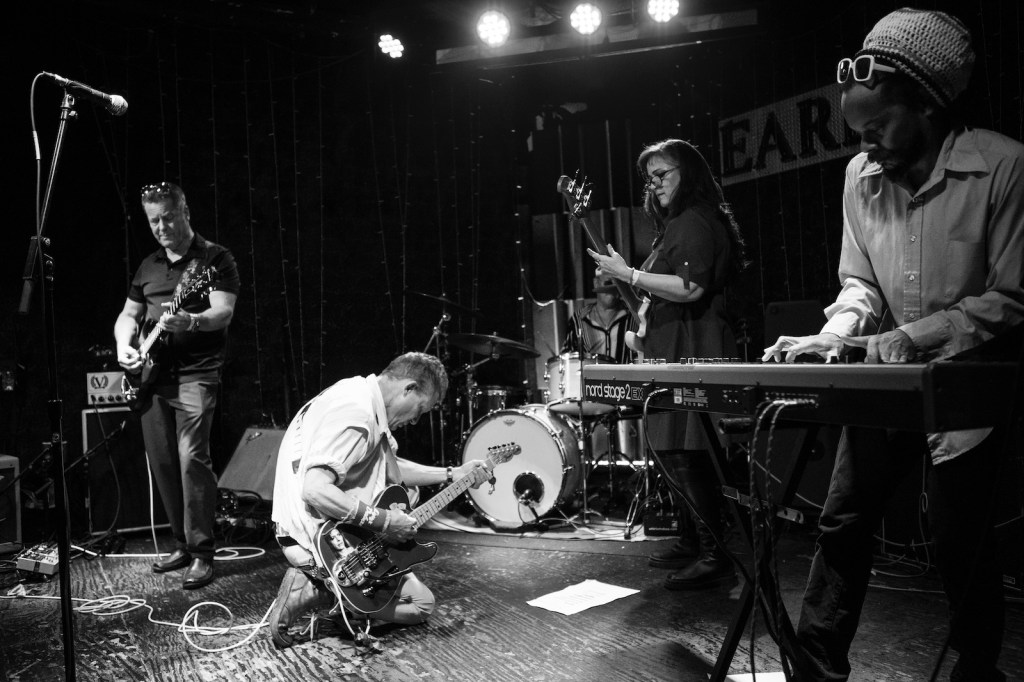
Fast-forward some 42 years later: Browne fronts the baroque alternative rock songwriting machine that is Lynx Deluxe. Backed by a lineup featuring bass player Lucy Theodora, drummer Brad Mattson, keyboard player Billy Fields, and guitar player Jeff Dean, the group’s take on “The Great American Bubble Factory” is a stylish and bucolic affair. Their cover pays homage to Kinney’s original number while reflecting on how industry outsourcing has affected the American economy and changed the landscape and middle class American culture as a whole.
“The Great American Bubble Factory” embraces a sense of nostalgia for a happier time and place in America, when daily life seemed simpler and more prosperous.
Kinney makes a cameo appearance in the song, playing harmonica, and Nielsen plays mandolin, making it the only song on the comp. to feature Drivin’ N Cryin’s two longest standing players.
Lynx Deluxe renders “The Great American Bubble Factory” even more precarious than the original, pushing the narrative forward by expanding upon Kinney’s lyrics in deeply personal ways.
In the second verse, Browne sings, “Did some time for a crime went a little loco / Slaved for two bits a day praying for a furlough.”
As Browne explains, it’s all a true story.
“I was in jail for 80 days, because I went a little loco,” Browne says. “The prescription oxycontin I was on for eight years due to a severe back injury left my dopamine and serotonin levels not so balanced for about a year and half. I was not exactly in the right state of mind, and was going through a very difficult time. While I was in there I was trying to get in the kitchen to work and make like .50¢ to $1 a day,” he adds. “But they wouldn’t let me do it.”
Later, Browne blends yet another homage into the song, this time giving a nod to “Union Sundown” from Bob Dylan’s 1981 LP Infidels. “Her dress reads Mozambique / This flashlights from Taiwan / These boots are from the Far East / Boxed and shipped from Amazon / The car parts come from China / Fenders made in Mexico,” he sings before calling back to the original number’s refrain, “If you can make it here, why you build it there?”
This new vision of “The Great American Bubble Factory” unfolds with an even greater sense of unwavering determination.
“We’re not much of a cover band,” Browne goes on to say. “When we pick a song to cover, we have to rewrite it a bit and make it our own.”

Songs for this living tribute project are amassing over the next 10 months. Previously released singles can be found here.
The first physical installment is available on vinyl now. Check it all out via TastyGoodyRecords.com.
If you have enjoyed reading this review, please consider making a donation to RadATL. Venmo to @Chad-Radford-6 or click on the Paypal link below.


 Rad/ATL