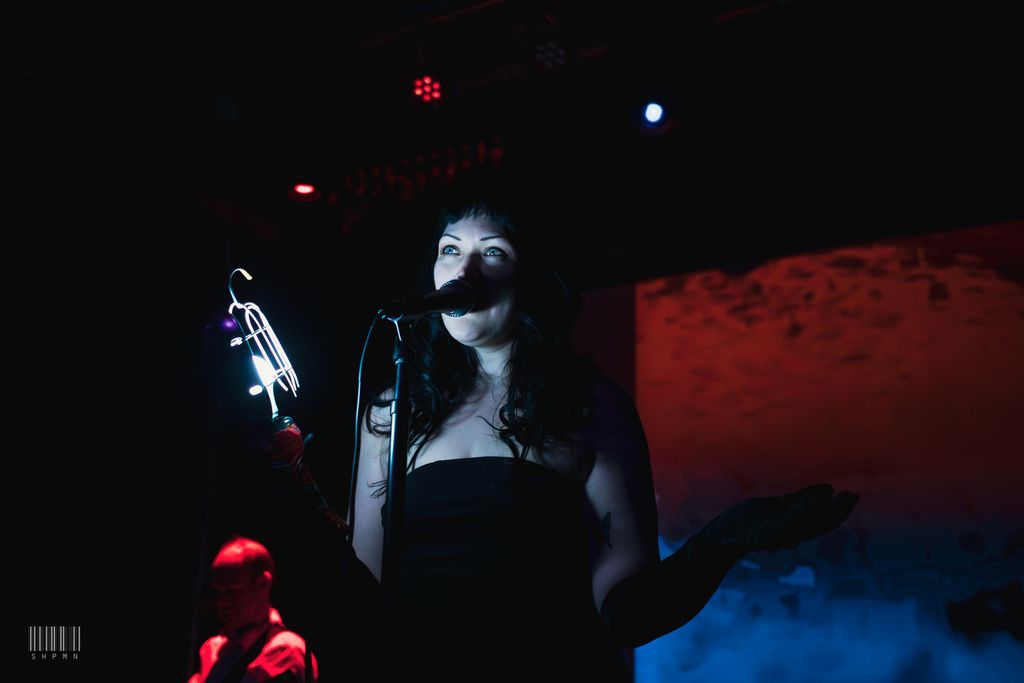
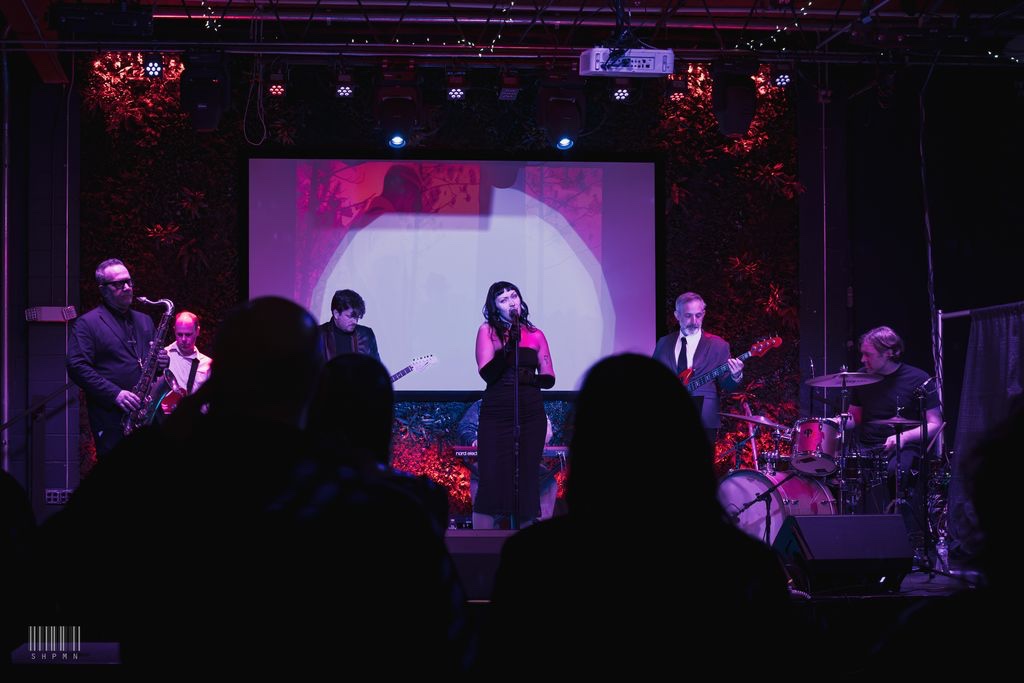
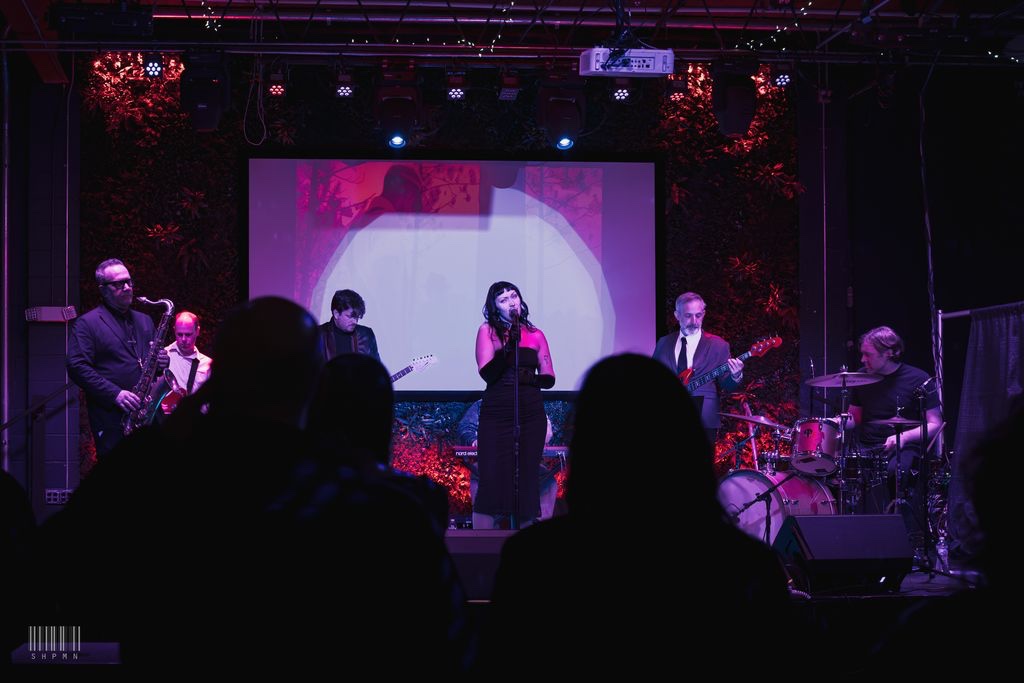
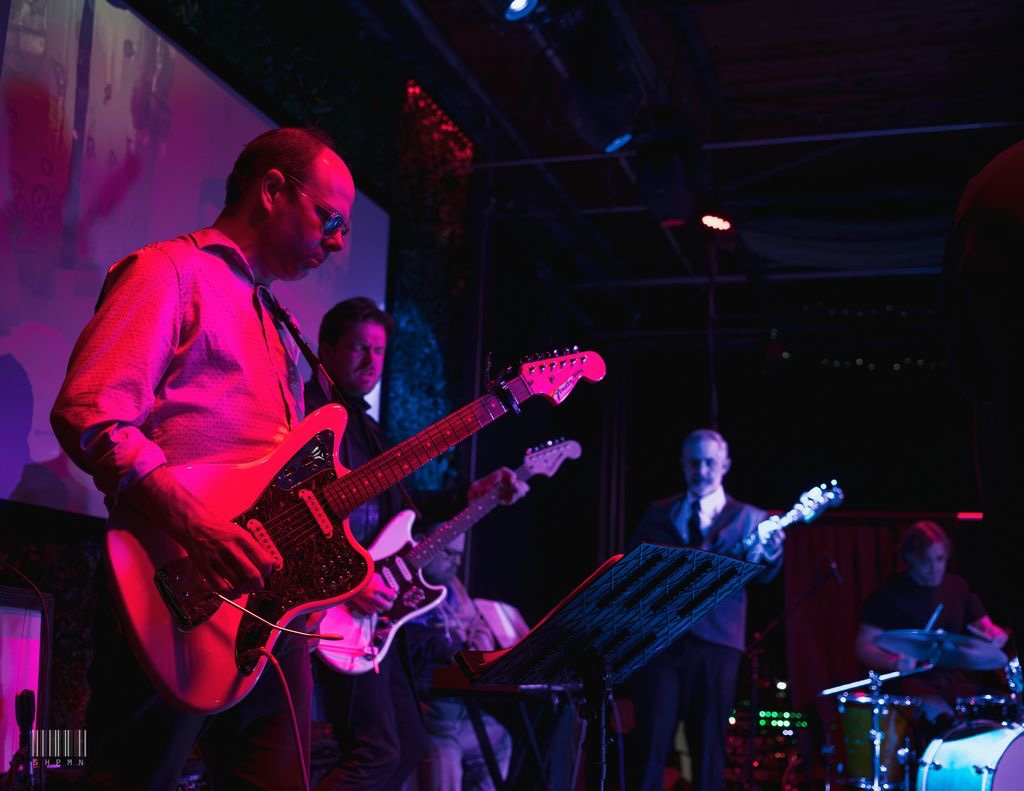
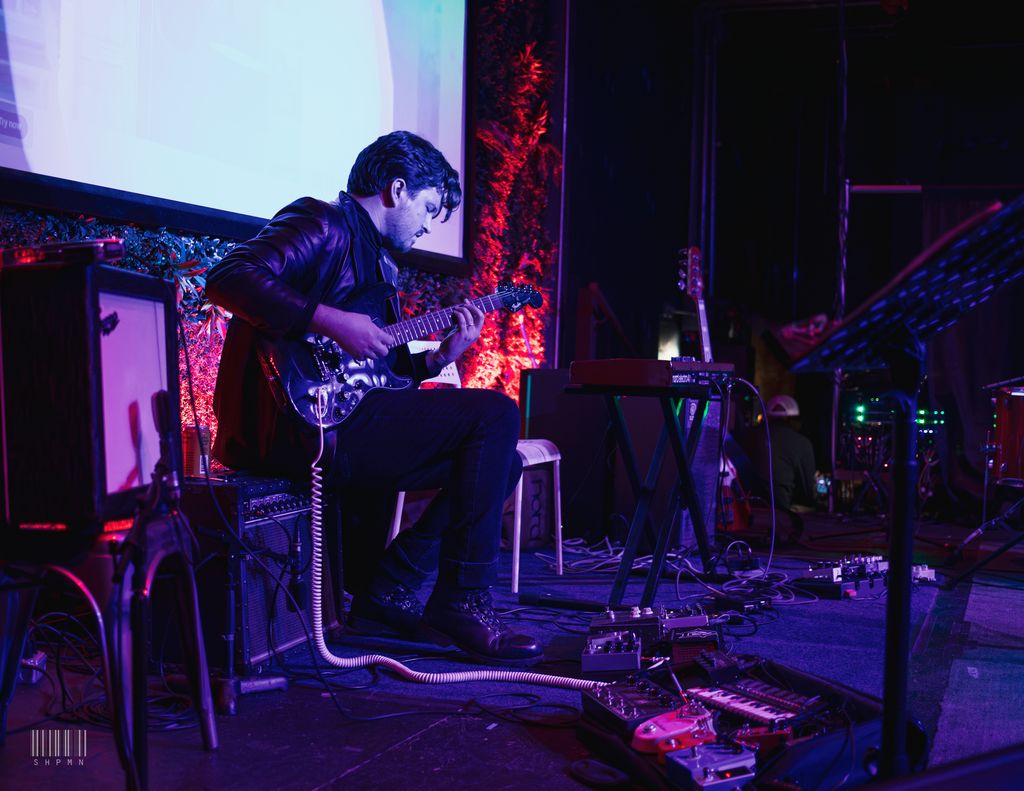
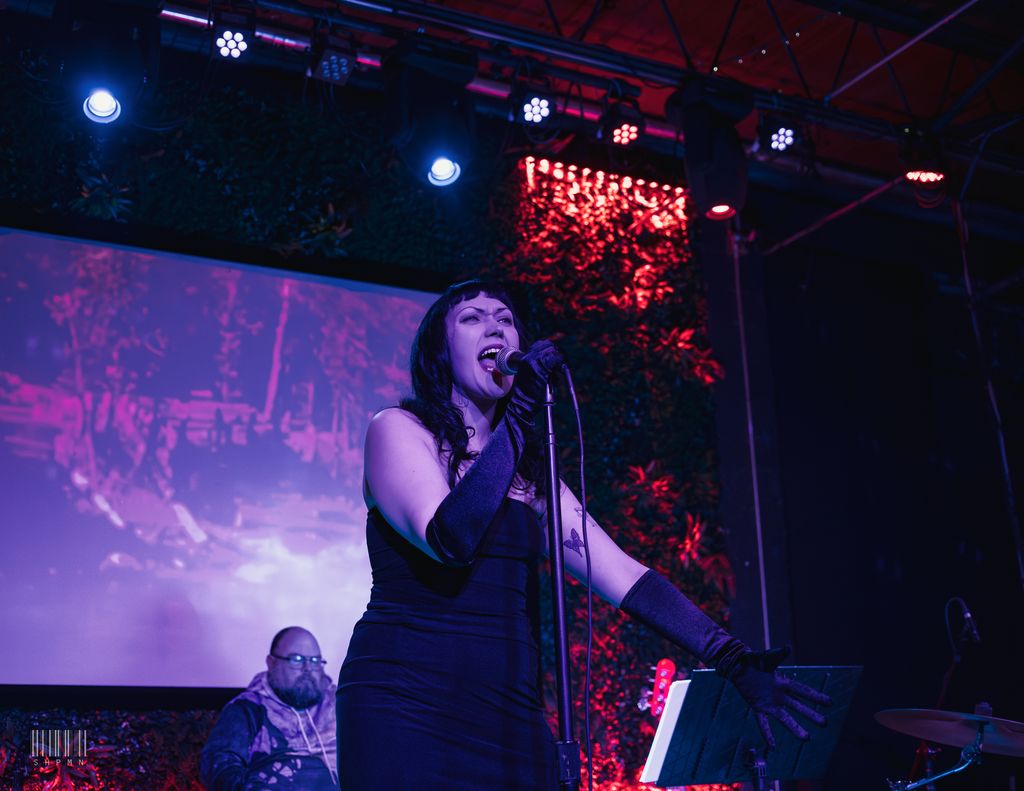
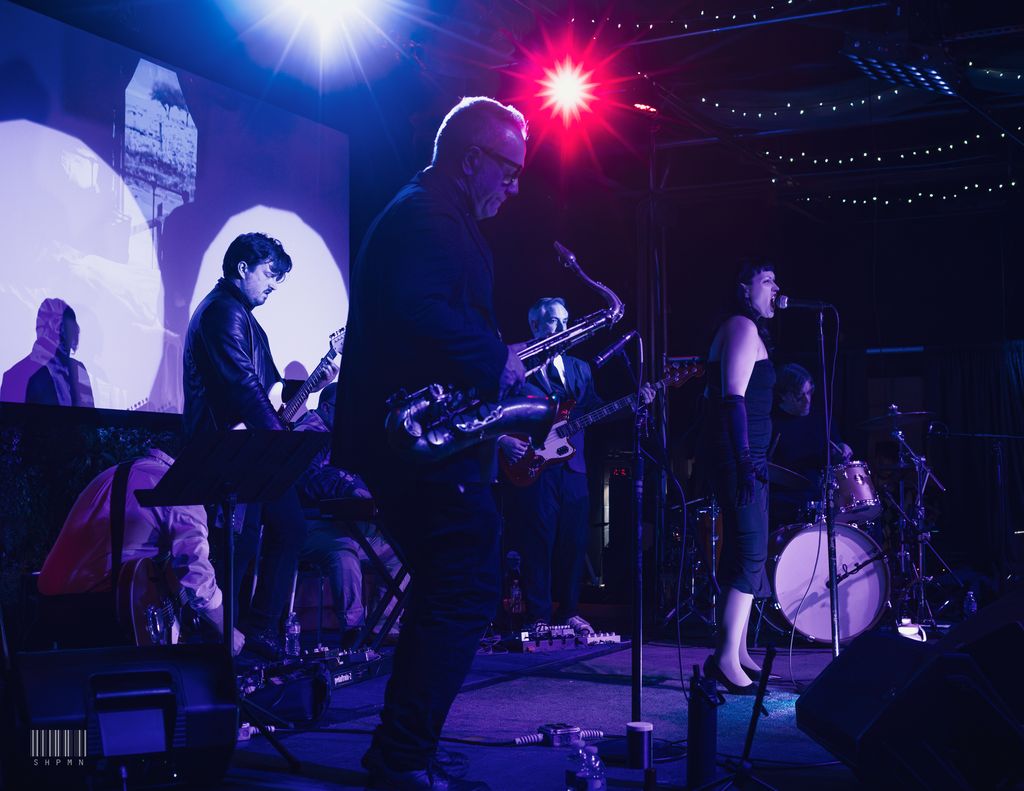
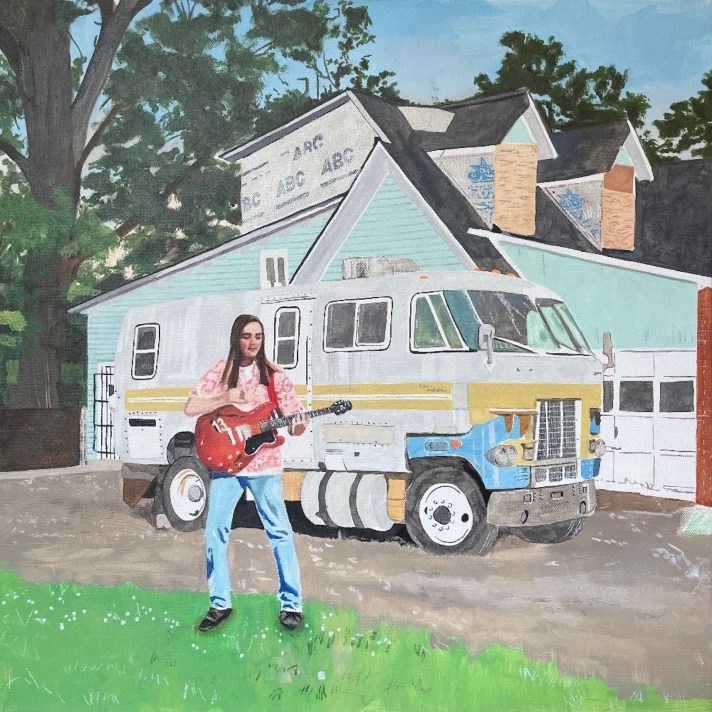
Pylon Reenactment Society’s “Christmas Daze” captures that peculiar mix of frantic motion and quiet clarity that settles in around the holidays. The song was born on instinct during a late-2021 rehearsal: bass player Kay Stanton dropped a riff that snapped the room into sharp focus. Within minutes the group had a new song on their hands. They carried that momentum straight into Chase Park Transduction, tracking the tune on December 29, 2021, while the season’s energy still hung in the air. The song was initially released via Bandcamp on December 1, 2023.
“Christmas Daze” follows a lone traveler who runs out of gas on the way to and from a family gathering. But the breakdown serves as a reset. Instead of leaning into frustration, the song’s narrator reconnects with the small charms that make the holidays worthwhile. Tiny flashes of warmth are found in roadside stillness, the glow of passing decorations, and the quiet pause between obligations.
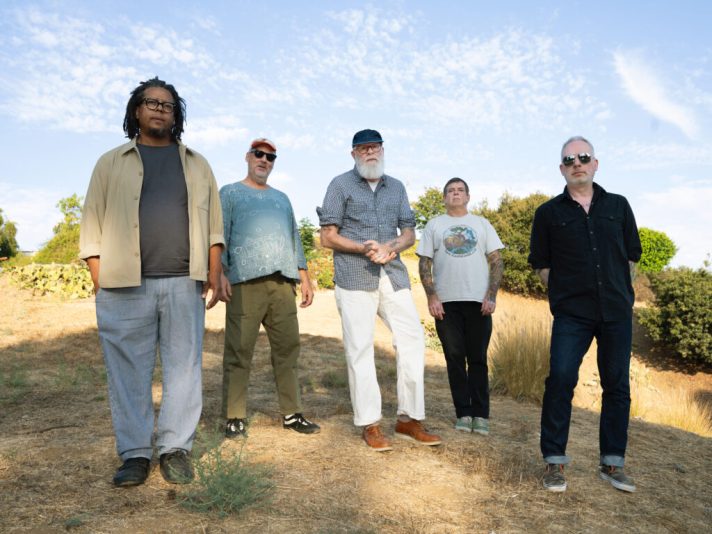
Pylon Reenactment Society. Photo by Christy Bush
PRS delivers it all with their signature taut and wiry pulse. Vanessa Briscoe Hay’s voice cuts through like a cold wind, carrying equal parts wry humor and wonder. Jason NeSmith’s guitar sparks and coils around Gregory Sanders’ crisp drumming, and Stanton’s riffs propel the music forward. ‘Christmas Daze’ hums with the notion that life moves better when you stay present enough to catch the beauty flickering in every passing second.
If you have enjoyed reading this post, please consider donating to RadATL. Venmo to @Chad-Radford-6 or click on the PayPal link below.
Since Edward Ka-Spel and cEvin Key first merged their creative worlds in the late 1980s—bridging the surreal poetics of the Legendary Pink Dots with the dystopian electronics of Skinny Puppy—their collaboration has always thrived on the outer limits of both realms. Astral Elevatorreinforces their hold on that liminal space where mysticism and melody blur into something strange and beautiful.
“Lady Fate” with its spacious and droning melodies rekindles the psychedelic beauty, melancholy, and paranoia of the Tear Garden’s defining masterpiece, 1992’sThe Last Man To Fly. Later, “Square Root” emerges like a spectral echo from 1987’s Tired Eyes Slowly Burning, subtly recalling the supreme weirdness of “My Thorny Thorny Crown.” Its interplay of a high, brittle vocal winding around a low, counting voice vaguely personifies a ritualistic dialogue between innocence and gravity—an auditory tether to the project’s origins, rendered here with the clarity that comes from decades of stylish evolution.
Astral Elevator, eschews the impenetrable darkness of 1996’s To Be An Angel Blind, The Crippled Soul Divide and 2000’s Crystal Mass. Here, the group—rounded out by Randall Frazier and Dre Robinson—reaches for a shimmering new plane where memory and revelation become one, and the music drifts like a transmission from some unknown realm that lies just beyond the edge of consciousness.
“War Crier” unravels around a skeletal rhythm, layered with shimmering synths that pulse like a dim heartbeat. Ka-Spel’s voice hovers in the mix like a transmission from a lost frequency—detached yet intimate. “Toten Tanz” channels the darker undertones of Key’s industrial roots, twisting through metallic percussion and vaporous drones, while “Exorcism” leans into rhythmic dissonance; its tension underscored by cascading synths that crackle like static in the ether.
“Swallow the Leader” balances that darkness with warped melodies, unfolding like a carnival waltz in zero gravity. “Chow Mein” delivers the record’s sharpest dose of surrealism, pairing grotesque humor with a hypnotic, playful groove. “Unreal” lands as one of the album’s most striking statements—a reflective confrontation with modern disconnection, holding a mirror to the hollowing effects of AI on human intuition, creativity, and trust in perception. It’s both prophetic and deeply personal, as its synthetic textures frame a lament for authenticity in an increasingly artificial world.
“It Just Ain’t So” and “Always Take the Highway” tap into a lighter strain of the chaotic pulse that propelled “Inquisition” from Skinny Puppy’s LastRights.
By the time “Undiluted Bliss” fades into focus, the record resolves its internal tension—weightless yet grounded, alien yet profoundly human. Ka-Spel, Key, and Co. refine their own musical vocabulary. The result is a work of hallucinatory grace, and an ascent that is entirely of this moment, yielding a worthy successor to the Tear Garden’s most luminous works.
Press play below to watch Randall Frazier’s video for “In The Name Of” and Cory Gorski’s “A Return.”
If you have enjoyed reading this post, please consider donating to RadATL. Venmo to @Chad-Radford-6 or click on the PayPal link below.
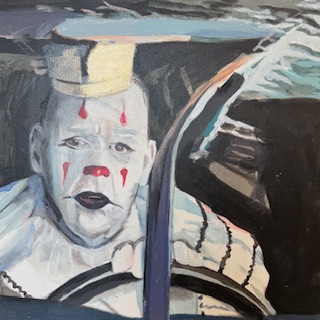
With Touch (International Anthem/Nonesuch), Tortoise takes a deliberate step forward, refining and reimagining the motoric pulse and Krautrock undercurrents that ran through 2016’s The Catastrophist (Thrill Jockey). The Chicago-Portland-LA-based ensemble has always thrived on subtlety—those interlocking rhythms and textural sleights of hand that reveal new details with every listen. Here, the group hones that language to near perfection. Songs such as “A Title Comes,” “Axial Seamount,” and “Organesson” inhabit familiar terrain, yet each one breathes with renewed clarity and intent. There’s no need for grand reinvention when refinement feels this purposeful.
The album’s cool, monochromatic hue contrasts the warmer analog tones of earlier releases, creating a sense of precision and poise that’s both cerebral and deeply human. The production places every element exactly where it needs to be, crafting an atmosphere that’s minimal yet immersive. “Night Gang,” with its twangy, Morricone-inspired guitar lines, closes the record with an air of cinematic grandeur that is self referential while marking a turn into a brave new world.
Tortoise: From left to right: Jeff Parker, Dan Bitney, Douglas McCombs, John Herndon, and John McEntire. Photo by Heather Cantrell.
With Touch, Tortoise sounds as vital as ever: confident, contemplative, and completely in control of their craft. It’s an album that rewards patience and close listening, unfolding in waves of understated brilliance that reaffirm the band’s quiet mastery of mood and motion.
If you have enjoyed reading this post, please consider donating to RadATL. Venmo to @Chad-Radford-6 or click on the PayPal link below.
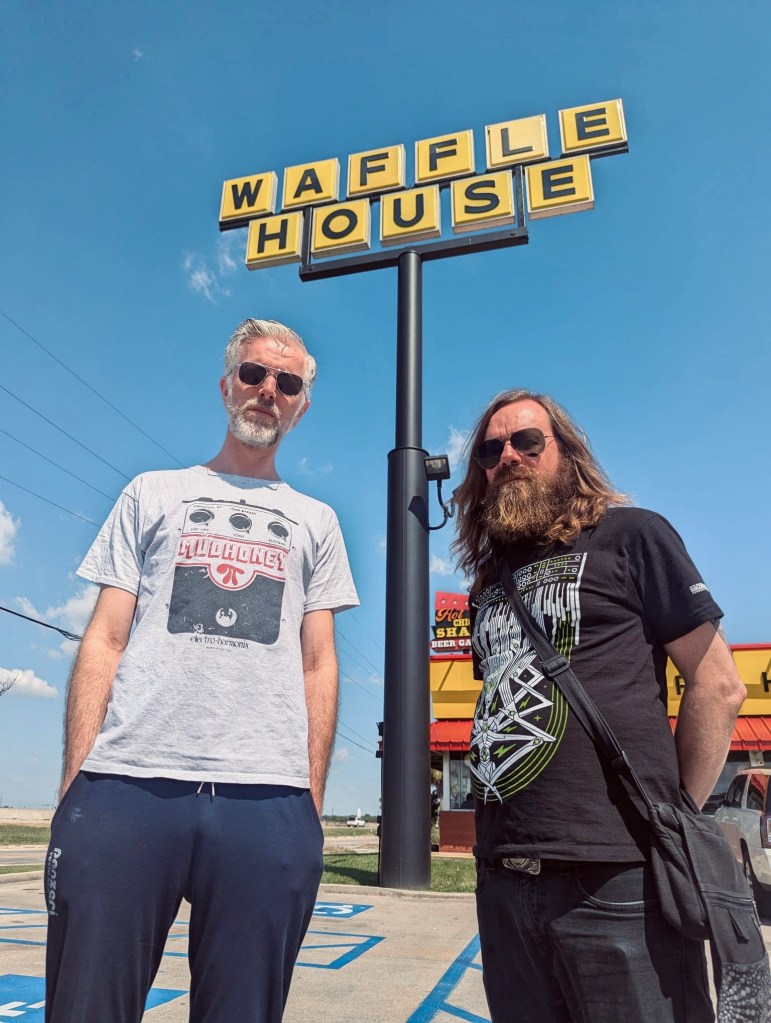
ORBIT SERVICE: Erik Drost (left) and Randall Frazier. Photo by Joep Hendrikx.
The Legendary Pink Dots and Orbit Service are two bands bound by a shared sense of mystery, atmosphere, and musical exploration. Over the years, both projects have cultivated an aura that’s equal parts cosmic and deeply personal—music that drifts between dream states, where melody and texture blur into something transcendent. Now, the connection between the two acts runs deeper than ever. Guitarist Erik Drost and keyboard and electronics player Randall Frazier—both longtime fixtures in the Pink Dots’ ever-evolving lineup—are on the road performing sets steeped in the ethereal tones of both Orbit Service’s Spirit Guide and the LPD’s latest album, So Lonely in Heaven, and the more abstract, experimental energy of Chemical Playschool 23–24.
In conversation, Drost and Frazier reflect on their creative chemistry and how their paths crossed during the making of 2004’s The Whispering Wall. They trace the evolution of Orbit Service from its early recordings to its current incarnation, and share what it means to inhabit the ever-expanding universe of Edward Ka-Spel’s songwriting. Together, they reveal that for all the mystery and gravity that surrounds their music, the heart of it all remains simple: connection, experimentation, and the pursuit of transcendence through sound.
Before playing a show in Purgatory at the Masquerade, on Friday, October 17, Drost and Frazier took an hour out of their day to talk about collaborating with each other, collaborating with Ka-Spel, and their go-to Waffle House meals while traveling across the United States.
Press play below to listen in on our conversation.
Since forming in London in 1980, the Pink Dots have carved out a singular space in the underground—too strange for pop, too melodic for noise, too abstract for goth, and too open-ended to be called industrial music. Led by enigmatic vocalist and founding member Edward Ka-Spel and rounded out by Randall Frazier (synths, samples, and electronics), Erik Drost (guitar), and Joep Hendrikx (live engineering and effects), the LPDs weave together surreal narratives and immersive, cinematic soundscapes that take shape like dispatches from a fever dream.
The group’s catalog spans countless albums, each one a kaleidoscopic swirl of experimental electronics, post-punk texture, avant-garde noise, and darkly poetic meditations on the human condition. On stage, their shows become ritualistic experiences—hypnotic and theatrical, blurring the line between performance and séance.
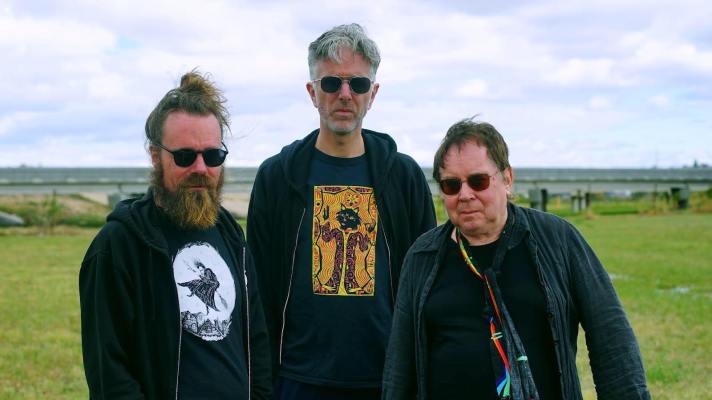
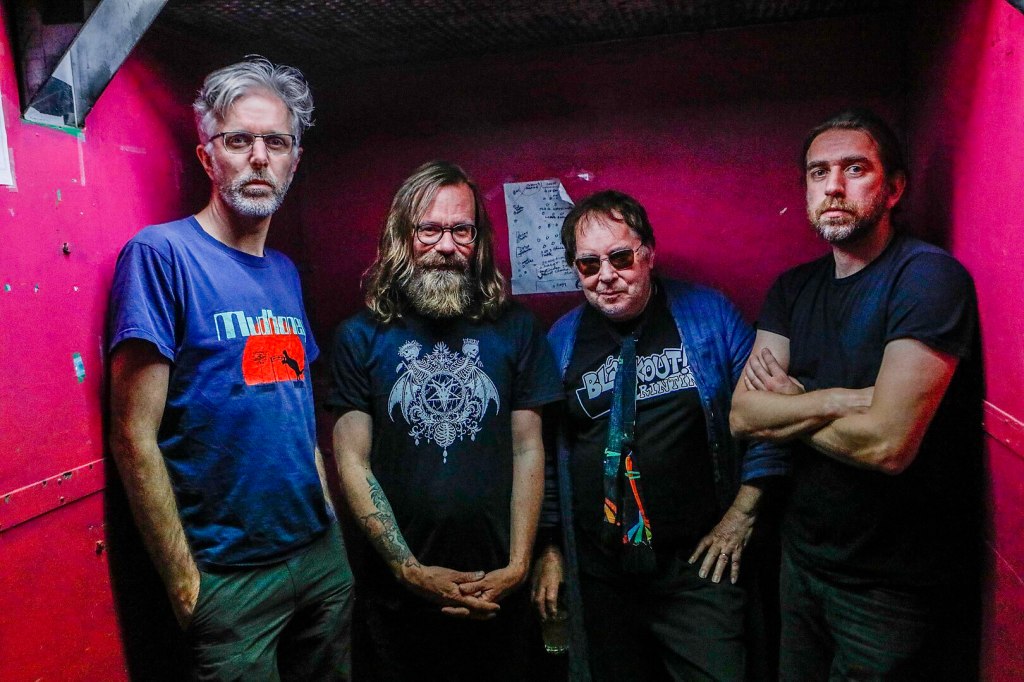
Erik Drost (from left), Randall Frazier, Edward Ka-Spel, and Joep Hendrikx. Photo courtesy the Legendary Pink Dots.
The LPD’s latest album, So Lonely In Heaven (Metropolis Records), finds the group at its most evocative, melancholy, and Orwellian in years, layering haunting synths, spectral melodies, and existential poetry into a deeply human meditation on isolation and transcendence. It’s a reminder that even after 40-plus years, the LPDs are still evolving; still chasing the unknown.
Bologna, Italy-based Orbit Service opens the evening with a set of deep, slow-burning atmospherics and haunted melodies. Featuring Frazier and Drost performing together, the duo builds patient, ethereal songs that hum with existential weight. They are the perfect gateway into the LPDs’ strange and beautiful world. The latest offering, Spirit Guide, leans deeper into cosmic territory, expanding its sound with shimmering drones, meditative textures, and a slow, patient gravity that feels like it’s tuning into another frequency.
For the faithful, this show is a rare chance to step back into the Dots’ orbit. For the uninitiated, it’s an invitation to get lost in one of experimental music’s most enduring and imaginative universes.
After Words at Excelsior Mill (pre-Masquerade). Photo by Sara Epstein.
Between July of 1987 and December of 1989, After Words played a crucial role in pushing Atlanta’s post hardcore scene into new musical terrain. Seminal hardcore band Neon Christ had called it quits a year earlier. In their wake, a new generation of musicians stepped up to carry their influence forward.
In the late ‘80s, After Words co-founding guitar player Brian Nejedly began booking shows while he was still in high school. “When the Metroplex shut down, that was the only all ages venue in town, so I just started looking for places that I could rent out to put on shows,” Nejedly says.
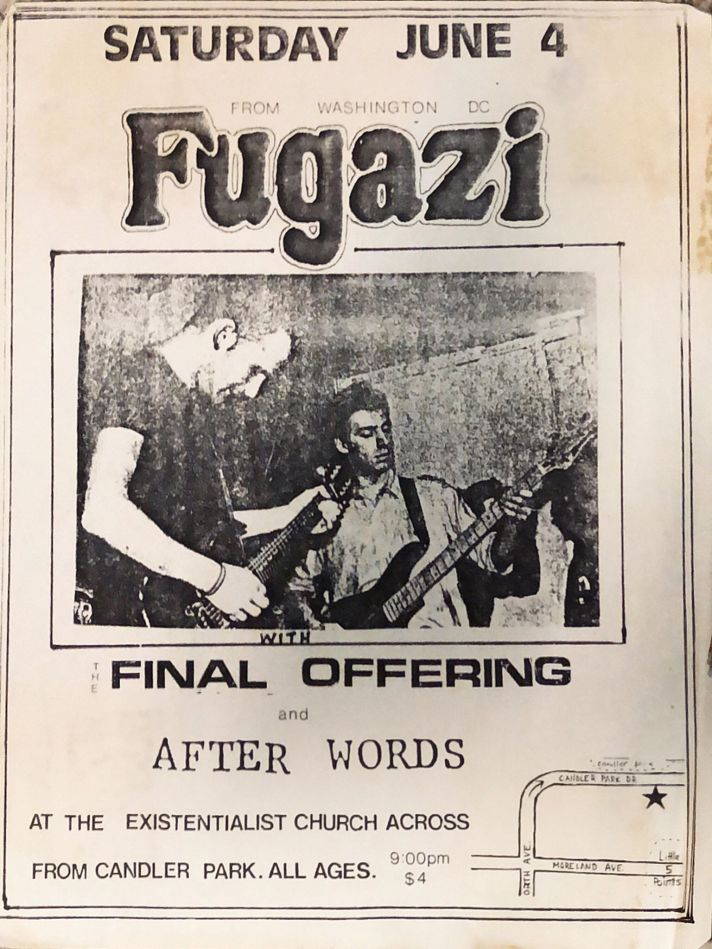
He booked Fugazi’s first Atlanta show at the First Existentialist Congregation in Candler Park. He booked Ignition, Soul Side, 7 Seconds and dozens of other acts. “Once I started booking shows, I realized that a lot of these bands had a list of people and places to call for shows in each town, and I was on that list,” Nejedly says. “For a while, I was the only guy in Atlanta on that list.”
Along the way, Nejedly sent After Words demo tapes out to pretty much every label that was on his radar. “I sent a demo to Cruz Records because we loved the band All,” he says. “We sent tapes to everyone, and Amanda MacKaye at Sammich Records wrote back.”
Amanda, sister of Ian (Dischord Records, Minor Threat, Fugazi, Coriky) and Alec (Ignition, Faith, and Hammered Hulls) MacKaye ran Sammich with Soul Side’s Eli Janney (Girls Against Boys). She offered to release the demo tape, making After Words the only band from outside of D.C. at the time to receive distribution through Dischord.
The label’s approval validated Atlanta as a place where post-hardcore ideas could thrive, and it placed After Words on the same label as Soul Side, Shudder to Think, and Swiz.
Drop a needle on After Words’ record and Nejedly’s jagged guitar carries weight over vocalist Noel Ivey’s cathartic voice, and propulsive rhythms laid down by bass player Craig McQuiston and drummer Kevin Coley. Emotional urgency guides songs such as “Looking Back,” “Ghost Dance,” and “As I See It,” all bearing the intensity of an early emo sound. The songs were never about nihilism or aggression. They were about wrestling with meaning, memory, and self-understanding.
In February 2024, Nejedly revived After Words for a one-off show 35 years after the album’s release. Ivey, McQuiston, and Coley are no longer living in the area. So Nejedly formed a new lineup featuring Geoey Cook (Fiddlehead) on vocals and guitar, James Joyce (Cheifs, Car Vs. Driver, Blood Circuits) on drums, and Justin Gray (3D5SPD) on bass to bring renewed energy to the songs.
In 2024, they locked in on an eight-song setlist—five from the original After Words LP, along with two other older numbers.
The two non-LP songs: “Things They Never Taught You” first appeared on The View: An Atlanta Compilation: 1984-1990, a cassette-only release that captured snapshots of the city’s underground post-hardcore and emo scene. Another song, titled “Without Answers” was documented during a 1989 Live at WREK session.
Earlier this year, the group recorded six songs with Tom Tapley at West End Sound—“Looking Back,” “As I See It,” “Without Answers,” “Third Party,” “Tell Me,” and “Ghost Dance.”
“We’re not doing anything different with the songs,” Nejedly says. “Pretty much keeping it true to the original with only minor changes. ‘Ghost Dance’ will always be my favorite,” he adds. “I think it’s the best song I’ve written and Noel’s lyrics were really good.”
Cook’s voice adds new dimensions to each song, adding depth and interplay. Joyce’s drumming locks into Gray’s bass lines with precision, adding heft, pushing each arrangement even further.
“We recorded it as a live studio session just for ourselves to document us getting together and playing these songs, but it came out so well Echodelick decided to release it,” Joyce says.
A release date for the record remains TBD.
What defined After Words in the beginning, and what continues to define the group now, is its place on the sonic landscape as early hardcore’s influence became diffuse and less severe. After Words proved that Atlanta was producing its own singular voices, capable of standing shoulder to shoulder with their peers in D.C., New York, Chicago, and elsewhere.
For Nejedly, the new recordings are about carving out relevance in the present tense, and honoring what the group built decades ago while refusing to let it calcify. For Cook, Joyce, and Gray, it’s about expanding on a framework that still has room to grow.
“After Words pivoted bands from Atlanta into a different direction in the early ‘90s,” says Joyce. “If you think about Fiddlehead or Freemasonry, Scout, or Car Vs. Driver, or the next wave of bands that followed them, they all changed course because of After Words.”
Moving forward, the group will play sporadic shows, but for now they aren’t writing any new material.
After Words. Photo by Brad Sigal.
If the late ’80s Atlanta scene was about carving out new space, After Words now stands as a reminder that the past can still fuel the present. The songs remain restless, powerful, and full of questions. That sense of questioning remains as vital now as it did when After Words record arrived in 1989.
Simon Joyner has spent more than three decades constructing one of the most devastating bodies of songs in American underground music. His catalog is steeped in bleak, Midwestern imagery, haunted characters, and unflinching emotional honesty that has drawn praise from the likes of Beck, Gillian Welch, John Darnielle of the Mountain Goats, and fellow Omaha songwriter Bright Eyes’ Conor Oberst.
With his most recent album, Coyote Butterfly, Joyner taps into a deeper vein of sorrow and resilience, reckoning with the loss of his son Owen, who died in August of 2022. The result is one of the most affecting albums in his career—and he’s bringing it to the stage with a six-piece band that adds weight to every cracked note, every rich musical texture, and every solemn word.
Simon Joyner & the Nervous Stars’ lineup includes Australian songwriter Leah Senior (keyboards, vocals, and percussion) and her partner Jesse Williams (guitar), both of whom accompanied Joyner during a recent tour of Australia and New Zealand. The live band also includes Mychal Marasco on drums and Phoenix-based brothers and experimental musicians Caleb (bass and vocals) and Micah Dailey (guitar, miscellaneous instruments, and tape loops).
Following the lead of Joyner’s voice and guitar, the group moves with unhurried rhythms and quiet existential resonance. Together, they’ll breathe new life into some of Coyote Butterfly’s bedrock numbers such as “The Silver Birch” and “Port of Call,” allowing the grief to unfold in real time.
If Coyote Butterfly explores a raw, open wound, songs from Joyner’s upcoming album, Tough Love, promise a more complicated take on perseverance and connection. Many of the songs from the LP in-progress are being revealed here for the first time on this tour. Both albums are intrinsically linked.
“For the kinds of tough love the album addresses, there’s the tough love that exists between citizen and government where you love the country but are struggling with its faults and are at the point of choosing to fight for it to change or maybe abandon it,” Joyner says. “There are a couple of political songs on the album dealing with the state of the country right now. There’s the tough love between siblings, and the tough love of a marriage or any romantic partnership. And of course the tough love as the term first came about, where loved ones of an addict wrestle with how to support the person they love who is struggling and sometimes resort to tactics which isolate or cut off the person struggling with the problem. There are a million little ways we all behave which could be forms of tough love, so the album is about people in various kinds of relationships behaving like humans do which is sometimes good but not always.”
Recently, Joyner & the Nervous Stars released a 7-inch and a CD featuring Bob Dylan, Lou Reed, and Velvet Underground covers to raise money to help offset the cost of taking a six-piece band on the road.
The group will also play various songs from throughout Joyner’s career, all elevated to the full-bodied sound that a six-piece band affords. Joyner’s songs have always balanced poetry and brutal realism, but there’s a new weight in the air this time—a sense that the personal and political grief he’s singing about is inescapable, but not insurmountable. These songs don’t offer resolution. They offer endurance, and in this moment, that might be exactly what the world needs.
Three years in the making, Total Peace’s self-titled debut album comes out of the gate strong with volume and urgency. What began as a neighborly chat between Michelle Williams and Matt Cherry during the peak of COVID isolation turned into a full-fledged band grounded in old school human interaction and no-frills songwriting.
Cherry is best known for slinging layered and complex guitar parts in the psychedelic post rock outfit Maserati. Here, he trades his effects pedals for a bass and a microphone. His voice is heavy, tuneful, and raw in songs such as “Taped Up,” “Trance,” and “Slipped.” It’s a bold pivot that calls to mind the ramped up energy of Gang of Four’s Entertainment! and the introspective back-and-forth between Tom Verlaine and Richard Lloyd throughout Television’s Marquee Moon—all driven by the sheer exuberance of the Stooges’Self-titled LP. The riffs are bold and the rhythms are undeniable, reveling in the power of repetition.
Guitarists Williams and Craig Gates and drummer Greg Stevens round out the lineup with a compelling synergy. Stevens and Williams share roots in Atlanta’s early aughts indie rock band Red Level 11. Their chemistry grounds the record’s driving pulse, as they thrive on stripped-down dynamics—no synths and no nonsense.
There is no concept at work here per se, but Cherry says, “Michelle and I are neighbors in Inman Park. She has a bunch of historical documents about people and events on our street in the 1910s and 1920s that we thought were interesting. Several of the songs are loosely about those things. Other songs,” he goes on to says,” “are about different topics ranging from fictional characters to various midlife crises and dark thoughts.”
Recorded live at Maze Studios in Reynoldstown with engineer Ben Etter (Erasure, Washed Out, Nikki and the Phantom Callers) and mastered by Joel Hatstat (Bambara, We Vs. the Shark, Liz Durrett), this self-titled debut leans into its compact and hook-laden energy. “Tom Talbot,” “Mold Blue” and “Be Free” dance on a tightrope between post-punk tension and anthemic release. There’s a visceral joy in cranking it up for the sake of catharsis, and Total Peace hits like a welcome jolt of electricity.
Nicholas and Peter Furgiuele are men of few words. For 23 years the closely-knit Atlanta-born brothers and songwriters have let their music do the talking for them. They first recorded together under the name A Fir-Ju Well in 2002. Years later, in 2007, they rebranded as Gringo Star and have carried on ever since, navigating shifting cultural tides, changing musical trends, and seemingly endless lineup shuffles with the kind of determination that comes from shared musical instincts, experiences, and D.N.A.—call it brotherly love.
Gringo Star’s latest album, Sweethearts, trades indie-rock grit for a 1950’s pop shimmer, weaving together soft-focus textures that imbue their signature blend of garage rock and psychedelia with a new and introspective depth. The album’s first two singles, “Blood Moon” and “I Sleep to Dream,” highlight a musical evolution in progress, each one floating in reverb, harmonies, and instantly familiar melodies wrapped around love stories. The songs shapeshift with dreamlike grace, expanding upon elements of both nostalgia and innovation, carrying the band into new terrain.
“We didn’t set out to make a record with any kind of underlying theme, but all the songs told these love stories, and the sound evolved as we went along,” says singer and guitar player Nicholas Furgiuele. “There is an underlying theme to it all, but I wouldn’t know how to explain it,” he goes on to say while offering that if anyone does hear a coherent concept at work throughout the album, it’s something that wrote itself.
“I have always been into the idea that music is open to interpretation, and what it means to me might mean something completely different to anyone else who’s hearing it and putting it all together in their head,” he adds.
Sweethearts is Gringo Star’s eighth full-length album, and their first with the Grand Rapids-based dizzybird Records. It’s also their second post-pandemic offering, recorded between 2023 and 2024, expanding upon the murky sound and vision of 2023’s On And One And Gone. Its songs take shape as surreal nods to simpler times in American life, channeling equal parts dreamy reverie and swirling self-reflection, filtered through a lens of vintage melancholy.
“We wanted to make a record that felt good, you know? Something that felt like remembering love,” Furgiuele says. “But at the same time, there’s a sadness in that memory. It’s not all sunny.”
Familial tendencies are also behind Nick and Peter’s penchant for a 1950s sound as well. From the 1940s-1975, their maternal grandfather, Ed “Dr. Jive” Mendel, was a DJ for WGBA-AM in Columbus, GA. He was also a chitlin’ circuit promoter, and record label owner who earned a couple of gold records for a duo he managed, Peggy Scott & Jo Jo Benson. Sam Cooke, Soul Stirrers, Otis Redding, James Brown, Martha and the Vandellas, the Shirelles, Little Stevie wonder, and Jackie Wilson were also among his associates.
“He died before my parents got together so we never knew him,” Nick says. “But my grandma’s photo albums were all filled with pictures of them with James Brown, Jackie Wilson, being around all of this music and all of these images of our grandparents was for sure an influence on what we do with Gringo Star.”
But an aura of peaceful optimism is the album’s guiding light. “Blood Moon” takes shape as a waltzing lullaby where layered vocal harmonies and languid guitars remain suspended in sensual ether.
One song, “Some Things Don’t Change,” was originally written for Nick and Peter’s first band, the King Street Blues Band, circa 1995 when they were in 9th and 7th grades respectively, while living for several years in Boone, N.C.
The band was named after downtown Boone’s main thoroughfare. “Some Things Don’t Change” was originally penned by their bandmate John Fulkerson, but it had never been properly recorded. For Sweethearts, Nick and Peter took what they remembered of the song, retooled it and wrote some new lyrics here and there.
“I kind of don’t remember what the original song sounded like, and it never really had any kind of arrangements,” Nick says.
The idea to revisit the song came when Nick realized he was unconsciously noodling the bass lines between other songs when the group was on stage. “I don’t know why it got stuck in my head, but it did, and so we gave it a whole new treatment—a whole new life.”
“Some Things Don’t Change,” as it appears on Sweethearts, is now one of the more sophisticated numbers that takes shape amid the tracklist. Still, the album remains deceptively simple, unraveling to reveal miniature worlds thriving inside lush turns of phrases, baroque instrumentation, and emotionally intense shading.
Gringo Star. Photo by Francis Furgiuele.
Since recording Gringo Star’s 2008 debut album, All Y’all, produced by Ben H. Allen III (Animal Collective, Deerhunter, Gnarls Barkley), the group’s body of work has existed outside of easy classification. But they have always been interested in stirring hot-blooded emotional meditation into their work. Nick, working alongside his brother Peter on bass, guitar player and vocalist Josh Longino, and drummer Mario Colangelo the group has carved out a one-of-a-kind cosmic rock sound. Surf-inflected riffs and distant rhythms in the instrumental song “Girl,” and a traipsing cover of Sam the Sham and the Pharaohs’ 1966 hit “Li’l Red Riding Hood” underscore the album’s surreal, dream-like essence.
On stage, instruments get swapped. Roles shift. There’s an elastic energy to the way the group performs—egalitarian and impulsive—and this live dynamic carries over into Sweethearts, careening movements from the janggling exuberance of “Count the Ways” to the wall-of-sound that binds “A Lonely One.” Each number offers a distinct postcard from a dream-world version of the past. A sense of longing underpins the whole affair—an ache for connection in a time when disconnection is the norm.
“In a world where division has become a rallying cry, we wanted to make something that reminds people of what connects us,” Peter says. “We wanted to get back to that raw emotion—love, heartbreak, joy, sadness. All of it.”
It’s easy to forget, in the churn of modern music, how rare it is for a band to last this long, all the while continuing to evolve. Gringo Star is one of those rare groups that has never stopped pushing forward, even when the rest of the world shut down, and even when doing so meant carving their own path outside of whatever music scene was in vogue at the time.
They’ve toured relentlessly over the years, sharing stages with the Zombies, Cat Power, Weezer guitarist Brian Bell’s band the Relationship, Best Coast, and Shannon and the Clams. Their sound has zigzagged across records like a living document of who they were at a given moment.
But what is, perhaps, most remarkable is the way the band has retained its identity while allowing each record to bloom in its own way, bringing their songs to life, and turning raw ideas into something that is quite cinematic.
Sweethearts sits comfortably out of time, reverent of the past but not beholden to it. The songs invite listeners to slow down, and to feel things deeply.
Nick and Peter may not be chasing any zeitgeist, but they are staying true to a vision that’s lasted nearly three decades without growing stale. With Sweethearts, they’ve added a rich new chapter to an already impressive catalog—one that lingers long after the needle lifts. And maybe that’s the real trick to Gringo Star’s longevity. The group doesn’t just survive. It resonates beyond words.
If you have enjoyed reading this post, please consider donating to RadATL. Venmo to @Chad-Radford-6 or click on the PayPal link below.
A version of this story originally appeared in the May 2025 issue of Record Plug Magazine.
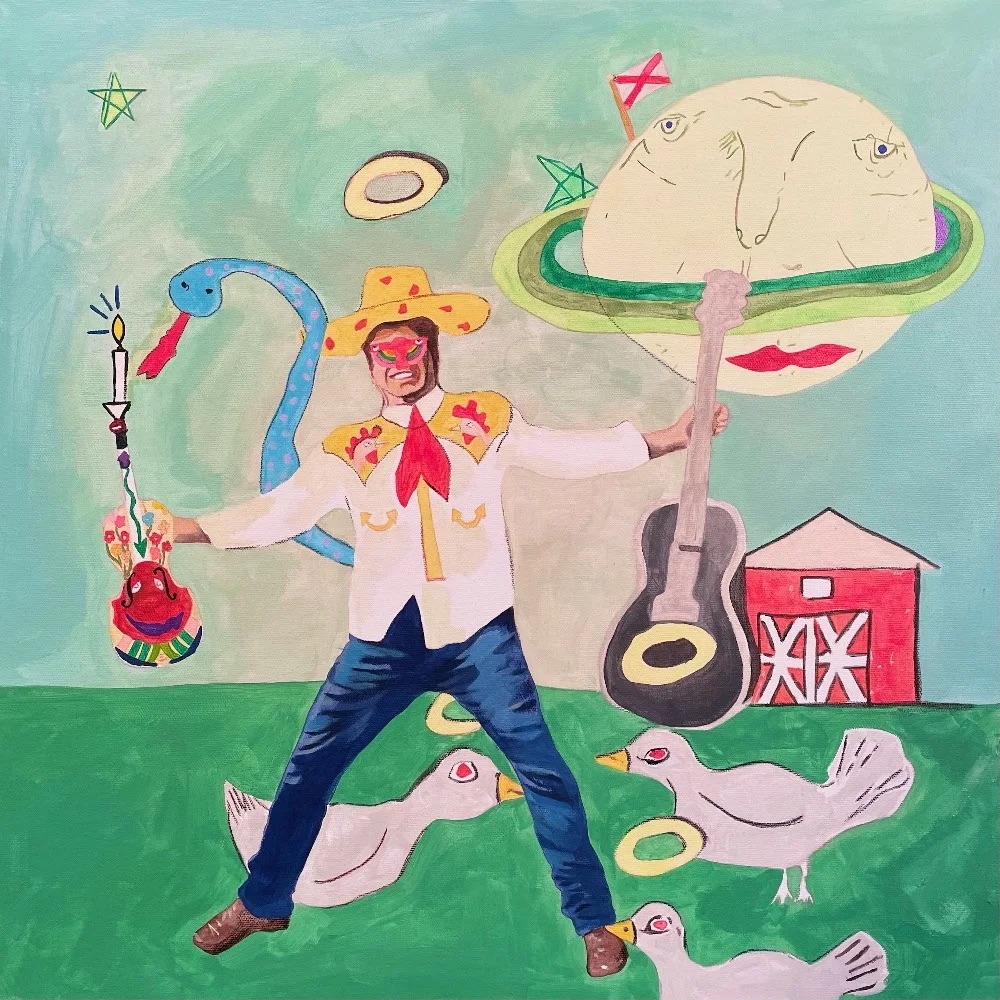
Shane Parish: Solo at Cafe Oto (Red Eft Records). Cover photo by Petra Cvelbar.
Shane Parish has unveiled details for an evocative new album, titled Solo at Café OTO, due out July 1, via his own label, Red Eft Records.
Captured live in London on November 14, 2023, the album showcases Parish in full exploratory mode, performing an instrumental fingerstyle electric guitar set drawn from a deep well of British and American folk traditions. The performance took place during a sold-out evening of solo sets the night before Bill Orcutt’s Guitar Quartet appearance at the London Jazz Festival.
The album’s first single, a rendition of Angelo Badalamenti and David Lynch’s “Sycamore Trees,” from the Twin Peaks soundtrack, sets the tone for a dark, drifting, and emotionally resonant album. Parish also leans into the melancholy and mysticism of folk ballads by Anne Briggs, Shirley Collins, and John Jacob Niles, reinterpreting them with his own idiosyncratic voice and a minimalist rig: just a Fender Squier Telecaster plugged directly into the house amp. It’s the same guitar he used for 4 Guitars Live at Le Guess Who? Festival in Utrecht the night before—a gift from Bill Orcutt, passed down when Parish joined the four-guitar ensemble.
Parish’s 2024 release, Repertoire (Palilalia Records) featured tight arrangements of outsider standards from various musical genres—Kraftwerk’s “Europe Endless,” Alice Coltrane’s “Journey Into Satchidananda,” Aphex Twin’s “Avril 14th,” John Cage’s “Totem Ancestor”—allowing their melodies and their vital essences to take on a gently glowing body via the resonating steel strings of his guitar. With Solo at Café OTO, Parish summons a raw and intuitive performance that’s closer in spirit to 2016’s Undertaker Please Drive Slow(Tzadik). Here, each melody becomes a jumping-off point for spontaneous invention, with Parish letting the songs drift, fracture, and reform as if guided by wind and water. The result is both intimate and expansive—an arresting document of a singular guitarist at the height of his expressive powers.