In January of 2020, Loony took the stage at 529 to play Radfest with Purkinje Shift and W8ing4UFOs—my birthday party. It was a Sunday afternoon “matinee” show that ended up going well into the night. Who knew we were so close to losing live music for much of the coming year?
A week before the show, singer Anela DeVille, bass player Silas Fiction, guitarist Scott Price, and drummer Isaac Makin got together for practice and recorded the “Dead Heat” demo that you see and hear above.
Over the last year, the group’s lineup has paired down to just Fiction and DeVille fleshing out six songs that they hope to release by this summer via Die Slaughterhaus Records. For these six new recordings that are currently in post-production, Price played guitar, and Amos Rifkin of A Rippin’ Production filled in as temporary drummer. While a permanent lineup has yet to take shape, Fiction and DeVille are pressing forward. First up: “Dead Heat.” Although this recording is a rough demo, it’s a solid sneak peek at the group’s full-throttle charge. It’s also an homage to one of Joe Piscopo’s finest/most absurd acting roles, Detective Doug Bigelow in the 1988 action-comedy sci-fi cult sleeper, Dead Heat.
“I had written those riffs, and later that day we watched Dead Heat,” Fiction says. We both loved it!”
LOONY: Silas Fiction (left) and Anela DeVille. Photo by Eric Gessler
Together, Fiction and DeVille penned the lyrics as a summary of the movie. “It’s so ingenious, and it had us laughing so hard,” DeVille says. “We wanted to make it known how badass this movie is. Those who haven’t seen it need to watch it in order to know what we are talking about.”
The music is inspired by So. Cal hardcore/nardcore Thrasher Magazine skate rock aesthetics of the ’80s. It’s music for fans of TSOL, RKL, Agent Orange, Agression, JFA, McRad, Doggy Style, Vision Street Wear, pulling off slappies and smith grinds, and getting awesome. Check out the lyrics below.
Dead heat Back from the grave Nothing to do No one to save
Dead man walking Cannot be shot down Terrorizing The entire town
Dead heat Back from the grave Falling apart Slimy decay
Infinite lives Soul cannot be found Decomposing Time is running out
Dead heat Back from the grave Dying to live Willing to trade
Time is running out!
If you have enjoyed reading this review, please consider making a donation to RadATL!
A decade has gone by since Überchriist last checked in with their self-titled debut cassette via Fan Death Records. But the black metal duo featuring Colin Mee (vocals, guitar, and bass) and Shane Patrick (drums, keyboard, and vocals ) brings a combined resume to the group that bridges a much broader swath of time and music in Atlanta. Mee is a former member of post-punk institution Deerhunter, indie rockers Hollow Stars, and heavy metal mashers Chopper. Patrick is the former drummer and co-founder of the confrontational noise rock and post-punk outfits HAWKS, Aku You, and Illegal Drugs.
After so much time in the void, Überchriist returns with Et Veniens, a new four-song EP of riffs and growling antagonism that’s both scorched and chilling on a supernatural level.
Photo courtesy Überchriist.
In Latin, Et Veniens, means “The Coming.” Here, the title announces the arrival of a more evolved sound and vision, of which these four songs are only the first glimpse. “Colin and I have spent years writing new batches of songs and giving Überchriist a more mature sound,” Patrick says. “We are coming back to the world, and we plan on releasing more material in the near future.”
The songs for the new EP were recorded by Matt Greenia at Diamond Street Studios in Little 5 Points. Kyle Spence (Harvey Milk, Tom Collins, Dinosaur Jr.) mixed and mastered the material at his studio in Athens. The result of their efforts draws out a feeling that is distinctly more demonic than their previous offering. This singular sound—rest assured, it packs a scolding white-hot fist to your mortal soul—makes Et Veniens an ideal second coming. The new songs, featuring titles such as “Sanctuary Defiled,” “Abysmal Despair,” “Ubernaut,” and “Breaking Ov The Light” expand upon the group’s sonic reach with a foreboding haze of haunted animosity.
A new full-length album is lurking out there somewhere in the inky black ether, as Mee and Patrick are working on new material with Spence. Expect more from Überchriist to arrive by next fall/winter. “This is just the beginning,” Patrick says. “We’re showing the universe that we’re back on the map. It is a sign. The coming.”
If you have enjoyed reading this review, please consider making a donation to RadATL.
Sometimes, it’s difficult to find the right words that express just how much you care for that special someone in your life. This year, let Didi Wray’s guitar do the talking. To celebrate Valentine’s Day, the Santiago, Chile-based surf rock torchbearer offers an enchanting instrumental take on the Ramones’ classic crush song, “I Wanna Be Your Boyfriend.”
True to form, her cover clocks in at just under two minutes, rendering the Ramone’s most sentimental number in rose-colored hues of reverb and tremolo. Here, “I Wanna Be Your Boyfriend” drifts in a breeze of Didi meets Dee Dee, taking shape as a tender and campy redux that hones the Southern California surf influence underscoring the Ramones’ sound. It’s the often overlooked element that adds depth and texture to the brothers from Forest Hills’ signature rock ‘n’ roll blitzkrieg, and it’s brought to the front and center here. Press play and fall in love again!
Jayne County (left) and Am Taylor. Photo by Christy Parry.
Jayne County is an avatar of social and cultural change—a transgender trailblazer, and a rock ‘n’ roll provocateur. “I Don’t Fit In Anywhere,” her latest single and collaboration with former Sexual Side Effects guitar player and songwriter Am Taylor takes stock of her six decades-long journey, from growing up in rural Dallas, Georgia to performing for New York City, London and the world. She worked side-by-side with and inspired legions of groundbreaking artists including David Bowie, Iggy Pop, Patti Smith, the Kinks, Lou Reed, the Ramones, and too many others to name here (seriously, books have been written chronicling her fascinating story). She even acted in Andy Warhol’s theatre production titled Pork. Despite such a long and illustrious career, though, “I Don’t Fit In Anywhere” resonates as a mantra, and an anthem for a life spent perpetually on the leading edge of cultural change. Now, teamed up with Taylor, the two have forged a path into new frontiers of rock ‘n’ roll as religion, safe haven, and ammunition to keep fighting in a contemporary landscape.
County and Taylor sat down with me to talk about how they met, recording their first single for Cleopatra Records, and where it’s all going from here.
Chad Radford: What’s striking to me about the video is the chemistry between the two of you. How did you start playing music together?
Am Taylor: We’ve known each other for about 10 years. We met through our friend Jen Belgard at the Euclid Avenue Yacht Club in Little Five Points. Obviously everybody knows Jayne, and she knew of my old band the Sexual Side Effects. One day, Jayne messaged me on Facebook and asked if I wanted to get together and write some songs.
Jayne County: I had played a few shows at the Yacht Club and at the Star Bar. Amber was there, and once we started talking we clicked immediately. I was looking for someone to help me out with some songs I’d written. She volunteered, and she understood what I was saying when I talked about how I wanted a song to feel, how it was structured, and what a song said. She picks up on all sorts of stuff, and adds her ideas, and makes it better!
AT: When Jayne messaged me, I’d been a hermit for a while—a recluse in my home—and was burned out on playing music. I’d done a lot of art and writing—I was taking courses and waking up every morning and doing object writing. I was in songwriter mode, and it was cool to have a collaborator. Jayne would hum a melody to me, I would craft the chords around it, and we’d have a song. That’s literally what our writing process has been.
JC: I don’t know where the songs come from. All of the sudden there’s a tune in my head. I’ll take it to Amber and say it goes like this [hums]. She picks up her guitar and plays what I hummed. Before long she’s playing the whole song!
Have songs always just come to you?
JC: Yes they have, they just descend down on me. Where do they come from? I’ve got that thing where there’s a constant humming in my ears—tinnitus. Sometimes that’s where the songs come from—my tinnitus hums a tune at me. I might be driving in my truck, feeding my cats, cooking, or doing anything, and a tune will come to me. If it disappears, it disappears. If it keeps coming back to me I know it’s catchy, and it will probably be a good song. I’ll record them into my phone. Then Amber works on them.
AT: I have my own process with my songs—I have a factory! I’ll sit down at the kitchen table or wherever, and write down an idea that comes to me, and that’s one session. Another phase: I’ll drive around in my car and rate the ideas that I have, one-through-five. Then I’ll have another session where I’ll piece the songs together. Then I’ll write a first draft. Then I’ll rewrite it and make it better. Then rewrite it again! I usually go through about four drafts. I spend a lot of time on my songs. With Jayne and it’s easy because she comes to me with ideas and it’s like boom, boom, boom, done. We’re a productive team.
JC: We can have one rehearsal session and come up with two or three songs.
AT: She’s into all of this ‘60s stuff and comes up with cool doo-wop and surf stuff that I wasn’t aware of. Working with producer and engineer Andy Reilly, we made our song sound really cool. He knows Jayne so it’s still rock ‘n’ roll. But with the new stuff we’re going to have a production that’s something like the Viagra Boys: loud drums, driving bass. But we’re adding some ‘60s elements. I’ve been playing through a Marshall, and I’ll have these Queens of the Stone Age sounds. With Jayne, I’ll play a Fender and get a James Bond surf rock sound.
JC: I like the folk-rock twangy kind of sound, too. You can hear it in “I Don’t Fit In Anywhere.” To me, the music of the ‘60s was great because it was taking rock ‘n’ roll but adding elements from Indian music, classical music, adding sitar, flute, harpsichord. There was a lot of experimentation with music going on back and then, and a lot of it stood out.
AT: I love Ennio Morricone who composed soundtracks for The Good, the Bad, and the Ugly, Danger: Diabolik, Deep Down. The soundscapes that he created were so weird and different and even the soundtrack for Barbarella: I love the guitar tones. We play music the way we do, but I want to bring those production elements into it as well.
What did you have in mind when you wrote “I Don’t Fit In Anywhere?”
JC: I am a big fan of protest music: “Eve Of Destruction,” P.F. Sloan, the Byrds, early Bob Dylan when he was still a protest singer—before it became really boring. “I Don’t Fit In Anywhere” came from out of nowhere, and the tune came with it. It’s along the same line as the Kinks’ song, “I’m Not Like Everybody Else.” We have this structure called society that says there are certain things that you have to do, and certain things that you have to believe in. Anyone who can’t do it, just can’t do it. They stick out, and that’s what that song is about. By that I mean not fitting into the gay world, not fitting in with the trans world, the straight world. It’s about being one creature—on your own in the world—but not letting it get you down. Making it work for you.
Jayne, you were a teenager in Dallas, GA during the Civil Rights era, you moved to New York City and participated in the Stonewall riots, and you were there when punk rock was forming.
JC: I was a little before punk, they’ve often called me proto-punk.
You’ve been a harbinger of cultural and social change. Do you look at contemporary society and see the results of what you’ve been a part of? Do you still feel like you don’t fit in?
JC: I have thought about this before: How much of an impact did I really make? I have always been anti-establishment, or whatever the established norm is. I truly do not fit in, so I try to change things for the better for everyone. I can see that certain things have changed as the result of some people being on the frontlines, and not being afraid to make change. You can’t be afraid, or change won’t happen. People have to be on the frontlines to build the different kinds of roads to go down. I had to make my own road to go down.
And yes, I still feel like I don’t fit in. I built my own road to go down, and that road always leads back to me not fitting in. But that keeps me going and working harder. If I fit in I probably wouldn’t be Jayne Country anymore.
Maybe that’s where the frontline is now: In the wake of social media, people need to find that road to embrace their identity.
JC: Yes, and younger people need to know more about history. People are really dumb about history now. I’m a history buff; people have done a lot of really shitty things in the past, but nobody seems to ever learn anything from it.
AT: I’m a history buff, too. The Roman Empire: I have a song about Julius Caesar called “Blood Moon,” and a song about Winston Churchill called “The Darkest Hour.” Instead of writing a song about how a boy or girl broke your heart, this was a different way of writing a song. I studied all of these eras and learned about their stories and pulled imagery from the locations and the people. One is Julius Caesar’s revenge as a ghost, which was cool. It was a lot like “Game of Thrones,” or something. Julius Caesar gets his revenge in the end.
JC: Ancient Egypt is my thing. If you look at the walls in my living room they’re covered with nothing but Egyptian stuff. Hundreds of statues of Bastet, Anubis, Tutankamon. I do a lot of painting with Egyptian themes, but my last two shows have been postponed because of the pandemic.
I have a three-legged cat named King Tut, but we just call him Tut. Most of my cats are rescues. Right now I have about 13 cats.
That’s a lot of mouths to feed!
JC: Oh I know it. My cat food bill is way too high, and I think I feed them too much. But they’re safe and they’re happy here. I leave dry food and water out for them, and I mix wet food with treats. All I have to do is shake the bag of treats and they come running!
Amber, when considering Jayne’s legacy, do you feel pressure to raise the bar for yourself?
AT: The way that I can raise the bar is by thinking about us together—making the songs the best that they can be. I think about how we work together, and respecting Jayne’s ideas, and giving her the space that she needs. I do a lot of rewriting of songs. Sometimes a great song isn’t complete. With “I Don’t Fit In Anywhere,” we didn’t have the hook at the beginning. We tried a bunch of different things, so that’s how I raise the bar.
There’s this trick that Radiohead and the Smiths do to make songs sound weird and cool and creepy, called using borrowed chords. You write out each note of the scale within a major scale and then pick the minor scale. For each one of those notes within that scale is a chord, and you create a chord progression. You can then swap out that chord—the fourth note in the scale is the fourth chord—and you could swap that out for the minor scale version. That’s what a lot of Beatles songs do, and you hear that in a lot of my songs. How can we make this cool as shit? How can we make it like the Smiths?
What would Johnny Marr do (WWJMD)?
AT: Yes! He does all of these inversions, and weird jazz shit. I want to add that into it as well. Make it go to an all new level of cool.
JC: No. I’ve been thinking about updating “Man Enough To Be A Woman,” but we’re concentrating on writing new songs.
AT: We have about five songs, and we’re getting more together for an LP.
JC: Among those five songs there are still ideas that haven’t been pulled out and worked on yet. But when we get 10 songs together we’ll be in good shape for an album.
You did the new single with Cleopatra Records. Are they interested in releasing an album?
AT: Cleopatra said, “Let’s see how things go with this one, and we’ll figure out what to do from there.” We’re still learning the business side of things. From this go around we’ve learned that Jayne has a huge following in Germany, Scandinavia, and Sweden. People were Shazaming the song an awful lot over there.
JC: Iggy Pop played the song on his BBC show. He played “Paranoid Paradise” on the show, so I sent him the new video. His response was, “It’s good …” He didn’t say he was gonna play it or anything like that. But he did!
AT: He said I was a “shrewd rockin’ chic!” I’ve never been called shrewd before, but that has to be Iggy’s stamp of approval, right?
Absolutely! You don’t want him to call you a goody two-shoes!
AT: I guess we did break into a church in the video, but at least we went to church, right?
It’s a long story, but our video turned into something much different from what we thought it would be. Initially we were going to go to all of these places and get kicked out. But since we didn’t have a lot of time or budget we shot it all there and at the Star Bar. As it turned out, he Star Bar had closed down a few days before we were supposed to shoot, but we got in touch with the new owners and got in there. Video Rahim is great, he had all of these ideas like “why don’t you smoke a joint in church, or somebody should grab this girl’s boob here.”
We were lucky to get Justin Welborn, who plays the preacher. He’s our friend, but he’s a TV star now. He was in The Signal, Unforgiven, the reboot of MacGuyver. He has a great look … Great priest! We just asked, “Hey, would you be in our video?” We have all this crazy extra footage of him freaking out and screaming about us going to hell. He’s such a great actor.
What’s next for you?
JC: When we recorded “I Don’t Fit In Anywhere” we also recorded another song called “Too Much Information.” We’ll make a video for that next.
AT: That song has extreme James Bond guitar in it, like spy hunter sounds.
JC: I talk about Facebook and Youtube on it: “Leave me alone/Youtube is on” … “Smart TV/MP3/Can you download your love for me?” Stuff like that.
Have the two of you played live together yet?
JC: Not yet. I’ve thought about doing an invitation show, where we play the songs in front of an audience. There’s a new song we’re working on that I’m excited about, called “She’s On A ‘60s Trip.” The lyrics are tongue-in-cheek, and the verses are constructed using titles from all of these ‘60s songs put together as verses, like “Come On Baby, light my fire, break on through to the other side,” ”Trapped in the house of the rising sun,” “I wanna hold your hand at the revolution.”
AT: We’ve only kind of worked out the acoustic part for it. It will start to morph a little more when we go into the studio and start doing demos. I’m big into creating soundscapes with music. I play a bunch of instruments, and I want to create these soundscapes behind things, so you know the ‘60s stuff that we keep talking about will be fun.
Ray (left) and Dave Davies of the Kinks. Photo by Karen Eyo.
JC: I met them at Max’s Kansas City years ago, and we’ve known each other for years.
I get the impression that, in the mid-to-late ‘70s, you were either a Max’s Kansas City band or a CBGBs bands. Some groups played both, but there was a perceived loyalty to one or the other. What was the line in the sand?
JC: Max’s was more diverse. CBGBs got to a point where it was suburban kids driving in with their punk clothes in the car. They’d dress up in their punk clothes in the car and go to the show. Afterward they’d go change out of their punk clothes, and get back into their office gear for work the next day.
Max’s held up the real freak scene. The real artists scene. There was a big gay clientele there, but it wasn’t a gay club. Gay people were welcome; everyone was welcome. CBGBs became kind of homophobic after a while. A war between CBs and Max’s started in about 1976, because Dick Manitoba from the Dictators jumped up on my stage one night at CBGBs. He’d been in the audience calling me all kinds of names. He jumped onto the stage and I thought he was going to attack me, so I clocked with the mic stand. He fell over and hit a table and was hurt really badly. I felt absolutely terrible about it. That started a war: A lot of people at CBs were taking the wrestler’s side—Handsome Dick Manitoba. People Max’s took my side.
He pressed assault charges against me, but he wouldn’t show up in court so the case was thrown out. He was embarrassed because word hit the streets that poor ol’ Dick Manitoba got his ass kicked by a drag queen.
After that, for a time, Patti Smith talked about it in her shows, saying: “You can’t judge people by what they look like, or by the clothes they wear.” … All because I whooped him. I only did it because I felt like I needed to. He’d been yelling homophobic things at me—just saying horrible things. When he jumped up onto the stage it scared me to death. He had a beer mug in his hand, and he turned at me. I thought he was going to hit me with that beer mug. Later, he said, “Oh, I was just trying to get to the bathroom.”
You moved to London soon after that, correct?
JC: Yes, I moved to London in ‘76 and started playing the clubs there. In ‘77 I went on tour. The Police were my opening band!
When people talk about the golden era of the Lower East Side of Manhattan, they think about the Talking Heads, Ramones, Television, that era at CBGBs. Over at Max’s there was Cherry Vanilla and later came the Misfits, the Victims, the New York Dolls. You were there before those scenes took shape, but you are one of the artists who laid the groundwork for that whole era to begin …
JC: People say that, but it’s hard for me to judge things clearly. I’m so close to it all, and it’s hard to think that was really even me—the person—who was there.
You really were there, and you really did kick Handsome Dick Manitoba’s ass at CBGBs.
JC: He tried to make it make it out like “Oh, I was just going to the bathroom and this big ol’ mean drag queen attacked me, a poor little ol’ wrestler.”
If you have enjoyed reading this interview, please consider making a donation to RadATL!
Didi Wray was born in Buenos Aires, Argentina, but has spent much of the last decade living in Mexico, Brazil, and in Santiago, Chile, where she currently resides. Surf music and wild rock ‘n’ roll are coursing through her veins, and if her travels have revealed to her one universal truth about music it’s that the most powerful recordings harness the energy of everyone playing in the room together, feeling the energy, and sharing the moment. It’s the chemistry between players—the strength of the performance itself—that turns so much reverb, rhythm, and tremolo into the stuff of magic heard throughout her second album Misión Tango Surf.
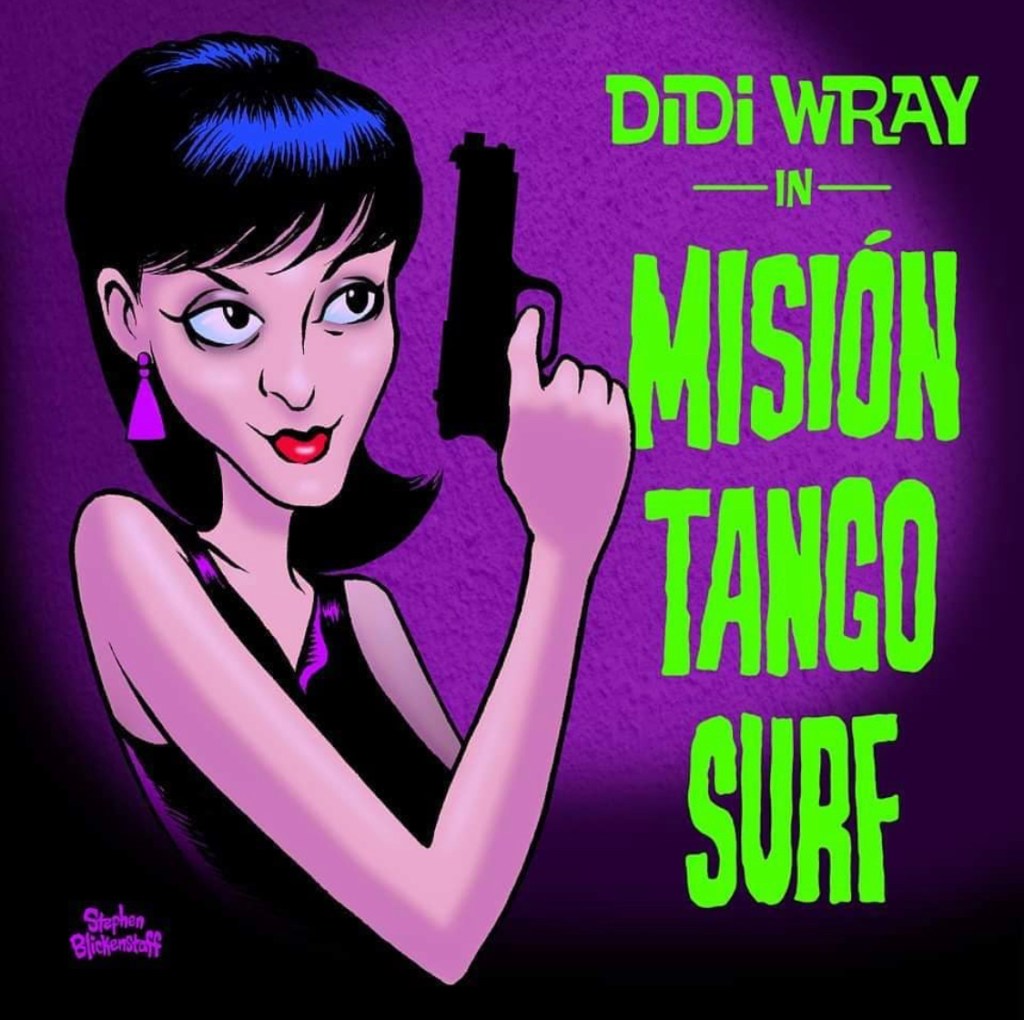
The CD was released by Surf Cookie Records in 2019. Two years later, Augusta, GA’s Missing Fink Records has reissued the CD and pressed the songs onto vinyl with new cover art by Stephen Blickenstaff, who’s best known for creating the artwork for the Cramps’ Bad Music for Bad People LP. Misión Tango Surf harbors 13 cuts of traditional surf sounds and old-school rock ‘n’ roll played with taut authority and nimble dexterity. The album’s opening title cut moves at a measured, psychedelic pace, blending classic kerrang and reverb with Latin flourishes. Songs with titles such as “Amazonic Hully Gully” and “El Sombrero” find balance in subtle restraint weighed against the full-throttle tremolo picking of “Por Una Cabeza,” and “Terremoto Stomp!” When placed side-by-side here, each song carves out a smooth and cohesive body of instrumental jams.
All told, there are nearly 40 musicians and engineers dubbed Liga Americana del Surf coming in and out of the frey. It’s a fellowship featuring a survey of South American and Mexican musicians including members of Brazilian acts the Dead Rocks and the Pulltones; Chilean groups Los Kanibales Surf Combo, Sindicato Tango Surf, and Los Yawares; Peruvian group Los Protones; Estereofónikos from Argentina; and the Tango-Surf Combo from Mexico.
More guests are sprinkled throughout the album as well. “The Godfather of Mexican Surf” himself, Daddy O Grande of Los Straitjackets brings winding grooves to “Blue Tango” and “Cielito Lindo.” Fellow Los Straitjackets guitarist Gregorio El Grande amps up the pace in “Pisco Saico Twist.” Caleb “Sr. Ramírez” Franco of Lost Acapulco brings steel-string heat to the closing number “St. Katharina Twangwest.” Each of these players dutifully serve the unified, oceanic ambiance of Wray’s vision.
With so many players lending a hand, though, the most Herculean feat here is Wray’s ability to rein in such an impressive cavalcade, and focus on creating unfettered, uncluttered music. Misión Tango Surf pushes the heavily-mined waters of surf and rock ‘n’ roll to thrilling and mysterious new places, while bolstering her flair for Latin cadences and melodies, offering a little shoreline beach break for the hodads and the hardcore alike.
If you have enjoyed reading this review, please consider making a donation to RadATL!
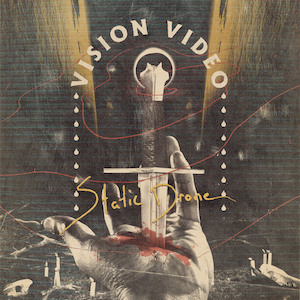
Vision Video’s singer, guitar player, and principal songwriter Dusty Gannon’s story follows a trajectory from listless teenager to Afghanistan War veteran to a firefighter and paramedic on the frontline of an ongoing pandemic. It’s an arc that’s perfectly illustrated by the euphoric pop and melancholy of the group’s latest single, “Static Drone.”
Taken from the group’s forthcoming debut album, Inked In Red (out April 16), “Static Drone” carries an intense release of physical and emotional angst; a real-time experience of grappling with deteriorating mental health while adapting to life and confronting mortality while working at a Metro Atlanta fire department. “I wrote ‘Static Drone’ in the middle of some intense manic episodes where my mental health had completely unraveled,” Gannon says. “There was this peculiar month-long period of time at my fire station when we were dealing with a death almost every shift, and it was mirroring my internal sentiment that I was beginning to feel like everyone was tragically fated to die alone.”
In light of confronting such heavy existentialism, though, “Static Drone” also brings with it a sliver of hope, and an outlet for exorcising these personal demons. “It’s one of my favorite songs to play, because I still feel that dropping panic when we shift to the chorus,” Gannon says. “It’s an intense, but cathartic track for me, and I feel like it truly set the pace for this record.”
In May of 2020, Vision Video’s “In My Side” b/w “Inked In Red” 7-inch stirred up an ethereal post-punk exuberance, underscored by new wave and goth-tinged pop melodies. The lead single, “In My Side,” is a direct descendant of New Order’s “Age of Consent” from the 1983 album Power, Corruption & Lies. On the B-side, “Inked In Red” channels the baroque and romantic pop atmosphere of the Cure’s ‘89 album Disintegration. Singer and keyboard player Emily Fredock, drummer Jason Fusco, and bass player Dan Geller pushed their burgeoning sound to bold and stately places.
Soon after, a cover of British post-punk outfit Ski Patrol’s 1979 anti-war anthem “Agent Orange” followed, capturing Gannon’s most vexed performance yet—made poignant by rich sonic flourishes courtesy of producer Tom Ashton (The March Violets, Clan of Xymox).
“Static Drone” raises the bar on all fronts. The song pops with shimmering confidence, energy, and a dramatic vocal attack that borders on the sublime while ascending to an ecstatic state of a macabre inward journey, further cementing the group’s place as the most exciting dance-rock act to sprout from Athens’ storied musical landscape in quite some time.
If you have enjoyed reading this post, please consider making a donation to RadATL.
“Fight Those Invisible Ninjas!” Produced and directed by Watch Out For Snakes.
Over the last two years, Watch Out For Snakes mastermind Matt Baum has played a transformative role in fostering Atlanta’s chipwave, chiptune, and synthwave music scene—electronic music that combines elements of video game sounds, Italo Disco, post-punk, acid house, and new wave songwriting. Since releasing his frenetic debut album UPGRADE in 2018, followed by Scars in 2019, the Florida-born electronic music producer, who has lived in Atlanta since 2006, has kept the art of high-energy live performance chief among his priorities. As standing quarantine orders lumber toward the one-year mark, Baum has channeled his efforts into creating his first video for a new song titled “Fight Those Invisible Ninjas.”
Baum took a few minutes to talk about the song, his experiences growing up amid the hardcore scene on Florida’s Space Coast, and bringing attitude and energy to electronic music.
Chad Radford: “Fight Those Invisible Ninjas” gives nods to soundtracks for games like “Ninja Gaiden” and the “Megaman X” series—it’s driving enough for the dance floor, and benefits from modern synth tones, yet it’s nostalgic enough to draw some seriously nerdy references.
Matt Baum: Totally! I draw influence from a lot of different sources, largely retro games from the Nintendo and Super Nintendo era, ‘70s/’80s outfits like Sparks, Depeche Mode, and ELO, synth-y composers like Tangerine Dream and Vangelis, and the energy of hardcore/punk bands like Minor Threat, Refused, Comeback Kid, and Underoath. I’d say 90% of my instrumentation is synthesized from NES chip tones, everything but my drums and pads, but I tend to arrange with a hardcore/punk sensibility because I want to throw down when I perform live. It’s always been about bringing as much attitude as I can to the electronic scene, because that’s the energy I respond to when I’m a fan in the crowd.
How did growing up on Florida’s Space Coast affect your relationship with music?
My introduction to any music scene was going to local hardcore shows in the late ‘90s/early 2000s. I spent a lot of time in community centers like the Melbourne Jaycees. We were all young and dumb with too much energy so all of those shows were a blast. Everyone would get super into dancing and throwing down—we were all super supportive of each other too because the scene was so small. I have a lot of nostalgia for that scene because there was a certain simplicity and authenticity to it. Everyone just wanted to make music that was fun and there weren’t a lot of gatekeepers. There was a single promoter down there called Little Reggies Productions that handled all of the hardcore, punk, and emo acts and they were super fair about how they booked acts, which fostered a lot of love across the scene. Everything I do now–live performance-wise—is trying to recapture the magic of those early days and show everyone a good time.
Did you play guitar before you switched to keytar?
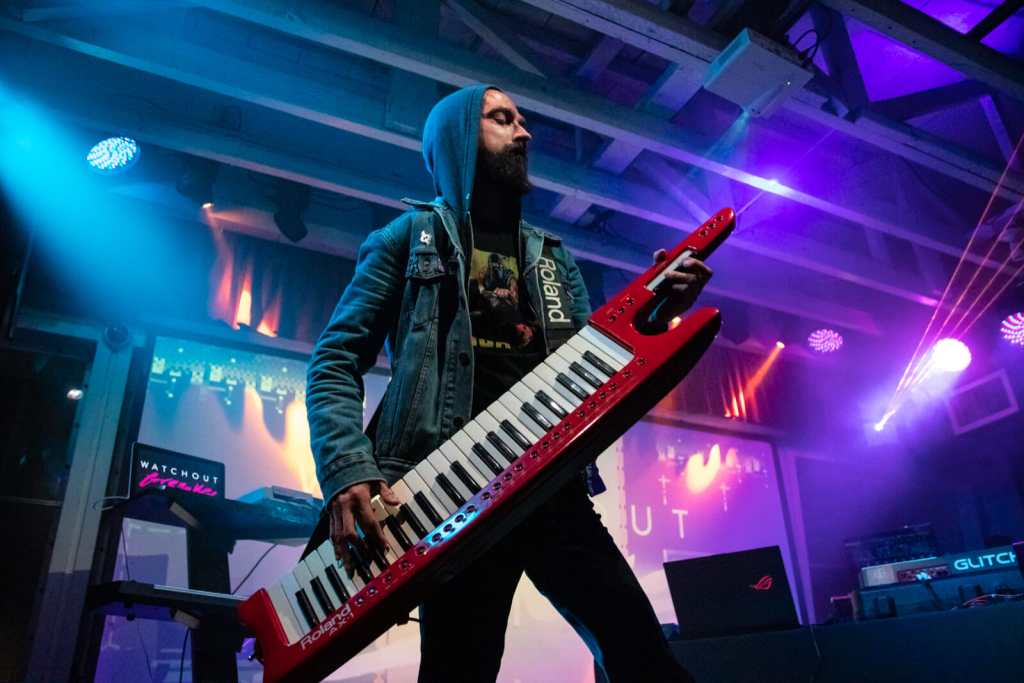
I grew up playing classical piano, but never really enjoyed playing music until I discovered that you could transcribe and play tunes that actually meant something to you. The first song I ever transcribed and played was the main theme for “Final Fantasy VI” on Super Nintendo. That was when I was in 4th grade and it was an epiphany for me, but it wasn’t until 2003 that I started performing at actual shows. I joined a melodic hardcore band in my Florida hometown of Indialantic, called Audrey. They wanted a synth player so I started writing with them. A few months in, I got jealous of the guitarists being able to throw down and engage with the crowd at floor shows so I bought a keytar off eBay and never looked back. I used that same keytar through Audrey, the first Atlanta band I was in, The Drownout (2007-2009), and on up to WOFS. I can’t not be mobile when I’m playing and I don’t like putting up a barrier of synths between myself and the crowd because the only reason I play is to directly feel that reciprocal energy between myself and the crowd.
On a side note, I bought a Telecaster with the intent of teaching myself guitar in 2010, but I didn’t get very far. I still want to spend time learning at some stage. Because I respect the hell out of multi-instrumentalists. I do know how to play oboe (three years in middle school), but I don’t know that there’s much call for oboe in popular music at the moment!
What inspired you to pursue this style of music?
I stumbled across chiptune and synthwave as genres without knowing that there were established genres for either. I’ve always enjoyed messing with minimal synth tones, which I mainly got from more contemporary groups like We Are Wolves, Metronomy, and Bloc Party. But this project mostly began as me thinking, “Hey, wouldn’t it be cool if someone wrote an ‘80s movie soundtrack concept album but had all the instrumentation sound like video game music?” The only reason I was even going down an instrumental avenue is because my previous project with my former bassist had fallen through and I was tired of trying to get a vocal tone in that project that I was happy with. It was only once I had a few tracks written that I discovered SURVIVE through The Guest soundtrack and then College through the Drive soundtrack. Those two groups really opened up my eyes that there was a demand for structurally simple, but pure musical ideas.
Watch Out For Snakes! Photo by Geoffrey Smith
How do you pull off your high-energy shows as a one-man act?
I had my first full album written almost a year before my first live performance primarily because I deliberated for so long about the best way to perform the music live. Originally, I experimented with a looper pedal because I loved what artists like Howie Day have done, building the whole song live, but the songs I’d written at that stage were too layered and had too many song parts for that to be practical. I also wanted to find a way of incorporating the actual Nintendo into what I was doing, but at the time, the only chiptune artists that were using actual consoles in a live setting were using them more as sequencers, not as instruments and I wanted listeners to connect with what I was doing on stage at any given second. I’ve seen some disappointing synth and chip shows where the artist either just hit play and stood around or was walled up behind so much hardware that you couldn’t tell what they were doing. I didn’t want that for me. So I found a way of compromising where I play backing tracks with the lead parts of each song section pulled out so that I can perform those parts live with the keytar and the softsynth Nintendo emulator I use, Plogue chipsounds.
My entire stage show was designed based on experiences in previous bands to be as easy to set up, tear down, and perform as possible so that I can just focus on the performance itself. I’ve had my share of embarrassing technical glitches with hardware, etc. right before a set and knew I didn’t want to deal with that in WOFS. Proud to say that I’ve only experienced one technical glitch in any of my live WOFS performances and it was something that got worked out during sound check thankfully.
As far as being solo goes, the biggest challenge comes more from travel, trying to figure out how to fly and safely transport all of my equipment from A to B. As an individual, this was probably one of the largest problems I faced, but I figured out a system involving some solid road cases and bungee cords that’s done pretty well for me. I’ve still experienced some unfortunate damage due to TSA checks though, but mostly minor stuff.
Is the song’s title, “Fight Those Invisible Ninjas.” about dealing with personal demons, or is it simply a “Ninja Gaiden” reference?
“Fight Those Invisible Ninjas” is actually a tongue-in-cheek homage to my hardcore days. There are certain mosh calls we’d use as hardcore musicians in the early 2000s to get the crowd to start throwing elbows, kicking, and basically just getting a good pit going. One of those mosh calls “Fight those invisible ninjas!” was one that musicians used half-jokingly because of how ridiculous it was and it eventually became a meme within the hardcore scene, but it perfectly captured this great energy that I always felt at those shows. I want to do what I can to bring more of that attitude and energy to the synth world especially, because I feel like synth artists tend to prioritize polish and aesthetic over grit and rawness.
You hit on some of the subtext of the track though, which was an intentional double-meaning in the title—battling personal demons, which in my case revolve around personal health and self-esteem issues. But each listener can re-interpret those demons to their own personal experience.
Part of your dynamic is channeling personal experiences into songs. How do you approach this?
When I start writing a song, it always starts with a combination of an emotion I’m feeling in that moment as well as some musical technique I want to explore. Musical expression is a form of therapy for me, which is why my songs span a variety of different tempos and musical moods. I’m not that different from most musicians. To this point, what’s inspired me to write has been an amalgam of different traumas and celebrations I’ve experienced over the course of my life: losing family, getting divorced, going through heart surgery, new relationships and friendships … If I find myself focusing on one of these things to the point where it’s overwhelming, that’s when I feel the urge to sit down and write.
I end up shaping these feelings through different song structures or instrument synthesis though, which is where the technical experimentation comes into play.
Initially, I suspected the name, “Watch Out For Snakes,” was a reference to old-school Pitfall for Atari, but it’s a MST3K reference.
I didn’t run across MST3K until I hit high school, but when I did, I went all in on it. “Watch out for snakes,” initially a one-off joke in their Eegah episode became a frequent callback through the entire series that just stuck with me. So when I knew that I wanted to start an attitude-driven chiptune project that kept things light-hearted and goofy, and began brainstorming project names, Watch Out For Snakes was something fun that I kept gravitating back to that no one else seemed to be using musically. I used to have great Google Search results too until a few years ago when the MST3K guys did a reunion “Watch Out For Snakes Tour.” Ah well.
Do you face a different set of standards, or is it difficult to be taken seriously?
The biggest challenge I face is booking shows, especially locally, as a “chipwave” artist. I’ve had a lot of great opportunities out on the road playing huge fests like MAGFest and BitGen Gamer Fest, both in Baltimore, Outrun the Sun Fest in LA, Neon Rose in Portland, OR, and NEON Fest in Providence, which got cancelled last year due to quarantine measures. I feel like I’m an act that wins people over in a live setting because of my energy. But it’s been a hard sell to get booked as support, especially here in Atlanta, for larger synth and video game acts because I ride a fine line between the two groups. Most of the time that can work to my advantage, because I have fan appeal across multiple genres, but a lot of promoters that haven’t seen my act sometimes find me too chippy for synth shows and too synthy for video game shows. I’m positive though that eventually everyone will come around!
There’s a lot of local synth and chip talent in the Atlanta area that doesn’t get the exposure it deserves because some promoters just don’t know what to do with us. That’s one of the reasons I started putting together an artist collective prior to COVID (in partnership with Drunken Unicorn and Outrun Brewery) called Terminus Retrowave, with the goal of providing more opportunities for touring chip and synth acts to perform in Atlanta while pairing them with relevant artists in our local community. Atlanta has one of the largest synthwave artist populations in the US, but Atlanta fans don’t know about them because there’s not a central hub/event to bring everyone together. Hopefully, once the COVID dust settles, we can get that going again in earnest, but in the meantime, I’m partnering with local artists to put something on together in a virtual livestream setting.
What’s next for you?
I quit my day job in November 2020 to pursue music full-time for at least a couple of months so I’m going all-in on a few soundtrack commissions for video games and film, exploring a split 7-inch release with a fellow musician, knocking out some remixes for people, and finishing some additional singles that will be out in the coming months. I’m also going to invest a lot more of myself in Terminus Retrowave and hope to get the first virtual livestream on the books by April 2021. Basically, I’m going to continue exploring how to diversify my music career in a way that’s sustainable and that hopefully gives back to the Atlanta music community.
If you have enjoyed reading this post, please consider making a donation to RadATL.
To celebrate the arrival of their first new album in over five years, Antagonizers ATL are hosting a weekend of soul, reggae, street punk, and oi rock ‘n’ roll sounds. The festivities kick off at the Star Bar on Friday, March 19. DJ Gonzo and The Low Life Sound System fly in from the West Coast to spin an evening of soul and reggae hits and deep cuts. It’s $10 to get in, and a limited number of tickers are available. Doors open at 9 p.m.
Villain, born Carmen Maria Hillestad, is an Oslo, Norway-based former model-turned full-time musician, who caught the world’s attention with the lilting avant-garde pop of her 2017 album, Infinite Avenue. Perlita, named in homage to Villain’s grandmother who lives in Puebla, Mexico, forges a much deeper path of sedate bliss, spherical rhythms, and instrumental beauty. It’s also built around a theme of hibernation and reemergence. Throughout the tape, songs such as “Everything Without Shadow,” “Two Halves Touching,” and “Light In Phases” take shape with a stylishly hushed approach that’s too well-composed to be called experimental music, and too abstract to draw any other concrete pop comparisons. Each number indulges in a deep-listening exploration of electronic drones, textures, and resonance itself as a musical instrument.
On the B-side, “Agua Azul” builds around Johanna Scheie Orellana floating flute melody, guiding dissonant rhythms, bringing this aural cycle to a fine point.
If you have enjoyed reading this article, please consider making a donation to RadATL.
Adron has rolled out a new single for coping with COVID-inflicted ennui. “Song About My Computer” is a lovely pop mediation on just how much of daily life is spent navigating a complicated relationship with a silicon-based companion, nemesis, and portal to the world and beyond. As with all good pop songwriting there are layers of meaning at work in the title as well as the hook, “I don’t want to write a song about my computer.”
On the surface, it’s a lighthearted ditty. Give a deeper listen, though, and the glow of melodic catharsis weighs heavily against the existential dread projected in the lyrics: “Maybe we’ll pull through / Maybe we’re all screwed.” Or as Adron says: “The song is a whimsical-pessimist take on pandemic loneliness, and how much I miss being a real-life musician, with some shouts out to LA venues I hope and pray will survive the long lapse.”
Every time I press play on the Youtube video the algorithm toggles away from “Song About My Computer” and follows up with “She Sells Sanctuary” by the Cult. I can’t help but wonder if my computer is taunting me or reciprocating Adon’s sentiments by offering its own message of solace in the nuanced barrage of 1s and 0s reflecting back at me.
Whatever the case may be, the accompanying B-side is a cover of Bruce Hornsby’s 1986 FM cheese hit “The Way It Is.” Adron’s version was originally recorded as a Christmas gift for drummer Colin Agnew (it’s one of his all-time favorite guilty pleasure songs). “The Way It Is” was produced and mixed by Adron in her bedroom in Los Angeles’ Silver Lake neighborhood, where she’s been cooped up since the beginning of the pandemic. The song features sounds derived from the AdLib Music Synthesizer Card—one of the premier pieces of software for home PCs circa 1986 through the mid ‘90s, and it shows.
“It’s my favorite digital synthesizer,” Adron says. “Obviously, since the pandemic, I’ve been on a bit of a tear, geeking out intensely on early PC game music and the sounds of that era.”
She goes on to say, “Basically, I went pretty far down the road to making an actual chiptune version of ‘The Way It Is,’ but decided to ditch authenticity—as far as what you can truly call chiptune—and sing on it and do effects processing and whatnot, because I was having too much fun.”
Back to “Song About My Computer …” This latest number was mostly recorded in her bedroom as well, all but the drums which Agnew recorded in his Adair Park home in Southwest Atlanta, where he also mixed the song. It also features a touch of the AdLib sound palette, albeit more subtly worked in.
This latest round of songs is a one-off release. Although Adron has recently finished recording a new album. When it arrives remains to be seen.
In the meantime, keep an eye/ear out here for what she likes to call the “evil twin” of “Song About My Computer”—a version of the song that’s arranged entirely using sounds derived from the late ’80s Yamaha PSS-170 toy keyboard. “This is a very dear and beloved sound palette for me,” Adron says. “I have this bizarre obsession lately with remaking a bunch of my songs using all PSS-170 samples.”
Head over to Adron’s Patreon page to check out an ongoing series of scores for imaginary video games she’s been putting together over the last year, and more offerings.
If you have enjoyed reading this story, please consider making a donation to RadATL.



 Rad/ATL