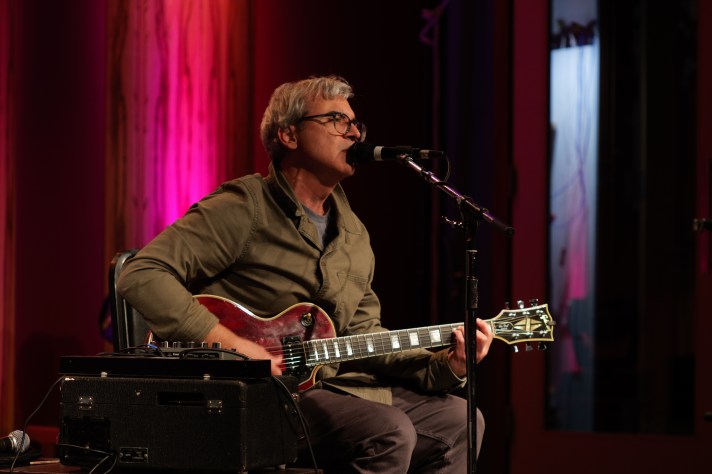
For guitarist Mike Baggetta, playing music has always been about exploring the shifting terrain of human interaction. Whether performing alongside bass player Mike Watt and drummer Stephen Hodges in MSSV, with Watt and Tortoise drummer Jon Herndon in Casa Sueño, or with upright bass player Viktor Krauss on the album Lonesome Town, Baggetta gravitates toward unpredictable exchanges that bring music to life. Now, he’s stepping into a different kind of conversation.
The Double Solos tour brings Baggetta and guitarist Eli Winter to Railroad Earth on Friday, November 6, for a show of individual solo performances. W8ing4UFOs singer and guitarist Bill Taft rounds out the bill.
For Baggetta, this run marks his first-ever solo tour, an opportunity to explore the subtleties of his playing without the familiar safety net of a band. His approach celebrates the possibilities of sustained tones, shifting textures, live looping, and sampling, allowing technical skill to serve a broader sense of exploration and the unexpected musical ideas that emerge when sound has room to breathe.
Ahead of Friday night’s Atlanta stop, Baggetta discusses the appeal of playing alone, the creative tension between composition and improvisation, his musical kinship with Winter, and more.
Mike Baggetta, Eli Winter, and Bill Taft play Railroad Earth. Fri., Nov. 6. $20. 8:30 p.m.
What inspired you to step out on your own for this run of shows, and what does playing solo allow you to explore that might not be possible when you’re working with other musicians?
With music, I’m always interested in the interactions with other people. At one time that meant only with the other musicians I was playing with. But as I got to play more it became about what it means to interact with the audience in that kind of relationship with the musicians. Then it became about the people listening. What is it like to put on a show with other people that are helping you put on the show, who aren’t necessarily the audience or a band?
These are things that I love about music: What can music show you about human interactions? It’s an intimate thing that I find gratifying. Over the years of playing, something happens where I’m trying to get to a musical idea. I don’t necessarily mean a series of notes, but a sound or a feeling that happens but it’s fleeting. You think about what that was and how to get that feeling again. One way I found to do that is to work on certain aspects of my music without playing with other people.
I’m not worrying about interacting with other musicians, which brings it to a musical moment. But if I want to spend time thinking about going deeper into something that is just a sound that I want to make, a good way to do that is to do it by yourself. I’ve found that to be a kind of a terrifying thing to play solo because you don’t have anyone else to lean on. But a few years ago, I found an entry point that made me want to explore it further.
What was the entry point?
For me, playing solo isn’t ever going to be about working out my technique, or here’s my blistering new version of “Giant Steps” (laughs). It’s not how I feel my best contribution to music is going to happen as an individual artist.
My friend Tim Lee, who lives in Water Valley, Mississippi, outside of Oxford, had a radio show—kind of a local Oxford version of Prairie Home Companion. They’ll focus on an author, then there’ll be an interview portion, there’s a house band, and they’ll have a guest musical artist.
I was that guest musical artist for one show. They gave me like 12 minutes to play. I was on a trip where I was doing things with other people that were in the locations I was going to. I’d meet up with a band and play and then do another project with somebody somewhere else, then drive to the next gig. I thought, “Maybe I should try this alone, work out a few new tunes, and see what happens.”
I was thinking about the things that I like about my sound and my music that I can get into?
One of those things is my use of live looping and live sampling in an ambient and memory type of way. I’m not an Ed Sheeran type of looper where I’ll lay down the bassline and then fake a horn part on the guitar body, then lay out the chords and then the melody. I actually can’t stand that type of thing. Just get a band at that point. But there is an interesting thing that’s more from a different school of looping that’s informed by like Terry Riley or David Torn or Nels Cline where it’s like grabbing pieces of things that you’ve played and having them spit back at you in different ways that might make you react with those things.
So it’s a little cheat code, like you’re playing with someone. You have things to play against and you don’t necessarily know what it’s gonna put back out for you to react to and inspire you to do something else. Then you get this feedback loop going with that sound. You can hear it in a lot of the records as little ambient guitar noises and stuff like that. That was kind of a way in.
Then slowing down and playing a chord on the guitar and letting it ring out and move the tuning a bit with the tremolo bar—just get into the depth of the subtlety of the things that I’m doing.
I struggled through that for the 10-12 minutes on the radio show. After I was done with it, I thought there’s more to explore there.
Your music occupies an interesting space between composition and improvisation. When you’re playing solo, how much of the performance is mapped out ahead of time and how much do you leave open to whatever happens in the moment?
Right now, none of it. I have a list of songs that I’ll pull from for these shows, but I haven’t put it together yet, and I don’t know how I’ll get from one song to the next. Usually when I play in my bands, I don’t stop between songs and say, “Hey, this next song’s about so-and-so and here we go. Take it away.” Those experiences of playing with bands have always been more about a journey from beginning to end with continuous sound, and getting from one place to another. But I might change it up for this. I might talk about the songs a little more, let people in and have it be more of an intimate thing.
Are you playing things from throughout your records?
I’m doing a couple of songs from records because I like playing them and I don’t really get a chance to play them too much otherwise. Like from the records I did with Jim Keltner and Mike Watt, the first album has a song called “Hospital Song” that I like playing. The second record, the title track is “Everywhere We Go.” I like playing that song. I have those on my list. The Casa Sueño 7-inch, “House of Dreams,” I might do a version of the A side from that because I can do it in a way that’s different than how we do it in the band.
There are a lot of new songs as well. I have six or eight new songs with words that I’m using this tour to try to work out because I haven’t done them too much yet. I’ve done a handful of solo shows over the past year. But things change the more you play it in front of an audience. It’s a good way to get the music in shape for thinking about how somebody might want to record it down the road.
You have worked in different settings, from collaborations with Casa Sueño and MSSV to the new record with Viktor Krauss, Lonesome Town. Does playing solo change the way you think about the guitar and the way that you listen to yourself?
It does because I’m freed from the sort of thing about, “Oh, what did they just play? That’s interesting. How can I answer that? Or, “How can I take that into consideration with what I’m about to play next?” That’s gone. The little sampling thing I do plays a part in that, but it gives me more space to do whatever I want. But as I’m saying that, I’m also conscious of it not turning into something totally self-gratuitous.
I love playing music with other people. It’s scary because what if I don’t have any ideas that night? What if I’m playing and all of a sudden I don’t know what to play? Usually I can lean on the person I’m with like, “Oh, they just played something interesting and now I have an idea.” But if it’s just me and I have no ideas, what do I do?
To answer more directly, it’s about being in the sound that I make and dealing with the subtleties more than I would have time to deal with if I was playing with someone else.
I’m not afraid to play a chord and listen to it for eight or nine seconds before I figure out what happens next. A lot of people, myself included at one point, would be kind of terrified to not be doing something for that long.
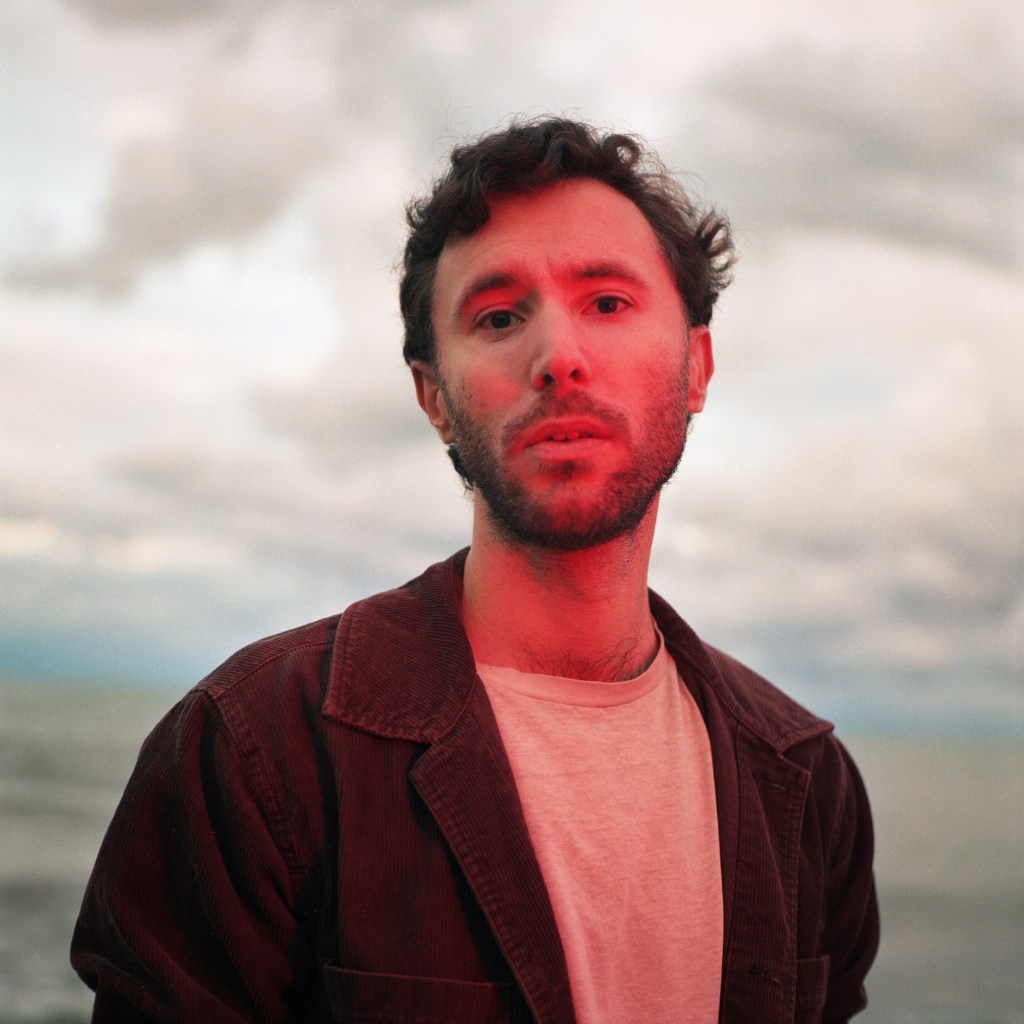
You’re sharing the bill with Eli Winter and Bill Taft. How does playing alongside other solo musicians create a different kind of conversation between the sets?
That’s something I’ve been thinking about, mostly because Eli and I are doing this whole tour together, the double solos tour, and we’re both ostensibly guitar players. I’ve incorporated a lot more vocals over the last several years, although I think Eli is doing some singing on this tour also. I think we both play in different enough styles, with enough of a different sound and musical aesthetic from one another that it won’t be like, “Here’s another solo guitar!” We play differently and our songs are different. It will be a good mix of people coming out, and a good mix of music. Everybody will hear something different enough to make it interesting. But I have been thinking about that because every place we’re playing is writing back saying, “I don’t know who’s playing first or last, you or Eli!”
We don’t know either yet. We might change it up from night to night depending on what we’re doing or who else is playing.
Bill Taft is such an awesome musician and guitar player that it’s always a little intimidating to go on after him. But it also lights a little fire under me too, because he’s so much fun to listen to, and he’s such an amazing artist. He’s an incredibly creative, inspiring guy. We’re lucky that he’s playing with us.
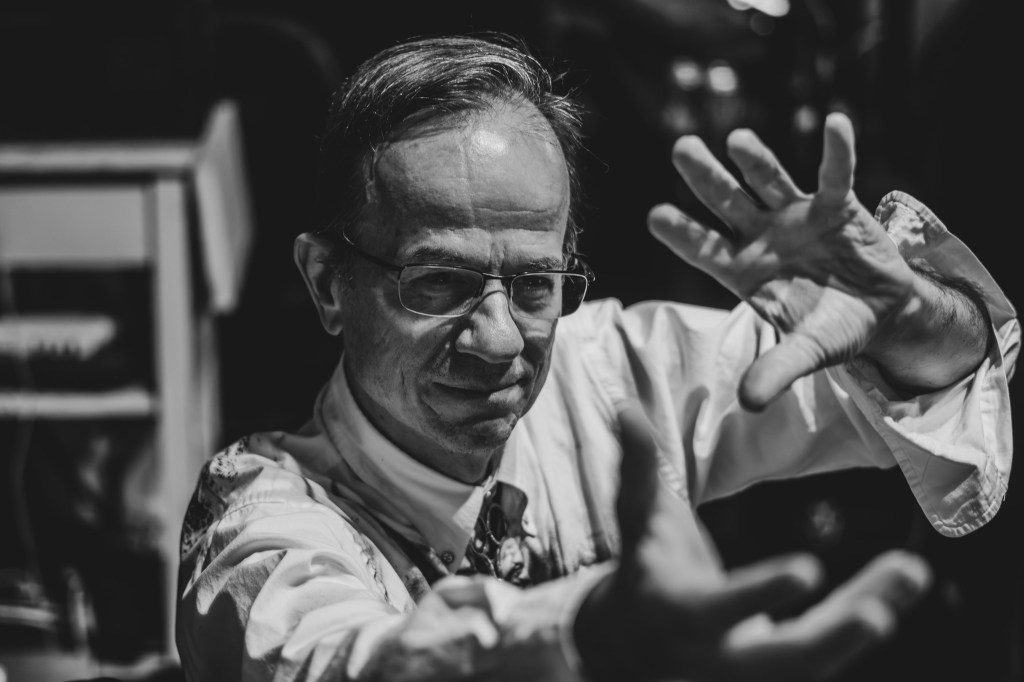
Eli’s awesome. He’s been in Chicago for a long time. He’s on the Three Lobed record label and has a couple albums out for them. When I first met him, he had a lot of that sort of American primitive, modern, interpretive John Fahey but on electric guitar kind of thing happening. He has a great album out with Cameron Knowler called Anticipation. It’s mostly acoustic. I love that album.
He’s branched out into some other things that involve a little more improvisation with people than that genre label might lead someone to believe. He’s a really interesting player who plays very differently from me. We’ve done a couple of shows together over the years—in Chicago and Gainesville. He’s a great guy to hang with.
The last time I saw you play at Railroad Earth was with Peter DiStefano from Porno for Pyros. Will that round of touring yield a record?
We recorded! We were just talking to someone that wants to put it out, and we have to decide what we want to put on the record. That whole tour was improvised music except for a couple of Peter’s songs. The recording is just improvising together for several hours. There’s great stuff there, but sifting through four or five hours of improvised music is an important and necessary step to getting a 45-minute record out of it. After this tour, I’ll have some time to sit down and do my sifting. Peter might be sifting already. We’ll send things back and forth to decide what’s good and what works with everything else. It’s in the works!
How did you meet Peter?
I was on one of the MSSV tours. We ended up in Los Angeles at this great club called Zebulon, which used to be in Brooklyn. I used to hang out there and play when I lived in Brooklyn. But they moved to L.A. so I play there in L.A. now.
It might have been the Human Reaction tour. He’s buddies with Watt, so that’s the real connection. I didn’t know him at all. I remember looking down when I was about to start playing and he’s standing there in the front row, right in front of me, looking at me with his arms folded, wearing his leather jacket. Of course I know who he is, so I’m like, “Okay, time to play” [laughs]. We did the set. Afterwards I knelt down and said, “Hey!” I talked to him briefly and he was super nice.
At the time, he’d been getting into improvised music. Maybe he’d asked Watt about me or Watt told him about me or whatever. So he came to the gig to check it out. He was just really kind and we hit it off. We ended up hanging out and I would go to L.A. for other stuff and we’d get together and play in a duo and hang out. We’d have dinner and talk about music, and we came to be friends. We did that tour a couple years ago. At that point, I was getting more into singing and writing songs like that in whatever my own way is. He was getting more into improvised music. We both saw it as an interesting thing to do where we could learn from each other about these things that we’re exploring a little more, and see what we end up with together. That was kind of the premise of that, which was a really cool thing to do.
Mike Baggetta, Eli Winter, and Bill Taft play Railroad Earth. Fri., Nov. 6. $20. 8:30 p.m.
If you have enjoyed reading this post, please consider donating to RadATL. Venmo to @Chad-Radford-6 or click on the PayPal link below.

